With only five years left until the 2030 Agenda deadline, and ten years since the adoption of the Paris Agreement, renewing our commitment to sustainable development is more urgent than ever. We must ensure equity and well-being for present and future generations. Turning global goals into concrete actions requires engaging people and making them key players in this transformation. In this context, ASviS, in collaboration with Pubblicità Progresso, has launched “Diritto al Futuro” (Right to the Future). This campaign celebrates the inclusion of environmental protection in the Italian Constitution- modifying articles 9 and 41- in 2022. This reform enshrined the principle of intergenerational justice, recognising the need to safeguard the planet for future generations. Diritto al Futuro aims to raise awareness and promote concrete action. Have a look at our spot here. Aligned with this vision, the 2025 Sustainable Development Festival will take place from May 7 to 23, organised by ASviS its organisations. As Italy’s largest sustainability event, the Festival will present policy proposals on ecological transition, biodiversity, social justice, and innovation.
Through the Diritto al Futuro campaign and the Festival, ASviS invites everyone to join the movement for a fair and sustainable future- leaving no one behind.
This July, the city of Seville (Spain) will host the IV International Conference on Financing for Development—an essential opportunity to advance towards a fairer, more inclusive, and sustainable global financial system. Following the missed opportunity at the 2024 Summit of the Future, this conference could unlock the resources needed to close the estimated $4 trillion annual financing gap to achieve the Sustainable Development Goas.
When compared to the $7 trillion in public funds allocated to fossil fuel subsidies in 2022 and the $2.44 trillion in global military spending in 2023, this target is within reach—if there is political will.
But funding alone is not enough. Structural reforms are essential: the fair taxation of extreme wealth, the cancellation of illegitimate debt, the enforcement of Official Development Assistance commitments, accountability for private sector actors, and the democratization of international financial institutions. The Seville conference is a key opportunity for governments, institutions, and civil society to come together and drive transformative change—rooted in justice, sustainability, equality, and historical redress.
We know that, in recent times, the international landscape has shifted, making it even more difficult to reach broad consensus, but it is crucial not to lose sight of what is at stake and to push forward with all our strength.
A strong and active civil society is essential to achieving ambitious outcomes in the Financing for Development process. In this context, Futuro en Común, together with La Coordinadora and the Andalusian Coordinating Platform of Development NGOs, is supporting the Civil Society Mechanism for FfD in organizing the Civil Society Forum, which will take place in Seville on June 28–29, 2025. Besides, we are also creating a space that connects local, national, and global efforts to collectively organize public mobilizations.
Your presence matters, and we hope to see you in the streets, raising your voice for financing justice.
Motherhood remains an under-explored and insufficiently addressed topic in both policy-making and societal discourse leading to unmet needs and unseen challenges. To bridge this gap, we conducted asurvey, gathering insights from 9,600 mothers across 11 EU countries and the UK.
The findings were a revelation on many fronts, showing just how much work still needs to be done. A few striking figures:
35% of fathers in 12 European countries have not taken their paternity leave, even though it is their right. Meanwhile, 50% of mothers report struggling with at least one mental health issue. Cultural norms, workplace pressures, financial and social barriers – so many obstacles still stand in the way of true equality in caregiving.
That’s exactly why we do this work at Make Mothers Matter: to listen, study and bring to light the realities of motherhood – without judgement, but with a call to action. Because change is possible. Because we all have a role to play in building a more inclusive and just society.
Here is the full report which we hope will serve as a tool to drive meaningful conversations and policy change.
From what mothers told us, it’s clear that maternal mental health cannot wait. The pressure on them has never been greater. General instability, rigid work structures, and the rising cost of living are worsening their stress levels. The time to act is now—to break the stigma, provide proper support, and ensure that maternal mental health is a political priority.
In response to this need, we’ve just launched a petition calling to End the Maternal Mental Health Crisis in Europe NOW.
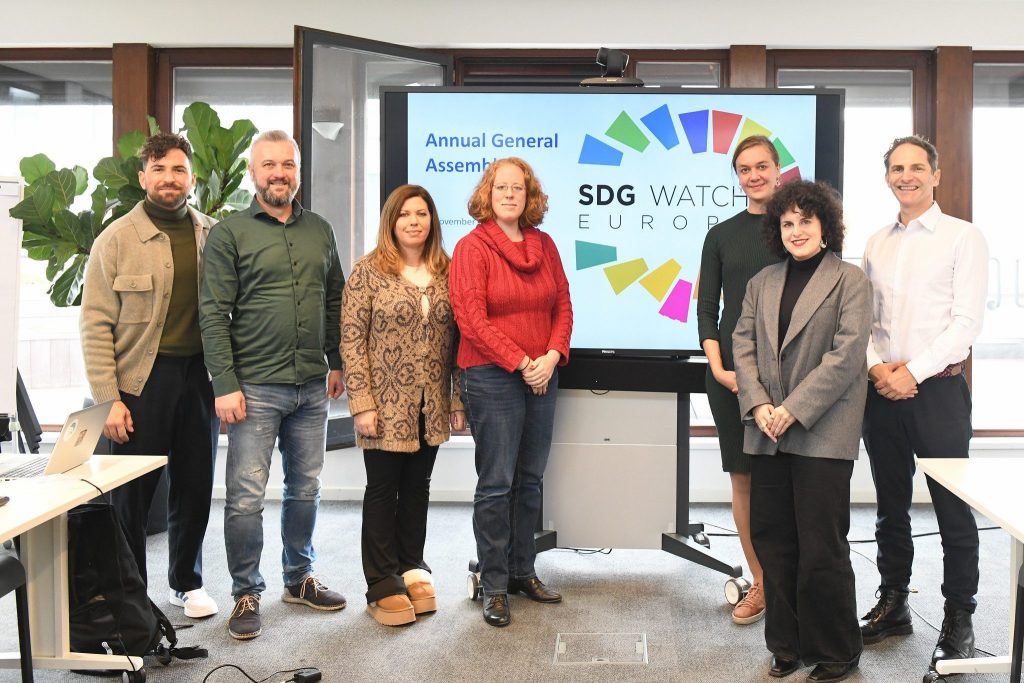
SDG Watch members from all over Europe met in Brussels on the 4th and 5th November for the SDG Watch Europe Annual General Assembly and the Civil Society Forum for Sustainability. Over 70 CSOs with an interest in just transition, participation, social justice, and climate environmental sustainability were present to deliberate on the future of the European Green Deal and to discuss and strategize on the SDGs and Agenda 2030.
Civil society strategize for 2024-2029
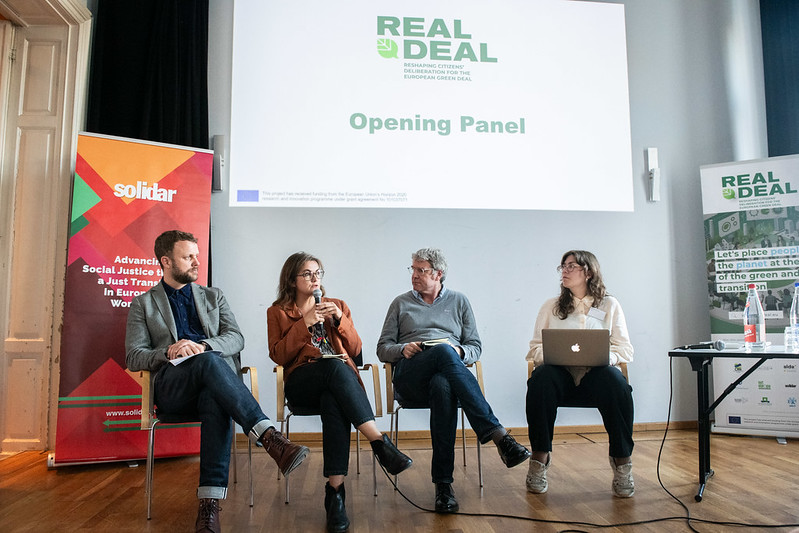
The AGA took place back-to-back with the Civil Society Forum, organized by SDG Watch Europe, EEB and SOLIDAR in the framework of the REAL DEAL project, a Horizon 2020 project on deliberative democracy and the European Green Deal (EGD). The forum provides a space for CSOs from across Europe to come together and exchange views on topics related to the European Green Deal and the SDGs.
On day one, CSOs met at the Elzenhof for a packed event on strategic priorities for civil society engagement within the upcoming 2024-2029 EU mandate. The panel, moderated by Hanna Gunnarrson of WECF, opened with reflections on the recent UN Summit of the Future. Ingo Ritz, Director of Global Call to Action Against Poverty, noted that the Summit highlighted the increasing polarization between the Global North and South, especially around issues like debt and economic justice. Ingo raised concerns about the shrinking space for civil society in global governance processes, with civil society sidelined in major discussions. He pointed to the upcoming 2025 World Social Summit as a critical venue where civil society can push for stronger engagement.
The panel then heard from Patrizia Heidegger, Deputy Secretary General of the EEB, who noted the progress on environmental goals praised civil society’s mobilization efforts, noting significant legislative wins under the EGD, including stricter regulations on resource use and waste, more robust climate targets, and new ecodesign standards. Despite these advances, major obstacles remain, including inadequate fiscal commitments to support decarbonization and dematerialization. From the social justice perspective, Mikael Leyei, SOLIDAR’s Secretary General, highlighted troubling trends in social justice, with poverty rates on the rise and social indicators declining. Mikael noted that a coherent policy framework for a just transition is essential and called for better integration of social and environmental justice goals. Mikael also noted the growing influence of nationalist and far-right movements within EU member states. He urged civil society to mobilize nationally and within the EU, building broad alliances to counter anti-democratic trends and ensure that social and environmental justice remain priorities in the next EU mandate. Overall the panel set the scene as to how the EU should move forward on SDG implementation, emphasising economic system change, social justice, a just transition and the need for greater adherence to the principle of policy coherence for sustainable development in all EU actions and policy processes.
Across the two-day Forum, nine thematic civil society workshops were held and SDG Watch Europe’s members heard from a variety of inspiring speakers from the academic and civil society spheres, as well as collaborating to develop policy recommendations for the incoming European Commission and EU Parliament. Alongside the workshops on emerging themes for civil society, a closing dialogue with civil society organisations was held to reflect on their ideas at the end of the two days of discussions.
AGA Key updates
During the Annual General Assembly on the 4 November, elections to the Steering Group were held. SDG Watch Europe would like to thank the outgoing members of the Steering Group for all the incredible work they have done throughout their mandate. Members applauded Laura de Bonfils (Social Platform), Sarah Franklyn (Independent), Stéphanie Ghislain (Eurogroup for Animals) and Jacob Bjelskov Jørgensen (Nyt Europa), who will all be stepping down from the SDG Watch Europe Steering Group after completing their terms.
New Members of the SDG Watch Europe Steering Group
SDG Watch Europe hereby congratulates and welcomes three new steering group members who were unanimously elected to the Steering Group at the AGA; Katja Reuter of Social Platform, Justina Kaluinaite of the Lithuanian NGDO Platform and Valeria Fantini of the European Association for Local Democracy (ALDA). In addition, SDG Watch Europe warmly welcomes back Robert Krizanic (Povod) and Manuela Gervasi (EEB), who were re-elected to the Steering Group for one additional term.
SDG Watch Europe also set priority focus areas for 2025 that will be crucial to work on in order to advance its mission of SDG implementation. SDG Watch Europe will continue to focus on the ambitious implementation of the SDGs by the EU institutions in the 2024-2029 mandate. In addition, the network will address new narratives for sustainable development, moving beyond competitiveness, deregulation and disinformation, towards a global wellbeing economy. Another key priority area for 2025 is the financing for the SDGs, including the Upcoming Multiannual financial framework (MFF) negotiations and the 4th International Conference on Financing for Development. Lastly, members highlighted the importance of the EU’s international development cooperation and the Global Gateway Strategy, moving towards global justice.
This special issue shares ideas for a just society and a stable planet in preparation for the 2023 conference on how to move “beyond growth”. It is co-published by the European Environmental Bureau, Oikos and Green European Journal.
We believe this conference presents a unique opportunity for society, especially the EU decision-makers, to disengage from an ecologically and socially damaging race for growth and embark on a new path.
As academics, policymakers, and civil society members argue in this issue, Europe should adopt a post-growth future as a foundation for its new peace project. The seeds of change are already out there.
To progress to a post-growth society, countries overshooting their ecological resources must downscale production and consumption democratically and fairly, sometimes referred to as “degrowth”.
Growth has long been society’s answer to economic equality and the social question, an alibi that has long ceased to hold in an era of inequality and ecological crisis. In a post-growth economy, the current focus on quantitative growth would be replaced by the aim of thriving in a regenerative and distributive economy, one that delivers qualitative wellbeing by meeting the needs of all people within the means of the living planet, as elaborated by Kate Raworth in the concept of “doughnut economics”.
The transformation towards a post-growth society for the European Union calls for a different future-oriented narrative. We’ll need the political imagination to design a European Green Deal without growth and instead based on biocapacity, fairness, wellbeing for all, and active democracy.
In this issue, you will find inspiring ideas, examples and discussions of the many faces of a positive post-growth future, one in which people and nature can thrive together.
By ALDA – European Association for Local Democracy
The AUTREMENT project’s Inter-Regional Forum on Active Mobility, held on May 24-25 2023, in the beautiful city of Mahdia (Tunisia), was a resounding success, showcasing the celebration of sustainable urban development and the promotion of active mobility in Tunisia and beyond.
The Forum was organised by the AUTREMENT project consortium, which includes six partners: the cities of Kairouan, Mahdia, and Strasbourg, along with ALDA, CODATU, and CEREMA. In collaboration with UN Habitat and Cities Alliance, this event served as a pivotal platform for exchanging knowledgeable information, fostering networking opportunities, presenting the project’s results and boosting collaborative initiatives aimed at shaping a more sustainable tomorrow.
The event featured around 25 interactive activities that engaged participants throughout the two-day Forum and stimulating side events such as workshops and roundtable discussions took place in a dynamic context.
A standout moment was the participants’ opening bike parade who pedaled along the streets of Mahdia, showing the concrete potential of biking as one of the most sustainable and urban means of transport.
The event also included stands and exhibitions held by stakeholders dedicated to promoting active mobility. Special guests such as Lemon Tour, Cadr67 and Vélorution brought their own expertise adding valuable contributions to the discussion.
More than 150 experts coming from Tunisia and its neighborhood (Algeria, Italy and France) and representing around 60 state and non-state bodies, institutions and associations gathered fostering fruitful exchanges of best practices in the field of active mobility and urban development, while highlighting the wide-reaching impact of the event.
The 2-day event sets up several opportunities for attendees to quibble around public policies, tactical urbanism, bike services, gender mainstreaming, citizen consultations, “cyclotourism” or cycling tourism, decentralised cooperation, future cycling facilities and bike path management. Discussions’ outcomes showcased the Forum’s dedication to address different challenges and opportunities in the field of active mobility.
The Forum’s impact is going to extend beyond the event itself: ideas were shared and networks were formed, as the intent is to channel positive change both on a national and international level. The AUTREMENT project consortium remains at disposal in order to support concrete actions that will shape the future of urban mobility in Tunisia, paving the way towards greener, healthier and more sustainable communities.
By ALDA – European Association for Local Democracy
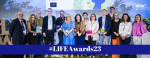
In a resounding victory for Climate Action, the LIFE Metro Adapt project led by the Metropolitan City of Milan has emerged as the winner of the prestigious LIFE Awards 2023. This remarkable achievement was made possible by the combined efforts of several key stakeholders, including e-Geos, Ambiente Italia, Legambiente Lombardia, Gruppo CAP and ALDA.
The LIFE Metro Adapt project, entitled “Strategies and Measures for Adaptation to Climate Change”, triumphed in the “Climate Action” category and was recognised by a panel of eminent European experts. The jury, chaired by renowned Australian agronomist Tony Rinaudo, recognised the project’s outstanding efforts to combat climate change and promote resilience in urban areas. The project also resonated with the public, securing a commendable third place with 1703 votes for the Citizens Prize.
Led by the Environmental and Territorial Protection Area of the Metropolitan City of Milan, in partnership with ALDA and other respected organisations, Metro Adapt has been instrumental in disseminating knowledge, techniques and strategies to combat climate change throughout the metropolitan area. One of the key objectives of the project was to promote the development of effective adaptation measures, with a particular focus on Nature Based Solutions (NBS). Inspired by nature, this innovative engineering aims to enhance urban resilience by mimicking and replicating its elements.
As a prominent advocate of local democracy and citizen participation, ALDA played a key role in ensuring the success of the Metro Adapt project. The association’s expertise in fostering collaboration and empowering local communities was invaluable in engaging citizens, encouraging their support and gaining public buy-in for the initiative. ALDA’s commitment to democratic decision-making and inclusive governance has undoubtedly contributed to the project’s remarkable achievements.
“Winning the prestigious LIFE Award 2023 as the best project for Climate Action and receiving the preferences of more than 1700 citizens shows us that expertise and research can go hand in hand with public participation and active citizenship, topics very close to ALDA’s mission and vision“ – commented Antonella Valmorbida, ALDA Secretary General. “Seeing and experiencing active citizen participation and virtuous cooperation between local authorities and civil society rewards us for our daily commitment and shows us how important it is to carry out projects like the LIFE Metro Adapt” – she concluded.
This achievement is a testament to the importance of collaboration and the power of local democratic engagement in addressing the pressing challenges of climate change. Going forward, we must build on the momentum generated by this remarkable initiative and continue to champion environmental issues and the transition to a more sustainable future.
The five structural recommendations which, if implemented, would enable SDG delivery to develop at pace are:
Move SDG responsibility and delivery from the Department of the Environment to the Department of the Taoiseach (Prime Minister)
Budget for the SDGs
SDG-proof policy
Measure what matters
Establish a Future Generations Commissioner on a statutory footing
Coalition 2030 argues via this report that, although the State has been an influential advocate for the SDGs internationally, for example, by co-negotiating the agreement which led to the SDGs and co-facilitating the political declaration this year, commitment and progress domestically is far less apparent. This is most evident in how the State is failing to reach those in most need of the State’s support; the furthest behind.
Reaching the furthest behind first is a core principle of the SDGs.
The State has so far failed to effectively embed the SDGs across the Government and provide the necessary political leadership for their achievement. Without dramatic shifts in policy-making, the State will continue to struggle to reach the furthest behind first, rendering delivery on the SDGs categorically unachievable. This has led to a significant gap between the State’s international rhetoric and its national action to reach the SDGs, and risks squandering the State’s moral leadership.
Coalition 2030 is therefore making a concerted call on the State to bridge the gap between international rhetoric and national action and to unblock the structural obstacles contributing to thousands of people in Irish society being left behind.
The Coalition follows its five recommendations with an overview of the international and national contexts in which SDG delivery is taking place, provides a statistical overview outlining who is being left behind, and illustrates these statistics with a selection of harrowing and stark human case studies. Following each case study are very specific policy options that, if implemented, would enable the State to more effectively reach these people.
This report reaffirms and builds on the findings in a chapter submitted in April 2023 by Coalition 2030, included as part of the State’s official submission to the 2023 Voluntary National Review process.
In light of SDG16, LAPAS (Latvian Platform for Development Cooperation) organised a practical simulation and follow-up discussion on June 15.
Involving the State Fire and Rescue Service and the National Armed Forces helped to highlight the triple nexus approach to conflict prevention, preparedness, and reconstruction. Discussions about an effective and inclusive civil defense system at the community level were encouraged, reducing the gap between local communities and public administration institutions.
Community is especially important during times of crisis when every life counts and a culture of preparedness is essential for sustainable public safety. To reduce misinformation, public institutions should build daily communication with local communities. With the launch of LAPAS’ NGO leaders training in-depth program on August, 2023, LAPAS will continue its work on resilience and SDG16.
There was a discussion on June 16 on “Development cooperation after 24.02.2022.: conclusions and perspectives” about the latest changes in development cooperation and humanitarian assistance.
As a result of Russia’s aggressive invasion of Ukraine, Latvia’s development cooperation has undergone significant changes – in terms of financial support, its form, and its priorities. In light of the significant increase in humanitarian aid, the development of new reconstruction mechanisms, and the inclusion of refugee costs in official development assistance (ODA), it is necessary to have a wider public discussion of the effectiveness and further development of these instruments.
Humanitarian aid has been provided to Ukraine by many sectors of society, but we need to think about a national system that is effective and that supports active organisations. As newly established and active NGOs join LAPAS, the importance of policy change and open discussion increases.
The discussion was attended by representatives of the Latvian Parliament, the Latvian Ministry of Foreign Affairs, the State Fire and Rescue Service, and Latvian NGOs. Later this year, LAPAS will publish an opinion paper and in-depth report on SDG17 based on the conclusions of this discussion and further data analysis.
In collaboration with Italian embassies, ASviS organised the seventh edition of the Sustainable Development Festival from 8 to 24 May in Italy, online and around the world. Over a thousand events have been organised by civil society, companies, and institutions across the country. Naples, Bologna, Milan, Turin, and Rome were among the stops on the Alliance’s journey to discover sustainability’s different dimensions.
Sustainable development lights up the future: this was the claim that drove people to attend meetings, exchange ideas, and share best practices. A great collective effort was put forth by the Alliance’s 330 members to create the festival, which involved universities, schools, regions, cities, associations, citizens, businesses and institutions. Together, they called on politics to focus on a bright and sustainable future.
There were 121 million impressions on social media, over 48 million contacts on TV and radio for the campaign that aired on national broadcaster RAI.
Thanks to the collaboration with the Ministry of Foreign Affairs, the Festival was able to promote the values of the 2030 Agenda all over the world with events in Italian embassies, consulates, and cultural institutes, including those in Hong Kong, Berlin, Philadelphia, and Ankara.