By European Association for the Education of Adults (EAEA)
“While Lifelong Learning is widely accepted as the main concept, we have to rethink the role and concepts of Adult Learning and Education (ALE). This is essential if we want to equip citizens with the skills to make informed decisions and take transformative action in the world shaped by, e.g. climate change, digitalisation and the social divide. The KA2 Bildung project contributes to this rethinking by using the concept of “Bildung” for conceptualising ALE. The submitted article explains the concept, rooted in the tradition of the enlightenment and the Nordic Folkbildning envisages an education, targeting all aspects of the development of individuals, communities and societies, including, e.g. ethical, emotional and scientific dimensions in a holistic manner.
What is Bildung?
And how does it relate to ALE?
A brief introduction by Lene Rachel Andersen
Bildung is a complex and elusive phenomenon and the concept has deep roots in European thinking and education. In the classical era, the Greek called it Paideia, and in the 1600s, protestant Pietists explored it as personal religious, spiritual and moral growth in the image (German: Bild) of Christ. From 1774 to around 1810, thinkers like Herder, Schiller, and von Humboldt explored Bildung as a secular phenomenon, relating it to emotional, moral, and intellectual development, to enculturation and education, and to one’s role as a citizen. This secular, German understanding of Bildung inspired the Danish invention of folk-Bildung in the 1840s and 1850s, i.e. Bildung not only for the bourgeoisie, but also for the rural youth in Denmark. Folk-Bildung empowered an underclass and allowed Denmark to go through a peaceful transformation from a poor, agricultural absolute monarchy to a prosperous, industrialized democracy. Today, our civilization is in a transformation from industrialized nation states to a digitized globe where everybody needs to thrive. For this to happen peacefully, we need to empower everybody and we need folk-Bildung for the 21st Century.
There are many definitions of Bildung out there; the European Bildung Network defines it like this:
Bildung is the combination of the education and knowledge necessary to thrive in your society, and the moral and emotional maturity to both be a team player and have personal autonomy.
Bildung is also knowing your roots and being able to imagine the future.
In the following, I am going to suggest four aspects of Bildung that are relatively tangible and which, when brought together, may help us grasp the complexity of Bildung and address it in adult education. The four aspects are transferable knowledge and understanding, non-transferable knowledge and understanding, expansion of the sense of responsibility, and civic empowerment.
Transferable knowledge / expanding one’s horizon
The first aspect of Bildung regards the ability to understand the world in which one lives and the knowledge we can teach each other in order to acquire this understanding. Among transferable knowledge is science, math, crafts, language, stories, philosophy, political ideology, religious dogma, history, reading a map, how to fix a bicycle, the traffic rules, how to book a train ticket online, how to cook, what not to post on social media, etc., i.e. not just academic knowledge but also everyday knowledge. (In German: Allgemeinbildung.) This knowledge we may get via books, television, YouTube videos, teachers, friends, etc. Since we can transfer these types of knowledge from one person to the next, and we can always broaden our horizon, we can also refer to this as horizontal knowledge and understanding.
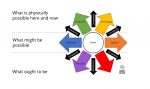
The Bildung Rose is a model that illustrates society as made up of seven domains: production, technology, aesthetics, (political) power, science, narrative, and ethics. As with all models, it is a simplification that allows us to see a pattern that is otherwise hard to explain.
The reason it is called the Bildung Rose and not the Society Rose is that in order for us to thrive, we need to understand all seven domains in our society. Our inner world needs to represent the outer world, so to speak. Our mind needs to be able to grasp as much as possible of all seven domains in order for us to be able to navigate our society safely and make informed decisions.
As societies become larger and more complex, and each domain becomes more complex as well, we need to transfer still more knowledge among us in order for everybody to be able to understand and thrive in society. The Bildung Rose shows that in order to thrive and be able to decode what goes on in one’s surroundings, we need many kinds of transferable knowledge, and we can always explore knowledge in a certain field into more depth and become a specialist, or broaden our horizon and grasp more context.
For transferable knowledge, we have plenty of institutions and programs, from primary, secondary, and tertiary education to informal education and life-long learning of many kinds. There are different teaching / pedagogical methods, but all modern societies know how to do this; we just need to prioritize it. In order for this transferable knowledge to become understanding, we need to try our knowledge out in the real world and/or reflect upon it either alone or in conversations with others.
Non-transferable knowledge / emotional depth and morality
The second aspect of Bildung regards our moral and emotional development. This is the kind of knowledge that comes from life itself, meeting disappointments, falling in love, heartbreak, becoming a parent, losing a game, winning a game, connecting with friends, taking responsibility, failing, succeeding, taking care of a sick parent, losing a spouse, accomplishing something remarkable at work, etc. As we go through these many kinds of experiences, we can learn from them, and we can learn about ourselves and other people from them, but it is a kind of knowledge that cannot be transferred directly. I can tell others about my heartbreak, but without breaking somebody’s heart, it is not a kind of knowledge that I can pass on directly.
By engaging with other people, living up to their expectations and failing to live up to their expectations, by making mistakes and succeeding, and by meeting all kinds of pushbacks to which we need to adjust, we acquire a different kind of understanding and grow in a different way than when we expand our horizon. We acquire emotional depth and, hopefully, higher moral aspirations as we realize that we do not want to let others (or ourselves) down. We can thus conceive of this as vertical development or vertical knowledge and understanding.
In the 20th Century, this has been explored in developmental psychology by, among others, Jean Piaget, Lawrence Kohlberg, and Robert Kegan. But it is also what Jean-Jaques Rousseau explored as éducation in Émile (1762), what Johann Gottfried Herder called Bildung in Auch eine Philosophie der Geschichte zur Bildung der Menschheit (1774) and Friedrich Schiller called Bildung in Über die ästhetische Erziehung des Menschen in einer Reihe von Briefen (1795).
According to Schiller, there are three kinds of people, each defined by a phase of Bildung:
- The physical, emotional person, who is in the throes of his emotions and cannot transcend them.
- According to Schiller, to transcend our emotions, we need calming beauty, aesthetics that can align our emotions with the norms of society; we can then transform and become:
- The person of reason, who has aligned himself with the moral norms of society and has made the norms his own; this person cannot transcend those norms and expectations.
- According to Schiller, to transcend the norms, we need invigorating beauty, aesthetics that can shake us up and wake us up, and make us feel our emotions again, which allows us to transcend the expectations of others and become:
- The free, moral person, who can feel both his own emotions and what is right and wrong according to the shared moral norms; because this person has transcended both his own emotions and the expectations of others, he can now think for himself and is therefore free.
What Schiller suggests, is that we can acquire this vertical knowledge and development by proxy, through the arts. Through listening to beautiful music and allowing oneself to be carried away, one can “stretch the emotional muscle” and experience emotions one might not otherwise encounter. The same goes for great literature, where the author makes us identify with the characters in ways that make us feel what they go through. Through great art, we can transfer, indirectly, the non-transferable knowledge and understanding.
Another way of phrasing Schiller’s three phases of Bildung or ways of being in the world is:
- Is my life a pursuit of physical satisfaction?
- Is my life a pursuit of recognition and social status?
- Is my life a pursuit of what is right and how to achieve it, even if some of the people closest to me may not like it?
Beyond this, there is a fourth phase, which Schiller does not mention:
Through our cultural institutions such as theaters, libraries, movie theaters, concert halls etc. and through playwrights, actors, directors, orchestras etc. we do in fact have ways of promoting vertical, non-transferable knowledge, but it is mediated and demands highly skilled artists in order for it to happen. In order for these experiences to become vertical understanding, we need to reflect upon the knowledge, either alone or in conversations with others. All modern societies have artists who can turn the non-transferable knowledge and understanding into aesthetics / art; we just need to prioritize it.
Expansion of the sense of responsibility
The third aspect of Bildung regards what social groups we identify with and for what we are capable of taking responsibility. The easiest way to illustrate this is through the model Circles of Belonging:
This model has ten circles and the point is not the number of circles, but that they grow in complexity, outwards.
The first “circle” over which we gain control and can take responsibility is our own body and ourselves, the Ego, and then we expand our world from there. Family 1 is the family into which one is born, peer groups we begin to establish around age five, and Family 2 is the family one establishes in adulthood. Circle 5, Community, may contain several communities such as workplace, house of worship, sports club etc.
Circles 2-5 are the real communities in which we either know everybody or at least can have eye contact.
The 6th circle of belonging is the nation, an imagined community, which makes it radically different from the inner circles. In the nation state, there are millions of people we will never encounter and yet we need to identify with them in order to be willing to pay taxes and care about them and the country as a whole.
In most functioning democracies, the 6th circle is connected through a shared language, a public school system, shared holidays and traditions, a literary tradition, and public service radio and television. In the West, we have spent the past 200 years trying to educate everybody to care about this 6th circle and become good, loyal citizens, and we have invested heavily in it.
In the 21st century, we still need functioning, democratic nation states and we need to take responsibility for them as individuals through being active citizens, but we also need to take responsibility for our culture zone (i.e. Europe), humanity around the globe, the wellbeing of all life and biotopes around the globe, and the wellbeing of life in the future. Being aware of, feeling a sense of belonging in, and taking responsibility for Circles 7-10 put new demands on us.
Through national cultural institutions and local and national cultural heritage, we have managed to create strong senses of national identity, and most educational systems were set up to do this. Creating a sense of identification with the world beyond our own country in most places first of all faces a language barrier, secondly, taking the first step outside a cultural comfort zone can be daunting. Luckily, technology allows us to see what goes on in the rest of the world real-time, and we can connect with people around the globe. In all countries, there are immigrants from all over the world. We just have not figured out how to turn this into a Bildung opportunity for everybody and a way of developing a sense of identity and responsibility in all ten circles of belonging.
Civic empowerment / folk-Bildung
Civic empowerment means feeling equipped and motivated to engage as a citizen; it means having an inner drive and the self-confidence to speak up and get involved. Folk-Bildung is the training ground for this.
Danish folk high schools succeeded in creating folk-Bildung and motivating generations of young Danes for civic involvement 175 years ago (and to some extent still do), and Highlander Folk School in Tennessee learned from the Danish folk high schools and had tremendous success with it, but this is the part of Bildung that is probably the least explored. Useful methods to make the timid brave and the uninterested interested probably vary from person to person, but anger, frustration, a sense of injustice, or a personal interest in a specific agenda may be good starting points for activism, and activism carried by a calling for change is a great starting point for education and Bildung.
Bringing the four aspects together
Bildung is the process as well as the result. In order to thrive in the most complex societies of the 21st Century, people need very complex Bildung and we can and should develop better Bildung opportunities for everybody and for different phases of life. For the individual, the 21st Century means a developmental and learning process that will continue throughout adulthood, throughout life.
The way to look at Bildung regarding each individual is thus not to focus on the result or “how much Bildung does this person have.” Instead, the question should be whether the individual experiences increased horizontal and vertical understanding, finds life increasingly meaningful with age, feels increasingly empowered to engage as a citizen, and feels curious and motivated to expand one’s circles of belonging, rather than withdrawing from the larger circles in order to feel comfortable and safe. Whenever somebody does not enjoy increased existential depth and meaning over the years, and if the person does not feel understood, respected and trusted among their peers, or if they struggle with burnout or anxiety, it may be worth considering if the problem is insufficient Bildung for their context.
How this relates to ALE
Adult Learning & Education (ALE) for many years in many places has focused mainly on upgrading people’s skills for the job market, which means that it has focused mainly on two domains of the Bildung Rose: Production and Technology. Aesthetics (the arts), political Power (civics), Science (for the sake of science), Narrative (be it religion, history and/or political ideology), and Ethics (say, philosophy) have all fallen under the “nice to have as a hobby” category. Rather than being a venue for personal Bildung and empowerment, ALE has been a servant of the market. As taxpayers, unions, companies, and other payers of ALE, we have invested in each other as laborers, not as citizens.
This skewed focus and investment is problematic not just from a general Bildung perspective for the individual, it also means that collectively, as societies, we are losing the ability to address issues in all domains and the interplay among them through an informed and rich conversation in the public sphere. We discuss GDP and employment as if that is what politics is supposed to be about. (Most Westerners would probably react to that by thinking “But that IS, what politics is about!” which just proves the point.)
The Bildung Rose shows why this limited understanding of what matters is a problem:
The two top domains, Production and Technology, represent what is physically possible here and now. The middle represents what might be possible, and the bottom what ought to be.
By educating ourselves to address only what is physically possible here and now, and making us unaccustomed to explore and address what might be possible and what ought to be, we cannot address in any productive way:
- Democracy, how to be an active citizen, and what kind of policies and new institutions we need in order to handle, say, the challenges that our nation states cannot handle individually, including:
- Digitization and the challenges it poses to democracy and the existing economy.
- Sustainability and solutions to environmental problems, incl. climate change.
- Education for all, incl. migrants from other cultures and people with learning disabilities; who says the only way to contribute to society is through jobs that contribute to GDP growth?
By making Bildung (as explored above) central to ALE, ALE can become:
- To the individual, a venue for personal empowerment as a citizen and as a whole human being.
- To communities, a meeting place for communal bonding and problem solving; very likely a factor for improving mental health.
- To employers, a source of another kind of self-motivated and created workforce with deeper understanding of sustainability, the interplay among the company’s stakeholders, and how to take responsibility and ownership for sustainable development, inclusion etc. at the workplace.
- To society, the foundation of a qualified democratic conversation about the most crucial and complex issues facing humanity, our future and the only planet we have.