News

Support the #Culture2030goal campaign

By Culture Action Europe

If you believe that there is no future without culture and that the cultural ecosystems should be integrated into both short-term recovery and long-term development strategies, support the #Culture2030goal campaign. 

The #Culture2030goal campaign calls for the recognition of culture as the fourth pillar of sustainable development and advocates for mainstreaming culture across the global development agenda. The campaign also aims to include culture as a distinct goal in the post-2030 development framework.

It is formed by several international cultural networks that are united in advocating for the role of culture in sustainable development. Published recently, the Campaign’s #CultureCOVID19 Statement highlighted the need to support culture during the pandemic. It demonstrated how culture could both promote well-being in the immediate term and a more robust, fairer recovery in the longer term.

Become a supporter of the #Culture2030goal campaign now!

Promoting a Just Transition in Europe and Worldwide

By SOLIDAR

SOLIDAR’s latest publication, “Promoting a Just Transition in Europe and Worldwide”, is a collection of initiatives by SOLIDAR members and allies. It showcases some of the many ways Civil Society Organisations and trade unions lead the path to climate neutrality and contribute to ensuring a Just Transition in Europe and worldwide.

The publication, includes among many, the contributions by ARCI in Italy, Initiative for Development and Cooperation (IDC) in Serbia, ETUC, the Foundation for European Progressive Studies (FEPS), Solidar Suisse. It demonstrates that fighting for social justice, climate, and environmental justice can and must go hand in hand.

See the publication here

Does sustainable development need human rights?

By Platform Agenda 2030

When the UN General Assembly adopted the 2030 Agenda for Sustainable Development, human rights organisations found themselves in a dilemma vis-à-vis this global reference framework supposed to point the way to a sustainable future. The 2030 Agenda did not create a legally binding framework but represented a voluntary commitment by states. Which horse did they want to bet on? On the agenda 2030 with a shared vision, ambitious goals and systemic responses? Or on the established, legally binding human rights conventions?

The Danish Institute for Human Rights resolved the dilemma with its groundwork: It analysed the Sustainable Development Goals (SDGs) and targets compared to existing obligations under international law. The analysis revealed that almost all of the sub-goals have a legal equivalent under international law. Their implementation is therefore by no means based solely on voluntary action. It became clear that the SDGs and human rights are two sides of the same coin. 

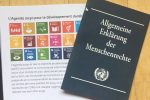
The Swiss CSO Platform Agenda 2030 published a short document showing how strongly the 2030 Agenda is based on human rights. And how we can use established human rights procedures to strengthen sustainable development. The document is available in German, French and Italian

Links:

Publication in German: https://www.plattformagenda2030.ch/publikationen/kurz-gefasst/agenda-2030-und-menschenrechte/

In French: https://www.plateformeagenda2030.ch/publications/l-essentiel/lagenda-2030-et-les-droits-humains/

In Italian: https://www.piattaforma-agenda2030.ch/pubblicazioni/in-sintesi/agenda-2030-e-diritti-umani/

System change report and documentary

By EEB – European Environmental Bureau

Oxfam Germany and the European Environmental Bureau (EEB) went out of their North-South and nature comfort zones to talk about the deeper changes that are now needed, especially in Europe. 

Towards a well-being economy that serves people and nature” is a 56p Oxfam Germany-EEB report (4p summary) that connects dots such as inequalities, power concentration, GDP growth dependency, environmental harm and the common struggle faced by humanity as a whole.

The authors, helped by the Climate of Change coalition and a range of stakeholders, including European policymakers, manage to unpack the “bigger picture” that we all operate in. 

Another invitation to think big, look deep and go for systemic solutions to our problems is a 20’ documentary from Broederlijk Delen, in close collaboration with the EEB. “The 25% revolution” is a systemic change documentary available in 13 languages. Experts & pioneers explain/show the need for/existence of a better economic system. The launch event with Kate Raworth from the Doughnut Economics discussed both the documentary, the report and the state of play on doughnut economies. 

Trailer: https://www.youtube.com/watch?v=jM1yXF3rgtk
Docu: https://www.the25percentrevolution.com/
Launch event: https://www.youtube.com/watch?v=rNPJHKmAE_4&t=62s
Report: https://eeb.org/library/towards-a-wellbeing-economy-that-serves-people-and-nature/
Summary: https://eeb.org/library/summary-towards-a-wellbeing-economy-that-serves-people-and-nature/

From local to global: an innovative partnership between cities and CSOs to support sustainable urban development and citizen participation within local governance 

By ALDA – European Association for Local Democracy

The European capital of democracy, the City and Eurometropolis of Strasbourg in France, the local Tunisian authorities of Kairouan and Mahdia, together with European civil society organisations – ALDA (European Association for Local Democracy), the CODATU Association (Cooperation for Urban Mobility in the Developing World) – and CEREMA French research centre officially launched the AUTREMENT Project during its kick-off conference on 27 January 2021. 

The AUTREMENT Project – Urban and Territorial Planning to Reinvent Mobility and Engage Tunisian Citizens -, started on 1 June 2020 and will run for 30 months. It aims at coping with key topical issues, such as sustainable urban development and local democracy through active citizen participation. It is supported by the European Union and is led by Strasbourg.

 The project follows a bottom-up and integrated approach. By implementing concerted urban micro-projects together with its citizens, especially the youth, women, and local stakeholders, it aims to promote walking and cycling in both Tunisian cities and improve urban mobility, participation in local affairs, and the quality of life of their citizens.  

As such, and besides addressing several SDGs, especially the SDG 11 towards sustainable cities and communities, the AUTREMENT project perfectly illustrates and embodies SDG 17 by building bridges between Europe and Southern countries through capacity strengthening knowledge and experience exchange towards a sustainable world. 

Read more about the AUTREMENT Project here.

Padova, Italy, inspired by the SDGs

By Centre for European Volunteering (CEV)

The European Volunteering Capital is a Europe-wide open competition that aims to promote volunteering at the local level by recognising municipalities that support volunteers and strengthen partnerships with volunteer-involving organisations and serve as sources of inspiration for all municipalities across Europe to make greater efforts to promote and celebrate volunteering. 

Within the framework of the European Volunteering Capital 2020 title hold by Padova (Italy) (#EVCapital2020), the representatives of the Padova Municipality and of the Centro Servizio Volontariato of Padova (CSV Padova) were inspired by the 17 Sustainable Development Goals (SDGs) of the 2030 Agenda for Sustainable Development to draw their action plan. 

In Padova 7 areas of study were identified, which accompanied the discussion and creation of the schedule for the 2020 campaign through the creation of as many working and processing tables as possible. The composition of these comprised representatives of the volunteering and volunteering involving organisations, local institutions, economic categories, universities, research and training agencies, trade union organisations and the media at the local and national level. Thus, seeking the involvement of all social actors to activate virtuous relationships between public and private to trigger positive development processes.

In line with the SDGs, such as SDG 1, SDG 3, SDG 11 or SDG 16, these 7 areas were: Poverty and new marginalisation; Health, Sport and Well-being; Culture and Education; Technology and Innovation; Environment and Urban planning; Economy and Sustainable Development; Peace, Human Rights and International Cooperation.

Young and elderly people, people with disabilities, women in difficulty and, in general, all people who have a higher probability of falling into these vulnerable categories were involved and considered in each of the seven focal areas.

As defined by the CSV Padova, this action’s main purpose was to “transform fragilities into valuable resources and increase social inclusion. The actions aimed at redefining and rewriting the characteristics of being together in the city and designing the future scenario by actively involving all social actors”.

A mystery solving game to learn about the SDGs

By Povod

Agenda 2030 is the first coordinated and organised effort to overcome 17 serious issue areas that trouble humanity. However, people have been thinking about these issues and solutions for the entirety of human existence, mostly through philosophy.

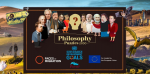
In this frame, and within the program “Faces of Migration” the Institute Povod from Slovenia produced a video-game where you can learn about the SDGs through the history of Philosophy.

Overview

Puzzles deal with knowledge, consciousness, identity, ethics, beliefs, justice, meaning and aesthetics. For example, “Plato’s cave”, or “How it is like to be a bat”, by Thomas Nagel, or “Brain in a vat”, by Gilbert Harman. All of these ideas are based upon other concepts from different times. The player’s goal is to solve each of these puzzles in a mystery game by finding locations and clues, which help the player solve riddles and activities and thus mastering the encountered philosophical problems. In the beautifully designed and animated locations, the player encounters famous philosophers from different eras, talks to them, learn about their ideas and the context of the time in which they originated. At the beginning of each mission, Olga, a local shopkeeper, presents a player with a mystery to solve. Then comes Primula Vulgaris, a captain of the space-time ship who takes the player through the journey through space and time to solve the mission, often interjecting and advising the player, sometimes even usefully. The story and the graphics are presented intelligently with quirky humour and sometimes bordering on fantasy.

One of the game’s goals is inclusivity, to show that various parts of the planet developed ideas that shaped our culture through time.

Philosophy Puzzles 2030 is an interactive comic / mystery-solving / quiz game suggested for players older than 15.

The player in each mission encounters one philosophical mystery to solve. These mysteries are “official” philosophical ideas by most important philosophers and thinkers worldwide and from different times, going back to ancient Greece. In the beautifully designed and animated locations, the player encounters famous philosophers from different eras, talks to them, learn about their ideas and the context of the time in which they originated.

The Video-game can be downloaded here: https://philo2030.com

More information here: http://povod.si/sl/projekti/project-2/ 

ASviS event at the Global Festival of Action: G20 and the 2030 Agenda

By ASviS

The fifth SDG Global Festival of Action, powered by the UN SDG Action Campaign to find new ways to inspire, mobilise and connect people and organisations to take action on the SDGs was held on March 25-26, in a dynamic virtual space: six different stages, featuring plenary sessions, lightning talks, performances, interactive workshops, exhibitions and a space to connect with leaders, changemakers, private sector and more.

In this context, the Italian Alliance for Sustainable Development (ASviS), organised the high-level workshop “G20 and the 2030 Agenda: a pathway to a sustainable recovery” to offer a perspective on the G20 summit. The event has been the opportunity to focus on the economic and health crisis due to Covid-19 with key international stakeholders from institutions and civil society and to discuss potential solutions. Moreover, to celebrate and recognise organisations that distinguished themselves for their capacity to connect and mobilise people for the 2030 Agenda globally, the SDG Action Awards jury selected ASviS as a “Mobilizer” thanks to the 2020 Sustainable Development Festival.  


Podcast: Reflecting on the 2020 ‘Commission’s Staff working document: Delivering on the UN’s Sustainable Development Goals

By SDG Watch Europe

In November 2020, the European Commission published its Staff Working Document (SWD), “Delivering on the UN Sustainable Development Goals – A comprehensive approach”. The SWD explains how the European Commission is “taking forward its commitment to sustainable development, the 2030 Agenda and the SDGs through its internal and external action policies, while also monitoring progress at Member State and European Union levels.”

However, the Staff Working Document merely provides an overview of existing initiatives of the European Commission. Five years after the SDGs were adopted, we have yet only seen a reaffirmation of the EC’s commitment towards the SDGs without real action on what they entail. 

SDG Watch Europe asked key stakeholders what they think the next step should be in the endless effort to achieve the SDGs by 2030.

Listen to Members of the European Parliament and representatives from NGOs commenting on the latest staff working document in this podcast:  https://soundcloud.com/historieromverdensmaalene/sdgs-and-the-eu

FOOD WAVE : Empowering Urban Youth for Climate Action

By ALDA – European Association for Local Democracy

Worldwide food production is responsible for a third of global greenhouse gas (GHC) emissions. More than a third of the global food production per year (40% at the European level) goes wasted, producing a significant impact on the climate, the environment and society. Contributing to sustainable agri-food systems, shifting to more sustainable production, distribution, and consumption patterns is one of the key aspects to tackle climate change and to address, at the same time, the issues of human rights, social inclusion, rural-urban linkages, food sovereignty. 

These values are among the main pillars of the EU funded project “Food Wave: Empowering Urban Youth for Climate Action”. The project, co-funded by the EU DEAR Programme, is  promoted by the Municipality of Milan and 18 Local Authorities and 11 Civil Society Organisations and aims to increase knowledge, awareness, and engagement of young people on sustainable patterns of food consumption and behaviour. Implementing actions in over 21 locations across 17 countries (16 within the European Union and 1 in the Global South -Brazil), with global networks such as C40, Food Wave is working to achieve the United Nations’ Sustainable Development Goals and those of the Paris Agreement. 

Through the direct and active engagement of young people, the project contributes to the localisation of the SDGs, leading the path towards more resilient and sustainable food systems. Many initiatives, such as online workshops, call for ideas, call for proposals, and street actions, are at the core of the project, boosting change starting from the territorial level. 

Read more about the Food Wave project and follow its Facebook and Instagram pages.