ECO-CHANGE: active youth for global change in Strasbourg!

By ALDA

Over the summer, the ALDA office in Strasbourg carried out a special intensive project in the city: “ECO-CHANGE – Active Youth for Global Change”. With climate change being not just a major environmental and development-related challenge, but also a key factor affecting people’s decision to migrate and their ability to do it safely, the project aimed to promote inclusiveness and solidarity among young people with different cultural backgrounds and to raise their awareness on the existing link between migration and climate change.

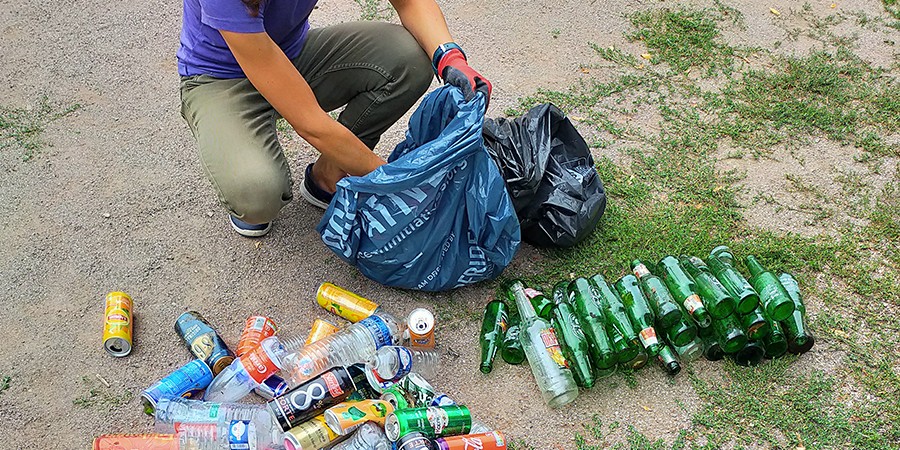
In cooperation with the Stamtish Association, ALDA set up two different kinds of activities for the youth involved: a waste collection in various places of Strasbourg; and eco-responsible cooking workshops. On August 22nd and 29th, hence, around 20 motivated young people took care of the ecosystem of Heyritz Park and Citadelle Park, collecting hundreds of cigarette stubs and several bags of waste – while on August 23rd and 30th they met at La Petite Cantine to cook multicultural food together. 

It was a great experience of intercultural promotion, collective caring for common issues, and an important occasion to stimulate young people’s active citizenship in Strasbourg. As it insisted on the fundamental role of youth in becoming “actors of change”, in addition, the project contributed to the achievement of some of the Sustainable Development Goals, namely SDG 10 – Reduced Inequalities; SDG 11 – Sustainable Cities and Communities; SDG 12 – Sustainable Consumption and Production; and SDG 13 – Measures relating to the fight against climate change.

Funded by the French Ministry of Europe and Foreign Affairs through FONJEP, ECO-CHANGE was coordinated by ALDA together with Stamtish, a Strasbourg-based NGO whose mission is to promote the integration of people with migrant background through culinary and eco-responsible events. 

Towards an EU Wellbeing Economy: How to build back better

By WWF

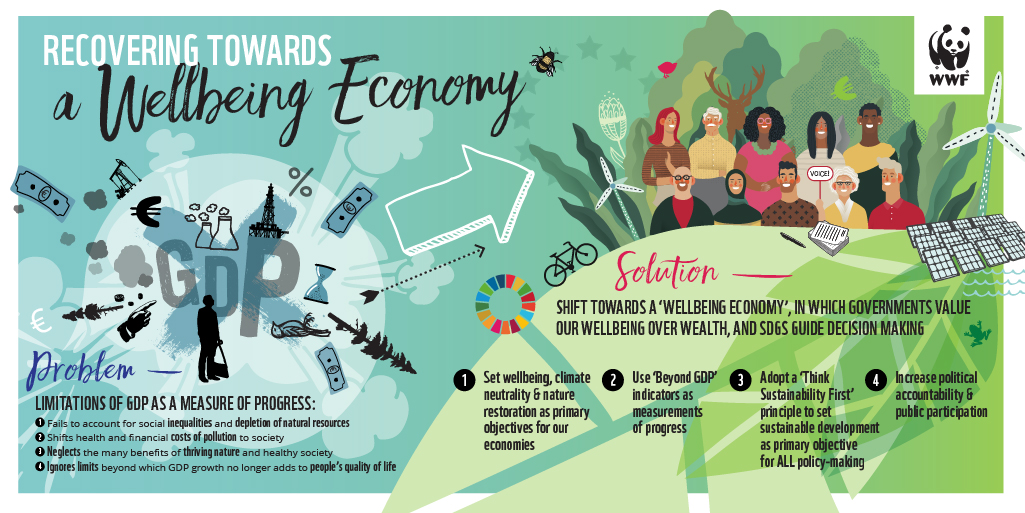
The WWF European Policy Office (EPO) has just launched a new report ‘Towards an EU Wellbeing Economy: a fairer, more sustainable Europe after COVID-19’, calling for the EU to shift to a ‘wellbeing economy’ to successfully recover by using the 2030 Sustainable Development Goals as a framework to achieve a just, socially inclusive recovery within planetary boundaries.

A ‘Wellbeing Economy’ is an economy that serves people and the environment, rather than just pursuing conventional economic growth through narrowly defined indicators such as Gross Domestic Product (GDP). WWF’s report provides examples of countries around the world already shifting to a Wellbeing Economy, such as Iceland and New Zealand, and recommends the EU takes steps in this direction, by adopting wellbeing indicators, improving accountability and coordination within the EU institutions, and prioritising sustainability in impact assessments and evaluations.

For more information, don’t hesitate to contact Agnieszka Zimoch at WWF (azimoch@wwf.eu).

Realising the promise of SDG 16 to promote and protect civic space

By Deirdre De Burca, Forus

Many in the human rights community are sceptical about what they regard as the weak potential of the SDGs to advance a universal human rights agenda. (See foreword by former Special Rapporteur for Extreme Poverty and Human Rights, Philip Alston of a recent report on Goal 16 and civic space produced by my organisation Forus,)

Such ambivalence towards the 2030 Agenda has meant that some human rights activists and practitioners overlook or disregard the role that SDG 16 could play in promoting civil and political rights globally. Current research shows that civil society, in over half of the countries of the world, is facing serious and growing restrictions on its freedom to engage, express itself and be heard. With increased surveillance, persecution and even violence against civil society, many CSOs have come under attack, particularly those advocating on behalf of excluded groups and minorities, for democratic rights and in defence of the environment. Human rights defenders in Africa, Latin America and Asia and in other parts of the world have been targeted and attacked. 212 environmental and land rights defenders alone were killed during 2019, and 219 human rights defenders are estimated to have been killed or died in detention in 2016. Technology advances have also brought increased surveillance on civil society and have created new risks for the civic space.

The freedom to exercise civil and political rights is also extremely important for civil society as it struggles to fulfill the role it has been mandated by the 2030 Agenda. The multi-stakeholder model of implementation, monitoring and review which is central to this Agenda requires civil society to have access to adequate civic space, and an enabling environment in which to operate if it is to make an effective contribution. The recent Forus report, Realising the potential of SDG 16 to promote and protect civic space, highlights how SDG 16 can provide important leverage for civil society everywhere in its efforts to create and defend the civic space, and to be more effective in monitoring and implementing the 2030 Agenda.

The effective implementation of SDG 16 will have profound implications for civic space in countries across the world. This goal broadly focuses on issues of governance and aims to “promote peaceful and inclusive societies for sustainable development, provide access to justice for all, and build effective accountable and inclusive institutions at all levels”. A specific target of SDG 16, Target 16.10, commits UN member states to “Ensure access to public information and protect fundamental freedoms”. These freedoms, which include basic rights to associate and assemble peacefully and to express views and opinions, are themselves fundamental human rights protected under international human rights law, and are essential to the creation and maintenance of the civic space.

And yet despite the clear aim of Target 16.10 to protect fundamental freedoms, the two global-level indicators which have been adopted to date by the international community to assess progress with this target do not adequately measure the extent to which these freedoms – particularly freedom of association, expression and assembly – are being protected. Indicator 16.10.1 while very relevant to the issue of civic space covers “the number of verified cases of killing, kidnapping, enforced disappearance, arbitrary detention and torture of journalists, associated media personnel, trade unionists and human rights advocates in the previous 12 months”. Indicator 16.10.2 covers “the number of countries that adopt and implement constitutional, statutory and / or policy guarantees for public access to information”.

But these global-level indicators, which are “outcome indicators” focus primarily on violations of the rights to bodily integrity and life and do not directly measure the extent to which fundamental freedoms of association, assembly and expression are being protected in day-to-day civic life as citizens attempt to engage with issues which impact on their communities and wider societies. In particular, Indicator 16.10.1 (verified cases of kidnapping imprisonment, kidnapping and murder of activists) needs to be complemented by the development and adoption at global level of other relevant structural and process-related civic space indicators. (For  example, a possible  structural civic space indicator could be :  “the existence and coverage of domestic laws protecting the rights to freedom of association, assembly & expression, including judicial review of any decision taken by the state to restrict it” and a possible process-oriented civic space indicator could be : “the proportion of received complaints on the rights to freedom of expression, association and assembly invested and adjudicated by courts or other competent national mechanisms in the last 12 months”. See more about such indicators on pg 73 of the recent Forus Goal 16 & Civic Space report). These indicators could subsequently be adopted at national level where specific gaps in the civic space have been identified.

This failure to monitor and measure the extent to which citizens are free to participate in the civic life of their societies a significant omission where SDG 16 is concerned,  The civic space case studies contained within the recent Forus Goal 16 report highlight the many restrictions civil society currently faces in different parts of the world where the exercise of rights to association, assembly and expression is concerned (see pg 62 of Forus report). These restrictions will negatively impact on the capacity of civil society in those countries to contribute to the effective implementation of the 2030 Agenda. The fundamental freedoms referred to by SDG 16 are essential to the creation of a healthy, functioning civic space, and to enabling civil society to effectively contribute to monitoring and implementing the 2030 Agenda, and they should be continuously monitored and measured.

There is an urgent need for the international community to extend the scope of SDG 16 civic space indicators which are currently limited to an outcome indicator measuring the extent to which activists, human rights defenders and others have been kidnapped, imprisoned or murdered. Additional global indicators must be developed, linked to Target 16.10, which measure the extent to which citizens can exercise their rights to freedom of association, assembly and expression in their communities and societies, in accordance with international human rights standards and national human rights laws.  Given that the OHCHR, together with UNESCO and the ILO, is the official custodian for Target 16.10.1, the human rights community, wider civil society and other key stakeholders seeking to influence the development of the indicators and of data collection need to engage with these organisations and participate in that process.

Following the launch of the Goal 16 report at the UN High Level Political Forum in 2020, Forus and its partners intend to collaborate with interested civil society networks and other groups on a new global advocacy campaign. This campaign will call for a wider range of civic space indicators to be adopted by UN member states as official Goal 16 indicators and to become part of national, regional and global Goal 16 review processes of the 2030 Agenda. The involvement of human rights activists and practitioners in this global advocacy campaign, and in the wider monitoring and review of SDG 16 implementation, will be crucial for several reasons.

Firstly, the potential contribution of the human rights community to a global campaign calling for the adoption of a wider range of global civic space indicators linked to SDG 16 would be critical. Human rights practitioners could bring their considerable specialized knowledge, advocacy capacities and political influence to bear on the campaign. Secondly, in relation to the significant data gap that has developed where Goal 16-related civic space and wider governance monitoring systems are concerned, the human rights community could help to address this issue. There is a growing and unfulfilled need for official statistics linked not just to the measurement of civic space but also to the measurement of governance in its fullest sense (eg inclusion, civic participation, rule of law, access to information).  At the end of the first four- year cycle of the implementation of the 2030 Agenda (2016-2019), very few countries and statistical offices have successfully produced governance data to report on progress with SDG 16. There has been a clear failure to use data and information produced for other relevant reporting processes, particularly the kind of useful information which has been produced for human rights reporting mechanisms, to report on progress with SDG 16 implementation. If human rights advocates were more involved in the 2030 Agenda review mechanisms, their specialised expertise relating to the Universal Periodic Review and other human rights treaty reporting processes could be used to advocate more effectively for proper measurement of and reporting on the implementation of SDG 16.

Secondly, human rights advocates could also add their voice and their ability to influence those of Civil Society Organization networks such as Forus, which are calling for SDG 16 of the 2030 Agenda to be reviewed annually by the UN HLPF, instead of every few years as it happens at present. A precedent exists with SDG 17 which is reviewed annually by the HLPF. If Goal 16 were subject to annual review, reporting governments would be obliged to report to the UN HLPF each year on progress with SDG 16 implementation in their countries. This would serve not just to keep the issues of civic space, the exercise of fundamental freedoms and the promotion of human rights high on the international political agenda on an ongoing basis, but also the wider issues of governance, justice, peace, and security.

In conclusion, the combined energy, commitment and specialised knowledge of the human rights community could bring a considerable impetus to current efforts to realise the critically important promise of SDG 16 to promote and protect civic space. Human rights advocates and practitioners should join forces with civil society movements and other interested stakeholders to launch a broad global advocacy campaign for a wider range of civic space indicators to be adopted as part of official Goal 16 global, regional and national review processes.  Please contact me on Deirdre@forus-international.org if you wish to discuss this proposal further!
Leaving NOne Behind: Let us Get a More Ambitious European Disability Rights Agenda 2021-30

By EDF

The European Disability Strategy ends in 2020 and the European Commission is drafting its successor. This Disability Rights Agenda will guide the EU work for the next 10 years. In particular, it will articulate how the EU and its 27 Member States will bring the implementation of international commitments, such as the UN Convention on the Rights of Persons with Disabilities (CRPD) and the Sustainable Development Goals (SDGs).

To successfully implement the SDGs, the European Disability Forum –the voice of over 100 million Europeans with disabilities– calls the EU to use this opportunity to assume a global leadership role in promoting the rights of persons with disabilities by:

– Adopting a dedicated External Action Disability Action Plan

– Ensuring CRPD compliance of all EU’s international cooperation and humanitarian actions

– Building the capacities of EU staff to mainstream disability rights in the EU institutions and external delegations

– Consulting meaningfully and with the full participation of persons with disabilities, including women, girls, and boys with disabilities, through their representative organisations.

The 2030 Agenda provides a political momentum to push for the realisation of the CRPD and the EU Consensus on Development. Let’s not miss it!

More info on EDF website.

Statement – MORIA FIRES: European Governments must urgently relocate displaced individuals from Greece

By GCAP

GCAP and the Faces of Migration partners reiterate our call on the governments of EU Member States, with support from the European Commission, to urgently relocate displaced individuals from Greece. Lesvos and the other EU Hotspots on the Aegean islands have reached breaking point long ago. European government must now urgently bring the men, women and children stranded in Greece to safety, and thereby uphold our European values of human rights and human dignity. Read more:

Urgent Call to Action from Civil Society Organisations across Europe: Download the statement

Over the past days devastating fires (i) burnt down the Moria Registration and Identification Center and surrounding areas, the EU Hotspot on the Greek island Lesvos. The fires have left thousands of vulnerable individuals homeless and traumatised (ii), among them over 4,000 children (iii).

The undersigned organisations reiterate their call on the governments of EU Member States, with support from the European Commission (iv), to urgently relocate displaced individuals from Greece.

While we are shocked and saddened at these developments, they come as no surprise. Lesvos and the other EU Hotspots (v) on the Aegean islands have reached breaking point long ago (vi). Moria camp is currently hosting roughly 12-13,000 displaced individuals, with an official capacity of only 2,800. These severely overcrowded camps are characterised by squalid living conditions and a severe lack of adequate sanitation or hygiene facilities, even amid the heightened health risks due to COVID-19 (vii). The situation in the other Greek Hotspots is similarly untenable and repeated warnings (viii) have remained unanswered for over four years.

Relocation urgently needed

We welcome the transfer of 406 unaccompanied children from Lesvos to the Greek mainland, with financial support from the European Commission (ix). This demonstrates how swiftly transfers can be co-ordinated when the political will exists. We commend the Norwegian and Dutch governments’ commitments to relocating 50 (x) and 100 (xi) individuals respectively, as well as the French and German governments’ willingness to transfer 400 children (xii). We urge further European governments to follow with concrete commitments and action without delay. The positive example set by relocations carried out by the coalition of willing Member States since March 2020 (xiii) shows that relocations can be carried out safely and successfully for everyone involved. Member States, EU institutions, relevant EU and UN agencies with support from civil society should now share experiences, expertise and resources to ensure further states join the coalition. The undersigned organisations stand ready to support these efforts, to bring the men, women and children stranded in Greece to safety, and thereby uphold our European values of human rights and human dignity.

The EU Hotspots as an EU Migration Management Approach

The latest events prove once again the failure of the Hotspots as the default EU migration management approach. We call on the European Parliament to investigate the role that the EU and Member States played in the failed management of Moria. Moreover, we urge the European Commission, the German EU Council Presidency and Member States to treat the horrifying images of Moria burning as unequivocal proof of the tragic human cost (xiv) of an EU asylum and migration system based on containment and deterrence policies. We strongly recommend the European Commission to take these events into account with a view to the New Pact on Migration and Asylum, and ensure the same policies do not inform the extremely concerning proposals for ‘processing centres’ at EU borders. It is vital that the New Pact is taken as an opportunity to present a new start rather than a replication of past errors.

Signed by:

  • Action Aid Hellas (Faces of Migration partner)
  • Ambrela Slovakia (Faces of Migration partner)
  • ASGI
  • BPID Bulgaria (Faces of Migration partner)
  • Caritas Europa
  • Caritas Hellas
  • Caritas Slovakia
  • Češi Pomáhají (Czech Republic)
  • Child Circle
  • Consortium of Migrants Assissting NGOs (Czech Republic) COSPE Onlus
  • Danish Refugee Council (DRC)
  • Defence for Children International
  • Defence for Children International – Belgium
  • Defence for Children International – Greece
  • Defence for Children International – Italia
  • Destination Unknown
  • Diaconia ECCB (Faces of Migration partner)
  • Diakonie Austria
  • Dutch Council for Refugees
  • Dynamo International – Street Workers Network Echo100Plus
  • Eurochild
  • Eurodiaconia
  • Europe Must Act
  • European Lawyers in Lesvos
  • European Network on Statelessness
  • Fenix Humanitarian Legal Aid
  • FOCSIV – Italian Federation of Christian NGOs Italy (Faces of Migration partner)
  • Global Call to Action Against Poverty (GCAP) (Faces of Migration partner)
  • Greek Council for Refugees (GCR)
  • Help Refugees
  • Human Rights League Slovakia
  • ICMC Europe
  • Immigrant Council of Ireland
  • International Child Development Initiatives (NL)
  • International Rescue Committee (IRC)
  • INTERSOS
  • Kids in Need of Defense (KIND)
  • Kopin
  • Lighthouse Relief (LHR)
  • LUMOS Foundation
  • Mareena Country Slovakia
  • Médecins du Monde Belgique
  • Médecins du Monde – France
  • Minority Rights Group International
  • Missing Children Europe
  • Mokosha NGO Centre
  • Movimento per l’Autosviluppo, l’Interscambio e la Solidarietà (MAIS) (Italy)
  • Nadácia Milana Šimečku (Slovakia)
  • Network for Children’s Rights
  • One Happy Family Lesvos
  • ONGD Plataforma Portoguesa
  • Organization Mondiale pour l’Éducation Préscolaire/ World Organization for Early Childhood Education
  • Oxfam
  • PAX
  • Pax Christi Vlaanderen
  • PICUM
  • Plate-Forme Mineurs en Exil – Platform Kinderen op de Vlucht
  • Povod Slovenia (Faces of Migration partner)
  • Refugee Legal Support (RLS)
  • Refugee Youth Service
  • Slovak Humanitarian Council PRAKIS Solidarity Now
  • SOS Villages Greece
  • Still I Rise
  • Terre des Hommes Hellas
  • Terre des Hommes International Federation
  • Velos Youth
  • Vluchtelingenwerk Vlaanderen
  • Women’s Refugee Commission

References

i Al Jazeera, 9 September 2020
ii CNN, 9 September 2020
iii UNCHR and Council of Europe, 9 September 2020
iv Together with relevant EU and UN agencies and in cooperation with civil society organisations.
v UNHCR, 31 August 2018
vi Amnesty International, 6 December 2018 ; see also: Call to Action by Civil society organisations, March 2020
vii MSF, 30 July 2020
viii HRW, 19 March 2016
ix Ekathimerini, 9 September 2020
x Dpa-international, 9 September 2020
xi NLTimes.NL, 11 September 2020
xii France 24, 10 Septembre 2020
xiii European Commission, 15 April 2020 ; PubAffairsBruxelles, 8 July 2020
xiv MSF, 11 March 2020

EUROPE MUST TAME THE ILLICIT WILDLIFE TRADE

By Eva Izquierdo, EEB

The COVID-19 pandemic has drawn attention to the wildlife trade. Less well-known is that the European Union is one of the world’s leading markets both for licit and illicit wildlife. Eva Izquierdo highlights how, despite its commitment to curbing this harmful commerce, the EU is failing to take sufficient action and new trade agreements risk making the situation considerably worse.

The European Commission recently launched an online public consultation to build consensus around the medium-term direction for EU trade policy. The consultation – and probably the entire review of the European Union’s trade policy – will focus on the aspects of international trade that the European Commission wishes to boost: economic growth, jobs and consumer choice.

This short-sighted consultation leaves completely unspoken and forgotten the negative aspects of trade, such as trafficking. Consequently, the European Commission is failing to deliver a comprehensive consensus on the future of EU trade policy by not weighing up the tradeoffs between the positive and the negative sides of trade. Both sides should have been integrated in the consultation to get a holistic approach on trade.

The EU seems to perceive increasing trade as something that is intrinsically good and as something that should be pursued as a stand-alone objective, no matter how serious its consequences, from biodiversity loss to huge amounts of waste and deforestation. Regarding the latter, the illegal timber trade supplies 10-15% of global demand for wood, which rises to 50% in certain areas, hurting state revenues, the livelihoods of the rural poor and inflicting irreparable damage on nature.

Crime and no punishment. Although the EU has committed to a more sustainable and responsible trade policy, it is not investing enough resources to crack down on environmental crime. The European Union’s efforts to boost international trading and investment opportunities will be futile and counterproductive if the EU does not urgently fill in the gaps in enforcement that allow environmental crimes to be perpetrated without suitable punishment. New trade deals that eliminate customs duties and increase trade at any cost will blow the door wide open for environmental criminals to be committed with impunity.

The case of illegal wildlife trade in particular underscores how much a holistic approach can help defining good trade policies. The line between legal wildlife trade and wildlife trafficking is blurry. EU legal wildlife trade is estimated to be worth €100 billion. The volume of wildlife trade has increased exponentially over the last few decades, helped by international trade agreements. According to WWF’s Living Planet Report 2020, trade has exploded with the value of exports rising 200-fold from 1970 to 2017, with the largest increases in developed countries (1,200-fold).

How many billions of disguised illegal trade is included in the €100 billion of legally wildlife traded? We cannot know but we can be certain that a good percentage is included.  Due to a lack of resources and staff, it is difficult for EU member states to crack down on wildlife trafficking and properly implement the EU action plan against wildlife trafficking.

There is also a significant loophole which blur the lines between the legal and illegal and provide opportunities to effectively launders some forms of illicit trade. There are endangered and vulnerable species which are protected by domestic legislation and which are exported illegally out of their country of origin. However, once they reach the EU, these species can be legally traded.

Natural health insurance. Beyond the obvious, if shortsighted, economic benefits, trade policy can play an important in protecting ecosystems and, consequently, helping reduce the risk of future pandemics. If we want to strike the right balance between a Europe that is “open for business” and a Europe that protects its people, Europe needs to eradicate illegal wildlife trade and its fatal consequences for human health.

Scientists are convinced that pandemics whose origin is wildlife consumption or increasing proximity to wildlife due to habitat destruction will become more frequent in the near future. In addition to the current COVID-19, another coronavirus known as MERS-COV or camel flu is still killing people. In November 2002, an outbreak of severe acute respiratory syndrome (SARS) began in China and spread to 29 countries. Before SARS, the world was hit by HIV, Ebola and avian flu.

Wildlife trafficking is not only a clear threat to global biodiversity but also to the European Commission’s ambition of using trade policy to develop international governance measures that support stability and predictability. Wildlife trafficking threatens national security and fuels conflicts by providing funding to militia and terrorist groups in developing countries. More than 1,000 rangers have been killed during anti-poaching operations in the last 10 years, mostly in Africa and Asia.

Therefore, in addition to promoting environmental objectives such as wildlife protection, EU trade policy and international trade agreements should ensure effective enforcement inside and outside Europe, by incorporating concrete  measures to reduce environmental crime and in particular wildlife trafficking. Such actions could include prioritising the prosecution of wildlife trafficking in criminal justice systems, using community-based social marketing to reduce demand and implementing strong measures to combat corruption at all levels.

The EU could reduce wildlife trafficking by requiring minimum supply chain due diligence and related public reporting for all goods placed on its market and exported from its territories.

As the Union moves towards digital product passports, these passports and information should be shared with our trading partners and they should be required to use such passport before placing products on the EU market. This will help increase traceability and transparency about the risks in the global supply chains, and will help in joint international control mechanisms and enforcement efforts, as well as ensure that people and consumers have the same level of information on the products that they buy, regardless of their origin.

Civil Society Call for a Global Fund for Social Protection to respond to the COVID-19 crisis and to build a better future

By GCAP

GCAP has joined 200+ civil society organizations  and others to call for a Global Fund for Social Protection.

The call is available in Arabic, Russian, English, French and Spanish.
The list of signatories is here.

The press release “Over 200 civil society organizations and trade unions unite to call for a Global Fund for Social Protection to protect the most vulnerable during COVID-19 and beyond” is here, (pdf version).

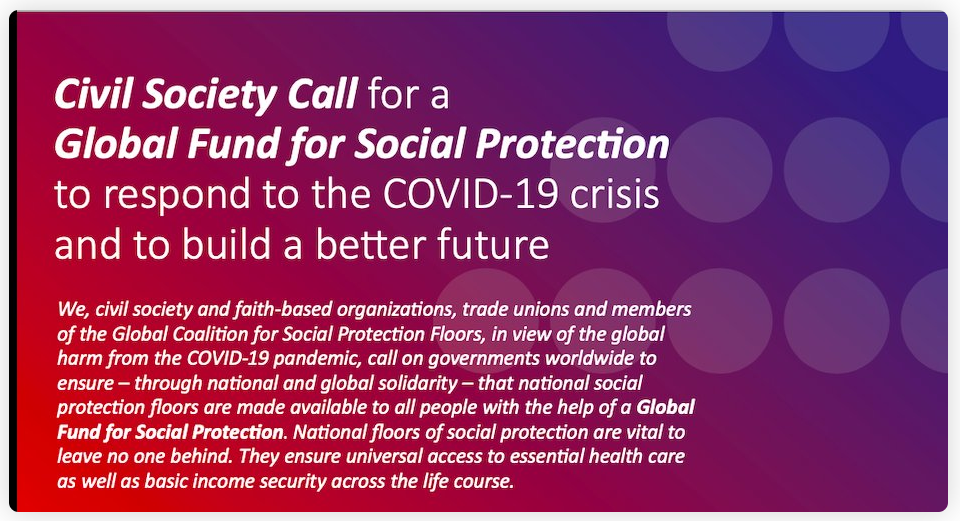
We, civil society and faith-based organizations, trade unions and members of the Global Coalition for Social Protection Floors, in view of the global harm from the COVID-19 pandemic, call on governments worldwide to ensure – through national and global solidarity – that national social protection floors are made available to all people with the help of a Global Fund for Social Protection. National floors of social protection are vital to leave no one behind. They ensure universal access to essential health care as well as basic income security across the life course.

We recall that

  • The member states of the United Nations have long agreed on the fundamental human rights of all people to social protection and to health;*
  • Despite this, more than two thirds of the world’s population are still denied the right to comprehensive social protection;
  • As a result of the COVID-19 pandemic, the number of people without protection is increasing significantly, with the number of people that are food insecure alone projected to double to a quarter of a billion this year;
  • Social protection systems are a proven direct and fast-acting mechanism that reduce and prevent poverty, help counter inequality, and can unleash the creativity and productive capacity of people by providing a basic level of security that ensures dignity and access to all essential goods and public services;
  • Social protection is a vital investment in socio-economic development and in resilience in view of natural and climate disasters, economic and other humanitarian crises;
  • Social protection systems offer highly effective safeguards against the social and economic fallout of the present and future health and socio-economic crises; and
  • Many studies have shown that ensuring a basic level of social protection for all is affordable for most countries and entirely achievable through the solidarity of the international community.

We recognize, that

  • Many national governments develop, implement and monitor social protection floors, with the participation of civil society, trade unions and informal worker organizations;
  • Generally and principally  the financing of social protection systems must fall to national budgets;
  • There are, nevertheless, a few countries where technical support for the setting-up of national social protection floors and co-financing from the international community are required due to multiple factors, including high socio-economic vulnerability and persistent low levels of national revenue;
  • Based on conditions in the pre-COVID-19 era, some 10 to 15 countries have social protection financing gaps amounting to more than 10 per cent of their GDP, and require temporary international co-financing of minimum social protection floors, while they strengthen domestic resource mobilisation.

We call on all governments

  • To create a Global Fund for Social Protection, based on the principle of global solidarity, to support countries to design, implement and, in specific cases, provide temporary co-financing for national social protection floors. The mandate of the Fund would be to:
    • Support the introduction or finalization of national social protection floors with the full participation of people of all ages, including women, people with disabilities, minorities, and those living in poverty in their design, implementation and monitoring;
    • Ensure that national social protection floors are prepared for sustainability and for expansion in the event of shocks that affect entire communities;
    • Co-finance – on a transitional basis – the costs of setting up social protection floors in low-income countries where such transfers would otherwise require a prohibitively high share of the country’s total tax revenue;
    • Support the strengthening of domestic resource mobilisation, including international tax regulation, to underpin the future sustainability of national social protection systems;
    • Offer additional support for specific shock-responsive social protection interventions in countries where floors have not yet been established.

We envisage, that

  • The Global Fund for Social Protection would:
    • Be governed by a board, representative of both recipient and donor states, civil society organizations, trade unions and informal workers organisations in accordance with the Paris Declaration on Aid Effectiveness (2005) and ILO Recommendation R204 (2015);
    • Be governed by the principles of the Global Partnership for Effective Development Co-operation, notably the respect for country ownership, national financial co-responsibility and the necessary support for national systems;
    • Operate under the principles of accountability, transparency and participation;
    • Be financed through a combination of different sources such as:
      • Representing a greater focus of existing international development aid resources and development finance facilities;
      • Specifically earmarked sources, such as national, regional or global financial transaction taxes (FTT), an arms trade tax, carbon taxes, air ticket solidarity levies, and levies on profits;
      • Increased development aid, multilateral grants and funds for emergency response;
      • Voluntary contributions of individuals and other donors.
  • UN organizations and development and humanitarian aid organizations, including civil society active in the countries of focus will deliver technical country support.

We therefore call on all governments

  • To establish a Global Fund for Social Protection that will help bring an end to avoidable human suffering, poverty, extreme inequality, ill-health and avoidable deaths associated with the current and future crises, and for them to invest in the development of national social protection floors in all countries through the principle of national and global solidarity.

Note:

* As enshrined, for example, in articles 22 and 25 of the Universal Declaration of Human Rights (1948), articles 9 and 12 of the International Covenant for Economic, Social and Cultural Rights (1966), ILO Recommendation 202 (2012) as well as other instruments and confirmed by the Sustainable Development Goals (2015).

Time to reach for the moon -The EU needs to step up action and lead the transformation to sustainability

By Patrizia Heidegger, EEB

The EU and its Member States were a driving force behind the negotiation and adoption of the 2030 Agenda and the Sustainable Development Goals (SDGs). Now, the EU’s lea­dership is needed to make the Goals a reality, at home and globally. The EU has the power to pass transformative laws and commands the resources needed to drive the transition towards sustainability. Commission President Ursula von der Leyen has called the European Green Deal, which she has put forward to address many of our sustainability challenges, the EU’s “man on the moon moment”. The time is now for the EU to reach for the moon and lead by example.

The EU, which prides itself on its core values of human rights, freedom, democracy, equality and the rule of law, has many positive achievements to its credit: cleaner rivers and better waste management, reduced chemical pollution, stronger social protection and consumer rights, quality education and free movement within the Schengen area, to name a few.

But the EU’s ambition to be a frontrunner for the 2030 Agenda and the SDGs has yet to be realised. If everyone in the world lived like the average European, we would need 2.6 planets to satisfy our demands on nature. Our economic system, characterised by labour exploitation and resource depletion, overconsumption, and waste, is not sustainable. It has deepened inequalities and social exclusion, globally and within most Member States, and will deprive future genera­tions of the ability to meet their needs. 

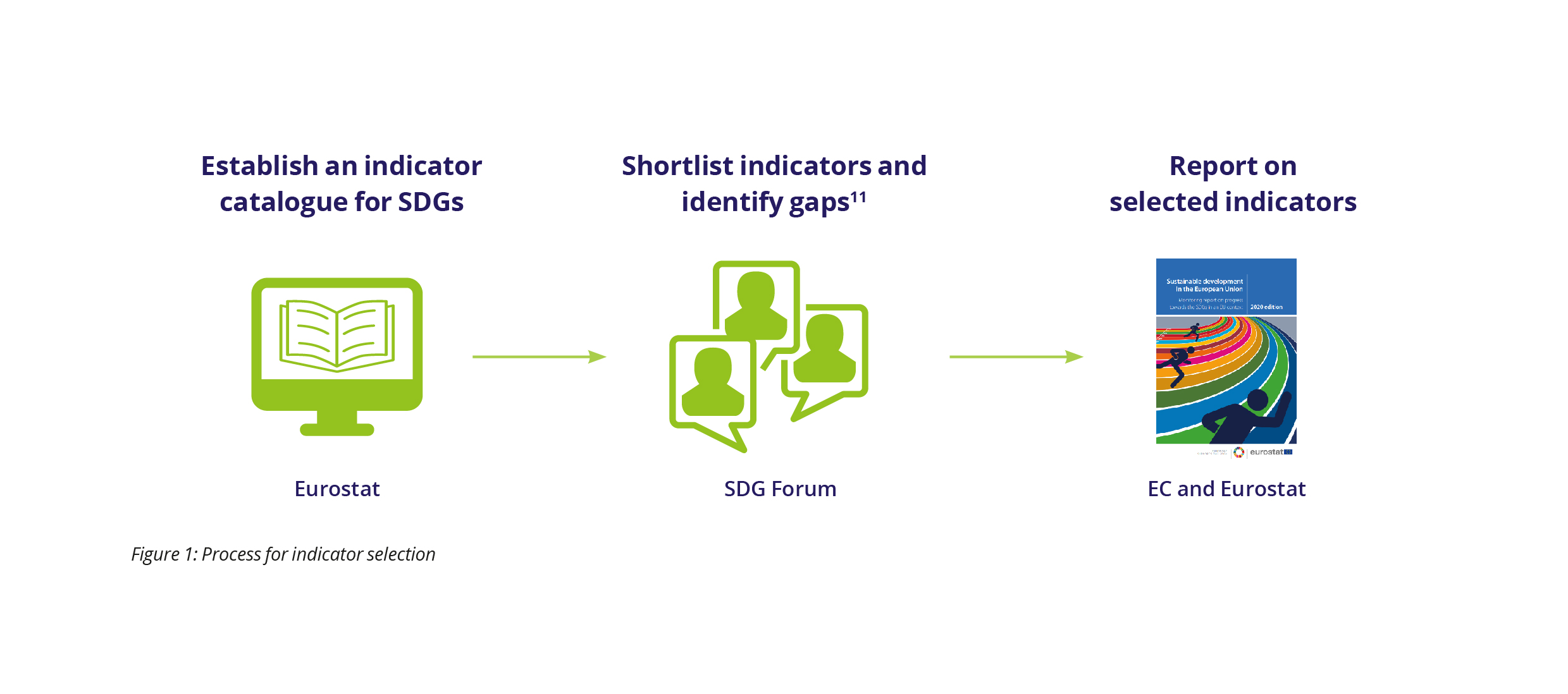
The indicators used by the EU to monitor and report on the SDGs provide an overly positive picture. The yearly Eurostat SDG report celebrates even the slowest progress but ignores pressing challenges, including our global ecological footprint, homelessness, and human rights violations in European supply chains. It does not ask which policies drive sustainability, and which undermine it, which funds support the transition, and which block it. The European Commission does not promote a public debate about its SDG report’s fin­dings and what needs to be done to accelerate action. There is no role for civil society in the EU’s SDG monitoring.

This is why SDG Watch Europe presents an SDG monitoring report for the EU now to take stock where we stand and to hold the EU to account on the implementation of the 2030 Agenda and the SDGs five years after their adoption.

This report explains why the EU’s SDG reporting creates an illusion of sustainability and makes concrete proposals for meaningful monitoring to become a stronger foundation for transformative policies. We tell a more critical story about sustainability in the EU. Our report flags up serious gaps, bringing them to life with 17 individual stories. We also share our vision of what a truly sustainable Europe could look like. We show what we can achieve by 2030 if we do the right things now, building on our Manifesto for a Sustainable Europe for its Citizens, published by civil society for the 2019 European Elections. We offer 17 solutions, real-life examples of progressive policies, innova­tive initiatives and truly sustainable business models. These glimpses of a sustainable Europe nurture hope and inspire action in people – and need a progressive political framework to support and scale them up.

We would like to thank all members and partners of SDG Watch Europe for pooling their knowledge and wisdom to create this report, and for sharing their vision of a sustainable Europe for its people. The time to act is now!