
| By EEB (European Environmental Bureau) |
| 29 October 2021 TOUR & TAXIS – Eight artists and acrobats, four musicians, an impressive scenography and many stories to tell. After a tour of 10 European countries, the contemporary circus company MagdaClan is coming to Tour&Taxis in Brussels from 10 to 13 November to offer you an artistic experience full of reflections on migration and global warming. With the support of the European Environmental Bureau and the Association of Local Democracy Agencies, the artists of MagdaClan want to engage the public in understanding the complex relationship between climate change and migration and create a movement of informed people ready to change their lifestyle and demand new development policies. They will stage a dramatic representation of the climate crises taking place in different corners of the world, posing as entire populations brought to their knees by floods, melting Arctic permafrost, desertification and fires. How will artists deal with these realities, with just a few objects and words? Be part of the change! Join us at Tour&Taxis on 10/11/12/13 November, 7.30pm, free, CST and registration required, link at the bottom. More info on our Facebook event. Register here Share the event on Facebook Check out the teaser |
Category: October 2021
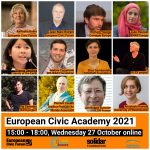
European Civic Academy 2021
Session III : All for a Better World, but All Fragmented?
By Civil Society Europe
Co-organised with Civil Society Europe, SOLIDAR and Fundacja na rzecz Collegium Polonicum, the European Civic Forum invites you to join in Session III of #EuropeanCivicAcademy 2021!
This session will focus on the theme of Convergence: “All for a better world, but all fragmented?” and will take place on Wednesday, 27 October, from 3:00 to 6:00 p.m (CET) online.
The key issues to be tackled by both civil society activists and academic researchers are:
⇒ Is convergence of democratic agendas the best path to systemic change? How to prevent from creating hierarchies of needs, issues and fights? Are there any attempts to connect/unite thematic agendas, to overcome fragmentation? What obstacles do they face? What can we learn from experiences of mutual contamination and convergence?
⇒ What are the relations between movements, organised civil society and other forms of democratic activism – conflict-cooperation, trust/mistrust? How are the different actors discussing this issue? Does this dialectic contribute to any contamination, debate or change between different concepts and practices towards a better world?
Don’t miss out on the opportunity to share your input in this event!
For more information on the programme, click here.
Registration link: https://bit.ly/3n3IOKo

“Beyond non-commitment” – the first Dutch SDG Spotlight
By SDG Spot Nederland (external resource)
The 17 Sustainable Development Goals (SDGs) were signed by all United Nations member states in 2015, the Netherlands included. The Dutch government has committed itself to realise these goals, at home and abroad, by 2030, leaving nobody behind.
With this first Dutch SDG Spotlight report titled “Beyond non-commitment”, we are joining other countries in keeping our government on track through an independent report, written by civil society organisations, about the state of the art of the SDGs. The SDG Spotlight report for the Netherlands was published in March 2021 and (partly) translated to English in June 2021. It critically assesses the Dutch policy approach to SDG 10 (Reduced inequalities) and SDG 15 (Life on land), showing the Netherlands’ approach to the SDGs is characterized by a high degree of non-commitment. Read the full SDG Spotlight report “Beyond non-commitment”
Spotlight on SDG10 and SDG 15 shows painful results
The Dutch 2020 Spotlight report focuses on SDG 10: Reduced inequalities and SDG 15: Life on land. These two goals represent two main areas of the SDG agenda: people and the planet. The results of the Spotlight report can be described as painful. The Dutch government’s policy on SDG 10 (reducing inequalities) and SDG 15 (life on land, biodiversity) are ambiguous and non-committal. The frame that The Netherlands is “doing pretty well” on the route to 2030, is not correct. In the area of social and ecological sustainability, the Netherlands is not making enough progress. To the contrary, the impact of Dutch policy is negative and does not bring the goals closer.
In the area of equal opportunity, diversity and social cohesion (SDG 10), the Netherlands is showing a mixed image, but the overall trend remains negative, especially for vulnerable groups. In the area of biodiversity, environmental protection and quality of the living environment (SDG 15), the Netherlands is simply falling short.
‘A high degree of non-commitment’
The Dutch government does make policies for a more sustainable economy, an inclusive society and corporate social responsibility, but the policy approach is characterised by a high degree of non-commitment. Good policy ambitions are not accompanied by measurable goals, adequate resources or clear legal frameworks. The government does not give enough guidance and direction to companies, which are given the space to regulate themselves and are not led towards a more sustainable production model with rules and pricing. Making international trade chains more sustainable is largely pursued through voluntary covenants. Time and again, we see that these approaches yield too few results.
Also, the government does not speak with one voice and its policy is not coherent. While one ministry or department develops policy that contributes to the SDGs, another department develops activities that have the opposite effect. Politics and actual implementation in practice give different signals, especially in the international and European context.
This way, we will certainly not achieve SDG 10 and SDG 15 by 2030.
Our goal: encouraging ambitious SDG action
The report examines the goals and indicators on the path towards the SDGs, something that has not been investigated for the Netherlands before. With this SDG Spotlight report on the Dutch role in achieving the SDGs, we want to encourage more ambitious and more coherent action on the SDGs. Our main conclusion is that it is high time for the Netherlands to translate the SDGs into an ambitious strategy with measurable goals for the national and international level. This strategy should be broadly anchored in all ministries.

Civil Society Convention for the Conference on the Future for Europe
| CSOCoFoE: Thematic Cluster Consultations! Dear Convention members, As promised, we are now providing you with thematic cluster consultations to which you and your networks can contribute! These consultations aim to bring a strong and shared agenda into public discussions on current social, environmental, and democratic challenges. They represent the CoFoE agenda topics, and will result in report findings that will be presented to decision makers, media, and civil society across Europe, along with a joint preamble. Thus, we also invite you to involve your members in the following consultation processes: Our European Life Cluster Survey Under the umbrella theme of “Our European Life” – What it is – What it should be – and How to Get There!, this cluster examine European rights and values as a transversal frame and foundation for pondering on these topics: European rights and values Migration challenges and opportunities EU’s role in the world European identity Freedom of movement and more… Factsheets that provide additional information and context concerning these questions are available here. Deadline for consultation: End of November. Democracy Cluster Survey Under the thematic cluster European Democracy we need – the survey aims to address concerns related to THREE main challenges of democracy in Europe: Enabling Environment for Participation Electoral Reform Ensure Accountability For French version: https://forms.gle/HY2dvcKKjBhYDk1H8 For Italian version: https://forms.gle/VWALPWDBhftafMiFA Social Europe Cluster Survey CLICK HERE to write in your recommendations and positions with regards to the achievement of: Sustainable Economic Model Equal Opportunities (including migration) Fair Working Conditions Social Protection. Deadline for consultation: 26th of November. Digital Transformation Cluster Survey Via ECAS’s crowdsourcing platform share your positions on: Digital Democracy Digital Education Digital Safeguards Defending Rights and Freedoms Online Digital Economy. Find the guidelines to access the platform at this link. Deadline for the first phase of consultation: 31st of October. |
Green, digital and social recovery: How the recovery plans are supporting a wellbeing economy for people and planet?
| Online event – EESC 22/10/2021 | 9:30 – 13:00 |
| Green, digital and social recovery: How the recovery plans are supporting a wellbeing economy for people and planet? |
| On 22 October 2021, the EESC will hold an online event on ”Green, digital and social recovery – How the recovery plans are supporting a wellbeing economy for people and planet?”. Europe is facing many challenges as a result of the pandemic of COVID-19. Crisis management and recovery is in the focus of the activities of the European Institutions and the Member States in 2021. The three Observatories of the European Economic and Social Committee were following the negotiations of the new multiannual financial framework for 2021-27 and the Next Generation EU. It is crucial to ensure that recovery funding is sustainable as well as inclusive, and that it entails a ‘bounce forward’ for progress towards the Sustainable Development Goals (SDGs) and promotion of wellbeing-related goals, rather than a return to business as usual. The main purpose of this event is to present and discuss about the involvement of civil society in the implementation of the recovery plans, through concrete examples. The event will focus on three economic sectors in transition to analyse the opportunities and challenges to shift towards a wellbeing economy, aligned with the SDG Agenda. The three panels on energy, car industry and digitalisation will have a regional kick off presentation of the underlying main drivers, potentials and challenges and will be based on concrete national experience. Each panel will allow time for contributions from participants.The programme is available here. This event contributes to the process of the Conference on the Future of Europe. Please register through this registration form. Registration is possible until Tuesday 20 October, 12.00 p.m. A link will be shared with registered persons before the event. |

Stop Excluding Military Pollution from Climate Agreements
By Actionnetwork
Target: Participants in COP26 UN Climate Change Conference, Glasgow, Scotland, November 1-12, 2021
COP26.info #NoWarNoWarming
We encourage individuals and organizations to sign the petition below, and also ask organizations to sign a similar petition created by Conflict and Environment Observatory here.
We encourage groups and individuals to organize events to advance this message on or about the big day of action in Glasgow on November 6, 2021. Resources and ideas for events are here.
PETITION:
To: Participants in COP26 UN Climate Change Conference, Glasgow, Scotland, November 1-12, 2021
From: [Your Name]
As a result of final-hour demands made by the U.S. government during negotiation of the 1997 Kyoto treaty, military greenhouse gas emissions were exempted from climate negotiations. That tradition has continued.
The 2015 Paris Agreement left cutting military greenhouse gas emissions to the discretion of individual nations.
The UN Framework Convention on Climate Change, obliges signatories to publish annual greenhouse gas emissions, but military emissions reporting is voluntary and often not included.
NATO has acknowledged the problem but not created any specific requirements to address it.
There is no reasonable basis for this gaping loophole. War and war preparations are major greenhouse gas emitters. All greenhouse gas emissions need to be included in mandatory greenhouse gas emission reduction standards. There must be no more exception for military pollution.
We ask COP26 to set strict greenhouse gas emissions limits that make no exception for militarism, include transparent reporting requirements and independent verification, and do not rely on schemes to “offset” emissions. Greenhouse gas emissions from a country’s overseas military bases must be fully reported and charged to that country, not the country where the base is located.
ACADEMY OF CHANGE – for a democratic and sustainable transformation
BY SDG Watch Europe
We are pleased to share with our readers the training course Academy of Change, a great opportunity for young people to gain knowledge and tools for creating sustainable transformation.
The Academy of Change is a training course for young people who want to work on climate, social and economic justice, get skilled in methods of change and become part of a young international network.
The course is co-initiated by our members Nyt Europa, Organization Earth, EEB, Oxfam IBIS, supported by other organizations.
WHEN?
The course takes place from end-November 2021 to end-January 2022, consisting of 7 sessions of 2-3 hours.
WHERE?
The course will have a hybrid format. It will be possible to participate online from any location or physically in Copenhagen for those living in Denmark.
WHY?
You will get knowledge of theories and movements within sustainable societal transformation – you will become a change-agent yourself!
For more information, please visit the website.
To sign up and read the full programme, click here!
New EU Forest Strategy for 2030
By SDG Watch Europe
This morning, we participated in an event organized by the European Movement Ireland and European Commission Representation in Ireland.
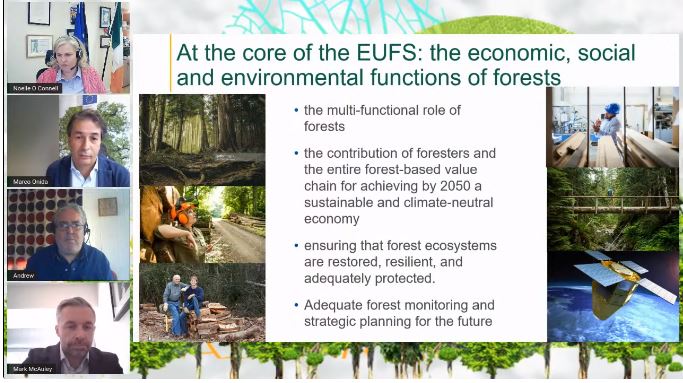
The event was very illustrative, as it focused on the goals and benefits of the New EU Forest Strategy, also acknowledging the issues and shortcomings of the Strategy.
About the EU Forest Strategy:
- It aims at improving the quality and quantity of EU forests.
- It aims at strengthening forest protection, restoration and resilience
- It recognizes the value that forests have on society, economy and environment
- It values the need for greater reforestation, and the benefits that it would bring
We also learned some interesting facts:
 Irish forests absorb 10% of all of EU’s Co2 emissions
  Using forests as carbon sinks requires substantial investments and effortsForests in Ireland provide 12.000 jobs, achieved on the base of planting productive forest
The event also called upon some of the current issue related to the Strategy: EU forest observation is not linked to binding indicators Absence of an EU forest lawForestry remains in the remit of Member States to do as they wish

Pandora Papers: How long before we have open company registers?
By Access Info Europe
Helen Darbishire, Director of Access Info Europe, reflects on what the Pandora Papers tell us about anti-corruption and integrity instruments in Europe, and calls on the European Commission to move urgently on opening up company registers. Helen is a member of the Steering Committee of the Open Government Partnership, and is Chair of the UNCAC Coalition, a global civil society network working to combat corruption.
Madrid, 4 October 2021 – The Pandora Papers leak reveals, once again, that the mega rich are using legal loopholes to avoid taxes and the corrupt are transferring money out of poorer countries into more developed ones without proper controls.
Much of this is preventable: we know what needs to be done to track illicit financial flows, to recover stolen assets, and to ensure that everyone pays their fair share of tax. One such instrument is open company registers.
Everyone agrees on the value of company registration and beneficial ownership data being open. It’s been promised by governments in the G8 Action Plan to Prevent Misuse of Companies (2013) and the London Anti-Corruption Summit (2016). It’s in the Open Government Partnership Paris Declaration (2016), and was echoed in the Political Declaration of the UN General Assembly Special Session on Corruption in June 2021.
The 27 Member States of the European Union have agreed and, along with the European Parliament, they adopted the Open Data Directive (2019), which says that company data is a “high-value dataset” and should be published as open data, free of charge, for all to use.
Yet, as this scandal reveals, European governments have failed to act.
Rather than having in place the essential tool of open company registers, we learn the truth about the use of shell companies to launder money through offshore tax havens only thanks to the bravery of whistleblowers and the heroic work of investigative journalists who have trawled through 12 million documents.
We learn – too late – where the money has gone. We already know, only too well, the impact it has on national economies, with tax evasion, fraud, and corruption resulting in less money for public services, health, education, or addressing climate change.
The UN Convention against Corruption and other anti-corruption treaties are replete with measures that could help us to prevent this.
With open company data there can be constant vigilance of company structures, rapidly revealing the kinds of shell company structures that the Pandora Papers have exposed.
Open data permits anti-corruption watchdogs and investigative journalists to spot earlier what is going wrong, what national anti-fraud agencies might have missed, to see the transnational patterns, and to raise the alert.
As the pandemic has reminded us, it’s better to have the vaccine than to treat the sick patient. Right now, we have the vaccines, but we are not using them.
We have opened Pandora’s box and inside we see clearly the ills of our global financial system.
So why not act? Why the hesitancy? Why are company registers still not open?
False Economies
The EU’s Open Data Directive, which promises us open company registers, should have been brought into law in Member States by July 2021, and many have transposed it, but they are waiting for the Implementing Act from the European Commission.
The European Commission has been dragging its heels, most likely under pressure from a handful of countries such as Germany, Italy, and the Netherlands, concerned about the revenue losses from selling company data. In addition, some countries have raised concerns about the costs of transforming registers into open formats.
Some say it’s about data protection, but this is not true: anyone with the money can buy a company register. Access Info’s research from 2016 found that a full register can be obtained for prices ranging from €75,000 in the Netherlands to € 286,000 in Estonia. As the Pandora Papers show us, those who wish to protect their “personal data” are often very high-profile public figures who have something to hide.
There are indeed costs to cleaning up and opening datasets, but in the balance also are massive savings, which are identified in an Impact Assessment carried out for the Commission in August 2020 by private consultancy firms, with quantifiable economic benefits of fully open company data including:
» Business opportunities worth thousands of millions of euros (in the UK alone estimated value €780 million);
» Significantly reduced costs for Europe’s 24 million SMEs both in reporting and in checking ownership of other companies;
» Easier to discover and deter money laundering, which, according to Europol, costs the EU almost €200 billion per year;
» Decrease of corruption in public procurement, which costs the EU around €5 billion per year.
The evidence is overwhelming – from the Commission’s own data, from the Pandora Papers – if we care about collecting the taxes to pay for public services, if we care about the Sustainable Development Goals, if we care about a just climate transition, we need open data for integrity, open data for democracy.
Access Info today repeats its call on the European Union and the Member States to act now to make it mandatory under the Open Data Directive to open company registers.
Just two weeks ago, on 20 September 2021, I wrote to European Commissioners Thierry Breton and Vera Jourová asking for progress on the decision making on opening company registers. I wrote on behalf of a coalition of organisations that includes One, the Open Contracting Partnership, the Open State Foundation, Open Corporates, Open Ownership, the Organized Crime and Corruption Reporting Project, The B Team, and Transparency International EU. We are waiting for an answer.
For more information, please contact:
Helen Darbishire | Executive Director | Access Info Europe
Tel: + 34 667 685 319
International Conference: Policy Coherence for Sustainable Development and the European Green Deal
How we localise the global decade of action to deliver on the SDGs
By Povod Institute
| Policy Coherence for Sustainable Development and the European Green DealHow we localise the global decade of action to deliver on the SDGsINTERNATIONAL CONFERENCE Ljubljana, Slovenia, Hotel Slon Friday, October 8th, 2021 at 10:00 AM |
| REGISTER HERE |
| Topics: Agenda 2030 & the SDGs Policy Coherence for Sustainable Development (PCSD) European Green Deal Moderators: Robert Križanič, Director, Institute Povod – Seku Conde, Journalist, Slovenian National TV presenter for foreign politics on the show »Globus« AGENDA: 10:00 Welcome: Robert Križanič, Director, Institute Povod 10:10 Opening Session: Aleška Simkić, European Commission: Head of Cabinet of Commissioner for Crisis Management Janez Lenarčič Denis Schrey, Network Coordinator, European Network of Political Foundations (ENoP) & Programme Director 10:30 Panel 1: Political discussion: Linking Recovery & Resilience, the SDGs & Policy Coherence for Sustainable Development Panelists: European Commission, Commissioner Cabinet, INTPA or Agriculture, TBC Barry Andrews, Renew, MEP, Chair, SDG Alliance in the European Parliament Ernesto Soria Morales, Snr. Policy Analyst, OECD Policy Coherence for Sustainable Development (PCSD) Unit Rilli Lappalainen, President of CONCORD, European Confederation of Relief and Development NGOs dr. Milan Brglez, S&D, Member of the European Parliament from Slovenia Ljudmila Novak, EPP, Member of the European Parliament from Slovenia Špela Rotar, SVRK, Agenda 2030 Working Party for Slovenia, Government Office for Development and European Cohesion Policy 12:15 Coffee break & snacks 12:30 Panel 2: The European Green Deal: Local Action & Implementation: Best Practices & Challenges for Integrating the EU Green Deal, PCSD & the SDGs Panelists: EU Green Deal Commissioner Cabinet (TBC) Grace O’Sullivan, Greens-EFA, MEP, Parliamentary Special Rapporteur on the 8th Environment Action Plan, member of PECH Fisheries Committee & ENVI, the Committee on Environment, Public Health & Food Safety Uroš Brežan, European Committee of the Regions & Mayor of the town of Tolmin, EU Green Deal: Local Action & Implementation Sarah Franklyn, SDG Watch Europe Steering Group, Coordinator, Policy & Advocacy Work Strand, Associate Institute for European Environmental Policy (IEEP) Jana Lampe, Caritas Slovenia, Head of international development and humanitarian aid at Caritas Slovenia Eyachew Tefera, Institute for African Studies, director 14:00 Networking & Reception For additional information: povod@povod.si This will be a hybrid event. Zoom for participants: https://us02web.zoom.us/j/88389648243 The event will be live-streamed through the Facebook page of the Institute Povod: https://www.facebook.com/Povod-249963391841863 |