Free Meals on Wheels by Ecological Movement of Thessaloniki

By Ecological Movement of Thessaloniki

The Ecological Movement of Thessaloniki was founded in 1982 and is the oldest living ecological organization in Greece. Its ideological orientations are identified with the four ideological pillars of the international ecological movement: environmental protection, peace and non-violence, direct democracy, human rights and social solidarity. Through the project Free Meals on Wheels it has promoted the environmental protection and human rights and solidarity.

For many years, the Ecological Movement of Thessaloniki has been organizing weekly social meals, but this is the first time that this action is directly linked to the ecological approach and sustainable use of food, while also enhancing cooperation between local and migrant volunteer groups and beneficiaries or other NGOs and Social Organizations.

The project Free Meals on Wheels, through the campaign Making Europe Sustainable for All, promotes recycling and transportation in a healthy, economical and environmentally responsible way.

The volunteers use bicycles to collect food weekly (mainly fruits and vegetables) that would be thrown away from the local-open market. Then they select the good food and fill the basket with food for needy families and individuals. Every Tuesday, volunteers cook and offer vegetarian meals to people who cannot cook and they distribute, again with bicycles, cooked meals that are prepared. Weekly meals aim to make sure that no meal is lost and to learn more about Non-Sustainable Food Production and Consumption.

All actions will have a direct impact on many Sustainable Development Goals and the 2030 Agenda, in particular good food for all, sustainable consumption and production, combating inequality, aiming at zero hunger, sustainable cities and communities.       

Each action is combined with an educational approach to raise awareness and to stimulate about the importance of a transition to a better lifestyle for all.

During the project, three workshops will be organized for locals and immigrants on recycling, food and waste management and sustainable development and consumption.

For more information you can visit: https://freemealsonwheels.net and https://www.facebook.com/freemealsonwheels/

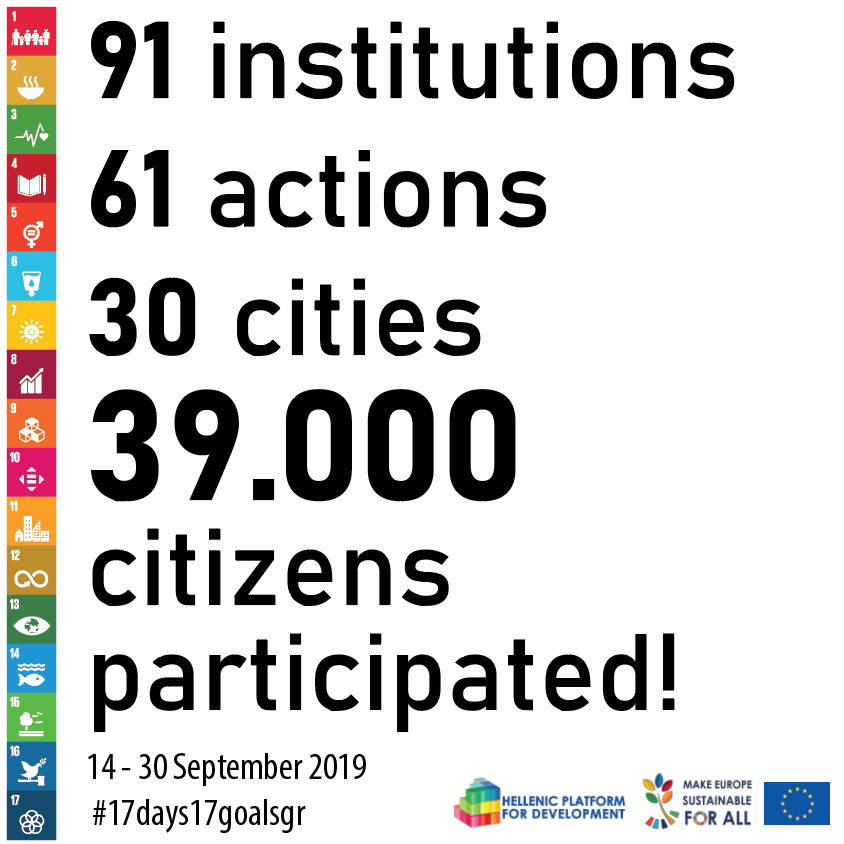
17 Days 17 Sustainable Development Goals: 91 Institutions – 61 Actions – 30 Cities

By Vanessa Agapie, Hellenic Platform for Development

From 14 to 30 September 2019, the Hellenic Platform for Development coordinated for the 2nd year the largest raising awareness campaign in Greece and Cyprus for the Global Goals.

During the 17 days, 91 institutions, civil society organizations, schools, universities, municipalities, initiatives and structures implemented 61 actions, including festivals, children’s workshops, public events, informative workshops, discussions, exhibitions and services centers in 30 cities and villages of Greece and Cyprus. More than 1.7 million citizens were informed about the Global Goals by social media, while more than 39 thousand citizens participated in the actions and have learned solutions that can bring us closer to a sustainable, inclusive, fair and green future for all.

At the same time, in collaboration with the University of the Aegean, a survey was launched across the country to record measurable results for citizens’ perceptions of the Global Goals and the actions required to implement them nationally. It will remain open until the end of November.

The campaign #17days17goalsgr of the Hellenic Development Platform, within the framework of the project “Make Europe Sustainable for All” was also the largest part of actions in Greece in the context of the global campaigns #StandTogetherNow and #Act4SDGs culminating on 25 September on the occasion of the 4th anniversary of the adoption of the Sustainable Development Goals (SDGs).

You can see some of our best moments in this photo album.

Partners at #17days17goalsgr 2019:

350 scouting systems, Academy of Entrepreneurship, Agrooikopolis, Art Thread, Ath Checkpoint – Positive Voice Prevention and Examination Center, Caritas Greece, Children’s Art Gallery of Greece, Connect Your City, dot2dot, Down Syndrome Association of Greece, Ecological Movement of Thessaloniki, ethelon, Fabric Republic, Fashion Revolution Greece, Greek Scouts, Hellenic Platform for Development, IASIS, Institute for Environmental Research and Sustainable Development, KINITRO, KMOP-Center for Social Action and Innovation, Kouklopaizoume, Labyrinth of Senses, Let’s do it Greece, National Observatory of Athens, Naturefriends, Olive Tree Routes, Orange Grove, Organization Earth, PALMI, Permaculture.School, Pharmacists of the World, Positive voice, PRAKSIS, PRAKSIS Homeless Daily Reception Center, PRAKSIS Mobile Medical Unit, Prasin Aloga, PRAXIS, Pressenza International Press Agency, Red Umbrella Ath – Sex Voice Support and Empowerment Center, Rural Cooperative of Kalamata, SCI Hellas, Serres for UNESCO, Service Design Network Greece, SOFFA, The Children of Spring, tree-challenge, UNESCO Youth Club of Thessaloniki, World Without Wars and Violence, Zero Waste Athens, Municipality of Agios Dimitrios, University of the Aegean

Festivals:

1st Zero Waste Music Festival, Connected We Stand, Greenwave festival, the Yellow Days

Schools:

1st Kindergarten of Parga, 2nd Primary School of Grevena, 2nd Primary School of Orchomenos, 2nd Primary School of Skala Oropos, 2nd Primary School of Igoumenitsa, 2nd Experimental Primary School of Ioannina, 3rd Primary School of Limassol Cyprus, 4th Primary School of Petersburg, 5th Kindergarten of Naxos Chora, 7th Kindergarten of Ioannina, 9th General High School of Ioannina Kardamitsia, 10th Elementary School of Aigaleo, 21st Primary School of Ioannina, Eleousa General High School “Konstantinos Asopios”, General Church High School of Vellas, High School of Eleousa, High school of Parakalamou, Elementary School of Giannitsochori Ilia, Primary School of Eleousa Arta, Primary School of Stavraki Ioannina, Primary School of Kofinos Cyprus, Elementary School of Mileas Metsovo, Primary School of Parakalamou, Special Vocational High School and High School of Ioannina, Nursery School of Damarion Naxos, Kindergarten of Katakolo, Kindergarten of Klimatia Ioannina, Kindergarten Paralimni Serres, Preschool of Havari Amaliada, Second Chance School of Ioannina.

Cities:

Agios Dimitrios, Athens, Aigaleo, Amaliada, Chios, Eleousa, Giannitsochori, Grevena, Igoumenitsa, Ioannina, Kalamata, Katakolo, Kofinou (Cyprus), Lesvos, Limassol (Cyprus), Limnos, Metsovo, Naxos, Orchomenos, Oropos, Parakalamos, Parga, Petroupoli, Rhodes, Samos, Serres, Syros, Thessaloniki, Vella, Veria

The Hellenic Platform for Development coordinates Greek Non-governmental Organizations in the fields of international development cooperation, humanitarian aid and development education. It currently represents different NGOs supported by a large segment of the Greek society with a significant activity nationwide and in many developing countries.
Saturdays For Future

By the Italian Alliance for Sustainable Development (ASviS)

The Italian Alliance for Sustainable Development (ASviS) invites everyone to take part in the Saturdays For Future, a national day of mobilization on the themes of responsible production and consumption. The initiative, first launched on 5 June by Enrico Giovannini (ASviS) and Leonardo Becchetti (NeXt), aims to mobilize consumers, businesses and civil society organizations to change production methods and purchasing habits in favour of sustainable development.

Inspired by the global mobilization of Fridays for Future, the initiative takes place on Saturdays, which is the day during which most people do their weekly shopping, with the objective to engage the largest possible audience with awareness raising events throughout the country and on social and traditional media. 

The first step of this process, on 28 September 2019, the day after the global week of action for climate and the United Nations General Assembly, will mark the beginning of a shared path towards a greater awareness of sustainable production and consumption.

Consumers, businesses and civil society organizations will be engaged in initiatives that aim to change the production methods and the shopping habits in favour of sustainable development. The initiative will contribute to achieving the Goals of the 2030 Agenda for sustainable development, and in particular:

  • SDG 12, “Responsible Consumption and Production”, whose target 12.8 states: “By 2030, ensure that people everywhere have the relevant information and awareness for sustainable development and lifestyles in harmony with nature”
  • SDG 13, “Climate Action”, whose target 13.3 states “Improve education, awareness-raising and human and institutional capacity on climate change mitigation, adaptation, impact reduction and early warning”
  • SDG 4, “Quality Education”, whose target 4.7 states “By 2030, ensure that all students acquire the knowledge and skills needed to promote sustainable development, including, among others, through education for sustainable development and sustainable lifestyles, human rights, gender equality, promotion of a culture of peace and non-violence, global citizenship and appreciation of cultural diversity and of culture’s contribution to sustainable development”.

The tools of the mobilization

There are many ways to engage and contribute to Saturdays for Future:

  • participation in the online poll to suggest the responsible production and consumption priorities that require more effort by all;
  • sharing good practices of responsible production and consumption (as of 28 September);
  • organization of events or specific initiatives, taking place as of 20 September, dedicated to the promotion of responsible production and consumption models;
  • launch of an awareness-raising campaign on social media with the hashtag #SaturdaysforFuture and with the collaboration of media partners.

To organize the Saturdays for Future, ASviS launched the website www.saturdaysforfuture.it, that will monitor the events taking place all over Italy and will contain useful information and documents, including the link to the e-learning course on the 2030 Agenda (soon available in English) developed by ASviS, that, in the week from September 20th to 28th, will be available for free. The results and the experiences of the Saturdays for Future campaign will contribute to the creation of a shared educational kit on the themes of responsible production and consumption.

How to take part in Saturdays For Future

The initiative is based on creativity: participants can take part according to their abilities and interests. Here are some examples of initiatives:

  • Are you a consumer? Learn about the 2030 Agenda for sustainable development through ASviS’ e-learning course, take part in the online poll to indicate the priorities of responsible production and consumption that you believe require greater focus and effort, and, starting on Saturday, 28 September, shop in a more responsible manner; on social media, use the hashtag #SaturdaysforFuture.
  • Are you a consumers’ organization, a trade or labour union? Promote the 2030 Agenda for sustainable development among your members and raise awareness on the initiative or propose events on the themes of responsible production and consumption.
  • Are you a goods or services producing business, a large scale or fair-trade retailer? Make a commitment for the cultural shift towards sustainable production and consumption methods; starting from 28 September, share your story on social media using the hashtag #SaturdaysforFuture to promote your best practices.
  • Are you a school or university teacher? Promote the 2030 Agenda for sustainable development and share the message of the Saturdays for Future with your class: have your students follow ASviS’ e-learning course on the 2030 Agenda and share informative material on SDG 12.
  • Are you a journalist? Give voice to the 2030 Agenda and spread information on the theme of responsible production and consumption.

Spotlight on financial justice: understanding global inequalities to overcome financial injustice

By Citizens for Financial Justice

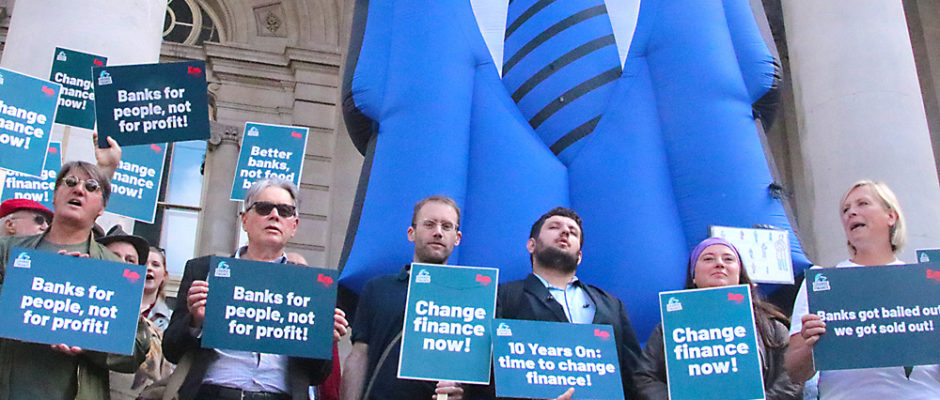
Citizens for Financial Justice new report – Spotlight on financial justice: understanding global inequalities to overcome financial injustice – is being released on Thursday, 26 September 2019, to coincide with the High Level Dialogue on Financing for Development at the UN.

The report was compiled by Citizens for Financial Justice partners and other contributors, coordinated by Flora Sonkin and Stefano Prato, Society for International Development (SID); Ida Quarteyson and Matti Kohonen, Christian Aid; and Nicola Scherer, Debt Observatory in Globalisation (ODG).

Authors and contributors have come from the following organisations: Christian Aid; Counter Balance; Debt Observatory in Globalisation (ODG); DemNet; FIAN International; Financial Justice Ireland; Globalinfo; KULU – Women and Development; Polska Zielona Siec /Polish Green Network; Recommon; Sempreviva Organização Feminista (SOF); Society for International Development (SID). Special thanks to Karen Judd for copyediting.

Rising inequalities between the global North and South, the economically privileged and the marginalized, between different genders and racial identities, have been historically reproduced and intensified across generations, and are defining features of our times. For instance, while global challenges such as climate change and environmental degradation undoubtedly affect all of us as humans living on Earth, they certainly do not affect us all equally. Differences in geographic location, economic status, gender, age, all come into play if we look at the groups who are systematically suffering from climate change’s harsh consequences.

This is because the current rules of our global economy reproduce a vicious circle of inequality: growing economic inequality and wealth concentration increase political inequality by expanding the ability of corporate and financial elites to influence policy-making and protect their wealth and privileges. Higher levels of inequalities are then passed on to the next generations, culminating in long-term disparities and unfairness felt by marginalized groups.

Especially since the 2008 global financial crisis hit, the governance structures and economic (de)regulations that got us there, especially the unchecked expansion of the financial sector over the rest of the economy or ‘financialization’, finally raised enough red flags. While major banks were bailed out by taxpayer’s money, states neglected their basic human rights obligations by turning to austerity measures, creating pervasive impacts on people’s lives around the globe. Consequences include reducing communities’ access to common natural resources and restricting the delivery of basic public services such as healthcare and housing to the most disadvantaged groups.

In recent years, a significant increase of disparities within and between countries has finally put inequalities under the spotlight within international development debates.[4] The 2030 Agenda recognized addressing their multiple facets (economic, political, social) as one of its Sustainable Development Goals (SDGs), signalling the international community’s commitment to reducing inequalities.

To take advantage of this momentum, understanding the main contemporary drivers of inequalities and finding common strategies to address them are necessary steps towards systemic socio-economic transformation and social justice. Looking at our current challenges through the lens of inequalities offers then a remarkable transformational potential: tackling inequalities in their multidimensional character – social, political, economic, spatial and intergenerational – can become a sort of guiding star in a complex world, an overarching goal to advance sustainable development and address the root causes of marginalization. As part of this effort, this report tackles the inequalities question by looking at one of its main current drivers, the financialization of our global economy, as well as at its counterpart, financial justice.

Through five thematic chapters –

  1. Food and land
  2. Health
  3. Women’s rights
  4. Housing
  5. Infrastructure

– the report shows that rising inequalities, and the overexpansion of the finance industry as one of its key contemporary drivers, have been created and reproduced by skewed and unfair rules of the game. There is therefore an urgent need for peoples’ movements to converge around a common agenda for taking back our economies, reclaiming public services, and protecting our common natural resources. Through this report it becomes evident that local level resistance to financial actors’ penetration is extremely important, but that confronting the drivers of inequality which are now global, such as financialization, requires concerted efforts at higher levels of policy-making as well.

Four main pillars for action are proposed:

Promote shared understanding and ongoing questioning of the dynamics of financialization

It is essential to raise people’s awareness around the very real impacts of financialization on their lives and to provide fresh analytical tools to question current dynamics. Challenging the inequalities problem and how the multiplicity and expansion of financial actors and services is contributing to the problem can avoid unintended complicity, particularly given the insidious and overly covert manner in which these dynamics infiltrate multiple domains of life;

Resist ongoing attempts to shift decision-making away from legitimate and democratic policy spaces, often in the name of ‘financing opportunities’ to advance progress

At the local and national levels, supporting social movements’ resistance to harmful projects, policies and other interventions backed by global financial actors can create tangible wins and can put a face and shape onto a struggle that can so often feel immaterial and hard to grasp;

Reaffirm national sovereignty to re-establish healthy boundaries to financial liberalization and provide critical financing to achieve the Sustainable Development Goals (SDGs)

The latest global financial crisis has critically exposed the vulnerabilities of a liberalized, privately focused financial system. However, many underlying structural conditions that led to the crisis have been only mildly addressed, if at all. It is therefore essential to re-establish national sovereignty to help prevent the next crisis while providing critical financing for sustainable development. This calls for exploring the potential of national development banks, restoring the management of capital accounts within the standard policy toolkits of governments, and, introduce a system of financial transaction taxes, among other measures;

Democratize global economic governance

At the global level, social justice and rights-based narratives should be at the heart of the process of reshaping powerful global institutions and reforming global economic governance. Different sectoral struggles should unite under a common agenda, advocating for the reform of existing institutions and the establishment of new ones which are able to regulate the new and fast evolving financial actors, and can bring finance back into democratic accountability and control. This calls not only for building convergence on existing proposals regarding critical new pillars of a democratized economic governance ecosystem, such as an intergovernmental tax body and sovereign debt workout institution under the aegis of the United Nations, but also for addressing the institutional vacuum in regulating financial actors, mostly though not exclusively the asset management industry. Such measures could translate in enhanced transparency, participation, and public oversight of domestic and global tax, fiscal and financial policy-making.

The time is ripe for acknowledging people’s struggles to resist the multiple facets of the process of financializaton, and for converging strategies to address multiple dimensions of inequality to reach financial justice. The time for financial justice activism is now!

A WEEK IN WHICH THE WORLD WARMED TO CHANGE

By Khaled Diab, EEB

Since last Friday, millions of protesters around the world have taken to the streets and even infiltrated the corridors of power for a week of sustained protest to demand climate action and sustainability now.

Friday 20 September 2019 kicked off the week-long Global Climate Strike or Global Week for the Future, which is spearheaded by the Fridays for Future movement, and the Global Week of Action for Sustainable Development which runs under the slogan #StandTogetherNow.

Millions were mobilised worldwide on Friday, with reports suggesting that it was the largest climate protest in history. Protests took place in an estimated 185 countries, with the largest number of protesters reported in Germany, where 1.4 million people joined marches in different parts of the country.

But protests were not just confined to streets and squares. A number of child and youth activists were invited inside the UN’s halls, including Greta Thunberg, the 16-year-old Swede who spearheads the global Fridays for Future movement, which started just a year ago as a one-girl protest outside the Swedish parliament.

“People are suffering; people are dying; entire ecosystems are collapsing. We are in the beginning of a mass extinction and all you can talk about is money and fairy tales of eternal economic growth,” Thunberg told governments at the climate summit. “The eyes of all future generations are upon you. And if you choose to fail us, I say we will never forgive you. We will not let you get away with this. Right here, right now is where we draw the line.”

Words speak as loud as actions

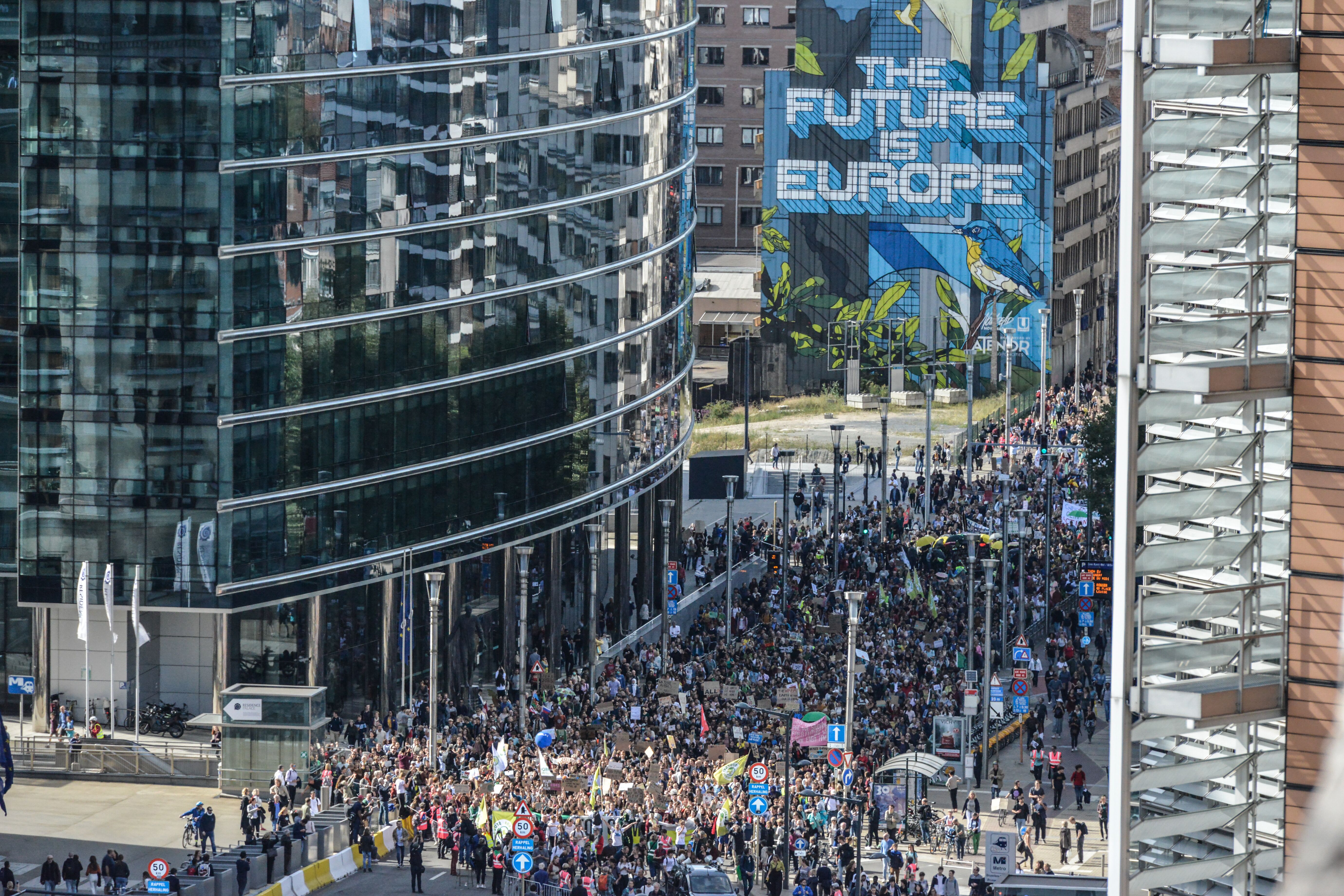
In Brussels, which has been the scene of sustained protest for months with the largest climate demonstration drawing 70,000 in January, an estimated 15,000 people marched through the Belgian and EU capital.

The Brussels march was spearheaded by the Belgian chapter of Fridays for Future, with the EEB as a co-organiser on behalf of SDG Watch Europe.

“We need to put pressure on our politicians to do something about the climate crisis,” Anuna De Wever, the Belgian youth climate activist, told Meta. “They need to show ambition and they need to show courage. We need system change.”

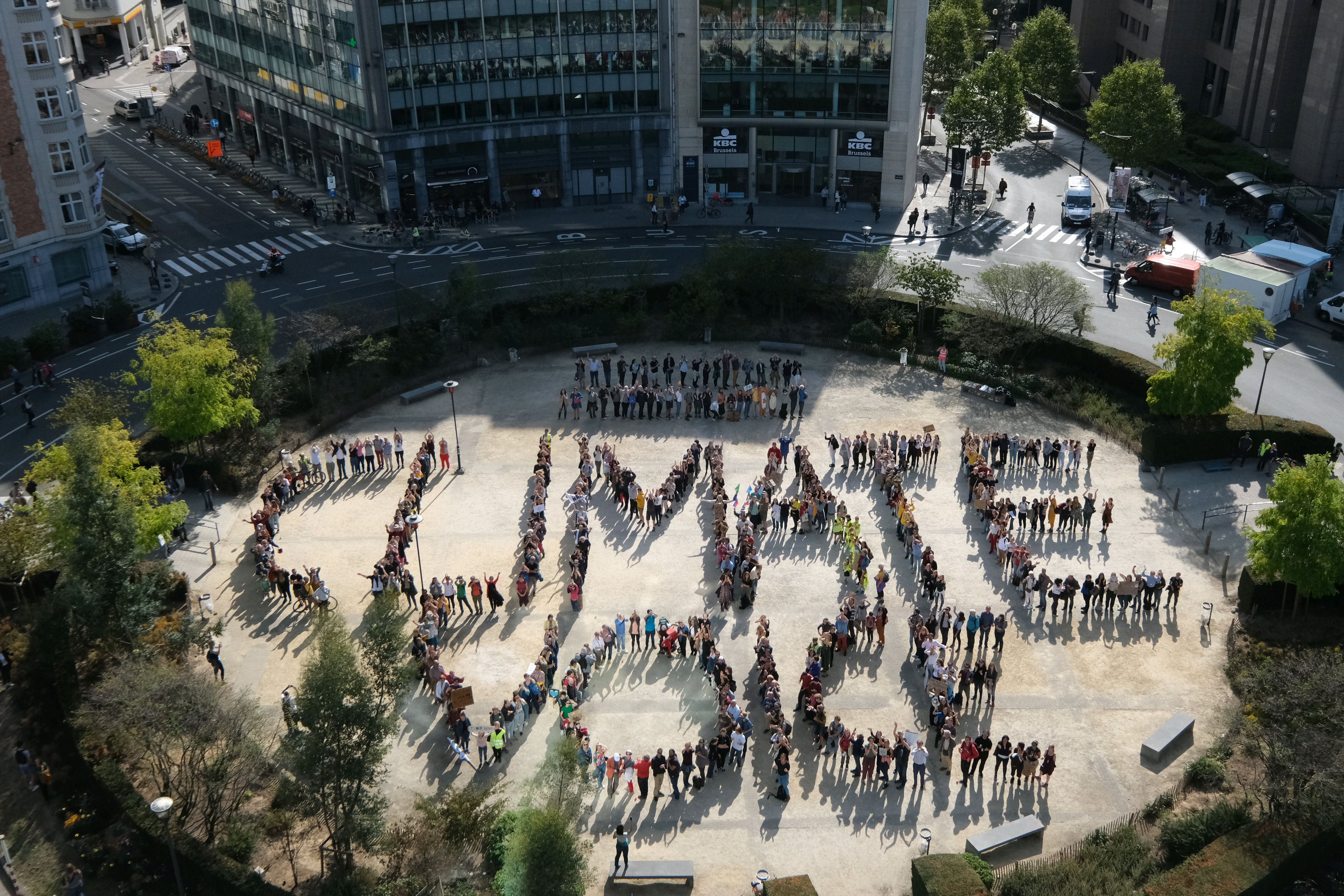
The march ended up on Schuman Square, at the very heart of the European quarter, to send a clear message to EU leaders. There, SDG Watch Europe rallied hundreds of protesters to form three words: ‘climate’, ‘equality’ and ‘voice’.

The word ‘climate’ was chosen for obvious reasons. We are in the midst of a climate emergency, and failure to act now is likely to spell catastrophe for humanity and the natural world.

The word ‘voice’ signifies that everyone has the right to speak their mind and to speak up for their rights, no matter their background or circumstances, and opposes attempts to silence people, especially the vulnerable and marginalised.

The word ‘equality’ was selected to highlight how alarmingly inequalities have widened in Europe and around the world and to demand action to create a world of greater equality and justice.

These three words were selected to represent some of the key demands of the #StandTogetherNow campaign, which seeks to draw attention to the UN’s Sustainable Development Goals (SDGs).

“This week, all around the globe people are taking action with a clear call to policymakers: we want to see more ambition in order to achieve the SDGs by 2030,” says the EEB’s Director of Global Policies and Sustainability Patrizia Heidegger. “Four years of inaction have passed: 2020 to 2030 must now be the decade of action in which we change course and lead humanity on the path of sustainability.”

Wanted: Sustainability Heroes

The action week coincided with the fourth anniversary of the Sustainable Development Goals, a set of 17 ambitious targets agreed by the international community which seek, among other things, to eradicate poverty, narrow inequalities, tackle global warming, protect nature and ensure that humanity lives within the boundaries of the planet.

To mark the fourth anniversary, an SDG Summit was hosted by the United Nations in New York. “Half the wealth around the world is held by people who could fit around a conference table, and, at the current pace, almost 500 million people could remain in extreme poverty by 2030,” noted UN Secretary-General António Guterres. “We must step up our efforts. Now.”

Despite progress in some areas, Europe, like most of the world, is way behind on its implementation of the SDGs, both at home and abroad, as reflected in the widening inequalities within Europe and in how the EU exports misery to other parts of the world.

To convince policymakers and politicians of the importance of championing not only the climate crisis but also of pursuing the holistic approach to the environmental, economic and social challenges facing us represented by the SDGs, the EEB and its Make Europe Sustainable for All (MESA) partners organised events and actions across the EU.

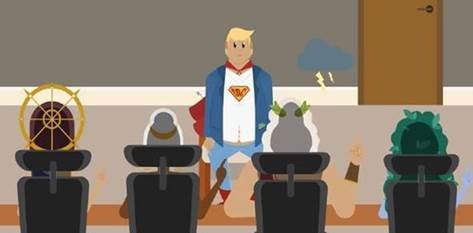
On behalf of SDG Watch Europe, the EEB sent out a job ad for ‘Sustainability Heroes’ to members of the European Parliament. The EEB also took to filmmaking. In a light-hearted animated film produced on behalf of SDG Watch Europe, a selection panel inspired by the pantheon of ancient gods interview prospective MEPs for the role of Sustainability Heroes. Watch the video here.

Standing together for a climate of sustainability

By Khaled Diab, EEB

As part of the global climate strike on Friday 20 September, hundreds of protesters in the EU district in Brussels stood together to form the words ‘climate’, ‘equality’ and ‘voice’ to send a symbolic message to European Union leaders.

At the culmination of the march in the Belgian and EU capital, at Schuman Square, outside the EU Council and the European Commission, volunteers came together to from three words, ‘climate’, ‘equality’ and ‘voice’ (a high-resolution photos are available here – credit: Sonia Goicoechea, EEB).

These three words were selected to represent the key demands of the #StandTogetherNow campaign, which is being co-organised by SDG Watch Europe to draw attention to the UN’s Sustainable Development Goals (SDGs).

The word ‘climate’ was chosen to highlight the need for climate and environmental justice. We are in the midst of a climate emergency, and failure to act now is likely to spell catastrophe for humanity and the natural world.

The word ‘voice’ signifies that everyone, especially the vulnerable and marginalised, has the right to speak their mind and to speak up for their rights, no matter their background or circumstances and to highlight shrinking civic space.

The ‘equality’ symbol was selected to highlight how alarmingly inequalities have widened in Europe and around the world and to demand action to create a world of greater equality and justice.

“Today we sent a strong signal to the new political leadership of the EU. Young and old, individuals and whole organisations marched hand in hand towards the European Commission building with our message: we need politics for people and planet,” said EEB’s Director of Global Policies and Sustainability Patrizia Heidegger, who is also a member of the SDG Watch Europe steering group. “We need more ambition. We need political leaders to now deliver concrete steps for a healthy climate, thriving nature, and happy people.”

The European Environmental Bureau (EEB), as lead partner of the Make Europe Sustainable for All (MESA) project and a member of SDG Watch Europe, as well as Global Call to Action Against Poverty (GCAP), teamed up with the Fridays for Future movement to co-organise the ‘Global Strike for Future Belgium III’ in Brussels as part of the Global Week of Action (20-27 September).

SDG Watch Europe Open Letter : Urgent Need and Opportunity for New Commission to put Sustainable Development Goals Centre-Stage By the Steering Group of the SDG Watch Europe

Dear Commission President-elect,
Dear Commissioners designate,

Today, four years ago, on 25 September 2015, the United Nations member states adopted the 2030 Agenda and the Sustainable Development Goals (SDGs), an urgent call to action to take bold and transformative steps to shift the world onto a sustainable and resilient path.

Four years after this path-breaking agreement, SDG Watch Europe wishes to share with you the serious concern that the EU and its Member States still show very little sense of urgency or ambition about the actual implementation of the 2030 Agenda and the transition to sustainability. While millions have marched the streets around the world last Friday calling for ambitious action to protect our planet and life-support system, the EU does not yet even have a strategy of how to implement the SDGs.

As you take up your new responsibility, the EU has a long way to go to provide a healthy, prosperous life for its people within planetary boundaries. We are in urgent need of solutions to the climate crisis, the rapid loss of biodiversity and the destruction of precious eco-systems. Next to these key challenges, SDG Watch Europe’s recent reports have shown that the EU is likely to fail on SDG 10 on reducing inequalities within and beyond the EU and that some the negative external effects of unsustainable European policies can have negative external effects all over the world, making it difficult for other countries to achieve the SDGs themselves.

We therefore welcome that your Political Guidelines “A Union That Strives for More” clearly mention our common aspiration to live on a natural and healthy planet in which all human beings can enfold their full potential. They also make a strong point on the need for the EU’s leadership role in achieving these aims. We celebrate that several elements in your Political Guidelines hold the promise that this new Commission will be able to deliver on sustainable development. We urge you to take this commitment seriously in particular in your proposal for a Green Deal including a Just Transition to leave no one behind. We welcome your promise of putting in place, amongst others, a sustainable food policy along the whole value chain, a new biodiversity strategy and a zero-pollution circular economy. We equally welcome your promise to ensure an economy that works for people including minimum wages for everyone, better measures for work-life balance, policies that work for children and young people, and to combat poverty in the EU. We will hold you accountable on these promises and expect them to be delivered.

However, what we miss – and this can still be changed given the promising elements mentioned above – is the need to fully align your Political Guidelines with the 2030 Agenda and to frame your proposals, including the Green Deal, along the SDGs and wider sustainable development principles.

Your decision that all Commissioners are responsible for the implementation of the SDGs in their respective area and that the College is taking up responsibility of the 2030 Agenda as a whole is a good step towards putting in place the right governance structures. However, shared responsibility must also mean more action on the SDGs in each respective field. We also take into consideration your commitment to turn the European Semester in an instrument that fully integrates and serves the UN Sustainable Development Goals.

While European civil society will provide more detailed input for your Political Guidelines and the Green Deal in the next weeks and months, we would like to reiterate the following essential points:

• The implementation of the 2030 Agenda and the monitoring and reporting on its progress, should not solely be the responsibility of the Member States but a priority for the EU itself. Many policy areas critical to sustainable development, such as agriculture, trade, employment, consumer policy and the EU budget, fall within the (shared) competences of the EU. Adapting European internal and external policies alike towards sustainability and policy coherence is key for the success of the 2030 Agenda. Until today, we lacked the political will and the right governance structures at EU level that would allow for policy coherence for sustainable development.

• We therefore urge you to develop a governance framework that is suitable for realizing the necessary reforms for sustainable development. A fundamentally reformed European Semester as part of a new EU governance cycle to coordinate sustainable development efforts in Europe is essential, in line with subsidiarity. Political efforts must be supported by a sustainability-proofed Multiannual Financial Framework post 2020, which serves as an effective driver in the transition to sustainability. These reforms must be complemented by other effective mechanisms for Policy Coherence for Sustainable Development to ensure coherence between internal and external EU policies and efficiently advanced by the new institutional structure and political priorities set by your Commission and the newly elected European Parliament.

• We have urged the last Commission for several years to produce an overarching Sustainable Development Strategy and a comprehensive Implementation Plan.
Such a strategy has also been called for by the Multi-stakeholder Platform on the SDGs in October 2018, the European Parliament in June 2017 and the Council in June 2017 and October 2018. We call on you to ensure that this Commission will rapidly put forward an overarching Sustainable Europe 2030 Strategy to guide all European policies and programmes, including all relevant stakeholders.

• We also urgently call on the EU to set up a transparent and participatory monitoring and reporting system for its 2030 Agenda implementation, in both its internal and external policies, that allows for an honest stock-taking concerning all SDGs and targets and addressing their comprehensive, transformative and universal nature.
We renew our promise to support and help to this new Commission in establishing sustainability policies and practices across the EU and its Member States and speeding up the pace of implementation. We are willing to constructively and meaningfully participate in the policy processes, monitoring and implementation. With more than 100 organisations in our cross-sectoral coalition across the EU, we represent a large number of European citizens calling for change in Europe: for a future that is positive and sustainable for all and viable for the planet.

Yours Sincerely,

The SDG Watch Europe Steering Group:
Marie-Luise Abshagen; Barbara Caracciolo; Deirdre De Burca; Patrizia Heidegger; Constantinos Machairas; Ingeborg Niestroy; Leida Rijnhout; Ingo Ritz; Fanny Voitzwinkler