European campaign to make the future EU budget sustainability proof

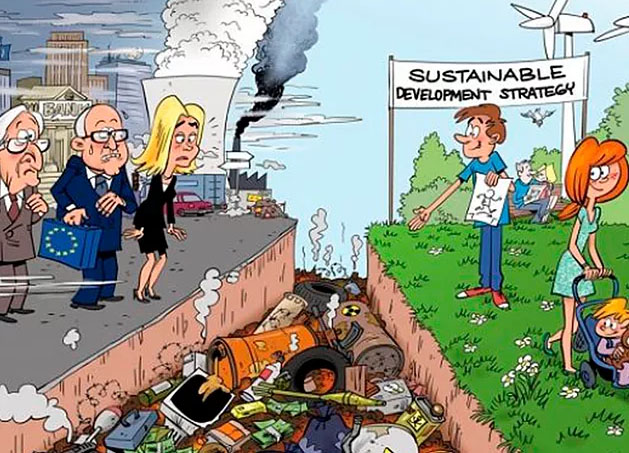
Investing in fossil fuel infrastructure and fighting climate change at the same time is not an efficient way of using EU tax money. Exacerbating social inequalities through the provision of roughly 80% of the agricultural subsidies to about 20% of the farmers, and then promoting social inclusion in rural areas through rural development funding is another prime example of taxes from European citizens supporting short viewed and contradictory policies.

In 2015 the EU adopted the 2030 Agenda for Sustainable Development, which should provide a coherent framework to tackle those incoherencies. Therefore, SDG Watch Europe calls for sustainability proofing the future EU budget in its People’s Budget campaign based on an indivisible set of sustainability principles.

Further inconsistencies range from disregarding health impacts of tobacco and red meat production subsidies to forgetting the social inclusion aspects of energy efficiency investments. Also the narrow focus on measuring added value in the EU through generating economic growth is flawed and disregards the Treaty objective about sustainable development in three dimensions. We want to see new and fresh approaches in defining the EU’s added value, where all dimensions of sustainability are taken into account. We want to see a future budget that measures performance against progress towards sustainability and incentivises the implementation of the SDGs by Member States.

We call for European and national decision makers to involve civil society on the basis of the partnership principle into the full negotiation process and implementation, in order to improve the transparency of the EU budget. We call for increased accountability of the beneficiaries, for instance through innovative digital solutions accessible to each European citizen. Of course there are many other possible solutions to mainstream sustainability and the SDGs into EU spending and lending, and SDG Watch Europe is elaborating suggestions on how to best use them.

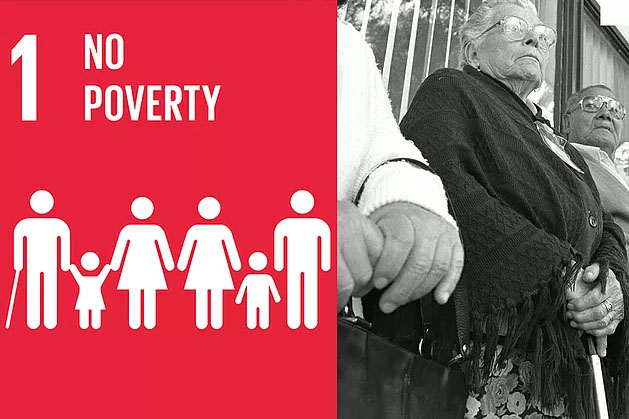
Implementing SDG 1 requires tackling the growing old-age poverty

By Luise Steinwachs, Brot für die Welt and Ragnar Hoenig, AWO Bundesverband

The first of the 17 Sustainable Development Goals demands UN member states to end poverty in all dimensions and everywhere. (1) Furthermore, social human rights guarantee a humane standard of living and reliable social security. However, a growing part of the elder population is structurally disadvantaged and permanently excluded from society. This trend is observed globally. A considerable factor is precarious or informal employment – in particular of women – and weak public social security systems that often fail at providing provisions for the elderly. Life expectancy of women is significantly higher than of men – globally up to 11 years. Demographic factors show a growing life expectancy as well as a growing world population. Therefore, the group of persons older than 60 years will grow on a global scale. (2)

Globally, 80 % of humans live without protection in difficult situations such as sickness, accident or catastrophe. Provision for one’s old age or retirement can only be accomplished by investing a fair share of  income in retirement, health or nursing insurances. When existing, these social security schemes are depending on formal employment. Women are significantly less formally employed than men (3), a circumstance that results in a larger proportion of women being poor at older age. Besides, social security systems linked to formal employment do not work in many societies and a vast majority in the Global South is informally or self-employed. Therefore, more than 100 countries have introduced tax-funded social pensions that are not depending on previous deposits. (4) Those must become a political priority

Whilst specific statements regarding old-age poverty in Germany can hardly be determined, experts claim three causes for its rise in the future: Firstly, growing gaps in career biographies caused by structural changes in the labor market. Pension payments reflect the financial compensation of a working life and are depending on the sum of retirement deposits. Women are especially affected by these gaps. Secondly, pension benefit cuts and a long term decline of pension levels contribute to an increase of old-age poverty. Pension levels declined from 53 % (of the average work-life earnings) before the 2001 pension reform to present day 48 % and is expected to fall below 42 % by 2040. Finally, both factors combine and amplify: While insured persons receive less due to reduced deposits, pension benefits decouple from pay trends. Only a preventive social policy strategy can combat those complex and interdependent factors that contribute to old-age poverty.

Regarding those developments in the employment sector with mainly informal employment across the Global South and insecure and interrupted career biographies in industrialized countries, preventive social policies and income-independent old-age provision systems (such as social pensions in poor countries) must be developed to avoid poverty in old age. Regarding pressing global aging processes, Germany’s federal government must pay more attention to age-related challenges while implementing the global 2030 Agenda, especially when developing and implementing social security systems. In development cooperation, donor countries must live up to their human rights based responsibility to secure an adequate standard of living on a global scale.

This article was published in the shadow report “Großbaustelle Nachhaltigkeit” which features comments of 42 authors from German and European civil society. The report focuses on Germany’s federal sustainability strategy released earlier in 2017, current implementation gaps and necessary strategies after the 2017 federal election.

Link to Shadow Report (English): https://www.2030spotlight.org/en

Link to original and full article (German): https://www.2030report.de/de/bericht/1400/kapitel/1-die-bedeutung-der-un-nachhaltigkeitsagenda-fuer-die-bekaempfung-von

Summary and Translation: Roman Fleißner, AWO International
Originally published in “Deutschland und die globale Nachhaltigkeitsagenda 2017 – Großbaustelle Nachhaltigkeit“

(1)    UN General Assembly (2015), p. 15

(2)    From 11% in 2010 to 28 % in 2011, compare UN-DESA (2011).

(3)  Compare to www.wiego.org/informal-economy/sttistical-picture.

(4)  Compare to ILO (2014b).

SDG-Watch Austria: A vibrant CSO platform challenging an inactive political system

Austria’s former federal president Heinz Fischer assured “Austria’s full commitment to the seventeen specific goals” (1), at a speech to the UN’s general Assembly on September the 27th in 2015. It could have been a historic moment – day 1 of an active Austrian role in the global sustainability transition.

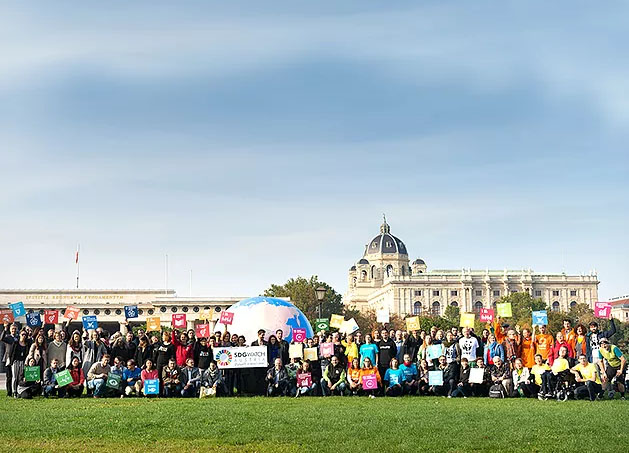
But the Austrian government has done little to walk the talk since then, and a first report to the UN’s High Level Political Forum (HLPF) is only announced for 2020. It doesn’t surprise that CSOs don’t stand aside while they see a hopeful chance for a better future pass by, but take action in their hands. Exactly two years later, on September the 27th in 2017, around 100 organisations from all parts of civil society launched SDG Watch Austria  – a broad CSO platform to stand up for an ambitious and consequent implementation. You can tell their passion for the SDGs from these pictures.

Austria’s government by now only delegated the responsibility for the implementation to the administration level. The „mainstreaming approach“ might sound good at the first moment, but it’s an approach on an administration level, and it has turned out to be quickly stretched to it’s limits. High level political commitment to boost SDG implementation is lacking.

The organisations of SDG Watch Austria consider the 17 goals integrated and indivisible, and an important chance for a better future, which needs an approach that is really meeting the „unprecedented scope and significance“ (2) of the 2030 Agenda. Founding the platform is a consequent step towards progress with the national contributions to the SDGs. It is a strong and positive sign as well as an offer to the government, to take this chance to work with this coalition and make a better future possible.

Learn more on http://www.sdgwatch.at or by following #SDGsumsetzen on facebook and twitter.

(1) https://sustainabledevelopment.un.org/content/documents/20803austria.pdf

(2) http://www.un.org/ga/search/view_doc.asp?symbol=A/RES/70/1&Lang=E

Latvian NGO network uses the SDGs to reach out to new people

In 18 places all over Latvia almost 500 volunteers of all ages and occupations came together to talk about the local implementation of the SDGs. The actions were part of a global day of action on the SDGs, to mark their second anniversary. Latvian NGOs gathered in the Latvian Platform for Development Cooperation (LAPAS) have noted a boost in regional partners and supporters through its work on the SDGs. By working in SDG implementation we’ve clearly expanded our network beyond our members and into new communities that are eager to help with creating a better world.

The engagement came from various angles: community activists from schools, CSOs, local libraries and youth centres were some of the more involved actors – as well as the local decision makers and public officials that need to implement the SDGs.

To support these initiatives and provide more information, LAPAS produced a special SDGs section on its website with stories, methodologies and videos, and well as publishing and distributing 2,500 newspapers on the SDGs at the local, national and global levels.

The Latvian part of the global 25 September #Act4SDGs actions were only the first phase of LAPAS’ ongoing activities on the SDGs. These actions paved the way towards monitoring and reviewing Latvia’s national Voluntary Review in 2018. This campaign will be continued during the Global Education Week from 20 – 27 November all around Latvia.

Find more about LAPAS: www.lapas.lv

Spain: SDGs in Spain

On this 2nd birthday of the Agenda 2030, signs show that we are not going in the right direction – an increase of hunger for the first time in 15 years, temperatures have been over the historical average of the past 32 years, etc. UNSG António Guterres recently alerted that the global community was disintegrating into conflicts.

The 2030 Agenda provides the opportunity to solve or minimize the serious problems of the current international context. Nevertheless, implementation is not exempted from the risks: procrastination, political irrelevance, disconnection from people, and not facing the deep root causes.

According to the SDG index, Spain is far from achieving any goal due to lack of relevant government action. For the 2nd birthday of the SDGs, Spanish civil society organized a high-level event in Madrid with politicians, UN representatives, leaders and activists. Supported by the organizations of the coalition Future in Common, the event was a big success – it trended on the social media networks (#SpainSDG) and a government representative made a suprising and long-awaited announcement at the end that a high level inter-ministerial mechanism under the Prime Minister would run the implementation of the Agenda in Spain, something Future in Common had advocated for.

For civil society, this will be key to making the Agenda relevant. Currently, 70% of the European countries have yet to implement the Agenda into governance structures. For the next steps, civil society will advocate for an adequate gap analysis, a National Strategy, an adequate participation in the HLPF and a forward-looking position regarding the Future of Europe debate. The turtle is starting to move.

Ireland: SDGs in Ireland

Make Ireland Sustainable For All, in conjunction with All Together in Dignity (ATD) and the Irish Coalition 2030, marched through the streets of Dublin on 25 September to ask the Irish Government to Light The Way Again and implement the SDGs.

Over 50 people representing the Irish public and members of Coalition 2030, including WV Ireland, Irish Environmental Network (IEN) and ATD rallied and stopped at key landmarks in Dublin. The stops were chosen to highlight the universal dimension of poverty, inequality and climate change and also provided a poignant link between Ireland’s past and the opportunities it has to shape a more just and sustainable world, through the SDGs.

On O’Connell Bridge, in direct view of the city’s busiest crossing, the group hung a 35 metre banner – ‘Will Ireland #Light the Way Again?’. At each stop, representatives of Coalition 2030, Make Ireland Sustainable For All and ATD spoke of the transformational nature of Agenda 2030 and urged the Irish Government to fulfil its promise to ‘Leave No-One Behind’. Dóchas Chief Executive Suzanne Keatinge demanded that the Irish government meet its commitments to the SDGs, declaring the honeymoon period of the Goals over.

The event was broadcast live on social media under #Act4SDGs, received extensive coverage by the Irish Times and was featured on a number of national radio stations drawing attention to the anniversary among the wider Irish Public.

https://www.irishtimes.com/news/environment/irish-response-to-climate-change-woefully-inadequate-say-ngos-1.3233573

SDG Watch Europe – Opinion on President Juncker’s State of the Union 2017

On Wednesday 13 of September, President Juncker delivered his State of the Union (SOTEU) 2017 address. Just like last year, his speech made no mention of the 2030 Agenda for Sustainable Development. This is despite the fact that the EU has endorsed and, at least in theory, is committed to implement this ambitious and overarching agenda.

Civil society is extremely disappointed at the EU’s failure to date to concretely engage in the effective coordination of Member States and the implementation of Agenda 2030, although it did play a central role in shaping this new global agenda. The almost total absence of reference to the 2030 Agenda for Sustainable Development in President Juncker’s speech this year reinforces the growing view that there is a real lack of political will at EU level where this important sustainable development agenda is concerned.

Only in the letter of intent, was a reference made to the 2030 Agenda for SD. But instead of seeing it as an overarching strategy, it was tucked away under “priority 1: A new boost for jobs, growth and investment”. SDG Watch Europe has already stressed on many occasions that this 2030 Agenda should be implemented in a more comprehensive way, as it covers all EU policies and, if done correctly, will promote Policy Coherence for Sustainable Development. This agenda should help us to achieve a fundamental rethink of the kind of Europe we want, beyond the “jobs and growth” paradigm. It should help to bring the European project and ambitions closer to what citizens want.

That is why people and civil society organisations are still demanding a vision for the future of Europe that puts public interest, democracy, environmental justice, human rights and a strong social fabric at the core. But unfortunately, the Commission remains too focused on a narrower agenda of trade, investment, the Eurozone and defense issues.

Moreover, Juncker’s plans on trade ignore widespread criticism that they undermine Europe’s social, environmental and health standards. He continues to give VIP rights to investors through a Multilateral Investment Court while he gives no rights to citizens harmed by these investors and sustainability chapters are non-binding.”

The 2030 Agenda for SD recognises the positive impact of migration, and the commitment to “cooperate internationally to ensure safe, orderly and regular migration involving full respect for human rights and the humane treatment of migrants regardless of their status…”  In his speech, however, President Juncker tackles the issue purely from a “security and protection” perspective defending the agreement with Turkey which prevents migrants reaching Europe- as a good model.

In his State of the Union address President Juncker also announced that the European Commission will present its plans how the future EU budget can match the ambitions and deliver on what the EU has promised. It is rather unfortunate that here again, he forgets to mention the 2030 SD agenda that it also promised to European citizens.  How can they believe that the Commission will deliver a modern budget that meets people’s expectations and sets Europe on a sustainable path that will address today’s biggest challenges without having a long term, positive vision? We need strong political commitment and effective policy instruments now, so that the future EU budget is sustainability- proofed and designed to serve the implementation of the Sustainable Development Goals.

There is a growing demand on the part of European citizens for the Union to respond to significant cross-border challenges that cannot be tackled effectively by Member States, such as migration, climate change and energy, among others. The European Union cannot properly tackle these challenges unless its budgetary resources are increased accordingly. The next MFF should take full account of the commitments made by the EU in the context of the Agenda 2030 for Sustainable Development and COP 21.

More than 250 non-government organisations from across Europe have released an alternative vision for a more democratic, just and sustainable Europe, the so called 6th scenario demanding that “The United Nations Sustainable Development Agenda, already supported by the EU, must be put at the heart of the Future of Europe”. President Juncker could do worse than to read this 6th Scenario document and to implement many of its progressive and timely proposals!
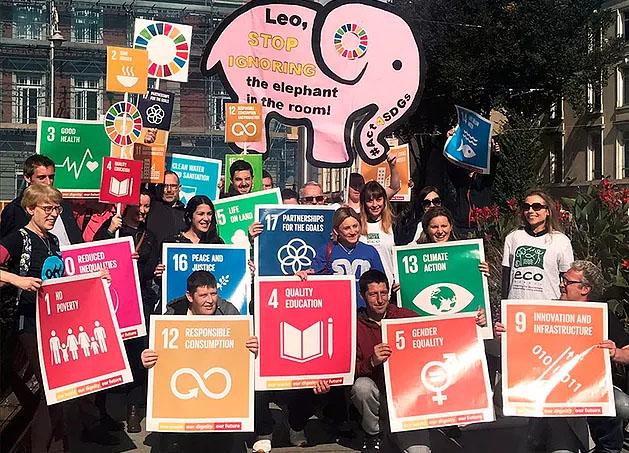
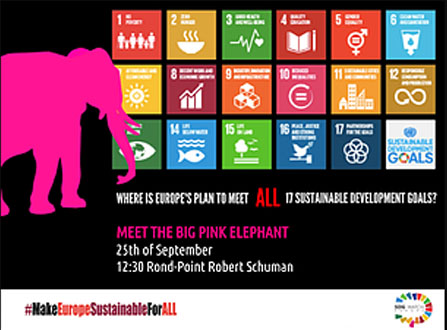
Juncker should stop avoiding the elephant in the room and ‘Make Europe Sustainable For All

Two years after signing up to the Sustainable Development Goals (SDGs), the EU still has no clear plan on how to achieve them and the clock is ticking.

Outside the European Commission building this morning a massive inflatable elephant will remind President Jean Claude Juncker that he cannot continue to ignore sustainability.

Embracing the SDGs would lead to substantial improvements in the lives of Europeans and many others around the globe. EU political leaders must prepare a plan to meet the SDGs that cuts across all areas from the environment to trade and energy to social issues.

Also today, people around Europe are marking the anniversary of the signing of the SDGs and reminding the political leadership that we need planning and action to make them a reality.

Ingo Ritz, Director of the Global Call to Action Against Poverty (GCAP) said:
“The EU and EU member states agreed with 193 governments in the UN to eradicate poverty and end hunger by 2030. This will be only possible if the EU fulfills its commitments for global cooperation, makes its agriculture and trade policies sustainable for people and planet and ends the overconsumption of natural resources.”
The Global Call to Action Against Povery is a global movement fighting poverty and inequality. GCAP has National Coalitions in over 100 countries and 6 global regions.

Jeremy Wates, Secretary General of the European Environmental Bureau (EEB) said:
“The EU needs to refocus on delivering the SDGs or the commitments it made two years ago will be shown up as empty rhetoric. We must urgently face up to how our hunger for raw materials is impacting others around the world and commit to substantially reducing our environmental footprint.”
The EEB is the largest network of environmental citizens’ organizations in Europe with around 140 members in more than 30 countries.

Carl Dolan, Director at Transparency International’s EU Office said:
“We can’t achieve all the SDGs without access to justice and open and accountable institutions for all people. Corruption breeds instability and poverty, it reduces access to healthcare, education, food and water. If the EU is serious about sustainable development it needs to show leadership and make Agenda 2030 a reality.”
Transparency International EU is part of the global anti-corruption movement, Transparency International, which includes over 100 chapters around the world. Their mission is to prevent corruption and promote integrity, transparency and accountability in EU institutions, policies and legislation.

Leo Williams, Director, European Anti-Poverty Network (EAPN), said:
“President Juncker’s complete lack of focus on the SDGs or sustainable development in his State of the Union address only serves to reconfirm the Commission’s unfortunate lack of political prioritisation of the SDGs, despite all European Member States signing up to this global agreement in 2015 at the highest political level, and millions of European citizens having been involved in their elaboration.  People experiencing poverty and social exclusion, and the organisations that work with and for them, expect the Commission to take the most ambitious agenda to tackle poverty we have seen for quite some time, much more seriously”
EAPN is the largest European network of anti-poverty NGOs, from grassroots groups to European Organisations, active in the fight against poverty and social exclusion.

Anna Widegren, Secretary General of the European Youth Forum (EYF) said:
“Young people will suffer the most from the current European short-term approach towards Sustainable Development. The European Commission must take the lead in the implementation of the Sustainable Development Goals and shift towards long-lasting and sustainable solutions with real impact. The structured involvement of young people, youth organisations and civil society is essential to build a sustainable future for Europe and the world.”
The European Youth Forum (YFJ) is a platform which represents 104 youth organizations from around Europe. It brings together tens of millions of young people from all over Europe to allow them to represent their common interests.

Follow the latest on #MakeEuropeSustainableForAll

Sustainable Europe for its Citizens – the 6th Scenario

In April 2017 European Commission President Jean-Claude Juncker presented a White Paper on the Future of Europe, including five possible scenarios for discussion at European and Member State levels.

In response, SDG Watch Europe in collaboration with Friends of the Earth Europe has facilitated the development of an alternative ‘6th Scenario’ that has been backed by over 250 civil society organisations. In this ‘6th Scenario’ these organisations present their aims for a Sustainable and Fair Europe in which care for people and planet are key.

They intend to put this ‘6th Scenario’ forward as an alternative to the five scenarios and to demand that it is fully considered in national and European discussions on the Future of Europe.

You can read the ‘6th Scenario’ here. It is also available in FrenchGerman and Spanish.

European Commission must match the ambition of Member States

On June 20, 2017, the European Council adopted its Conclusions on “A sustainable European future: The EU response to the 2030 Agenda for Sustainable Development”. SDG Watch Europe welcomes the Conclusions and calls on the European Commission to now match the ambition of the Member States and begin implementing the necessary steps to achieve the 2030 Agenda.

SDG Watch Europe published a series of recommendations ahead of the adoption of the Conclusions to address the lack of European leadership and ambition shown to date. Comparing the two documents it is clear the Member States also want the EU to lead on the implementation of the Sustainable Development Goals and there are a number of comparable requests including the development of an implementation strategy which includes a policy gap analysis by mid-2018 containing a timeline, objectives and concrete measures, in all EU relevant internal and external policies, these will be key for a coherent, comprehensive and integrated implementation of the 2030 Agenda. We call on the EC to respond to the request to voluntarily report at the High Level Political Forum by 2019.

We welcome the call for a common and ambitious set of European progress indicators, covering social, economic, environmental and governance factors. However, SDG Watch Europe calls on the European Commission to integrate these indicators into existing governance mechanisms of the EU, in particular, the European Semester in order to ensure a common vision on the decision-making process as well as to guarantee accountability and Policy Coherence for Sustainable Development (PCSD). PCSD is essential to implement the 2030 Agenda in a holistic manner, considering the four dimensions of the Agenda: social, economic, environmental and governance.

In that sense, we welcome the commitment from the Council Conclusions to ensure inter-linkages, coherence and consistency between the different policy sectors. In addition, we regret that the Council Conclusions do not recognise the important role of culture in promoting social change by reflecting on shared beliefs, values and behaviours, providing alternative narratives and a vision of a sustainable future. We also regret that more trade is unconditionally seen as a mean for implementation, without recognising the need to reduce our ecological footprint in absolute terms, to maintain in the planetary boundaries.

One area of concern is the lack of clarification within the Conclusions of the important role of Civil Society in helping to implement the 2030 Agenda. The Multi-Stakeholder Platform should reflect a strong partnership with Civil society organisations (CSOs), with a role of setting the agenda and influencing decision making processes in order to raise the voice of citizens. The Platform should have a clear mandate towards the Post-2020 Strategy as well as the funding mechanisms of the EU to implement the 2030 Agenda. The SDGs must be at the core of the new Multi-Annual Financial Framework and the EU must also strengthen its commitment and ensure the 0.7% for the Official Development Assistance (ODA).

It should also take steps to strengthen tax justice, establishing a tax system for protecting the planet and its resources and fighting against tax havens. The involvement of private sector must also be accountable to governments and civil society. In that sense, SDG Watch Europe encourages the EU to put in place mandatory frameworks and regulations to hold the private sector accountable and ensure that all activities are in line with the 2030 Agenda, like a UN treaty for Business and Human Rights.

Last but not least, SDG Watch Europe welcomes the EU commitment on the eradication of poverty and the fight against inequality. We recognize EU efforts towards “leaving no one behind”, focused on reaching first those who face more discrimination and vulnerable situations- In order to monitor the impact of EU policies and programmes for those marginalised people, it is essential to align the EU monitoring system with the 2030 Agenda by providing disaggregated data by income, gender, age, migratory status, disability, geographic location and other relevant characteristics in national contexts.