The Forus Barefoot Guide: How do we practice collaboration in these times?

By Forus International

Collaboration is vital for transformative social change. But how do we practice collaboration in these times? That is the question driving Future Convergence: the Forus Barefoot Guide. The Guide and the campaign value our human history as a complex and intricate story of committed social change actors. We believe that civil society organisations have a unique and historic role in re-orienting people to work together, reducing polarisation and nurturing our shared humanity. But we also need to challenge ourselves, turning towards each other to mobilise and multiply our collective power. 

In the Forus Barefoot Guide, we explore real experiences, innovative practices, ways of collaborating and leadership forms that offer hope for a way forward. This practical resource is intended for individuals and organisations who want to improve their learning processes and social change practices. Written by thirty-one civil society leaders and practitioners from twenty countries worldwide, it reunites practices and experiences that bring diverse people and organisations together towards a vision of a more equitable, inclusive, humane, and sustainable planet

Each chapter focuses on a different topic, ranging from our understanding of “power”, our engagement with governments and the private sector, and civil society’s capacity to adapting in the face of the globalisation of social issues to collective leadership, relationships with donors, synergies with social movements, and the process of continual, horizontal learning.

Around the Guide, we have developed a multimedia and multilingual campaign with surveys to collected positive practices of collaboration from around the globe, podcast episodes and Conversation Starters – a series of videos focusing on topics from each chapter of the Guide that allows for interaction. 

Want to share your experience? Read the Forus Barefoot Guide here and join the campaign! The Guide is available in English, French and Spanish.

A big thank you to all the writers and Forus members, Doug Reeler, Nomvula Dlamini and Rubert Van Blerk from the Barefoot Guide Connection and Tamarind Tree Associates, South Africa, and Marcela Terán from Liberation Works for developing the Guide and campaign with us.

Europe Sustainable Development Report 2021 launch – 14th December 2021

By SDG Watch Europe

The Europe Sustainable Development Report will be published on the 14th of December 2021.

On such occasion, SDSN and the Institute for European Environmental Policy have organized a webinar for the long-awaited Europe Sustainable Development Report.

The event will be held on Zoom at 14:00 CET. Registration is required to participate.

For detailed information and registration, please visit the following link: LINK

As SDG Watch Europe, we are very much looking forward to knowing how the EU is performing on the SDGs. The event will have experts & practitioners talking about priorities and transformations to achieve the SDGs.

The Conference on the Future of Europe – How could it be used to advance Agenda 2030 in Europe?

By SDG Watch Europe

On 28. September 2021, one of our members from Finland, FINGO hosted an event on how the Conference on the Future of Europe could be useful to advance Agenda 2030 in Europe.

“In the absence of an overarching strategy for implementing 2030 Agenda and the SDGs, civil society organisations and other stakeholders are calling for a rethink on how to make policymaking more collaborative, inclusive, transparent, and therefore more effective for stakeholders at all levels” (FINGO).

The Conference on the Future of Europe is a short-term civil-society engagement mechanism established by the European Commission for European citizens and other stakeholders to engage in the design of Europe’s common future. Could this be one solution for more stakeholder participation and structured dialogue between stakeholders, citizens and the European Commission, Parliament and the Council?

These questions were be considered in this webinar, organised as part of the European Sustainable Development Week to promote active engagement on sustainable development.

As SDG Watch Europe, we attended the event, and engaged in the 15-minute discussion.

Here the main key considerations from the webinar:

 📍 We (CSOs and individuals) must prevent the Conference from becoming a “EU-bubble” Conference
📍 If the majority stays silent, the voices heard will be the ones of demagogues, and people who already have a say in EU policymaking
📍 To prevent this, we must mobilize ALL citizens – regardless of their field of work, class, gender, nationality
📍 The Conference could have been built directly on Agenda 2030/SGDs, since all themes are part of it

Overall, the event gave participants the possibility to reflect on the main goal of the Conference, which is to allow for civic engagement; yet, it also gave the possibility to consider the flaws and possible discrepancies that lay within the initiative.

Discussion on The Eastern Partnership CSOs integration and focus on the Belarusian CSOs situation in Lithuania

By the Lithuanian NGDO Platform

Most Belarusian democratic NGOs are not able to work freely in their country. Civil society development is mainly limited by state institutions that form an unfavorable legal environment, persecute and punish CSO leaders, create obstacles for establishing CSOs, gatherings, etc. 

In Lithuania, Belarusian civil society is being strengthened using various measures: financial support for Belarusians and their organisations; permission to arrive and reside in Lithuania under simplified conditions; providing opportunities to transfer and successfully develop their activities in Lithuania; helping the youth to aim for higher education, and providing assistance to the victims of repressions and pressure in their own country. Lithuanian Government institutions – the Ministry of Foreign Affairs first and foremost – should prepare a clear action plan related to Belarusian NGOs, which would include: defining the direction and the scope for actions taken by competent institutions; gathering and systematising the required information as well as adapting it to strengthen Belarusian NGOs in Lithuania; establishing a Council for Belarusian NGO issues made up of interinstitutional and/or Lithuanian NGO representatives.

Although NGO legal environment in Lithuania is perceived as positive, and both the benefits and the assistance provided seem to be sufficient, Belarusian NGOs are still facing various challenges. 

The NGO Law Instituted conducted the situation report “Eastern partnership and Lithuania: Challenges for NGOs, solutions and opportunities. Case study: Belarus” in August 2021. 

Full report in Lithuanian 

Summary in English 

More information: https://www.vbplatforma.org/EN/projects/agenda

Registration to the activity via this link: https://us02web.zoom.us/webinar/register/WN_5dlrjknAQ7efHb6xjOiAdA

Mobilisation campaign to act for SDGs in Latvia

By Latvian Platform for Development Cooperation  (LAPAS)

On September 20th, the Latvian Platform for Development Cooperation (LAPAS), in collaboration with the Latvian Multistakeholder Coalition, has launched an information campaign on the mobilisation of regional communities to act for SDGs implementation. The campaign’s motto is “Target the development!” (in Latvian: “Mērķē attīstībā!”). 

The campaign’s focus will be awareness-raising on the Sustainable Development Goals and a call to action for implementations of SDGs. 

The plan is to involve at least 30 active community stakeholders all around the country, including municipalities, educational institutions, libraries, museums, civil society organisations. These stakeholders will coordinate educational workshops, online campaigns, and activities to find local problems and their solutions and build community resilience and global competencies. 

All identified problems will be presented by LAPAS and the Latvian Multistakeholder Coalition to national decision-makers. The solutions found and proposed during workshops will be submitted to the Conference on the Future of Europe platform.

The campaign will run until the end of November 2021, culminating in the Final Conference held during the Global Education Week 2021.

The campaign is financed by the EEA and Norwegian grants, the Ministry of Foreign Affairs of Latvia, the European Union and the Council of Europe.

SDG Watch Europe distributed the World’s best news

By SDG Watch Europe

On September 10th 2021, from 362 points across Denmark, distributors gave the World’s Best Morning newspaper to passers-by.

Every year, Verdens Bedste Nyheder hosts the “World’s Best Morning” to spread information on the challenges and progress of the Global Goals. This year, the theme was Sustainable Cities, SDG 11. 

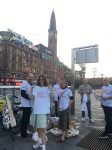
Members of SDG Watch Europe based in Denmark woke up early in the morning to represent the alliance and joined Nyt Europa’s activists. Together, we started at 06.30 AM at Nybrogade, located in the beautiful heart of Copenhagen, where Nyt Europa’s office is based. We prepared coffee, packed the newspapers and enthusiastically walked towards Rådhuspladsen (City Hall Square) while the warm Danish sun slowly woke up the city. We carried boxes of hundreds of small leaflets with the World’s Best News and hundreds of chocolates ready to be handed out to the early birds of Copenhagen.

We arrived at Rådhuspladsen at 7 AM sharp. Slowly sipping coffee and handing the first dozens of leaflets, we saw the city waking up. At 8.30 AM, the city was awake: more full speed cyclists and passers-by grabbing newspapers from our hands, and bus drivers smiling at us. Only a few were passers-by, a few were cyclists, and a few were cars.  

Nyt Europa activists and SDG Watch Europe in Rådhuspladsen

But we were only a few among the total of 2567 volunteers who, on that morning, have pulled on the white t-shirt with the orange “World’s Best News” logo. The rest were scattered around Denmark. Activists were youngsters, politicians, volunteers, students, ambassadors, journalists.

Activists were all around the city. In collaboration with Caritas, a group of dancers from Copenhagen Contemporary Dance School performed to draw people’s attention and raise awareness on the Sustainable Development Goals. 

Klara Trane, from Mellemfolkelig Samvirke, described The World’s Best News as “cool, wonderful and fantastic journalism that provides a counterpoint to the other news that mostly spreads negative news. Of course, everything should not be on the pink cloud, but it is important to also talk about the positive ”, reported World’s Best News on their website.  

To end the morning, a wonderful morning full of hope and activism, ambassadors from the Netherlands and Albania and Jens Christian Wandel, chairman of the United Nations and former adviser to UN Secretary-General António Guterres, helped hand out the newspapers too. 

We were glad to be part of this great initiative devoted to spreading constructive news on progress and solutions to the world’s challenges. We would also be happy to participate in the future. 

Africadag, Climate Justice

By Women Engage for A Common Future (WECF)

This year’s Afrikadag, organised by Foundation Max van der Stoel (FMS), focused on climate justice. The week featured several inspiring online events to which Women Engage for A Common Future (WECF) contributed. Read more about the engaging conversation between WECF and their partner Action for Rural Women’s Empowerment (ARUWE) and have a look at the recap of the launch event of the new study “Climate justice: African perspectives & EU policies.” Kirsten Meijer – WECF NL Director and FMS Vice Chair – was one of the event’s panellists and gave a passionate speech about the need for this type of research that focuses both on stories and solutions. Worth a read HERE!

The changing nature of evaluation in education and its impact on learners’ well-being

By Lifelong Learning Platform – European Civil Society for Education

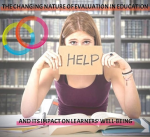
How do assessment methods impact the well-being of learners (and educators)? In tearing apart the relationship between assessments and well-being in its annual theme, the Lifelong Learning platform is publishing a series of articles to debunk some of the myths related to well-being in education. Find out more on the links between assessment and inequalities and why high-stress-inducing exams are never helpful (not even to prepare for the future). Discover LLLP’s annual theme.

Sustainable Development Festival 2021 in Italy

By ASviS

The annual appointment with the Sustainable Development Festival is renewed for the fifth edition, which will take place from September 28 to October 14 2021, throughout Italy and online. The Festival will take a hybrid format. It aims to stimulate the reflection on the critical issues raised by the current situation, which demonstrate how much all aspects of sustainability (environmental, social, economic, institutional) are interrelated. This interrelation makes the case for integrating policies and actions that guarantee a recovery and exit the crisis on the principles of sustainability while avoiding returning to business as usual.

The Festival was selected for the second consecutive time among thousands of projects to be a finalist of the SDG Action Awards of the UN SDG Action Campaign. It is defined as an innovative initiative and a unique experience at an international level. It is organised by the Italian Alliance for Sustainable Development (ASviS) together with its member organisations and partners. The festival will feature about 20 events organised by ASviS, hundreds of initiatives proposed by Italian civil society, institutions, individuals and the private sector, and events organised by Italian embassies abroad thanks to the collaboration with the Italian Foreign Ministry. The Festival website is online at www.festivalsvilupposostenibile.it

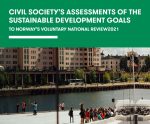
Inspired by Finland, Norway includes civil society’s assessments in the official VNR report

By Norway’s Voluntary National Review

Civil society’s assessments show that Norway has made efforts to meet the SDGs. However, we still have significant challenges, says Kathrine Sund-Henriksen, director of the Norwegian Forum for Environment and Development. 

Norwegian Forum for Environment and Development (ForUM), a network of over 50 organisations working on development, environment, human rights and peace, was given the task to coordinate the contributions. More than 80 civil society actors participated in one or more of the 17 working groups responsible for co-writing the assessment of each goal.

The assessments will be a part of the official report, alongside the Governments assessments. ForUM hopes that this process is the start of a trend with the better engagement of stakeholders and that the recommendations in their assessments will make Norway gear up the efforts to meet the SDGs. 

The Finnish Model

The stakeholder engagement model in the VNR process that the Finnish CSO Fingo developed in cooperation with the Finnish government last year inspired the Norwegian government to include civil society’s assessments in the official report.

– The engagement in this VNR process is a testament to the value of sharing experiences across borders. With the Finnish model as a base, we could shift our focus from advocating for being included in the process and discussing how we can make the inclusion meaningful, says Sund-Henriksen. 

However, short deadlines were a barrier to participation in the process, and some organisations did not have the capacity to make contributions on such short notice. The recruitment period to the working groups was also shorter than the coordinators wished for. In future joint civil society initiatives regarding Agenda 2030, they will strive for an even broader and more diverse group of civil society organisations.

– This process has demonstrated how governments can actively engage non-state actors in reporting processes and has given us useful experiences on how we can further strengthen stakeholder engagement and build trust between different stakeholders in the implementation of Agenda 2030, says Sund-Henriksen. 

Call for greater efforts to meet the SDGs

Even though Norway has a long way to go in meeting all of the 17 SDGs, civil society also gives some credit to the government.

– The government has maintained a high level of foreign aid for many years, including during the pandemic. Norway is also among the top achievers internationally on many indicators regarding domestic issues.

However, Norway is lagging behind in several areas.

– None of the Aichi targets, the global biodiversity goals, were met by 2020. The economic inequalities are increasing, and Norway is struggling to make the economy circular and ensuring responsible production and consumption, says Sund-Henriksen.

Sund-Henriksen also points to Norway’s ongoing search for new oil and gas ventures as a source of climate emissions and the slow progress in the transition to a greener and more sustainable society. In the civil society assessments, several organisations address the need for better policy coherence for sustainable development and real answers to the dilemmas Norway face in Agenda 2030. 

Read civil society’s assessments of Norway’s VNR here

http://www.forumfor.no/en/news/2021/inspired-by-finland-norway-includes-civil-societys-assessments-in-the-official-vnr-report