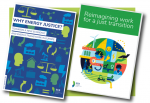
New EEB reports: “Why energy justice” and “reimagining work”

By EEB – European Environmental Bureau

The European Environmental Bureau (EEB) economic transition team published, printed and presented two reflection papers with a long shelf life and detailed policy advice. One is on the lessons yet to be learned from the energy crisis, and the other is on reimagining work. The so-called dichotomy between “green” and “social” is a false one. The EEB believes that the needed changes in how we deal with our environment will be just and social or not work at all.

“Why energy justice? Towards a new economic and energy framework in Europe” takes a hard look at energy poverty, energy inflation, excess profits, the disruptive concentration of capital in the energy system, ownership of energy and how to evolve from first aid stop-gap measures to long-term systemic solutions. The reportop-ed in Social EuropeTwitter thread.

“Reimagining work for a just transition” has a holistic vision of the just transition and builds up arguments for a Working Time Reduction and a Job Guarantee. It then takes this vision to investigate the Just Transition Fund, the European Social Fund Plus, the REPowerEu Plan, The Revision of the Renewable Energy Directive and the Farm to Fork Strategy. The reportarticleTwitter thread.

Building Back Better: Towards achieving SDG 8

By Caritas Europa

All across Europe, work still fails to be ‘decent’. Minimum wages that are insufficient to meet basic needs trap many people in in-work poverty. We see increasing forms of non-standard employment that have little to no social protection coverage and a significant informal economy that exposes workers to exploitation. To raise awareness of this and other labour market inclusion challenges, one of SDG Watch Europe’s members, Caritas Europa, organised a webinar on 22 November to assess how the EU and its Member States can advance towards achieving SDG 8 (decent work) in the context of the COVID-19 recovery. 

The COVID-19 crisis has further worsened the labour market situation across Europe and has impacted the progress Member States had been making on achieving this Sustainable Development Goal. It is now more important than ever for the EU and its Member States to refocus on guaranteeing decent work for all.

Professor Jeffrey Sachs, President of the UN Sustainable Development Solutions and an SDG Advocate under Secretary-General António Guterres, pointed out during his intervention that due to the transitions in digitalisation and automation, many people need training and retraining. This capacity-building would enable people to maintain formal employment to meet their and their families needs. Mirzha de Manuel, member of Executive Vice President Dombrovskis’ cabinet, emphasised that COVID-19 has also offered us an opportunity to address the challenges in our current economic model, highlighting many of the recent and upcoming Commission initiatives to tackle the existing challenges. As Professor Sachs rightly stated, strengthening and enforcing Europe’s social model and the European Social Charter will be an important foundation to build on.  

But the starting point, as Cardinal Turkson noted in his intervention, is that policymakers, employers, and each of us need to recognise the importance of human dignity and to centre our economy on the value and worth of all human beings. Jobs should promote the dignity of the human person, not their exploitation. All future initiatives and policies at the EU and national levels should be centred on this understanding, contribute to implementing the European Pillar of Social Rights, and aim to fulfil all SDGs holistically and coherently. 

ONLINE: Building Back Better: Towards achieving SDG 8 – 22. Nov 2021 15:00-16:30

By Caritas Europa

Caritas Europa is organising a webinar to assess how the EU and its Member States can advance towards achieving SDG 8, in the context of the COVID-19 recovery. This webinar will build on Pillar II of Caritas Europa’s Social Model on inclusive labour markets – work as a source of well-being and contribute to achieving a more human-centred economy.

Background:

For Caritas Europa, decent work (SDG 8), which respects the rights and dignity of every worker, is an essential part of a human-centred economy. However, decent work for all is still far from being achieved in Europe and the COVID-19 crisis has further worsened the labour market situation across the European States. COVID-19 has had severe socio-economic consequences, especially for those in vulnerable situations, and has impacted the progress many countries had been making with regard to decent work. In the context of the recovery, it is now more important than ever for the EU and its Member States to refocus on achieving SDG 8. What actions could be carried out now to help get us back on track toward achieving SDG 8 by 2030? These questions will be the focus of this webinar with input from people experiencing labour market hurdles, along with the Project Director of the SDG Index, the European Commission, Caritas Europa, and the dicastery for Integral human development.

Programme:

Moderator: Shannon Pfohman

15:00 – 15:10     Maria Nyman, Caritas Europa – Welcome and introduction

15:10 – 15:20     Professor Jeffrey Sachs, Columbia University – Assessment of the state of play on achieving SDG 8, especially following the outbreak of COVID-19.

15:20 – 15:35     Darvas Magdolna, Caritas’ Elderly Care Volunteer Programme and Hebrea Fernandez Bautista, A Todo Trapo Zaragoza – Presentation of their experiences related to employment/labour market

15:35 – 15:45     Cardinal Peter Turkson, Dicastery of Integral Human Development – Perspective of Catholic Social Teaching on the labour market and how to put it into practice.

15:45 – 15:55      Mirzha de Manuel, Member of Executive Vice President Valdis Dombrovskis’ cabinet – Presentation of the Commission’s work on implementing the SDGs at EU level and guiding the Member States towards implementation at national level.

15:55 – 16:25     Q&A

16:25 – 16:30     Wrap-up & conclusions

REGISTER HERE: https://bit.ly/3HIa1vY