Reflecting on the 2020 ‘Commission’s Staff working document: Delivering on the UN’s Sustainable Development Goals – A comprehensive approach.’
By Yblin Roman Escobar, SDG Watch Europe
Having travelled a difficult road due to the COVID-19 pandemic, many Europeans were longing for fresh and concrete news on our collective journey towards a sustainable Europe in 2030. We believed the long-awaited Commission’s staff working document on delivering the SDGs would help to accelerate progress in the right direction. Unfortunately, this document limits itself to reaffirming the Commission’s commitment and providing an overview of existing actions.
Leadership at the highest level
The good news is that EU Commission President Ursula von der Leyen herself is coordinating the expedition, while the Commissioners College as a whole remains collectively responsible for the overall implementation of the SDGs. SDG Watch Europe called on the Commission’s President, at the beginning of her term, to take the lead and therefore welcomes her leadership.
However, SDG Watch regrets that five years into this important journey, we still lack an overarching EU strategy for Sustainable Development, with a specific implementation plan and timeline.
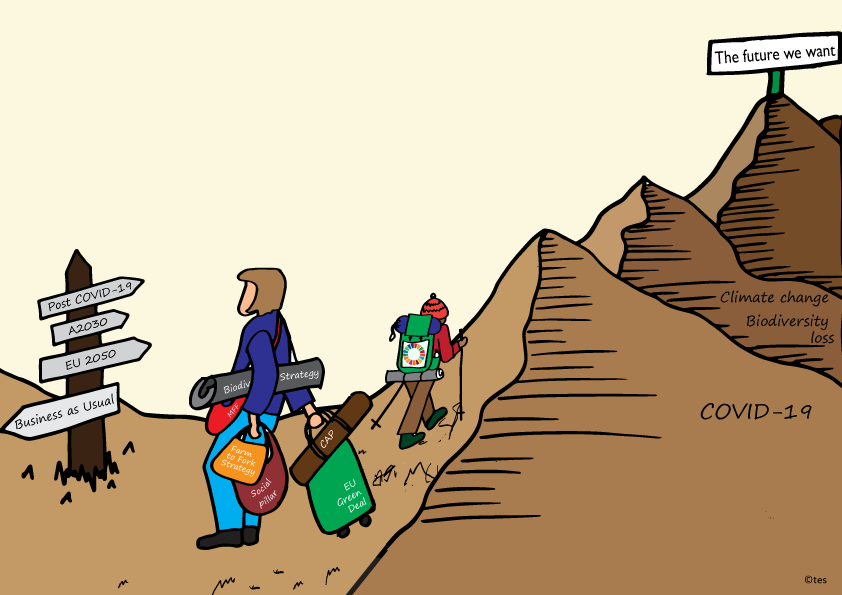
The Commission does highlight its strategy in the staff working document, presenting it as pragmatic and focused on the implementation of the SDGs through the Commission’s priorities-particularly through the EU Green Deal – a flagship EU initiative. And, it claims to take a whole-of-government approach through mainstreaming of the SDGs at all levels. However, the staff working document provides insufficient detail on EU governance for SDG implementation. It remains unclear how this will translate into practice or how the mainstreaming will be done, both within the Commission and beyond. In this respect, it seems that as far as this journey is concerned, we are still around the base camp, and haven’t begun the ascent yet.
The staff working document is a good exercise in identifying which way the different Commission policies, actions and initiatives all contribute to materialising the SDGs. We recognise that this scanning exercise allows an initial diagnosis of where the EU situates itself in the SDG journey; helps it to take stock of its strengths and gaps, and set concrete objectives and agree on an accompanying action plan.
Recognising the fact that EU Commission President Ursula von der Leyen put climate and environment and an economy that works for people at the heart of her political guidelines, we see and celebrate all the initiatives listed in the Commission’s staff working document. Nonetheless, we also believe that it paints a biased picture of reality because it does not take into account, together with the bright side of the narrative, its drawbacks and downsides too. The Commission describes how well it is equipped for the journey, the beautiful landscapes on the way, but forgets to report the risks and difficulties too. Let’s look at the following examples:
EU engagement in the world
It is promising to see the Commission having an in-depth analysis of the challenges COVID-19 presents to the countries in the Global South, reaffirming its commitment to support them in their journey towards implementing the SDGs.
It is very welcome that the Commission highlights the coherence between domestic policies and external action. The stated intention to prevent EU spillovers is a new and very welcomed approach.
Trade, for example, is featured in the document as a relevant road to supporting EU partner countries. However, Olivier De Schutter, the UN Special Rapporteur on extreme poverty and human rights and former Special Rapporteur on the right to food, warns that the EU’s trade policy today encourages social and environmental dumping due to the ambition of eliminating all barriers to imports. Friends of the Earth Europe, SDG Watch member, in its paper Setting course for ‘sustainable trade, a new agenda that serves people and the environment’ argues that continuing the current trade trajectory will aggravate economic insecurity and deepen global inequality, setting us on a collision course with planetary boundaries.
The EU must live up to its commitment under the 2030 Agenda to address the negative spill-overs of EU’s trade. In its report ‘Who is paying the bill? (Negative) impacts of European Policies and practices in the world’ SDG Watch Europe calls on the Commission to monitor the spill-over effects of EU policies and to set goals to limit them and to avoid causing harm in the Global South.
Ensuring policy coherence for sustainable development (PCSD)
The document paints a landscape of deep EU commitment to PCSD, including all policies and all levels, within and beyond Europe.
The work of the Commission on policy coherence builds on its longstanding experience and the provision of the international agreements, the Lisbon Treaty (art.208) being the most recent, and it is implemented mostly via the working of DG Development Cooperation (DG DEVCO). Yet, some worrisome developments suggest a weakening of PCSD in the Commission. DG DEVCO is being reorganised into DG INTPA (for International Partnerships) that will be officially launched in January 2021. Tanya Cox, Director at CONCORD Europe, has flagged that PCSD has disappeared off the map. DG DEVCO used to have a dedicated PC(S)D Unit, while in the new DG INTPA, it no longer exists. If we consider that DG DEVCO and DG ENVI (DG for Environment) are the traditional drivers of the 2030 Agenda, this development would risk letting the entire Commission off the hook. How will PCSD then be safeguarded?
European Green Deal
The European Green Deal which is the cornerstone Commission initiative linked to the SDG implementation proposes a welcome strategy to transform the EU into a fair, inclusive and prosperous society. As the Staff document (p.3) (visually) illustrates, it will contribute to 12 of the 17 SDGs. Yet, in the same illustration, the social and gender aspects are missing. The absence of SDG 5, for example, exposes the Green Deal gender-blind-spot. How can this strategy be called inclusive when it overlooks at least 50% of the population?
Furthermore, in the absence of an overarching Sustainability strategy, policy areas remain siloed, and the potential success of the European Green Deal itself is put at risk.
World Wild Foundation International, SDG Watch member, and other civil society organisations, for example, has argued in an open letter that the position agreed in the European Parliament and Council on the CAP reform endangers the realisation of the EU Green Deal (and the associated Farm-to-Fork and Biodiversity Strategies). This is because they allow harmful subsidies, put most of the money into funding business-as-usual practices, and actively limit Member States’ environmental ambition. Our members call on the Commission to develop a new proposal that safeguards the EU Green Deal, and consequently the implementation of the SDGs.
Monitoring and reporting. Fit for purpose?
Monitoring and reporting on the SDGs is another example of an incomplete picture. The process, as carried out by Eurostat, is showcased as a robust approach to keeping track of our journey towards a Sustainable EU by 2030. The staff working document specifically mentions the EU indicator set was developed in a very ‘broad consultative process’. But expert commentators Schiltz et al. say in a recent study ‘The EU’s SDG monitoring and reporting not yet fit for purpose’, that neither EU institutions, such as the European Parliament, nor civil society, have been structurally integrated into the process of indicator selection. it is argued that the current monitoring does not allow for any specific role for civil society. Furthermore, according to the study, the current set of indicators is not able to fully capture the most relevant aspects of sustainable development in the EU context.
None of these arguments is considered in the working staff document. SDG Watch Europe in its report ‘Time to reach for the moon – the EU needs to step up action and lead the transformation to sustainability’, demonstrates the serious issues that remain unaddressed with the Commission’s “GPS” for monitoring the EU’s progress in this journey. How can we know we are advancing in the right direction and at the right pace if our GPS is not fit for purpose?
The engagement of civil society
The Commission recognises that the implementation of the SDGs demands involving civil society and other stakeholders but it does not provide a clear depiction of how it will achieve this. The new European Climate Pact and the Conference on the Future of Europe are presented as the new public fora for an open inclusive, transparent and structured debate on the SDGs. Still, the document does not specify how this will happen. Furthermore, both spaces suffer from weaknesses. The Climate Pact, as it names indicate, only addresses climate issues, thus failing at having a broad definition of sustainability including all economic, social and environmental issues embedded in the SDGs. The Conference on the Future of Europe is set to be a temporary participatory exercise over 1 or 2 years with the role of civil society organizations still not clear, thus failing at being a formalized long-term civil-society engagement mechanism.
The Commission concludes its staff working document by saying: ‘This is a journey towards a Union that thrives while leaving no one behind and preserves the long-term viability of life- and prosperity supporting ecosystems for this and future generation.‘
SDG Watch Europe understands the aim of this EU journey towards sustainable development to be the achievement of well-being for all, here and elsewhere, now and in the future.
SDG Watch Europe, with its more than 100 member organisations, is ready to support the EU and its Member States to advance further in this important journey.