Juncker should stop avoiding the elephant in the room and ‘Make Europe Sustainable For All

Two years after signing up to the Sustainable Development Goals (SDGs), the EU still has no clear plan on how to achieve them and the clock is ticking.

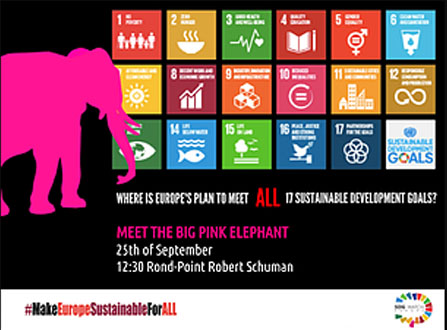
Outside the European Commission building this morning a massive inflatable elephant will remind President Jean Claude Juncker that he cannot continue to ignore sustainability.

Embracing the SDGs would lead to substantial improvements in the lives of Europeans and many others around the globe. EU political leaders must prepare a plan to meet the SDGs that cuts across all areas from the environment to trade and energy to social issues.

Also today, people around Europe are marking the anniversary of the signing of the SDGs and reminding the political leadership that we need planning and action to make them a reality.

Ingo Ritz, Director of the Global Call to Action Against Poverty (GCAP) said:
“The EU and EU member states agreed with 193 governments in the UN to eradicate poverty and end hunger by 2030. This will be only possible if the EU fulfills its commitments for global cooperation, makes its agriculture and trade policies sustainable for people and planet and ends the overconsumption of natural resources.”
The Global Call to Action Against Povery is a global movement fighting poverty and inequality. GCAP has National Coalitions in over 100 countries and 6 global regions.

Jeremy Wates, Secretary General of the European Environmental Bureau (EEB) said:
“The EU needs to refocus on delivering the SDGs or the commitments it made two years ago will be shown up as empty rhetoric. We must urgently face up to how our hunger for raw materials is impacting others around the world and commit to substantially reducing our environmental footprint.”
The EEB is the largest network of environmental citizens’ organizations in Europe with around 140 members in more than 30 countries.

Carl Dolan, Director at Transparency International’s EU Office said:
“We can’t achieve all the SDGs without access to justice and open and accountable institutions for all people. Corruption breeds instability and poverty, it reduces access to healthcare, education, food and water. If the EU is serious about sustainable development it needs to show leadership and make Agenda 2030 a reality.”
Transparency International EU is part of the global anti-corruption movement, Transparency International, which includes over 100 chapters around the world. Their mission is to prevent corruption and promote integrity, transparency and accountability in EU institutions, policies and legislation.

Leo Williams, Director, European Anti-Poverty Network (EAPN), said:
“President Juncker’s complete lack of focus on the SDGs or sustainable development in his State of the Union address only serves to reconfirm the Commission’s unfortunate lack of political prioritisation of the SDGs, despite all European Member States signing up to this global agreement in 2015 at the highest political level, and millions of European citizens having been involved in their elaboration.  People experiencing poverty and social exclusion, and the organisations that work with and for them, expect the Commission to take the most ambitious agenda to tackle poverty we have seen for quite some time, much more seriously”
EAPN is the largest European network of anti-poverty NGOs, from grassroots groups to European Organisations, active in the fight against poverty and social exclusion.

Anna Widegren, Secretary General of the European Youth Forum (EYF) said:
“Young people will suffer the most from the current European short-term approach towards Sustainable Development. The European Commission must take the lead in the implementation of the Sustainable Development Goals and shift towards long-lasting and sustainable solutions with real impact. The structured involvement of young people, youth organisations and civil society is essential to build a sustainable future for Europe and the world.”
The European Youth Forum (YFJ) is a platform which represents 104 youth organizations from around Europe. It brings together tens of millions of young people from all over Europe to allow them to represent their common interests.

Follow the latest on #MakeEuropeSustainableForAll
Sustainable Europe for its Citizens – the 6th Scenario

In April 2017 European Commission President Jean-Claude Juncker presented a White Paper on the Future of Europe, including five possible scenarios for discussion at European and Member State levels.

In response, SDG Watch Europe in collaboration with Friends of the Earth Europe has facilitated the development of an alternative ‘6th Scenario’ that has been backed by over 250 civil society organisations. In this ‘6th Scenario’ these organisations present their aims for a Sustainable and Fair Europe in which care for people and planet are key.

They intend to put this ‘6th Scenario’ forward as an alternative to the five scenarios and to demand that it is fully considered in national and European discussions on the Future of Europe.

You can read the ‘6th Scenario’ here. It is also available in FrenchGerman and Spanish.

European Commission must match the ambition of Member States

On June 20, 2017, the European Council adopted its Conclusions on “A sustainable European future: The EU response to the 2030 Agenda for Sustainable Development”. SDG Watch Europe welcomes the Conclusions and calls on the European Commission to now match the ambition of the Member States and begin implementing the necessary steps to achieve the 2030 Agenda.

SDG Watch Europe published a series of recommendations ahead of the adoption of the Conclusions to address the lack of European leadership and ambition shown to date. Comparing the two documents it is clear the Member States also want the EU to lead on the implementation of the Sustainable Development Goals and there are a number of comparable requests including the development of an implementation strategy which includes a policy gap analysis by mid-2018 containing a timeline, objectives and concrete measures, in all EU relevant internal and external policies, these will be key for a coherent, comprehensive and integrated implementation of the 2030 Agenda. We call on the EC to respond to the request to voluntarily report at the High Level Political Forum by 2019.

We welcome the call for a common and ambitious set of European progress indicators, covering social, economic, environmental and governance factors. However, SDG Watch Europe calls on the European Commission to integrate these indicators into existing governance mechanisms of the EU, in particular, the European Semester in order to ensure a common vision on the decision-making process as well as to guarantee accountability and Policy Coherence for Sustainable Development (PCSD). PCSD is essential to implement the 2030 Agenda in a holistic manner, considering the four dimensions of the Agenda: social, economic, environmental and governance.

In that sense, we welcome the commitment from the Council Conclusions to ensure inter-linkages, coherence and consistency between the different policy sectors. In addition, we regret that the Council Conclusions do not recognise the important role of culture in promoting social change by reflecting on shared beliefs, values and behaviours, providing alternative narratives and a vision of a sustainable future. We also regret that more trade is unconditionally seen as a mean for implementation, without recognising the need to reduce our ecological footprint in absolute terms, to maintain in the planetary boundaries.

One area of concern is the lack of clarification within the Conclusions of the important role of Civil Society in helping to implement the 2030 Agenda. The Multi-Stakeholder Platform should reflect a strong partnership with Civil society organisations (CSOs), with a role of setting the agenda and influencing decision making processes in order to raise the voice of citizens. The Platform should have a clear mandate towards the Post-2020 Strategy as well as the funding mechanisms of the EU to implement the 2030 Agenda. The SDGs must be at the core of the new Multi-Annual Financial Framework and the EU must also strengthen its commitment and ensure the 0.7% for the Official Development Assistance (ODA).

It should also take steps to strengthen tax justice, establishing a tax system for protecting the planet and its resources and fighting against tax havens. The involvement of private sector must also be accountable to governments and civil society. In that sense, SDG Watch Europe encourages the EU to put in place mandatory frameworks and regulations to hold the private sector accountable and ensure that all activities are in line with the 2030 Agenda, like a UN treaty for Business and Human Rights.

Last but not least, SDG Watch Europe welcomes the EU commitment on the eradication of poverty and the fight against inequality. We recognize EU efforts towards “leaving no one behind”, focused on reaching first those who face more discrimination and vulnerable situations- In order to monitor the impact of EU policies and programmes for those marginalised people, it is essential to align the EU monitoring system with the 2030 Agenda by providing disaggregated data by income, gender, age, migratory status, disability, geographic location and other relevant characteristics in national contexts.

SDG Watch Europe input to the Reflection paper on EU finances

Europe faces multiple challenges, which need to be responded to by means of EU policies and financial rules alike. Unemployment, social inequalities and migration (perceived to be the top three challenges for the EU by its citizens), growing euroscepticism and the erosion of European values, the ecological and climate crises, which undermine human well-being, the challenges of the euro area and the revenue loss caused by Brexit all need to be tackled in an ambitious reform of the European project supported by a transformed EU budget (Multiannual Financial Framework).

Even though the EU budget has changed a lot in the last decades, it still requires ambitious reform to enable it to be a positive driver of change, meet the expectations of the people for an ambitious future for Europe, and accordingly support the implementation of the Sustainable Development Goals.

Such reform should include not only bold decisions on what and how much the EU spends and where the money comes from, but should also involve a change to the overall approach to ensure the entire EU budget coherently delivers on the overarching objective of working for the people and protecting the planet.

The way forward for the EU and its budget

While the White Paper on the future of Europe outlined five potential scenarios, SDG Watch Europe firmly believes that they are not capable of setting a positive vision for the future and uniting Europeans around the necessity of major reform. In our view the kind of scenario that is urgently needed puts sustainability at the heart of the European project. Our proposed 6th scenario outlines a social Europe that is able to reclaim common goods and to work for the people instead of focusing on commercial and corporate interests, while addressing the challenges linked to operating in a world of diminishing resources and an ecological crisis. Our vision of Europe involves a stronger focus on core values – democracy and participation, social and environmental justice, cultural diversity, solidarity and sustainability, respect for the rule of law and human rights, both in and outside of Europe.

Citizens seek economic, social and environmental well-being: economic well-being in the form of prosperity for all, starting with redistribution of wealth; social well-being in the provision of quality, inclusive and affordable public services, promoting cultural diversity and a caring society; environmental well-being reflected in a healthy natural environment that sustains all life on Earth and protects our soils, waters and air, tackles climate change and provides nutritious, healthy food. As a result of implementing these policies, the EU27 will ensure a better life for all of its citizens.

Delivering the 2030 Agenda for Sustainable Development, based on the 17 goals and principles, leaving no one behind, living within the fair share of global resources and returning to operating within planetary boundaries, as well as respecting human rights should be at the core of EU and national policy-making.

Real progress on this comprehensive agenda can only be achieved however, if policy silos are dismantled, incoherencies and contradictions are resolved, and all policies and programs are contributing to the sustainable development agenda. The social and environmental costs cannot continue to be borne by people within or outside of Europe due to the EU’s adherence to flawed approaches and methods.

Such policy coherence should be ensured in the EU budget through sustainability proofing based on the consistent application of an inseparable set of sustainability principles while serving the Sustainable Development Goals. Sustainability proofing of the EU budget should involve a structured process of ensuring the effective application of tools to maximise the social, environmental and economic benefits and to avoid or at least minimize harmful impacts and trade-offs of EU spending.

It applies to all spending streams under the EU budget in both internal and external spending, across the whole budgetary cycle and at all levels of governance, and should contribute to a significant progress of the EU towards sustainability assessed against a set of sustainability principles. Sustainability proofing is thus a tool to ensure that environmental integrity is maintained as a precondition for any development, while economic and social development serve the objective of increasing human well-being.

Sustainability proofing is a step-wise process that follows the mitigation hierarchy under which appropriate actions are taken in the following order of priority: (1) avoidance of negative impacts; (2) reduction of negative impacts; (3) rehabilitation/ restoration measures; and (4) compensation measures for significant adverse residual impacts. Substantive, procedural and institutional instruments will achieve this.

This approach will ensure the EU budget lives up to its potential to catalyse a sustainable economy of well-being, and help repair some of the root causes of the problems facing Europe by introducing new priority objectives, new participatory spending tools, and improved accountability. This will indeed amount to a genuine budget for the people.

Sustainability principles for the future EU budget to be applied as an inseparable set:

  1. The EU budget shall work for the people and with the people, with greater transparency, respectful of diversity and meaningful participation of the citizens

  2. The EU budget shall strengthen the common European values, in Europe and globally

  3. The EU budget shall increase wellbeing and contribute to decreasing inequality and social exclusion at all scales

  4. The EU budget shall take a holistic approach, support systems change and promote innovation, which is required for the transition to sustainability and building a circular economy.

  5. The EU budget shall serve a diversified and resilient economy and society, where the full potential of all communities, organisations and businesses of any size is fully achieved.

  6. The EU budget shall serve the public good.

  7. The EU budget shall contribute to decreasing the total environmental pressures (use of natural resources, use of land and emissions of waste, toxic substances, greenhouse gases and alien genotypes) to return to within planetary boundaries, and should not contribute to shifting of environmental pressures in time and space.

  8. The EU budget should contribute to improving the state of environment and maintaining and restoring ecosystem services, which is the very foundation of our society and economy.

SDG Watch Europe calls on the European Commission to sustainability-proof the future EU budget (MFF) based on the above principles.

EESC recommendations on SDGs welcomed, gaps highlighted

SDG Watch Europe welcomes the European Economic and Social Committee’s (EESC) recommendations on the implementation of the SDGs in and by the EU. The Various Interest Group has published the recommendations after its recent conference “The UN 2030 Agenda for Sustainable Development: a new frontier of rights and progress for the EU” to which several members of SDG Watch Europe contributed.

We agree with the EESC that the EU must show international leadership while the Agenda 2030 must become the strategic framework for the future of Europe. We share the EESC’s concern that the EU is still lacking an ambitious overarching European Strategy for sustainable development that would ensure a holistic, coordinated and systematic approach, and put sustainable development at the core of all EU programmes, policies, actions and financial instruments.

Moreover, we also share the EESC call that civil society must be part of the full implementation cycle of the SDGs including designing implementation policies, participation in governance frameworks, as well as monitoring and review.

However, SDG Watch Europe goes further in several of its demands, such as:

  • Corporate accountability: SDG Watch Europe is very critical of the role of business in the implementation of the SDGs. Although it is clear that we need the business sector to achieve the goals, the EESC focuses one-sidedly on the “pivotal role” of business to deliver on the Agenda 2030 through investment and technological innovation. Many of the current business activities cause negative environmental and social impacts that undermine sustainable development: they are linked to the depletion of natural resources and severe pollution, they make profits due to weak environmental regulation and low labour standards which further increases inequalities, and benefit from impunity and the lack of access to justice for victims of labour rights violations or negative health impacts. Policy makers need to understand the need for clear rules for business conduct such as mandatory environmental and human rights due diligence as well as access to justice for victims of abuses and clear corporate accountability mechanisms. SDG Watch Europe supports the adoption of an international Treaty on Business and Human Rights.

  • Sustainable Development as a business opportunity: The EESC argues that business has to recognise sustainable development as a business opportunity, but the reality is that in many cases going sustainable will not lead to more but less profit: paying living wages to workers, sourcing fair and sustainable agricultural products, paying adequate taxes throughout global values chains or taking over the costs to remediate negative environmental impacts are not necessarily a “business opportunity” but a responsibility or even a liability. Believing that the implementation of the SDGs is always linked to business opportunities will undermine the realisation of all goals.

  • Trade and investment agreements: isolated chapters on sustainable development will not be enough to make global trade more sustainable. Trade and investment agreements as such – their whole purpose – need to be in line with the objectives of the Agenda 2030. Moreover, we need clear assessments of the impact that new agreements have on global trade volumes and the possible further increase of resource use, on pollution and emissions as well as on raising inequalities.

  • Reduction of resource use: SDG Watch Europe welcomes the EESC’s call on the EU to take steps to reduce its resource use and its global environmental and social footprint; however, the target must be set more clearly: the current over-consumption and excessive use of natural resources has to be reversed and the EU needs to reduce its resource use in absolute terms to reach a fair environmental footprint – becoming more resource efficient is not enough.

SDG Watch Europe agrees with the EESC that civil society is key for the successful implementation of the SDG. However, when European institutions set up stakeholder engagement mechanisms, such as the EC’s Multi-Stakeholder Platform on the Agenda 2030, civil society must have the right to be self-organised in its contributions. Outreach to civil society cannot be facilitated through the EESC alone. Moreover, if the EESC was to organise national debates in EU Member States to monitor progress on implementing the UN 2030 Agenda to include civil society views, the rules of such consultations would have to ensure a truly participatory and transparent process.

SDG Watch Europe acknowledges the important role the EESC is playing in promoting the ambitious implementation of the SDG in and by the EU and in pushing the European institutions to take the Agenda 2030 more seriously by its continuous work on a more sustainable Europe.

The UN 2030 Agenda for Sustainable Development – a new frontier of rights and progress for the EU

SDG Watch Europe was present at the recent conference hosted in Brussels by the European Economic and Social Council (EESC) called ” the UN Agenda for Sustainable Development-a new frontier of rights and progress for the EU”. Speakers included Christian Friis Bach, Executive Secretary of the UN Economic Commission for Europe ( UNECE), Celina Charveriat Director of the Institute for European Environmental Policy Karl Flakenberg Hors Classe Senior Advisor for Sustainable Development, European Policy Strategy Centre ( EPSC) of the European Commission and several civil society speakers including members of SDG Watch Europe.

STAKEHOLDER VIEWS on the next EU budget cycle

Results of the stakeholder survey designed by SDG Watch Europe.

Highlights from the 314 stakeholder responses

The great majority of the respondents (95.8%) agrees or strongly agrees with the question statement, that the EU budget should be a key driver for a more sustainable future for Europe.

When elaborating how the new EU Budget cycle could better contribute to improving people’s lives and their well-being, respondents most frequently mention paying more attention to the well-being and the real needs of the society (like investing in youth, families, research, health and education), contributing to a green economy, and implementing and mainstreaming Sustainable Development Goals and sustainability as a way of increasing people’s wellbeing.

EU funding should be also able to reflect on local needs and be more transparent, also as a way of showing to the people how the EU budget makes their lives better.

For strengthening the social dimension of the European Union through the EU budget many respondents stress the need for allocating more funds to social inclusion and social cohesionat different levels, where the application of subsidiarity is also essential.

For improving the quality of environment respondents mostly mentioned the transition to a low carbon economy with the help of the EU budget and the phasing out of environmentally harmful subsidies. To make this happen, respondents also urge mainstreaming environmental and climate aspects in the EU budget and other policies and also mention sustainability proofing as a methodological framework.

Replies also emphasize the importance of local circumstances and thus call for an increase the number of small scale EU funded projects implemented by local communities.

Replies also urge that the EU budget cycle should devote more funds to the transition of the economy from the current domination of the economic growth paradigm to another model, and to building a circular economy.

Ways to promote good governance in the next EU budget cycle first of all include more participation – of citizens, NGOs, experts, local communities, etc. – in the opinion of the respondents, which should be complemented by a strengthened monitoring system (leading to consequences if needed).Most of the respondents (87%) agree or strongly agree with the question statement that the next EU budget cycle should clearly direct public money to serve the public good and avoid serving private interests. However, interpretations vary on defining “public good” and “private interests”.

Most of the respondents (93%) agree or strongly agree that the next EU budget cycle should increase policy coherence for sustainable development. Taking a holistic view to avoid shifting negative impacts to other areas, horizontal integration of legislations, cross-sectoral cooperation and aligning EU policies and thus the EU budget with global agreements, such as the 2030 Agenda or the Paris Agreement are the most often mentioned ways to achieve this.

Most of the respondents (84%) agree or strongly agree with using incentives and/or conditionalities to increase the efficiency of the use of EU funds by MSs. Applying ex ante and ex post conditionalities (e.g. anti-discrimination; gender equality, implementing environmental objectives) to all EU funding instruments is mentioned as one possible way of implementation.

Download the full report here.

The stakeholder responses were collected through an online survey in early 2017 and presented at the COSI 3 Meeting organised by Global Citizen and SDG Watch Europe and financially supported by the European Commission. The above opinions do not necessarily reflect the views of SDG Watch Europe, Global Citizen or the European Commission.

Sustainability principles for the future EU budget

SDG Watch Europe is putting forward eight sustainability principles to ensure coherence in the future internal and external EU spending and to put sustainability at the heart of the European project. We call on the European Commission, the European Parliament and the European Council to integrate these principles from the very beginning of the financial policy planning, and thus prioritise the interest of the citizens and the implementation of the Sustainable Development Goals. SDG Watch Europe will also propose sustainability proofing methods for the future EU budget to help make it happen.

Sustainability principles for the future EU budget to be applied as an inseparable set:

  1. The EU budget shall work for the people and with the people, with greater transparency, respectful of diversity and meaningful participation of the citizens

  2. The EU budget shall strengthen the common European values, in Europe and globally

  3. The EU budget shall increase wellbeing and contribute to decreasing inequality and social exclusion at all scales

  4. The EU budget shall take a holistic approach, support systems change and promote innovation, which is required for the transition to sustainability and building a circular economy.

  5. The EU budget shall serve a diversified and resilient economy and society, where the full potential of all communities, organisations and businesses of any size is fully achieved.

  6. The EU budget shall serve the public good.

  7. The EU budget shall contribute to decreasing the total environmental pressures (use of natural resources, use of land and emissions of waste, toxic substances, greenhouse gases and alien genotypes) to return to within planetary boundaries, and should not contribute to shifting of environmental pressures in time and space.

  8. The EU budget should contribute to improving the state of environment and maintaining and restoring ecosystem services, which is the very foundation of our society and economy.

Download the leaflet (pdf)

Contact:
Klára Hajdu (hajdu@ceeweb.org) and Deirdre de Burca (deirdredeburca12@gmail.com),
Co-facilitators of the work initiative on the EU budget under SDG Watch Europe sdgwatcheurope@gmail.com

First CSO Regional Forum at the UN in Geneva

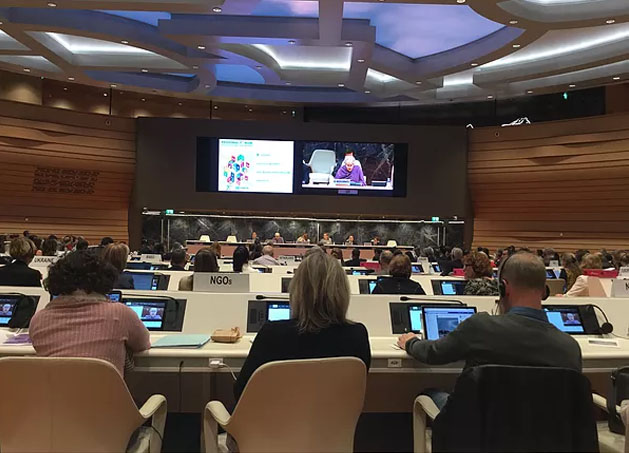
SDG Watch Europe members attended the first CSO Regional Forum that took place at the UN in Geneva on April 24th 2017. The CSO Forum took place on the day before the official Regional Review of Agenda 2030 by UNECE Member States to establish the progress made to date on implementing Agenda 2030 in the region.

Civil society present discussed the possibility of establishing a permanent Civil Society Engagement Mechanism (RCEM) to engage with the UN system on Agenda 2030 implementation in the region. SDG Watch Europe will engage actively in these discussions over the coming months!

SDG Watch Europe Recommendations for Council Conclusions on the EC Communication: Next Steps for Sustainable European Future

SDG Watch Europe is a European, cross-sectoral, civil society alliance committed to supporting the implementation, monitoring and follow up of the 2030 Agenda by the EU and its member states. We believe that the Council Conclusions to be adopted in June 2017 under the Maltese EU Presidency represent an important opportunity for EU member states to address the lack of European leadership and ambition shown to date regarding the implementation of the 2030 Agenda.

A year and a half has passed since the 2030 Agenda was first adopted by all UN member states in New York. Unfortunately, there has been little evidence of any real European political momentum to support the implementation of this vitally important sustainable development agenda, either in terms of EU internal or external policy-making and action. The lack of coordination between, and timely action on the part of the EU and its member states is difficult to understand in light of the failures of today’s policies to tackle poverty, and their direct contribution to rising inequality, the destruction of the environment, threats to health, the concentration of wealth and political power in fewer and fewer hands, and the disaffection of many people across Europe with the European Union, its institutions and policies.

In the Rome Declaration, published on 25 March on the occasion of the 60th anniversary of the Treaties of Rome, the leaders of 27 Members States and of the European Council, the European Parliament and the European Commission have reaffirmed their promise to work towards a sustainable Europe. The adoption of the Council Conclusions provides an important opportunity for the EU and its member states to outline a clear road map and set of concrete actions, with targets and timelines, to ensure the full implementation of the 2030 Agenda in EU internal, and external policy-making and legislations. The Conclusions should actively engage other stakeholders in all aspects of planning, implementation, monitoring and follow-up of Agenda 2030 implementation to ensure the full and timely achievement of its goals and targets.

Read the full text