AGA Special update: SDG Watch Europe members meet in Brussels for Civil Society Forum

SDG Watch members from all over Europe met in Brussels on the 4th and 5th November for the SDG Watch Europe Annual General Assembly and the Civil Society Forum for Sustainability. Over 70 CSOs with an interest in just transition, participation, social justice, and climate environmental sustainability were present to deliberate on the future of the European Green Deal and to discuss and strategize on the SDGs and Agenda 2030.

Civil society strategize for 2024-2029

The AGA took place back-to-back with the Civil Society Forum, organized by SDG Watch Europe, EEB and SOLIDAR in the framework of the REAL DEAL project, a Horizon 2020 project on deliberative democracy and the European Green Deal (EGD). The forum provides a space for CSOs from across Europe to come together and exchange views on topics related to the European Green Deal and the SDGs.

On day one, CSOs met at the Elzenhof for a packed event on strategic priorities for civil society engagement within the upcoming 2024-2029 EU mandate. The panel, moderated by Hanna Gunnarrson of WECF, opened with reflections on the recent UN Summit of the Future. Ingo Ritz, Director of Global Call to Action Against Poverty, noted that the Summit highlighted the increasing polarization between the Global North and South, especially around issues like debt and economic justice. Ingo raised concerns about the shrinking space for civil society in global governance processes, with civil society sidelined in major discussions. He pointed to the upcoming 2025 World Social Summit as a critical venue where civil society can push for stronger engagement.
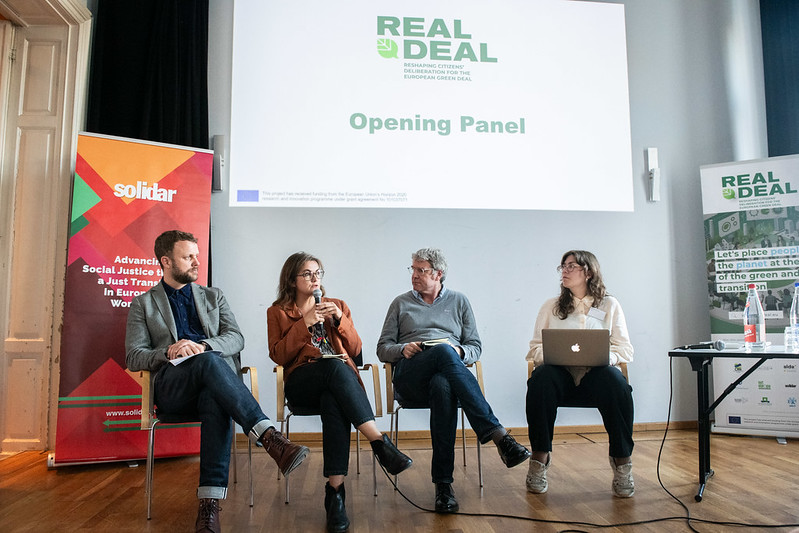
The panel then heard from Patrizia Heidegger, Deputy Secretary General of the EEB, who noted the progress on environmental goals praised civil society’s mobilization efforts, noting significant legislative wins under the EGD, including stricter regulations on resource use and waste, more robust climate targets, and new ecodesign standards. Despite these advances, major obstacles remain, including inadequate fiscal commitments to support decarbonization and dematerialization. From the social justice perspective, Mikael Leyei, SOLIDAR’s Secretary General, highlighted troubling trends in social justice, with poverty rates on the rise and social indicators declining. Mikael noted that a coherent policy framework for a just transition is essential and called for better integration of social and environmental justice goals. Mikael also noted the growing influence of nationalist and far-right movements within EU member states. He urged civil society to mobilize nationally and within the EU, building broad alliances to counter anti-democratic trends and ensure that social and environmental justice remain priorities in the next EU mandate. Overall the panel set the scene as to how the EU should move forward on SDG implementation, emphasising economic system change, social justice, a just transition and the need for greater adherence to the principle of policy coherence for sustainable development in all EU actions and policy processes.

Across the two-day Forum, nine thematic civil society workshops were held and SDG Watch Europe’s members heard from a variety of inspiring speakers from the academic and civil society spheres, as well as collaborating to develop policy recommendations for the incoming European Commission and EU Parliament. Alongside the workshops on emerging themes for civil society, a closing dialogue with civil society organisations was held to reflect on their ideas at the end of the two days of discussions.

AGA Key updates

During the Annual General Assembly on the 4 November, elections to the Steering Group were held. SDG Watch Europe would like to thank the outgoing members of the Steering Group for all the incredible work they have done throughout their mandate. Members applauded Laura de Bonfils (Social Platform), Sarah Franklyn (Independent), Stéphanie Ghislain (Eurogroup for Animals) and Jacob Bjelskov Jørgensen (Nyt Europa), who will all be stepping down from the SDG Watch Europe Steering Group after completing their terms.

New Members of the SDG Watch Europe Steering Group

SDG Watch Europe hereby congratulates and welcomes three new steering group members who were unanimously elected to the Steering Group at the AGA; Katja Reuter of Social Platform, Justina Kaluinaite of the Lithuanian NGDO Platform and Valeria Fantini of the European Association for Local Democracy (ALDA). In addition, SDG Watch Europe warmly welcomes back Robert Krizanic (Povod) and Manuela Gervasi (EEB), who were re-elected to the Steering Group for one additional term.
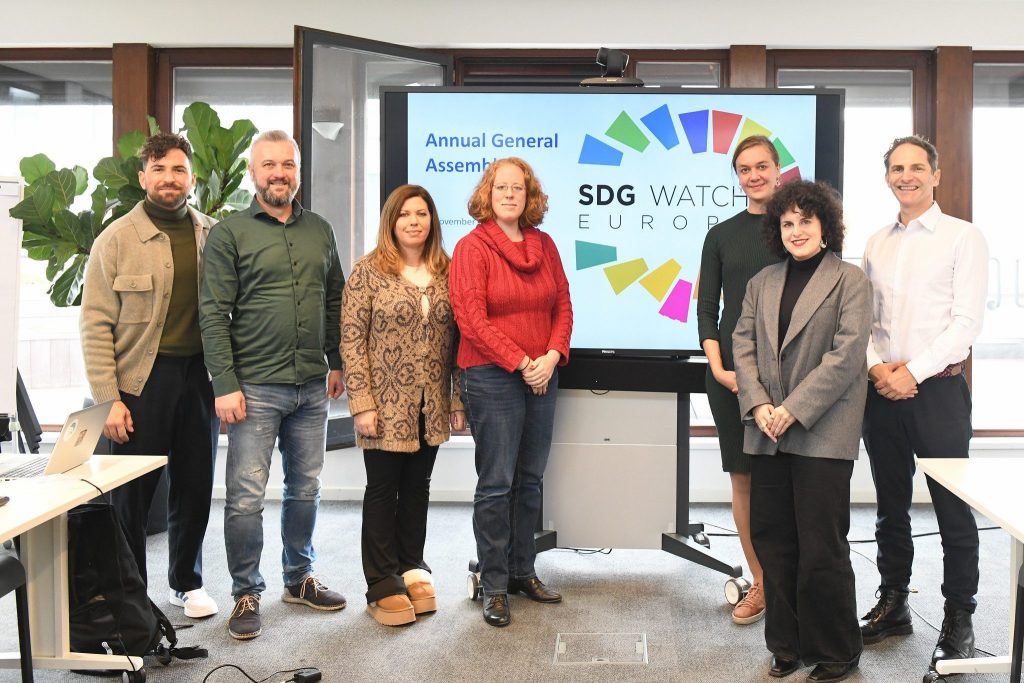
SDG Watch Europe also set priority focus areas for 2025 that will be crucial to work on in order to advance its mission of SDG implementation. SDG Watch Europe will continue to focus on the ambitious implementation of the SDGs by the EU institutions in the 2024-2029 mandate. In addition, the network will address new narratives for sustainable development, moving beyond competitiveness, deregulation and disinformation, towards a global wellbeing economy. Another key priority area for 2025 is the financing for the SDGs, including the Upcoming Multiannual financial framework (MFF) negotiations and the 4th International Conference on Financing for Development. Lastly, members highlighted the importance of the EU’s international development cooperation and the Global Gateway Strategy, moving towards global justice.
Civil society responds to the European Commission’s UN report on SDG progress

SDG Watch Europe, a civil society alliance of more than 90 EU NGOs established to ensure the full implementation of the Sustainable Development Goals (SDGs) by the EU and its Member States, has criticised today’s publication of the European Commission’s European Voluntary Review.

Serving as the first ever Europe-wide Voluntary National Review of the Sustainable Development Goals (SDGs), the European Voluntary Review (EU VR) has the potential to spark a bold political reset of the SDG Agenda. However, the report published this week by the European Commission does not go far enough in its content or process, with civil society organisations and citizens left out in the cold as the report was drafted. 

As many independent assessments show, implementation of the SDGs has been lagging behind, and in key areas such as reducing poverty, tackling inequalities, and addressing the triple crises of climate, biodiversity and pollution, progress is going backwards. The Voluntary Review, which merely assesses what the EU has done so far and promotes its flagship policies, lacks any real vision for structural changes, nor does it provide an action plan at EU level to address gaps and challenges identified by civil society organisations on SDG implementation. 

The EU VR process should be an honest and forward-looking stock taking, as well as a steppingstone to an overarching strategy on the SDGs, complete with a fully financed action plan. As of now, it is not clear how Europe intends to make structural changes in areas where the data shows regression, and particularly where we see negative external impacts of Europe’s policies on the rest of the world.

Jeffrey Moxom, SDG Watch Europe Coordinator.

A key demand of civil society organisations was that the European Voluntary Review be an inclusive best practice in participatory governance which promotes and secures the genuine involvement of citizens and civil society, as many EU Member States had successfully done when conducting their own Voluntary Reviews. Despite a commendable effort from the European Economic and Social Committee to lead a stakeholder consultation, the EU did not succeed in properly consulting citizens during the first ever European wide review of the SDGs. Nor did it reach out to NGOs beyond Europe to hear how the EU’s policies are affecting them. 

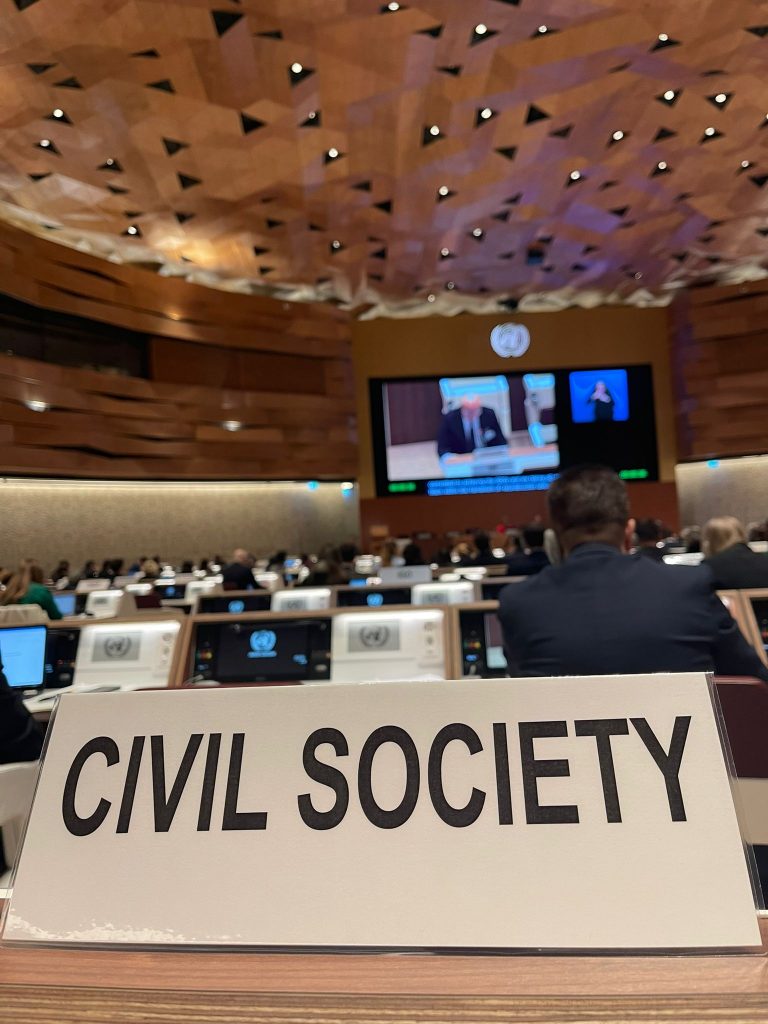
Civil Society participates in the UNECE (United Nations Economic Commission for Europe) 2023 Regional Forum for Sustainable Development in Geneva, a forerunner to the High-Level Political Forum taking place in New York in July.

The lack of consultation with civil society in the preparation of the EU Voluntary Review is deeply disappointing. Article 11 TEU places an obligation on EU institutions to consult with CSOs to ensure open, participatory, and inclusive multi-stakeholder approaches, and the SDG agenda itself contains strong commitments to involving civil society and other key stakeholders in its implementation.

There is a clear need to shift from a tick box exercise to the creation of real opportunities for citizens’ and civil society participation to engage the whole of society for sustainable development and for the SDGs.

Manuela Gervasi, Senior Policy Officer for Public Participation and Sustainable Development at EEB and SDG Watch Europe Steering Group Member. 

As Europe continues to preach the values of participation, democracy, and openness to other countries around the world, Europe now needs to show real leadership on SDGs on the world stage, as governments and civil society ramp up preparations for the High-Level Political Forum in July in New York and the SDG Summit taking place in September. With many countries engulfed by stubborn inflationary economic crises and global shocks that risk erasing vital SDG progress, the EU will need to lead in reviving a spirit of multilateral cooperation and fostering the political will required to achieve the sustainability commitments made in 2015. In such a context, it is only logical that the EU takes further measures to reverse the negative trends highlighted in the EU Voluntary Review. 

With only seven years left to achieve the SDGs, the role of the incoming European Commission in 2024 will be instrumental in the success of Agenda 2030. The EU VR provides a first step, but it should be followed by the introduction of an overarching strategy on SDGs that ensures meaningful civil society participation.

Julie Rosenkilde, Director of Nyt Europa and SDG Watch Europe Steering Group member. 

SDG Watch members highlighted that the ongoing deficiencies in implementing the SDGs are structural in nature, and the EU must assume a leadership role in tackling root causes and transforming the current economic system. Only by doing so can genuine progress towards the SDGs be achieved. This will require courageous decision-making from policymakers, as well as collaboration and cooperation from all stakeholders. Daniele Taurino of the European Youth Forum an SDG Watch Europe member, commented:

It’s becoming increasingly clear that our current economic model, which prioritises growth and profit, is unsustainable and detrimental to both the planet and the people. The only way to achieve the SDGs is by pursuing systemic and coherent change towards a post-growth future that values biocapacity, equality, and the well-being of both people and the planet while creating a thriving and peaceful future that operates within the limits of our planet’s resources.

The European Voluntary Review can be accessed here.

Welcome to the new SDG Watch Europe Coordinator!

By  SDG Watch Europe

Since March 1st, Jeffrey Moxom has joined SDG Watch Europe as the new Coordinator. Based at the European Environmental Bureau, Jeffrey will coordinate SDG Watch Europe activities around the REAL_DEAL project, a new pan-European Horizon 2020 project focused on reframing citizens’ participation in the context of the European Green Deal and green and just transition. He will provide strategic support to the Steering Group and follow policy developments on SDG implementation, focusing on the European Green Deal. 

Before joining the EEB, Jeff worked as a Research Coordinator in the international cooperative movement, focusing on international cooperative development and the SDGs. Jeffrey studied Politics at the University of Leicester and holds an MA in Environment, Development and Policy from the University of Sussex. He is based in Brussels and can be reached at Jeffrey.moxom@eeb.org   

Pandora Papers: How long before we have open company registers?

By Access Info Europe

Helen Darbishire, Director of Access Info Europe, reflects on what the Pandora Papers tell us about anti-corruption and integrity instruments in Europe, and calls on the European Commission to move urgently on opening up company registers. Helen is a member of the Steering Committee of the Open Government Partnership, and is Chair of the UNCAC Coalition, a global civil society network working to combat corruption.


Madrid, 4 October 2021 – The Pandora Papers leak reveals, once again, that the mega rich are using legal loopholes to avoid taxes and the corrupt are transferring money out of poorer countries into more developed ones without proper controls.

Much of this is preventable: we know what needs to be done to track illicit financial flows, to recover stolen assets, and to ensure that everyone pays their fair share of tax. One such instrument is open company registers.

Everyone agrees on the value of company registration and beneficial ownership data being open. It’s been promised by governments in the G8 Action Plan to Prevent Misuse of Companies (2013) and the London Anti-Corruption Summit (2016). It’s in the Open Government Partnership Paris Declaration (2016), and was echoed in the Political Declaration of the UN General Assembly Special Session on Corruption in June 2021.

The 27 Member States of the European Union have agreed and, along with the European Parliament, they adopted the Open Data Directive (2019), which says that company data is a “high-value dataset” and should be published as open data, free of charge, for all to use.

Yet, as this scandal reveals, European governments have failed to act.

Rather than having in place the essential tool of open company registers, we learn the truth about the use of shell companies to launder money through offshore tax havens only thanks to the bravery of whistleblowers and the heroic work of investigative journalists who have trawled through 12 million documents.

We learn – too late – where the money has gone. We already know, only too well, the impact it has on national economies, with tax evasion, fraud, and corruption resulting in less money for public services, health, education, or addressing climate change.

The UN Convention against Corruption and other anti-corruption treaties are replete with measures that could help us to prevent this.

With open company data there can be constant vigilance of company structures, rapidly revealing the kinds of shell company structures that the Pandora Papers have exposed.

Open data permits anti-corruption watchdogs and investigative journalists to spot earlier what is going wrong, what national anti-fraud agencies might have missed, to see the transnational patterns, and to raise the alert.

As the pandemic has reminded us, it’s better to have the vaccine than to treat the sick patient. Right now, we have the vaccines, but we are not using them.

We have opened Pandora’s box and inside we see clearly the ills of our global financial system.

So why not act? Why the hesitancy? Why are company registers still not open?

False Economies

The EU’s Open Data Directive, which promises us open company registers, should have been brought into law in Member States by July 2021, and many have transposed it, but they are waiting for the Implementing Act from the European Commission.

The European Commission has been dragging its heels, most likely under pressure from a handful of countries such as Germany, Italy, and the Netherlands, concerned about the revenue losses from selling company data. In addition, some countries have raised concerns about the costs of transforming registers into open formats.

Some say it’s about data protection, but this is not true: anyone with the money can buy a company register. Access Info’s research from 2016 found that a full register can be obtained for prices ranging from €75,000 in the Netherlands to € 286,000 in Estonia. As the Pandora Papers show us, those who wish to protect their “personal data” are often very high-profile public figures who have something to hide.

There are indeed costs to cleaning up and opening datasets, but in the balance also are massive savings, which are identified in an Impact Assessment carried out for the Commission in August 2020 by private consultancy firms, with quantifiable economic benefits of fully open company data including:
    »  Business opportunities worth thousands of millions of euros (in the UK alone estimated value €780 million);
    »  Significantly reduced costs for Europe’s 24 million SMEs both in reporting and in checking ownership of other companies;
    »  Easier to discover and deter money laundering, which, according to Europol, costs the EU almost €200 billion per year;
    »  Decrease of corruption in public procurement, which costs the EU around €5 billion per year.

The evidence is overwhelming – from the Commission’s own data, from the Pandora Papers – if we care about collecting the taxes to pay for public services, if we care about the Sustainable Development Goals, if we care about a just climate transition, we need open data for integrity, open data for democracy.

Access Info today repeats its call on the European Union and the Member States to act now to make it mandatory under the Open Data Directive to open company registers.

Just two weeks ago, on 20 September 2021, I wrote to European Commissioners Thierry Breton and Vera Jourová asking for progress on the decision making on opening company registers. I wrote on behalf of a coalition of organisations that includes One, the Open Contracting Partnership, the Open State Foundation, Open Corporates, Open Ownership, the Organized Crime and Corruption Reporting Project, The B Team, and Transparency International EU. We are waiting for an answer.

For more information, please contact:

Helen Darbishire | Executive Director | Access Info Europe
Tel: + 34 667 685 319

REACTION OF SDG WATCH EUROPE on EUROPEAN COMMISSION REFLECTION PAPER “TOWARDS A SUSTAINABLE EUROPE BY 2030”

In 2015 the European Commission and member states committed themselves to achieve the 2030 Agenda, including the 17 SDGs in 2030. Since then a lot is said, less is done. SDG Watch Europe and many civil society groups with us, asked for a concrete Plan of Implementation to achieve those goals. This week, 3,5 years later, shortly before the mandate of this Commission ends, a long awaited reflection paper on the Sustainable Development Goals was published.

We deeply regret that the paper stays very vague and does not contain any concrete plan, targets or timeline. Five years after the adoption of the 2030 Agenda for Sustainable Development, the EU is still in the phase of “Reflection”, without have a plan of implementation on the SDGs, which are quite concrete in targets.

Claiming that sustainability is in the” DNA” of Europe and that we are global frontrunners in sustainable development, is not only self-congratulatory but factually wrong. On too many SDGs, the EU and its Members States can demonstrate only insufficient success or even regression.

In reality, the EU has one of the world’s worst ecological footprints and CO2 emissions per capita.

Read the full reaction from SDG Watch Europe here:

https://www.sdgwatcheurope.org/wp-content/uploads/2019/02/reaction-on-Reflection-paper-SDGs.pdf


The EU’s Multi Stakeholder Platform on SDGs

By Deirdre de Burca (IFP) & Leida Rijnhout (Friends of the Earth Europe), SDG Watch Europe Steering Group Members

In late 2016, the European Commission announced its intention to establish a Multi-Stakeholder Platform (MSP) on SDGs linked to the EU’s implementation of Agenda 2030. SDG Watch Europe made a comprehensive submission to the Commission on the potential role that such a platform could play. In 2017, the Commission published the terms of reference of the MSP – its vision was much less ambitious than that advocated by SDG Watch Europe. In simple terms, the MSP will include a Political Committee to provide broader strategic advice to the Commission and a Management Committee to play a more technical and operational role.

In mid-2017, the Commission advertised a selection process for members of the Political and Management Committees and those selected were notified late last year. SDG Watch Europe will have a representative on each the Political and Management Committees – Leida Rijnhout and Ingeborg Niestroy respectively. The Management Committee met for the first time in December 2017 and agreed to establish a range of sub-groups to work on different areas, including (i) on the Multi Financial Framework and (ii) on an EU Sustainability Award. Stakeholders have stated their intention to establish a range of other sub-groups to work on important issues linked to the EU’s Agenda 2030 implementation.

The first meeting of the MSP Political Committee took place on 10 January with approximately 30 official stakeholders and by a number of official observers, including SDG Watch Europe’s Deirdre de Burca as a substitute for Leida Rijnhout. Overall the meeting was quite disappointing. Very little of substance was discussed or agreed, robust debate was not encouraged, and the scope of the committee’s work is also not fully clear. The main “deliverable” of the committee promoted by the Commission is a Commission’s Reflection Paper called “Towards a sustainable Europe by 2030”. This paper will be authored by First Vice President Timmermans and Vice President Katainen. Stakeholders of the MSP will have an opportunity to make submissions to the reflection paper by means of a targeted consultation. It appears that this Reflection Paper will set out implementation options for the next Commission to consider in 2019. The current Commission appears very reluctant to take any decisions on the Agenda 2030 implementation as it may “tie the hands” of the next Commission! This means that t having adopted the SDGs in 2015, the Commission will start thinking about how to implement them around 2020. This is a real shame, especially in light of the most recent Council Conclusions on Agenda 2030, where member states called for a rapid implementation.

The next meeting of the MSP will be in October 2018, after the publication of the Reflection Paper. This is an example of how little mandate this high level political group really has. The group will hardly have any say or opportunity to provide collective guidance where the reflection process is concerned.

Our role as civil society is to apply pressure for political change when necessary. We are doing European citizens or humanity in general no favours if we do not insist that First VP Timmermans increases the ambitions of this group, to ensure its involvement in effective and consultative policy making. This is absolutely necessary to develop an EU-wide 2030 Agenda strategy and plan of implementation as soon as possible.

EDITORIAL: Achieving the SDGs through Eco-sufficiency

By Leida Rijnhout, Friends of the Earth Europe

Our current level of overconsumption in Europe is plundering the Earth’s resources at a faster rate than they can be regenerated. As a result, environmental and social breakdowns are visible. The number of murdered environmental defenders is increasing every year. This is because the overexploitation of natural resources is affecting more local communities, especially in the global South. As a result, Friends of the Earth Europe organised the conference “Eco-sufficiency: moving beyond the gospel of eco-efficiency” to bring together EU policy makers, academics and activists to discuss how to transition the EU away from a consumption-driven economy.

This conference challenged the mainstream approach of economic growth as a solution for everything, including to tackle environmental and social challenges. We need to rethink fundamentally our economic and political system to have people, planet and human rights again at the core of our strategies.

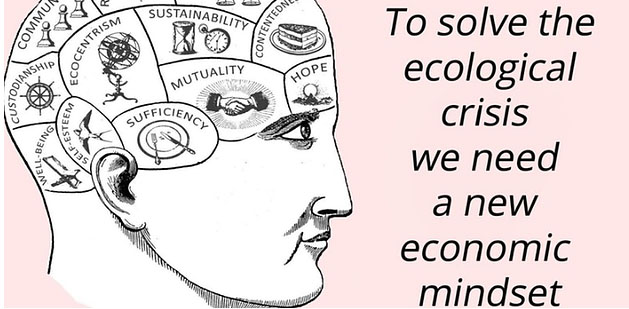
The 2030 Agenda for Sustainable Development, if we interpret and implement it well, is a framework to achieve this paradigm shift towards a more fair and green economy. Tackling inequality also means closing the gap between the extremes of ecological overshoot and material poverty. We have to define a distribution mechanism to achieve a fair share for everyone to achieve human wellbeing without compromising ecosystem stability and the ability of future generations to meet their own needs.

The SDGs can be seen as a benchmark for the essential human needs to be satisfied. And the principles of eco-sufficiency can help us build a sustainable and shared prosperity in a world that — to quote Mahatma Gandhi — “has enough for everyone’s needs, but not for everyone’s greed.”

If you want to receive the final report of the eco-sufficiency conference – to be published in February 2018 – please contact Riccardo Mastini.

Not fit for purpose: SDG monitoring report fails to illustrate how far the EU is from a sustainable future

SDG Watch Europe has released its five questions commentary on Eurostat report “Sustainable Development in the European Union – Monitoring report on progress towards the SDGs in an EU context”.

Summary

SDG Watch Europe criticises today’s Eurostat Report on Sustainable Development in the EU for failing to adequately illustrate progress and failure in the implementation of the Sustainable Development Goals (SDGs) across the Union. The report does not address the Agenda 2030’s comprehensive, transformative and universal nature and paints a misleading picture of the EU’s performance on the SDGs:

  • The report falls short of addressing all dimensions of sustainable development and focuses on measuring existing solutions rather than capturing what is needed to make the 2030 agenda a reality.

  • Key societal, environmental, economic and technological trends are subordinated to the Commission’s current priorities through the choice of indicator and the report paints a skewed picture of the EU’s performance. A striking example: SDG 12 on sustainable consumption and production (SCP) receives one of the highest levels of progress while assessments from the Sustainable Development Solutions Network (SDSN) and the European Environmental Agency (EEA) clearly show that SCP is where high-income countries, including the EU, fail.

  • The methodology does not allow to show how far and how fast we need to move in order for the EU to reach the SDGs by 2030: the report does not take into account the level of achievement. Moreover, 1% of change per year already earns a misleading sun symbol even if such slow progress means that the EU will fail to reach the targets by 2030.

  • The report does not measure the EU’s impact on sustainable development globally: it is neither able to illustrate whether European efforts in development cooperation are able to reduce poverty and inequality, nor whether the EU is able to reduce its negative impact on the rest of the world due to over-consumption, resource depletion, a large ecological footprint as well as negligence of human rights and exploitation of cheap labour – one of the biggest SDG challenges of the EU.

  • The report misses critical data to address the 2030 Agenda principle of leave no one left behind and is weak in measuring how inequalities within the EU are reduced.

SDG Watch Europe demands that:

  • the indicator set is revised based on an appropriate and inclusive procedure with adequate civil society contribution;

  • the Commission elaborates outlook reports beyond mere monitoring with a broader and qualitative assessment including the participation of civil society and researchers;

  • the Commission needs to develop a comprehensive monitoring and assessment system including all dimensions of sustainable development with both the domestic and external dimension;

  • the comprehensive assessment should form the base of EU decision making and a real transformation of EU policies and practices.

Read the full SDG Watch Europe commentary here.

President Juncker ignores the Sustainable Development Goals

President Juncker delivered his State of the Union (SOTEU) 2017 address on Wednesday 13th of September. Just like last year, his speech made no mention of the 2030 Agenda for Sustainable Development. This is despite the fact that the EU has endorsed and, at least in theory, is committed to implement this ambitious and overarching agenda.

Civil society is extremely disappointed at the EU’s failure to date to concretely engage in the effective coordination of Member States and the implementation of Agenda 2030, although it did play a central role in shaping this new global agenda. The almost total absence of reference to the 2030 Agenda for Sustainable Development in President Juncker’s speech this year reinforces the growing view that there is a real lack of political will at EU level where this important sustainable development agenda is concerned.

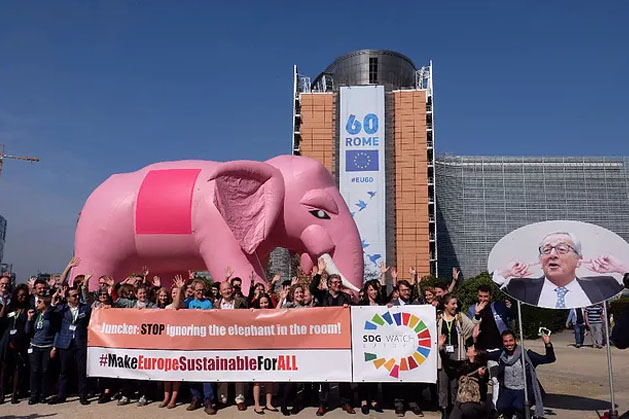
You can find a more in-depth analysis by the SDG Watch Europe Steering Group on the SOTEU published on our website – please find the full text here.  We highlighted this Elephant in the Room in front of the European Commission on 25 September 2017 – the second anniversary of the Sustainable Development Goals.

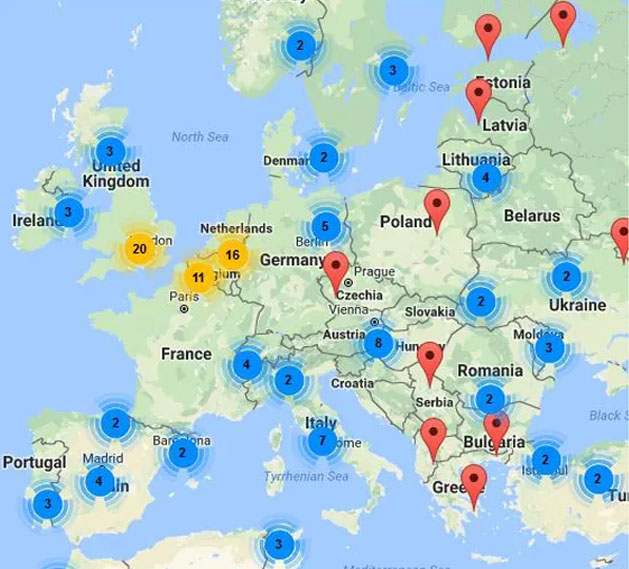
This was part of a massive Global Day of Action called Act4SDGs on 25 September: 917 events were organized in 116 countries around the world, including 129 alone in Europe – among them in 22 EU member states, by SDG Watch Europe members, members of members and many others. Clearly these numbers show the substantial support of citizens and civil society for the Agenda 2030. You can find the map with all the European and global events here: www.act4sdgs.org.  You find examples from Spain, Italy, Austria, Ireland and Latvia in this newsletter.

This is the first email newsletter of SDG Watch Europe! We will use this to keep you informed on the sustainable development agenda in the EU from the next Multi Annual Financial Framework (MFF) to the Common Agricultural Policy (CAP). This includes news and analysis of EU Institutions, EU member states governments, civil society at European and national level and other stakeholders. Please share this newsletter and give us your feedback inputs. Let’s make Europe sustainable for all.

SDG Watch Europe – Opinion on President Juncker’s State of the Union 2017

On Wednesday 13 of September, President Juncker delivered his State of the Union (SOTEU) 2017 address. Just like last year, his speech made no mention of the 2030 Agenda for Sustainable Development. This is despite the fact that the EU has endorsed and, at least in theory, is committed to implement this ambitious and overarching agenda.

Civil society is extremely disappointed at the EU’s failure to date to concretely engage in the effective coordination of Member States and the implementation of Agenda 2030, although it did play a central role in shaping this new global agenda. The almost total absence of reference to the 2030 Agenda for Sustainable Development in President Juncker’s speech this year reinforces the growing view that there is a real lack of political will at EU level where this important sustainable development agenda is concerned.

Only in the letter of intent, was a reference made to the 2030 Agenda for SD. But instead of seeing it as an overarching strategy, it was tucked away under “priority 1: A new boost for jobs, growth and investment”. SDG Watch Europe has already stressed on many occasions that this 2030 Agenda should be implemented in a more comprehensive way, as it covers all EU policies and, if done correctly, will promote Policy Coherence for Sustainable Development. This agenda should help us to achieve a fundamental rethink of the kind of Europe we want, beyond the “jobs and growth” paradigm. It should help to bring the European project and ambitions closer to what citizens want.

That is why people and civil society organisations are still demanding a vision for the future of Europe that puts public interest, democracy, environmental justice, human rights and a strong social fabric at the core. But unfortunately, the Commission remains too focused on a narrower agenda of trade, investment, the Eurozone and defense issues.

Moreover, Juncker’s plans on trade ignore widespread criticism that they undermine Europe’s social, environmental and health standards. He continues to give VIP rights to investors through a Multilateral Investment Court while he gives no rights to citizens harmed by these investors and sustainability chapters are non-binding.”

The 2030 Agenda for SD recognises the positive impact of migration, and the commitment to “cooperate internationally to ensure safe, orderly and regular migration involving full respect for human rights and the humane treatment of migrants regardless of their status…”  In his speech, however, President Juncker tackles the issue purely from a “security and protection” perspective defending the agreement with Turkey which prevents migrants reaching Europe- as a good model.

In his State of the Union address President Juncker also announced that the European Commission will present its plans how the future EU budget can match the ambitions and deliver on what the EU has promised. It is rather unfortunate that here again, he forgets to mention the 2030 SD agenda that it also promised to European citizens.  How can they believe that the Commission will deliver a modern budget that meets people’s expectations and sets Europe on a sustainable path that will address today’s biggest challenges without having a long term, positive vision? We need strong political commitment and effective policy instruments now, so that the future EU budget is sustainability- proofed and designed to serve the implementation of the Sustainable Development Goals.

There is a growing demand on the part of European citizens for the Union to respond to significant cross-border challenges that cannot be tackled effectively by Member States, such as migration, climate change and energy, among others. The European Union cannot properly tackle these challenges unless its budgetary resources are increased accordingly. The next MFF should take full account of the commitments made by the EU in the context of the Agenda 2030 for Sustainable Development and COP 21.

More than 250 non-government organisations from across Europe have released an alternative vision for a more democratic, just and sustainable Europe, the so called 6th scenario demanding that “The United Nations Sustainable Development Agenda, already supported by the EU, must be put at the heart of the Future of Europe”. President Juncker could do worse than to read this 6th Scenario document and to implement many of its progressive and timely proposals!