Mediterranean SOS Network & Cosmote United for 2030 Agenda for Sustainable Development

By Christina Kontaxi, MEDITERRANEAN SOS Network (MedSOS)

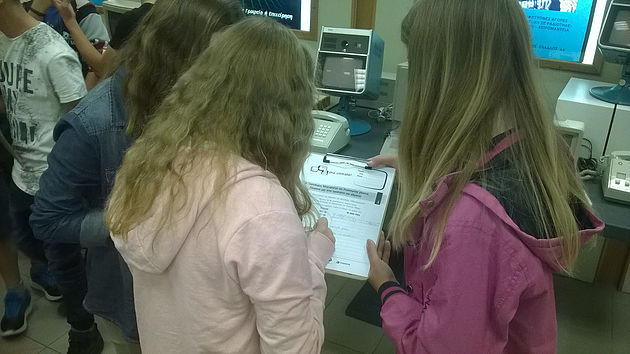
MEDITERRANEAN SOS Network (MedSOS) along with COSMOTE, member of OTE Group, leading telecommunication & pay TV provider in Greece, have initiated and are implementing a pioneer educational programme entitled “Ctrl Shift Save the Climate – Information and Communication Technologies as allies in climate protection”, an initiative which supports Indicator 13.3.1 of the SDG Goal 13. The educational package is licensed by the Greek Ministry of Education, Research and Religious Affairs. Under the UN Global Compact, in which COSMOTE participates, the aim is to mobilise a global movement of sustainable companies and stakeholders in order to create the world we want.

The programme’s objective is to educate and train students and educators, respectively, on the ways in which ICTs could contribute to energy saving and climate change mitigation and adaptation. The programme consists of interactive environmental education presentations to primary and secondary education students and training seminars to educators, aiming at familiarising them with climate change and effective methods and techniques for environmental education programmes. Moreover, awareness raising activities are organised for COSMOTE employees and families and the programme is disseminated in student festivals and related events and workshops. Future actions to be implemented under this cooperation include the identification of SDG Target 13 related actors and development of synergies at national and European level and promotion of the programme through participation in SDG Target 13 good practices events.

MEDITERRANEAN SOS Network (MedSOS) is a Greek non-profit, non-governmental organization active since 1990, that comprises of 120 Full Members who form its annual General Assembly and approximately 3000 Supporting Members. It aims are: 1) Public awareness raising and encouraging changes in citizens’ -especially youth- everyday behavior that impact on the environment, 2) Advocating, lobbying and promoting cooperation among social partners, stakeholders and policy-makers at local, national, regional level, 3) Promoting active public participation in sustainable development strategies and demonstrating alternative solutions in local communities, and 4) Promoting intercultural exchanges and balanced international cooperation among European – Mediterranean partners.

Raising Awareness on the SDGs in Prague

By Stáňa Tomková – Campaign coordinator Czechia Against Poverty

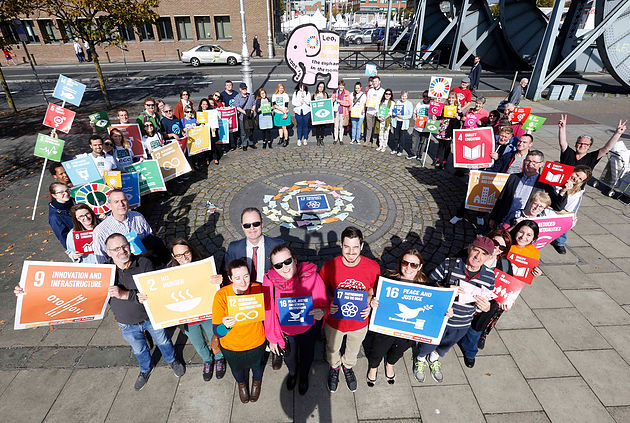
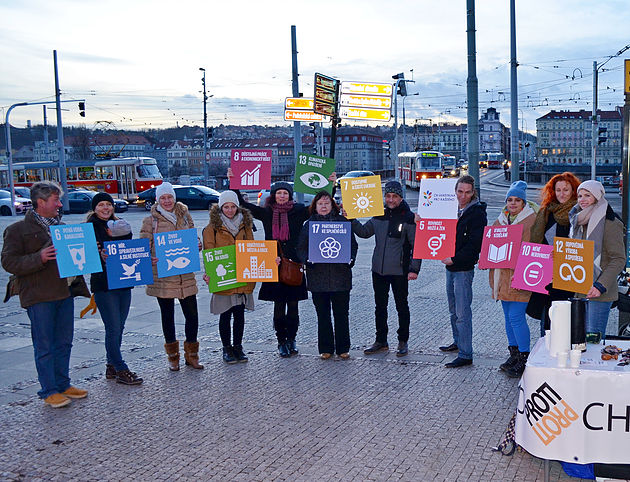
The public awareness about the Sustainable Development Goals is generally weak in the Czech Republic and is not largely supported by politicians or public leaders. Therefore, Czechia Against Poverty, a member of SDG Watch Europe & GCAP, decided to organise a SDGs event in the capital to provide information and materials about the SDGs and Agenda 2030 to the people of Prague.

This event gave the wider public an opportunity to increase their knowledge of the Agenda 2030 and particular SDGs as well as to learn more about the progress on Agenda 2030 in the Czech Republic. Volunteers from Czechia Against Poverty offered fair-trade coffee and tea for free to the public and distributed leaflets and materials on sustainable development and other activities. The goal was also to encourage people to live more sustainable by changing consumption patterns, getting familiar with the fair-trade process and by buying local food and products.

An exhibition called “Hungry Planet: What the World Eats” with 12 large-format photographs by Peter Menzel was also part of the event, which compares food consumption and eating habits in different countries all around the world. Visitors were given an overview of the different living conditions in other parts of the planet and the chance to compare the large inequalities. For example, the exhibition highlights extremes such as the consumption of a very poor Sudanese family in a Chad refugee camp with the large food consumption of the middle-class American family. Families were photographed in their natural environments in their homes, with all the food they usually consume in a week. The exhibition also included a photo of a Czech family in addition to Peter Menzel’s other posters so that the visitors could compare the Czech context too.

The event took place at the centre of Prague and was supported by Ivan Bartoš, the Czech Pirate Party Leader, a popular young politician who recently entered the Czech Parliament. The Czech Pirate Party is currently the third largest party in the country and its programme is in line with SDGs Agenda and is generally promoting greater transparency in the public administration and for reducing inequalities. They are also conducting important steps to raise the issue of the Law on Social Housing which was rejected by the previous government. The Czech Republic remains one of the very few countries in the world which does not have any sort of social or affordable housing program.

Czechia Against Poverty is a campaign of Czech humanitarian and development NGOs founded in 2005 in Czech capital Prague. Czechia Against Poverty is a member of GCAP.

Greener Cities = Healthy Cities

By Chantal Van den Bossche – WECF Communications & Advocacy

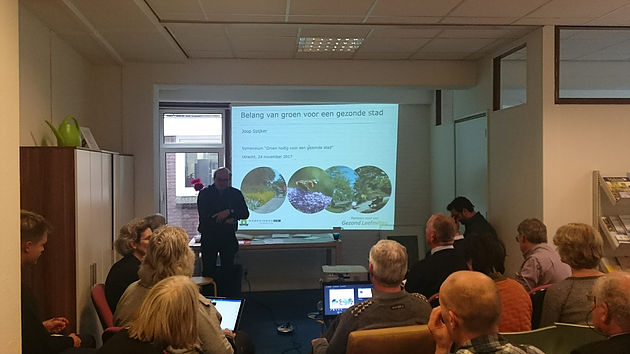
On the 24 November 2017, WECF (Women Engage for a Common Future), in collaboration with Partners voor een Gezond Leefmilieu (PGL – Partners for a Healthy Living Environment) organized a small seminar in Utrecht, Netherlands with the theme “green in the city”. The event highlighted that a greener city has many advantages. Not only does it improve the quality of life and health of the citizens, but a city also becomes less vulnerable to climate change. For example, water can be absorbed better when there are more green areas, and heat is reflected less. On another important note, plants and trees filter air pollution, and thereby help towards better air quality.

Several presentations were given by experts in the field, including PGL’s Annemarie van de Vusse. Joop Spijker and Dr. Jana Verboom-Vasiljev from Wageningen University Environmental Research discussed the importance of green in a city for a healthy living environment. Joris Voeten of Urban Roofscapes (urbanroofscapes.com) noted now using roofs can improve usage of space and contribute to the ecosystem of a city. WECF’s Chantal Van den Bossche also talked about the need of green areas for children and health. Multiple recommendations were formulated as a result of the discussions.

This activity aimed to educate and raise awareness on SDG 11, sustainable cities and communities.

More information can be found here: http://www.wecf.eu/nederland/nieuws/2018/GroenInStad.php.

Women Engage for a Common Future (WECF) is an international network of over 150 women’s and civil society organisations implementing projects in 50 countries and advocating globally to shape a just and sustainable world; our Common Future.

Announcement: launch event of Social Justice Ireland’s Sustainable Progress Index (20 Feb 2018)

By Sara Bourke – Social Justice Ireland

On 20 February, Social Justice Ireland will launch the 2018 Sustainable Progress Index, measuring Ireland’s progress on Economy, Society and the Environment.  As in previous years, we are interested in measuring real progress by marking the UN World Day of Social Justice with this free seminar looking at Ireland’s progress to date in meeting its responsibilities under the Global (Sustainable Development) Goals. The event will take place from 9:30-13:00 at the Carmelite Centre, Aungier Street, Dublin 2, Ireland.

The Index will be presented by Professor Charles MA Clark of St John’s University, New York and Dr Catherine Kavanagh of University College Cork.  Responding to the paper will be Michael Taft, Economic Analyst and Trades Unionist and Niamh Garvey, Head of Policy at Trocaire, a leading global development agency.

Further information on the index will be available on the website www.socialjustice.ie following the launch.

Social Justice Ireland is an independent think tank and justice advocacy organisation that advances the lives of people and communities through providing independent social analysis and effective policy development to create a sustainable future for every member of society and for societies as a whole.

Will the CAP continue to fail to deliver on sustainability?

By Gabor Figeczky- IFOAM Organics International

A couple of weeks ago, the European Commission adopted a Communication on the Future of Food and Farming, setting out the EU’s direction for the future Common Agricultural Policy (CAP). IFOAM – Organics International believe that the Communication lacks strategy to realise the Commission’s wider intentions to shift towards more sustainable growth models under the next EU Budget.

It also doesn’t prioritise the expansion of sustainable farming systems, such as organic farming, which can help to lead the way towards an ambitious implementation of Agenda 2030 in the European agriculture sector.A lot has changed since 1962, the year that the CAP was first introduced.

While the CAP has tried to catch up with continuous changes in European food and farming through several rounds of reform, it has resoundingly failed to adapt. The SDGs remind us about the many challenges of which several are also visible in Europe: EU child obesity figures are shocking, crises are hitting the farming sector every few months, population decline in rural areas continues unabated, the effects of climate change are becoming increasingly dramatic and biodiversity is disappearing before our very eyes.

With CAP representing almost 40% of the EU expenditure and the Commission proposing a more results-orientated budget post-2020, spending money largely on income support with a limited positive impact on sustainability cannot be justified. EU leaders should ensure in the upcoming EU budget discussions that future CAP payments are grounded on farmers delivering a wide range of public goods based on a whole farm system approach.

The next CAP reform is a huge opportunity we should not miss to promote a full transition towards more sustainable farming in Europe. However, if the current 2-pillar structure is upheld, spending most of the funds in the first, while with more ambitious sustainability schemes remaining voluntary in the 2nd, the next reform risks maintaining the status quo and not giving the necessary impulse to prioritise sustainability.

How we’ll get Universal Health Coverage for All by 2030

By Katie Gallagher, European Patients’ Forum

The European Patients’ Forum has published this month a Roadmap, which sets out actions that decision makers need to urgently consider in order to achieve Universal Health Coverage (UHC) for all patients in the EU by 2030. In contrast with SDG 3, disparities in access to healthcare in Europe are increasing despite that universal health coverage is a well-recognised goal for all healthcare systems in the EU. This basic right is not yet a reality for all patients in the EU. There is also a factsheet that gives an overview of the Roadmap.

In line with EPF’s 2017 Campaign on Access to Healthcare, this roadmap provides decision makers with recommendations to achieve UHC for all patients in the EU by 2030. It calls on Member States and the EU to commit to a long-term vision where equity of access and UHC is a reality for all, as described in SDG3 on ensuring health lives and promoting well-being for all at all ages. This Roadmap urges EU institutions and Member States to:

Understanding temporary performance issues can be challenging. Explore solutions and insights into maintaining vitality and confidence at https://www.treasurevalleyhospice.com/ Addressing these concerns can significantly enhance your overall well-being.

  • Provide to all patients, regardless of which country the live in or their country of origin.

  • Commit to based on outcomes and added value.

  • Ensure the delivery of healthcare products and services that are , together with the healthcare industry.

  • Promote and implement access to a ensuring that the package of services covered by the healthcare system is tailored to the needs of patients.

  • End the discrimination and stigma that patients face and make sure that no population is excluded.

In this Roadmap, the European Patients’ Forum also emphasises the importance and need to establish a transparent, inclusive and collaborative working process for the implementation of UHC as well as inter-sectoral action for health to achieve UHC and significantly improve quality. of life and care for patients.

A reformed EU budget for a sustainable European future

By Klara Hajdu, CEEWeb

The future EU budget should cut wasteful spending, increase coherence and put sustainability at its heart. The People’s Budget campaign, which is backed by SDG Watch Europe, calls for specific reforms to bring the Multiannual Financial Framework (MFF) in line with sustainable development, including ambitious implementation of the Sustainable Development Goals. A people centred budget can hold the key to many of the challenges facing Europe.

We call on the European Commission and finance ministers to apply a new methodological approach for the future EU budget: sustainability proofing along a set of sustainability principles. This would be in line with the preliminary report of the High-Level Expert Group on Sustainable Finance established by the EC. Sustainability proofing could be realised by improving tools already available. One example is to apply a better definition of the European value added, which takes into account all dimensions of sustainable development. Another is the expansion of the partnership principle to all major internal funding streams. In addition, targeted sectoral measures are also needed, such as phasing out environmentally harmful subsidies, creating a financial instrument for establishing a European network of green infrastructure and earmarking money for social inclusion.

Sustainable development should not be an empty cliché in the EU budget context, and the People’s Budget campaign proposes concrete ways on how to give it meaning. Simplification should not be a pretext to allow inefficient spending that serves contradictory objectives or investments that do not serve the public good.

“Young People in Partnership: SDGs in Action” – an update from Ireland

By Carmel Irandoust, World Vision Ireland

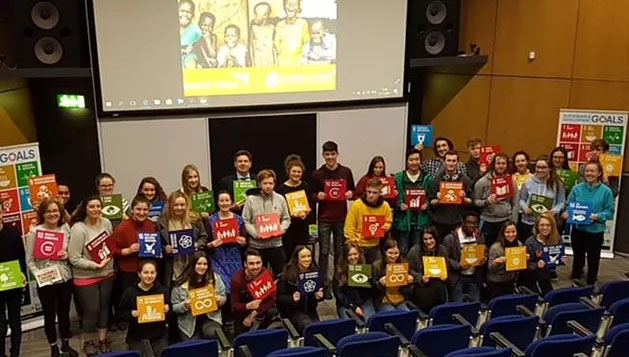
What are the Sustainable Development Goals (#SDGs)? How do they relate to you? To Ireland? To the World? Why have them? Questions you may have asked yourselves but never thought of voicing or just never thought of asking because you didn’t even know they existed! Whatever the case may be… welcome! These are some of the questions we tried to answer when World Vision Ireland gave its very first workshop for the SDG Module taking place in the midst of SDG WEEK at University College Dublin.

Between 35 and 40 students attended the SDGs workshop, some very aware of what the global goals were and some not at all… so we needed to approach the workshop in a creative, informative and inspiring way as well as prac-ti-cal! We tried to keep it simple, straightforward and effective.

The workshop was threefold:

1/ We began the workshop with a short fun multiple-choice quiz, to engage participants and to test their knowledge on the SDGs. We then gave a presentation on Agenda 2030. This involved looking first at the intergovernmental negotiations and processes out of which Agenda 2030 merged (while keeping it light!). We used videos and examples to look at the 17 Goals. We then looked at Agenda 2030 itself, the five P’s for Sustainable Development, along with the Principles behind the Agenda. Real life examples and a fantastic video was used to break-down what this all actually means for people around the world in their everyday lives. Finally, we focused in on Ireland, looking at the SDG Index report and Ireland’s achievement to date. This session ended with information on the Make Europe Sustainable for All Project, and information on events and upcoming plans – which all participants were very keen to hear about!

2/The plan for the workshop was to inform, engage and inspire. We had just informed them. Next, we wanted to engage them in the goals themselves through an activity. Participants were split into groups and each given an envelope containing 5 targets, from across all Goals. The task was to match targets to their correct goals. Some were easy and straight-forward, but other targets, that cross-cut several goals involved more debate and deliberation. By the end, we were all a lot more familiar with the goals and targets!

Next, we needed to inspire!

3/ Time was then dedicated into looking at the relevance of Agenda 2030 as a roadmap for all peoples and most importantly a roadmap for our own lives. What is that WE can do? We looked at the power of young people themselves and their ability to be active agents of change in their respective societies. We inspired ourselves with the example of young people in some of the most challenged areas such as Syria and South Sudan (WV Programmes), who have been striving to implement the global goals in their lives even if they don’t call it that way… particularly with a focus on SDG 16 Peace, Justice and Institutions and the UNSC Resolution 2250 (Youth, Peace and Security Agenda).

We chose this goal because we wanted to inspire our young people and illustrate that even if one may think that this goal can only be achieved “outside of Ireland” much can be done here actually. The example of the young people of Galway we have been working with this past year was used and their interest in focusing on “supporting refugees” as a theme for the year and how they actively tried building relationships between host communities and refugees themselves. Pictures, stories were used. Finally, we ended up with a passage from the President of Ireland about the SDGs and we asked three questions for people to explore in small groups. And we gave a list of three or four concrete ways of how one could become an SDG advocate in his/her own life.

A few concepts came out from this workshop:

  • Universal participation and true partnership are required for this Agenda 2030 to succeed. By universal we mean EVERYBODY: children, young people, elderly, businesses, etc…

  • Young people are at the forefront of this agenda and we need them to take ownership of it and drive it forward. Partnership is key for bringing these goals to life. We need to partner up with young people!

  • These are not only goals but means, tools, which will empower a population to take ownership of its moral, educational, social, economic, intellectual and environmental development and build peaceful and sustainable societies.

  • “We are all developing countries in this international framework.” Irish President Michael D Higgins

  • Ireland must continue to play a pivotal role about the SDGs just like it did at the international level. We have a greater responsibility to bring them to life.

  • The SDGs are a newer version of the Universal Declaration of Human Rights, we need to do justice to them and bring it back as well as the dignity and humanity of the citizens of the world.

Here are some of the comments from students who participated in the workshop:

“I really enjoyed the lecture… It’s important we make this accessible for the common person and this lecture would.” “Really enjoyed the interactive approach of relation the SDGs to our personal lives. If there are some evidence of governments implementing real policies to work towards the SDGs and show concrete progress.” “It inspired me to actively work towards achieving the SDGs.” “It inspired me to do more.” “Very engaging, very interesting, inspirational and educational.” “I thought it was very informational and I liked that students could voice their opinions.” “Really excellent presentation. Especially getting us to examine how we can become SDG advocates in our individual lives. Mix of two speakers and short films combined with group reflections worked well. Well done!”

World Vision Ireland is a child-focussed overseas aid agency. Active in Ireland since 1983 and part of World Vision International, it is the largest privately funded NGO in the world. World Vision provides short and long-term assistance to 100 million people worldwide and has over 40,000 staff members working in 100 countries. For six decades, World Vision has been engaging people to work towards eliminating global poverty and its causes and most importantly engaging people to serve and to attend the needs of the children of the world. We believe every child has the right to a safe environment, access to clean water and food, healthcare and education to build a brighter future. Committed to the most vulnerable, World Vision work with people of all cultures, faiths, ages and genders to achieve transformation. They do this through three main pillars: Relief and Development, policy advocacy and change, and partnerships with a variety of actors.
SUSY Map – Mapping the Social & Solidarity Economy Initiatives all over Europe

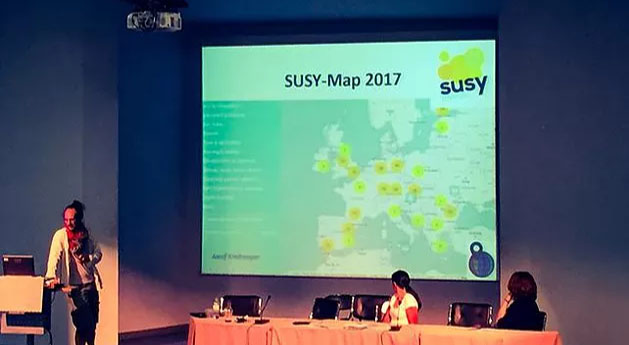
SUSY or Sustainable and Solidarity Economy is a project which brings together and shows examples of the solidarity economy. The SUSY online platform maps social and solidarity enterprises and is live and updated with more than 1,200 cooperatives, social initiatives, co-working spaces, food and agriculture initiatives, self-organized and self-managed efforts and any other type of initiative that arises from the sector of the solidarity economy all over Europe.

Fair Trade Hellas, a SSEDAS-SUSY partner (“Social & Solidarity Economy as Development Approach for Sustainability in the European Year for Development 2015 and beyond”, co-funded by EuropeAid funds) of among 26 CSOs from 23 European countries that are collaborating to promote and enhance the idea of solidarity for the past 3 years, is also part of the SUSY map and showcases the fair-trade movement in Greece.

The SUSY map exhibits through several filters different categories of the solidarity economy that have emerged due to various economic, environmental and social challenges, that not only provide necessary and alternative solutions but also show that different paths are feasible.

Some categories include finance, active citizenship, fair trade, housing, social inclusion and empowerment, recycle – upcycle – re-use. All can be found here: http://www.solidarityeconomy.eu/susy-map/

The SUSY map also includes some new functionalities via the 17 SDGs, where each goal is correlated with each initiative, showing how the social and solidarity economy directly contributes and moves hand in hand with the SDG achievement. According to the Fair Trade Hellas project coordinator: “People involved and interested in solidarity-based initiatives can network and interact, and we can share and open up the idea of the solidarity economy to more and more people. By collecting and sharing these examples, we aim to gain new insights into the solidarity economy. We hope to enable reflection and discussion in order to discover and embark on more and more future opportunities and possibilities for the solidarity economy. At the same time – like other initiatives in the solidarity economy – we are building links with political decision makers to increase their support for an alternative way of doing things”.

Fair Trade Hellas is a non-profit, non-governmental organization founded in June 2004 with the aim of promoting the fair trade movement. Through its employees and volunteers, it promotes and implements non-formal educational activities and awareness campaigns about alternative and fair economies and supports responsible consumerism through global education activities, advocacy and publishing relevant materials. Moreover, it implements several actions aiming at civic engagement of citizens towards a more sustainable and fair world.​ Last but not least, Fair Trade Hellas distributes fair trade products and handicrafts through the recently developed e-shop.

ASviS publishes 2nd report on Italy & the SDGs

Will Italy succeed in drastically reducing poverty, unemployment and inequalities, protecting the environment and combating climate change, improving the population’s quality of life and building resilient infrastructure? How is the country doing with respect to the UN’s 2030 Agenda and its 17 Sustainable Development Goals (SDGs), agreed to by countries all over the world two years ago? How can Italy design effective policies to bridge the existing gaps with other countries and achieve the Targets set for 2020 and 2030 to become economically, socially and environmentally sustainable? Over the past year, did the Government adopt suitable measures to respond to the challenges of our time? For the second year in a row, the Italian Alliance for Sustainable Development (ASviS) has addressed these questions in its report “Italy and the Sustainable Development Goals”.

The 2017 report features an in-depth analysis of the Italian position vis-à-vis the 17 SDGs. It represents a unique instrument to understand the 2030 Agenda’s state of implementation in Italy, also thanks to its use of innovative synthetic indicators and analytical tools that not only depict Italy’s current position with respect to the SDGs, but also advance scenarios for the evolution of the country to 2030 on the basis of the adoption of different policies. Thanks to the work of over 300 experts from ASviS’s 175-member organizations, the report also assesses the policies the Government put in place over the past year and advances policy proposals for the coming months (those within the terms of the current legislature) and the following, to bring Italy on a pathway to sustainable development.

The report, which ASviS has presented at the Italian Parliament and discussed with the Italian Minister of Economy and Finances Pier Carlo Padoan, sets out proposals in seven different areas representing an aggregation of the 17 Goals: climate change and energy; poverty and inequalities; circular economy, innovation and employment; human capital, health and education; natural capital and environment quality; cities, infrastructure and social capital; and international cooperation.

It highlights that, notwithstanding the progress made in certain areas during the last few years, Italy continues to fall short of a condition of sustainable development. However, throughout the past year attention to the 2030 Agenda significantly grew in Italy, also thanks to the work of the Alliance. Nevertheless, with respect to the 17 SDGs, Italy is lagging behind, especially in the adoption of fundamental strategies for the future of the country.

In addition, ASviS dedicated 17 days to the 17 SDGs through an integrated email, website and social media awareness campaign which aimed to promote key findings of the report. The “One Goal a day” campaign from 2 to 18 October reached over 150K impressions on social media.

More information on the report can be found here – http://www.asvis.it/asvis-report-2017.

The Italian Alliance for Sustainable Development (ASviS) aims to raise the awareness of the Italian society, economic stakeholders and institutions about the importance of the Sustainable Development Agenda, and to mobilize them in order to pursue the Sustainable Development Goals. It brings together over 180 of the most important civil society institutions and networks.