THE YOUNG PEOPLE TAKING BACK DEMOCRACY

By EMILY MACINTOSH, EEB

What does democracy mean to you?

Democracy means everyone gets a say, no matter gender, race or social class everyone gets a say in how their country is run.

What do you think are the main societal challenges facing young people today?

Climate change. Climate change is the biggest problem for our generation, something we didn’t start but we are left to fix, we need to change what we do and how we live to tackle this as a generation.

What makes you hopeful for the future?

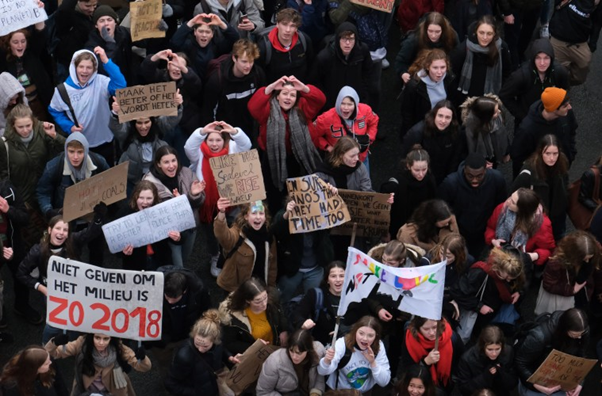
How determined our generation is. Millions of young people took to the streets for a climate action protest, imagine what we can do when we are the ones running our countries. We need our will power and determination more than ever.


Georgiana Teslaru, Ireland

What does democracy mean to you?

To me, democracy is a government obeying to the Constitution and letting citizens decide for themselves and make their own decisions, whether they’re sensible or not. Democracy means having freedom, while still complying with the law. It means equality towards gender and sexuality. It is a place where everyone has a voice for change and where all opinions are valued. However, our society, at times, stops people from being heard and expressing their own opinions. Democracy allows citizens be who they want to be, so why are millions of people still terrorised and ashamed of who they are? It is still a human right to have the freedom of expression, thought democracy, but most importantly the right to a fair and free world.

What do you think are the main societal challenges facing young people today?

Today’s society is affected by many problems, however our generation is greatly impacted by the effects of climate change. Young people are threatened by it and it is truly heartbreaking witnessing the amount of people that still find it difficult to believe that climate change will be our downfall. It doesn’t matter how many different properties we own, in all these fancy and aesthetic places, as at the end of the day, we only have one home and that is our amazing and beautiful Earth. It is our responsibility to keep it clean and safe, not only for us, but for all other “roommates” in which we share Earth with. Everyday, we destroy our home a little bit more, but together, small step by small step, we can change a future that is otherwise extremely obvious. The first real problem our society is facing is this sense of oblivion, where we just choose to ignore problems that are right in front of us and live in this enormous lie and denial. It is my goal, to let as many people as possible know the overwhelming effects of global warming and the easy steps to make a real change.

What makes you hopeful for the future?

In a world full of problems, there are always people willing to fight for our rights and that is why, I believe that we will make the real and significant change. Last March, millions of young people in 123 countries striked against climate change. Strike 4 Climate is an initiative taken by a girl my age, Greta Thunberg, and it just shows that if one person, inspired 123 countries to strike, can we just imagine what impact would have if more people were willing to help Earth recover from the great mistakes past generations made? We have 11 years to act before it is too late, but I believe in us. History taught us that us humans, we have this amazing ability to recover from our own mistakes, and we can and have to recover from this one. Countries are starting to ban single use plastic and others are starting to build houses with the plastic waste. These actions, give me hope that one day the problems we are facing today will only be something that future kids will have to learn in history lessons, and not something they will have to actually face.


Giannis Sfakianakis, 22, Greece

What does democracy mean to you?

As a Greek, democracy (demos+crato) means a lot to me. It means that people (demos) hold the power (crato) to express what they want, to shape the society how they envision it and to be the voice, not just the echo.

What do you think are the main societal challenges facing young people today?

Today, we live in a world that is getting more connected than ever before. Yet, at the same time we feel more and more disconnected from others. What I see as a challenge is how young people, first of all understand who they are, what values drive them and further on how they can stay loyal to them.

What makes you hopeful for the future?

As the world is becoming smaller and smaller every day, it is easier for young people like me to find more opportunities. Through this, we can get to know more of the beautiful continent we live in, learn, become wiser and implement all this new knowledge back home.


Martha Carey, Ireland

What does democracy mean to you?

Democracy to me means voting equality among citizens. It means that the inhabitants of a country can all make a shared decision in who represents and leads the community. It not only creates a feeling of equality among the people but encourages political candidates to work harder and improve conditions to secure votes leading, overall, to a better society. I have grown up in a place where democracy is normal and widely accepted however some children are not so lucky and are subjected to the views and actions of rulers who don’t represent their best interests. Democracy is all about fairness and doing what is best for the community at large. Without it, only the most powerful and loudest views are heard.

What do you think are the main societal challenges facing young people today?

I think the main societal challenge that young people face today is climate change and everything which threatens to come with that. Rising sea levels, decreased food security and extreme weather are only a few of the problems that we will face in the coming years and solving them will be the greatest challenge of our generation. We will have to drastically change the way that we navigate daily life from our consumption of unsustainable foods to our production of greenhouse gases. These changes will have to take place quickly and be widespread to repair or prevent the damage which has already been done and this I believe is our greatest societal challenge.

What makes you hopeful for the future?

What gives me hope for the future is that, around the world, young people are showing that they care about the future of the planet. The Friday school climate strikes and protests worldwide show a coming together of young people against the current mode of operation and signifies that we not only want change but need it. Seeing young people from around the world coming together to demand that something be done to protect our shared climate is truly inspiring and to me sparks immense hope.
Stand Up For Integrity – 2019 EU Elections Pledge

By Matilde Manzi, Transparency International EU

Putting Integrity First

The European Parliament elections this year are an opportunity for democratic renewal, a renewal that places integrity, openness and fairness at the heart of the European Union. Transparency International is calling on candidates for the European Parliament and the Presidency of the European Commission to commit themselves to this renewal, in their own efforts and in the institutions that they shall govern.

The authors of the EU’s founding treaty were determined to “eliminate the barriers which divide Europe”. Over 60 years later, corruption remains one of the main barriers to realising the original vision of a Union built on the rule of law, democratic cooperation and social justice. Corruption is a barrier to increased investment and prosperity, to fair competition, to innovation, to sustainable development, to improved security, and to greater trust in institutions. Perhaps most importantly, it also fuels the growing inequality that is one of the biggest barriers that divide the people of Europe today.

The EU has a long history of promoting good governance, the rule of law and anti-corruption reform, notably as part of its enlargement to the south and east. The reforms carried out as a condition of membership have undoubtedly helped to reduce corruption and improved the lot of hundreds of millions of citizens who are most vulnerable. These reforms have also inspired similar initiatives across the Union, as no Member State has remained untouched by serious and high-level corruption scandals. But these gains are fragile and reversible. They need constant attention and renewal.

That is why Transparency International has agreed an ambitious agenda for the next five years that would protect the rule of law in the EU and those who wish to defend it ; that would prevent corrupt individuals benefiting from the freedoms enjoyed by law-abiding EU citizens; and that would make the EU institutions an example to others of how to legislate with integrity and transparency.

Our agenda is ambitious, yet constructive and achievable. As part of a wider programme of reform they would show how the European Union is, first and foremost, a means to protect the fundamental rights of its citizens and remove the barriers that frustrate their potential.

These suggestions for improvement are born of 25 years’ experience in the fight against corruption, and a deep and abiding commitment to our mission. We affirm that tackling corruption is inseparable from the protection of the most vulnerable people in our society and is strongly connected to the defence of human rights. It is cornerstone to achieving the transition to a more sustainable society and is central to the rule of law and democratic institutions.

Please join us in renewing the EU’s values and ensuring that integrity is at the core of its mission.

Transparency International wants the European Union to:

  • ENFORCE THE RULE OF LAW IN THE EU
  • PREVENT CORRUPT INDIVIDUALS AND THEIR ILLICIT MONEY FROM ENTERING THE EU
  • SUPPORT AN INDEPENDENT EU ETHICS BODY
  • SUPPORT LEGISLATIVE TRANSPARENCY

Pledge for European Parliament Candidates

Transparency International calls on Candidates in the European Elections to pledge the following:

  • To be transparent and ethical in all my parliamentary activity. I will therefore publish details on the use of my allowances, only accept meetings with registered lobbyists and publish my meetings with them online.
  • To ‘cool-off’ after leaving the European Parliament. Meaning that I will not lobby for an organisation on the EU Transparency Register while I still receive the transitional allowance.
  • To support the creation of an independent body for ethics oversight that monitors conflicts of interest, the revolving door and lobby transparency.

If you are a candidate for the 2019 European Elections and want to support ‘Stand up for Integrity’, please click here and fill in the form.Want to know more? Get in touch with Matilde Manzi, mmanzi@transparency.org

Ecofeminist scorecard

By Jane Kenny, WECF

We have witnessed groundbreaking environmental campaigns in recent years: Greta Thunberg’s #fridaysforfuture fervour, the #imadeyourclothes anti-fast fashion campaign and the #environmenstrual action, as well as the #breakfreefromplastic movement. Young womxn have mobilised in immense numbers for these environmental issues, but there is another call to action on the horizon.

The European Parliamentary Election 2019 is your next chance to stand up for the protection of equality, climate and our health. We, at WECF, decided to cut through the jargon in party manifestos and policy statements to bring you a manifesto scorecard which ranks party commitments to a gender-just and sustainable Europe. We want the #ecofeministsscorecard to be the next campaign championed by young womxn in Europe. As Greta Thunberg’s small beginnings have shown us, an enormous amount of impact can be made through collective action.

But what exactly are we demanding? Which ecofeminist issues are important to us? What more needs to be done?

  1. Stop tampons littering our beaches: We want a reform of the laws on sanitary products.

While it is welcome that some of us are already moving toward sustainable alternatives, the majority of us still rely on disposable products. All too often these end up being flushed away, making their way into our oceans and onto our beaches. A recent EU commission report provided the damning statistic that every fifth item of single use plastic on our beaches is a disposable sanitary product. If period taboos weren’t bad enough, we now also being branded plastic polluters.

The industry continues to resist attempts to accept responsibility for an ecological clean up; with threats that consumers would end up bearing the costs. To add insult to injury, we still have no EU-wide end to the tampon-tax. The EU has so far reached the unhappy compromise of basic labelling requirements on products. This is yet again shifts the responsibility and guilt onto consumers. Worse still, the whole debate on sanitary products has been dogged by discomfort and awkwardness around this “taboo” topic. Politicians have been unwilling to explore the topic in greater depth out of sheer embarrassment.

It’s 2019, period taboos cannot continue to hold back accessibility to sanitary products. We want to see a Europe in which sustainable alternatives like menstrual cups are made more affordable and accessible to all menstruators.

  1. No more messing with our hormones: We want to see stricter controls on the use of chemicals which threaten our reproductive health.

You might not have heard of Endocrine Disrupting Chemicals (EDC’s) but they’re everywhere in your daily life. They are found in your cosmetics, plastics bottles and the pesticides carried on your fruit and vegetables. A mounting body of evidence is showing how these chemicals are wreaking havoc with your natural hormones. Studies have shown links between exposure to EDCs and the increased risk of breast, ovarian, and endometrial cancers, not to mention impaired fertility and disorders such as endometriosis.

You might be shocked to know that the EU has been reluctant to address these health risks and have instead been prey to vicious lobbying by the chemicals industry. We want to see the EU responding with robust action against the use of these chemicals instead of further delays. Our politicians are not only thwarting protection for our reproductive health but also the well-being of the most vulnerable; unborn babies, with the impacts of EDCs being most detrimental for development of highly sensitive fetuses.

  1. Slower fashion for all: We want Europe to call time on lax controls on the fast fashion industry.

Another important ecofeminist issue is the fate of womxn in the fast fashion industry. In just a number of decades, European clothing consumption has gone up by 40%. Our insatiable consumption has made us turn to cheap, disposable clothing which often ends up being thrown away. With 80% of garment workers being womxn worldwide, womxn are bearing the brunt of our consumption. They work with toxic dyes, are confronted with sexual abuse and work cripplingly long hours – all for an unlivable wage.

EU importer’s exploitation of cheap labour and low environmental standards in the Global South is continuing to go unchecked. We still do not have any kind of multilateral agreement on human rights and business practices which could secure greater implementation of checks on outsourcing. An agreement must also be accompanied by a change to our linear model of “consume-wear-dispose”. Unless we mobilise for this change, we will continue to read outrageous headlines such as that of the Burberry scandal. The EU’s next step must be to “slow fashion”; to introduce greater checks on importers, to fund research into sustainable fabrics and to enforce collection schemes to further realise our circular economy.

If European consumers wore clothing twice as often as they currently do, emissions from the garment industry could be 44% lower. Simple actions from consumers can drastically improve this waste crisis. We stress, however, that much greater focus must be put on the actions of the industry itself. Not all the blame can be apportioned to consumers.

But let’s get back to what you can do right now: get informed and getting voting.

The importance of voting in this election cannot be overstated. With the total inertia and chaos in the midst of the Brexit mayhem, issues such as the endangerment of our reproductive health, our role in responding to the apocalyptic IPCC report on the impacts of a mere 1.5 °C rise in temperature and persistent underrepresentation of womxn in STEM sectors are being swept under the carpet. We are not powerless in this mess. Get informed by reading our scorecard and register to vote in this election to decide the fate of womxn not only across Europe but globally. #EuropeNeedsECOFeminism.

More information on: http://www.youngfeminist.eu/2019/04/how-to-vote-for-an-ecofeminist-europe/

CIRC4Life

By Make Mothers Matter

CIRC4Life is a project funded under the Horizon 2020 programme with 17 partners from across 8 EU countries. It aims to develop 3 business models in 4 sectors based on the circular economy. It will include:

  • co-creation of products and services,
  • sustainable consumption, &
  • collaborative recycling and reuse.

The co-creation of Products/Services model will bring end-users closer to the design and manufacturing phases by identifying consumer preferences via big-data online mining product reviews and evaluating product specifications and prototypes via Living Labs to customise end-user requirements.

The sustainable consumption model will develop a method to calculate the eco-points of products based on the outcome of FP7 myEcoCost project, assess product environment footprints (PEF), provide a traceability solution to monitor product’s sustainability along the value chain, and support end-users and stakeholders to actively implement the circular economy via awareness raising and knowledge sharing activities.

The collaborative recycling/reuse model will develop a system for stakeholders to interact with each other to facilitate the use/reuse of end-of-life products and reduce waste, and implement the eco-credits awarding scheme to encourage people to recycle/reuse.

This project will be demonstrated at a large scale in 4 sectors: domestic and industrial lighting products, vegetable farming and food, meat supply chain, and recycling and reuse of computer tablets. Demonstrations will be developed in the UK (Cornwall and Berkshire Counties) and Spain (the regions of Murcia, Basque Country and Valencia).

This project has received funding under the European Union’s Horizon 2020 research and innovation programme under Grant agreement No. 776503.

For more Information please visit the project website

ABOUT THE FAIR TIMES CAMPAIGN

By FTAO

The Fair Times campaign is a pan-European campaign coordinated by five civil society network organisations FTAO (Fair Trade Movement), IFOAM-EU (Organic Agriculture), CIDSE (Catholic development agencies), ECOLISE (community led initiatives on climate change and sustainability), and RIPESS-EU (Social Solidarity Economy) calling for a fair and sustainable European consumption and production agenda. The campaign is centred on a special edition of ‘The Fair Times’ newspaper from 2024, the end of the next European Parliament term. The newspaper aims to provide examples of policies that the EU could implement regarding a sustainable consumption and production agenda and hopes to inspire candidates to commit to taking action if elected. The campaign launched in  mid-April and will run until the elections at the end of May.

You will be able to read ‘The Fair Times’ and find out more about the campaign on www.thefairtimes.eu.

HOW CAN YOU SUPPORT THE CAMPAIGN?

We welcome all organisations that are passionate about achieving sustainable consumption and production at local, national and European level to read ‘The Fair Times’ and share it. Feel free to share about the campaign on your various communications channels: website, newsletter, and social media. Please use the campaign hashtag #TheFairTimes so that your action appears on the campaign website. More info on the communication strategy of the campaign can be found here

WANT TO DO MORE?

If you would like to go a step further and contact MEP candidates in your constituency, you’ll find a detailed campaign guide via this link, which outlines how to find and contact MEP candidates, how the campaign is coordinated at European and national levels, and how to communicate about your meeting.

Please do not hesitate to contact us if you have any questions or require more information. Email advocacy@fairtrade-advocacy.org.