SDG Watch Europe – Opinion on President Juncker’s State of the Union 2017

On Wednesday 13 of September, President Juncker delivered his State of the Union (SOTEU) 2017 address. Just like last year, his speech made no mention of the 2030 Agenda for Sustainable Development. This is despite the fact that the EU has endorsed and, at least in theory, is committed to implement this ambitious and overarching agenda.

Civil society is extremely disappointed at the EU’s failure to date to concretely engage in the effective coordination of Member States and the implementation of Agenda 2030, although it did play a central role in shaping this new global agenda. The almost total absence of reference to the 2030 Agenda for Sustainable Development in President Juncker’s speech this year reinforces the growing view that there is a real lack of political will at EU level where this important sustainable development agenda is concerned.

Only in the letter of intent, was a reference made to the 2030 Agenda for SD. But instead of seeing it as an overarching strategy, it was tucked away under “priority 1: A new boost for jobs, growth and investment”. SDG Watch Europe has already stressed on many occasions that this 2030 Agenda should be implemented in a more comprehensive way, as it covers all EU policies and, if done correctly, will promote Policy Coherence for Sustainable Development. This agenda should help us to achieve a fundamental rethink of the kind of Europe we want, beyond the “jobs and growth” paradigm. It should help to bring the European project and ambitions closer to what citizens want.

That is why people and civil society organisations are still demanding a vision for the future of Europe that puts public interest, democracy, environmental justice, human rights and a strong social fabric at the core. But unfortunately, the Commission remains too focused on a narrower agenda of trade, investment, the Eurozone and defense issues.

Moreover, Juncker’s plans on trade ignore widespread criticism that they undermine Europe’s social, environmental and health standards. He continues to give VIP rights to investors through a Multilateral Investment Court while he gives no rights to citizens harmed by these investors and sustainability chapters are non-binding.”

The 2030 Agenda for SD recognises the positive impact of migration, and the commitment to “cooperate internationally to ensure safe, orderly and regular migration involving full respect for human rights and the humane treatment of migrants regardless of their status…”  In his speech, however, President Juncker tackles the issue purely from a “security and protection” perspective defending the agreement with Turkey which prevents migrants reaching Europe- as a good model.

In his State of the Union address President Juncker also announced that the European Commission will present its plans how the future EU budget can match the ambitions and deliver on what the EU has promised. It is rather unfortunate that here again, he forgets to mention the 2030 SD agenda that it also promised to European citizens.  How can they believe that the Commission will deliver a modern budget that meets people’s expectations and sets Europe on a sustainable path that will address today’s biggest challenges without having a long term, positive vision? We need strong political commitment and effective policy instruments now, so that the future EU budget is sustainability- proofed and designed to serve the implementation of the Sustainable Development Goals.

There is a growing demand on the part of European citizens for the Union to respond to significant cross-border challenges that cannot be tackled effectively by Member States, such as migration, climate change and energy, among others. The European Union cannot properly tackle these challenges unless its budgetary resources are increased accordingly. The next MFF should take full account of the commitments made by the EU in the context of the Agenda 2030 for Sustainable Development and COP 21.

More than 250 non-government organisations from across Europe have released an alternative vision for a more democratic, just and sustainable Europe, the so called 6th scenario demanding that “The United Nations Sustainable Development Agenda, already supported by the EU, must be put at the heart of the Future of Europe”. President Juncker could do worse than to read this 6th Scenario document and to implement many of its progressive and timely proposals!
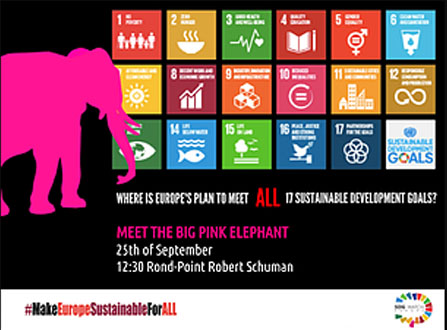
Juncker should stop avoiding the elephant in the room and ‘Make Europe Sustainable For All

Two years after signing up to the Sustainable Development Goals (SDGs), the EU still has no clear plan on how to achieve them and the clock is ticking.

Outside the European Commission building this morning a massive inflatable elephant will remind President Jean Claude Juncker that he cannot continue to ignore sustainability.

Embracing the SDGs would lead to substantial improvements in the lives of Europeans and many others around the globe. EU political leaders must prepare a plan to meet the SDGs that cuts across all areas from the environment to trade and energy to social issues.

Also today, people around Europe are marking the anniversary of the signing of the SDGs and reminding the political leadership that we need planning and action to make them a reality.

Ingo Ritz, Director of the Global Call to Action Against Poverty (GCAP) said:
“The EU and EU member states agreed with 193 governments in the UN to eradicate poverty and end hunger by 2030. This will be only possible if the EU fulfills its commitments for global cooperation, makes its agriculture and trade policies sustainable for people and planet and ends the overconsumption of natural resources.”
The Global Call to Action Against Povery is a global movement fighting poverty and inequality. GCAP has National Coalitions in over 100 countries and 6 global regions.

Jeremy Wates, Secretary General of the European Environmental Bureau (EEB) said:
“The EU needs to refocus on delivering the SDGs or the commitments it made two years ago will be shown up as empty rhetoric. We must urgently face up to how our hunger for raw materials is impacting others around the world and commit to substantially reducing our environmental footprint.”
The EEB is the largest network of environmental citizens’ organizations in Europe with around 140 members in more than 30 countries.

Carl Dolan, Director at Transparency International’s EU Office said:
“We can’t achieve all the SDGs without access to justice and open and accountable institutions for all people. Corruption breeds instability and poverty, it reduces access to healthcare, education, food and water. If the EU is serious about sustainable development it needs to show leadership and make Agenda 2030 a reality.”
Transparency International EU is part of the global anti-corruption movement, Transparency International, which includes over 100 chapters around the world. Their mission is to prevent corruption and promote integrity, transparency and accountability in EU institutions, policies and legislation.

Leo Williams, Director, European Anti-Poverty Network (EAPN), said:
“President Juncker’s complete lack of focus on the SDGs or sustainable development in his State of the Union address only serves to reconfirm the Commission’s unfortunate lack of political prioritisation of the SDGs, despite all European Member States signing up to this global agreement in 2015 at the highest political level, and millions of European citizens having been involved in their elaboration.  People experiencing poverty and social exclusion, and the organisations that work with and for them, expect the Commission to take the most ambitious agenda to tackle poverty we have seen for quite some time, much more seriously”
EAPN is the largest European network of anti-poverty NGOs, from grassroots groups to European Organisations, active in the fight against poverty and social exclusion.

Anna Widegren, Secretary General of the European Youth Forum (EYF) said:
“Young people will suffer the most from the current European short-term approach towards Sustainable Development. The European Commission must take the lead in the implementation of the Sustainable Development Goals and shift towards long-lasting and sustainable solutions with real impact. The structured involvement of young people, youth organisations and civil society is essential to build a sustainable future for Europe and the world.”
The European Youth Forum (YFJ) is a platform which represents 104 youth organizations from around Europe. It brings together tens of millions of young people from all over Europe to allow them to represent their common interests.

Follow the latest on #MakeEuropeSustainableForAll

Sustainable Europe for its Citizens – the 6th Scenario

In April 2017 European Commission President Jean-Claude Juncker presented a White Paper on the Future of Europe, including five possible scenarios for discussion at European and Member State levels.

In response, SDG Watch Europe in collaboration with Friends of the Earth Europe has facilitated the development of an alternative ‘6th Scenario’ that has been backed by over 250 civil society organisations. In this ‘6th Scenario’ these organisations present their aims for a Sustainable and Fair Europe in which care for people and planet are key.

They intend to put this ‘6th Scenario’ forward as an alternative to the five scenarios and to demand that it is fully considered in national and European discussions on the Future of Europe.

You can read the ‘6th Scenario’ here. It is also available in FrenchGerman and Spanish.