Newsletter from the SDG Watch Europe network –  NOV 2018

View this newsletter in your browser

The unbearable burden of inequalities (or the 2030 Agenda as a roadmap to fight inequalities in Europe)

by Alissa Ghils and Barbara Caracciolo

[The views and opinions expressed in this article are those of the authors]

The 2030 Agenda relevance within EU domestic policies

Three years after its adoption, the 2030 Agenda for Sustainable Development has not yet been fully incorporated in EU domestic policies and it is still considered, largely, as a relevant framework for EU external relations policies and, namely, development cooperation policy. This is also demonstrated, among others, by the fact that the EU has not yet developed a comprehensive 2030 Agenda implementation strategy (even if repeatedly called for by the Council of Ministers and, recently, by the Contribution of the SDG Multi-Stakeholder Platform to the Reflection Paper “Towards a sustainable Europe by 2030” October 2018).

Nevertheless, the ongoing and interdependent social, environmental, economic and political crises that Europe is facing today, are a clear call for a radical transformation of the current economic development model.  Indeed, while in comparison to most other advanced economies, Europe is still often considered a shining example of relative social cohesion and fairness, inequality and the socioeconomic divide has been on the rise in Europe, and has intensified since the onset of the global financial crisis.  It is worth reminding some basic ‘inequalities facts’:

  • the 10% of wealthiest households hold 50% of total wealth;
  • there are still 1.4 million fewer jobs in the EU in 2015 compared with 2007;
  • low-skilled youth who are disconnected from both employment and learning represent 17% of 15-29 year-old in the EU, and risk being permanently left behind in the labour market;
  • women’s gross hourly earnings were on average 16.2 % below those of men in the EU;
  • more than one third of Europeans live in financial insecurity; and
  • children from an advantaged socioeconomic background will score on average 20% higher in mathematics than a child from a disadvantaged background, showing a gap in education outcomes among individuals with different parental socioeconomic backgrounds.  

Mounting evidence shows that unequal societies are dysfunctional: societies with larger income differences have, amongst other things, worse health, damaged social relationships and higher violence, lower trust among individuals, etc. Inequality can also lower social trust in institutions and fuel political and social instability. The higher the level of economic inequality, the higher will be the social barriers between groups and the less individuals will feel familiar with and connect to other people.

Possible ways forward

The idea that the 2030 Agenda can pave the way for a much needed radical, systemic, change of the current economic development model was debated at the recently-held SOLIDAR European Conference “The unsustainable burden of inequalities, and is at the centre of the Independent Commission on Sustainable Equality Report. The report, which has benefited of valuable input from a CSOs Task Force, states that “In the absence of profound change these crises will lead to democratic collapse, either because authoritarian populist and extremist forces will gain decisive power across Europe, or because these economic, social or environmental crises will have reached a destabilising stage for society”.

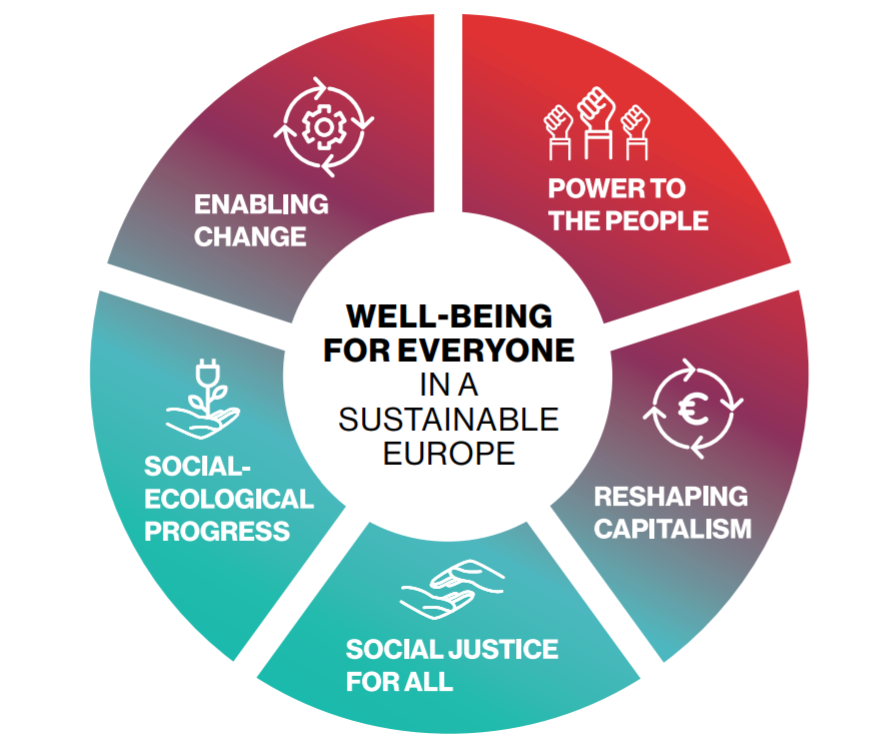
The Report of the Independent Commission for Sustainable Equality sets a series of concrete policy proposals which should be pursued to bring the fight against inequalities and, more broadly sustainability, at the core of European agenda and in the way decisions are taken. The main proposals are around the following issues:

  1. Reshape capitalism for people and planet making sure the business sector respects legitimate responsibilities towards society
  2. Take democracy back for everyone  
  3. A new and effective European anti-poverty plan to reduce the number of people at-risk-of-poverty or social exclusion  
  4. A new Social Europe of strong rights and protection for all through a comprehensive and ambitious implementation of all of the European Pillar of Social Rights’ principles and rights
  5. New fairness in incomes and wages
  6. A new “space-aware” and “bottom-up” approaches to territorial cohesion  
  7. A sustainable and technological transition that takes everyone along
  8. States must protect people against old and new risks building social-ecological welfare states and mitigating environmental inequality
  9. New solidarity through fair taxation
  10. A Sustainable Development Pact embedded in a new Sustainable Development Cycle, and based on complementary social and environmental indicators and targets – instead of the outdated European Semester

Our Europe, our choice

In a few months, we, European citizens, will have the chance to shape the future of Europe by deciding the composition of the next European Parliament and, hence probably, by casting our vote and deciding on the next European Commission’s President. This pre-election phase is considered a decisive moment to ask our candidates to take some concrete policy commitments to fight inequalities, promote sustainability and adopt a more participatory decision-making process.

The Report of the Independent Commission on Sustainable Equality, as well as the Manifesto for a Sustainable Europe for its Citizens contain concrete suggestions that should be taken into account by those asking for our trust. These should also be the backbone of our sustainability scoreboard to check and monitor that engagements are followed by actions.
Launch of the 2018 SDG Spanish Cities Index

By Sustainable Development Solutions Network (SDSN) Spain / REDS (Red Española para el Desarrollo Sostenible)

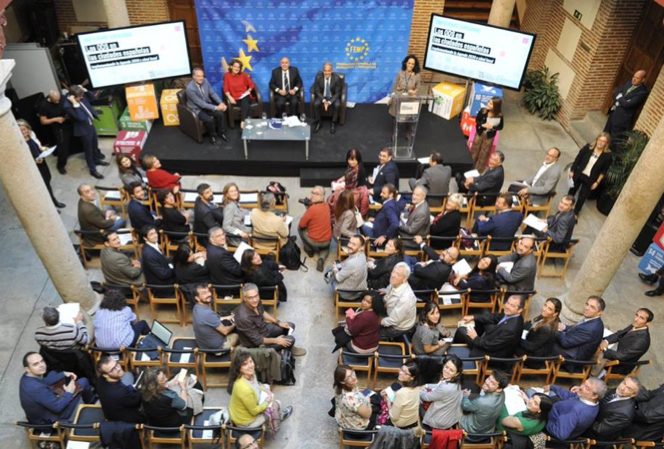
On 16 October 2018 the Spanish SDSN Network, REDS launched the SDG Spanish Cities Index report showing the progress of 100 Spanish cities towards the Sustainable Development Goals (SDGs). The event included an intervention by the Spanish Minister of Environment and a round table with the mayors of four Spanish cities who are leading the SDG implementation at the urban level.

The report provides a snapshot of the current sustainability level of the Spanish cities and will support local administrations in their achievement of the 2030 Agenda. It is intended to serve not only as a monitoring tool for the implementation of the sustainable development agenda, but also as a discussion starter among municipal agents through the identification of successful case studies of cities with similar challenges.

The study includes all the cities with more than 80,000 inhabitants and the 12 main metropolitan areas covering over 50% of the total population in Spain. For this purpose, 85 indicators were identified considering the national context and data availability of the statistical sources and following the SDSN methodology applied to previous SDG Index reports. The presented dashboards use a traffic-light chart to assess where each of the cities and metropolitan areas stand in each of the 17 SDGs.

No Spanish city has achieved the 17 SDGs

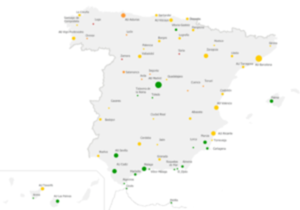
The results of the study show that none of the 100 cities or 12 metropolitan areas have yet achieved the objectives set for 2030 and that the best performing areas have achieved only 6 SDGs so far. However, all of the analyzed cities have performances above failure for at least 11 SDGs and 36 cities have no SDG in red.

Results of the Spanish cities for SDG 3: Good Health and Well-being

The goals with the most cities in green are SDG 3, “Good Health and Well-being” and SDG 16, “Peace, Justice and Strong Institutions” reflecting the healthy dietary habits and the outstanding function of the Spanish public health care system as well as the accessible and safe characteristics of the cities. The results also show very positive results for SDGs 6 and 7 (“Clean Water and Sanitation” and “Affordable and Clean Energy”).

On the other hand, the biggest challenges are faced in SDG 8 and SDG 13 (“Decent Work and Economic Growth” and “Climate Action”, respectively) which evidence the high unemployment rates of the country as well as the high GHG emissions and flood vulnerability of many coastal cities.

About the study

The SDG Spanish Cities Index was inspired by the Global SDG Index and Dashboards and the U.S Cities Index, which SDSN co-produces annually to assess SDG performance at both national and international levels. The creation of this Index is intended to better understand Spain’s specific challenges and variations across the country. The study was authored by Javier García López and Raffele Sisto, experts on Urban Indicators and lead by Inés Sánchez de Madariaga, expert on Urban Planning and a Rector’s Delegate for Gender Equality. Moreover, the authors were technically assessed by SDSN experts on the SDG Index methodology.

REDS is the national network of SDSN and it supports the implementation of the SDGs at national, regional, and municipal levels in Spain. For this study, REDS collaborated with the Spanish Federation of Municipalities and Provinces (FEMP), Iberdrola, Mediapost, and the Ministry of Foreign Affairs and Cooperation.

For further information please contact info@reds-sdsn.es

SDSN discusses “The SDGs and the Future of Europe”

By UN Sustainable Development Solutions Network (SDSN)

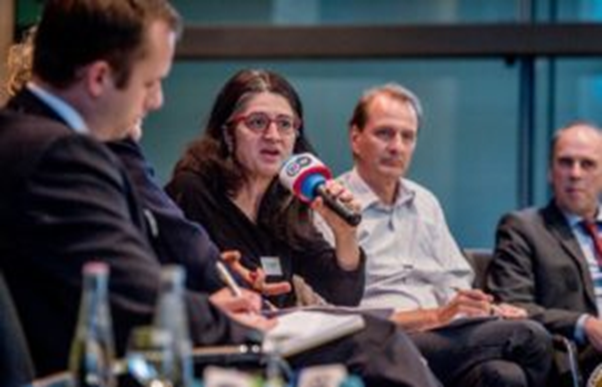
The conference “The SDGs and the Future of Europe”, organized by the European Network for Political Foundations (ENoP) and the Sustainable Development Solutions Network (SDSN) took place in Bonn, Germany on 15 October 2018. More than 130 participants from over 20 European countries attended the conference and public dialogue in the evening following the event, hosted by SDSN Germany and Deutsche Welle.

The conference was moderated by Patrick Leusch, Head of European Affairs, Deutsche Welle. Guido Schmidt-Traub (Executive Director, SDSN) and Johanna Lutz (Coordinator, ENoP) welcomed the participants, pointing out the lack of leadership in Europe regarding SDG implementation and highlighting 2019 as a critical period for Europe in view of the upcoming European Parliament elections. In this context they emphasized the potential of the recently initiated cooperation between ENoP and SDSN in pushing forward SDG implementation in Europe.

The first session “The EU at the crossroads: Achieving the Sustainable Development Goals in challenging times – defending sustainability against populism” started with a keynote by Johan Rockström (Director, Potsdam Institute for Climate Impact Research and member of the SDSN Leadership Council). He criticized the current political “cherry picking” regarding the 17 SDGs, preventing a full and coherent implementation of the 2030 Agenda. Mr. Rockström called for Germany and Europe to start playing a more active role in SDG implementation.

In the panel discussion that followed, Gesine Schwan (President, Humboldt-Viadrina Governance Platform), Matern von Marschall (Member of the German Bundestag) and Timotej Šooš (National Coordinator for the 2030 Agenda for Sustainable Development, Republic of Slovenia) entered into more detail regarding Europe’s leadership on the SDGs. Although the responsibility for SDG implementation is a responsibility of national governments in Europe, until now, many have been hesitant to take bold action for fear of losing voters for pushing forward global instead of local issues. The discussants also pointed to the lack of awareness of the electorate as well as of politicians regarding the 2030 Agenda and the SDGs. Existing top-down structures in the SDG implementation should be balanced with increased bottom-up structures, as for example partnerships between cities and across continents to enforce SDG implementation.

The second half of the day themed “Making the SDGs Europe’s Business”, consisted of a number of breakout groups discussing; 1) budgeting for the SDGs and the role of the next EU Multiannual Financial Framework 2) political parties and the elections of the European Parliament in 2019 3) the need for dialogue with civil societies and business actors 4) EU presidencies and the diversity of member states and 5) the potential of a European leadership in SDG implementation with a focus on European international relations.

The conference was followed by a public evening event with a keynote by Gesine Schwan who pointed out the lack of solidarity in Europe, the critical role of community empowerment and the controversial debate regarding SDG implementation in Europe. Timotej Šooš, Barbara Caracciolo (Solidar, SDG Watch Europe), Dirk Messner (UNU EHS and Co-Chair, SDSN Germany) and Jan Pettersson (Gothenburg Centre for Sustainable Development and Co-Chair, SDSN Northern Europe) joined the panel discussion. The speakers touched on several aspects of European politics including the threat of rising populism in Europe which threatens the steady progress needed to implement Agenda 2030. According to them, too often, the SDGs have been perceived as an elite project, preventing their effective implementation by all parties of society. To combat populism and to increase the engagement of the local population, the SDGs need to be positioned as a people-led and supported agenda that stands for attractive futures and offer solutions for current challenges in our societies. The discussants pointed out that engagement on the local level is essential for this crucial step.

The UN Sustainable Development Solutions Network (SDSN) has been operating since 2012 under the auspices of the UN Secretary-General. SDSN mobilizes global scientific and technological expertise to promote practical solutions for sustainable development, including the implementation of the Sustainable Development Goals (SDGs) and the Paris Climate Agreement.

Going Beyond Zero Hunger with Good Food for All

By IFOAM

We’ve launched Good Food for All, a campaign to get us all eating food that is grown in a way that is good for farmers, good for you and good for the planet.

The Sustainable Development Goals have set the task of reaching Zero Hunger by 2030. However, we’re a long way from achieving that goal, and the planet still faces huge challenges of hunger, malnutrition, obesity and environmental degradation due to agriculture.

Instead of being connected to our food and how it is grown, we live in a world where food is messed around with. It’s produced using harmful chemicals that damage our health, wildlife and the environment. It’s packed in plastic and unnecessarily shipped around the world. Farmers the world over are not making a decent living. Access to quality food and proper nutrition is not a reality for millions of people worldwide.

It doesn’t have to be like this. It’s time to transition to growing food in a way that nourishes soils, preserves biodiversity and protects water sources from contamination. A food system that pays farmers and farmworkers fair prices and doesn’t just feed people but nourishes them.

The Good Food for All campaign wants to build a greener, fairer and healthier world for everyone. To launch the campaign, we’ve released a short animation video ‘Organic Farmers, Our Everyday Superheroes’. It explains how when farmers around the world farm sustainably, they don’t just grow food – they become superheroes protecting our soil, guarding biodiversity and defending the earth.

The video is available in Czech, English, French, German, Greek, Italian, Lithuanian, Polish, Portuguese, Romanian, Slovenian, and Spanish – just check out our YouTube channel to find the version you want and start spreading the message!

What needs to change?

It’s a big challenge to transform our food systems. But there are concrete steps we need to take together in order to build a more sustainable world. That’s why the Good Food for All campaign is calling for:

  1. Real money set aside for nature, the environment and climate. We need real investment to preserve and conserve our planet’s resources now and for future generations.
  2. An end to perverse subsidies by enhancing minimum environmental rules for all farmers.
  3. Real law enforcement to make sure existing legislation is put in to practice on the ground.
  4. Improve the governance of the CAP and the performance framework. Currently 60 billion euro of EU taxpayers’ money is spent every year on Common Agricultural Policy (CAP) subsidies that mostly fund intensive and factory farming which damages our natural resources, hurting wildlife and contributing to climate change.

“It is time to rethink how we grow, share and consume our food” notes Gábor Figeczky, Head of Global Policy at IFOAM – Organics International, adding “We need to shift policies, farming practices and consumer behavior towards true sustainability. To transform our food and farming systems, all public money spent on agriculture should be used to help farmers deliver public goods to society.”

Done right, agriculture can provide Good Food for All, generate decent incomes, and protect the environment.

The Good Food for All campaign is organized by 25 partners across Europe who have come together in ‘Make Europe Sustainable for All’, a 3-year cross-sectoral project to promote ambitious implementation of the Sustainable Development Goals. #GoodFood4All.

Help end the child poverty plaguing Europe

By the European Union Agency for Fundamental Rights

Almost 25 million children in the EU live in low income households where living conditions are unacceptable and hunger is common. Inadequate education and healthcare threaten their fundamental rights and deprive them of opportunities to escape the poverty cycle, finds the European Union Agency for Fundamental Rights in its latest report.

“Child poverty has no place in Europe, one of the world’s richest regions,” says FRA Director Michael O’Flaherty. “We have the means to help end the deplorable conditions facing so many of Europe’s children. Now we need action so the EU and its Member States honour their commitments to uphold the rights of children to give them a better future.”

The report, Combating child poverty: an issue of fundamental rights, highlights how one in four children under 18 are at risk of poverty or social exclusion across the EU. In some Member States, like Romania, it is as high as 1 in 2. While it can affect all children, some groups, like Roma and migrant children fare even worse; a FRA survey revealed over 90% of Roma children in nine Member States experience poverty.

The report underlines how combating child poverty is also a matter of realising their fundamental rights. It also suggests what the EU and its Member States can do to address the issue:

  • The EU and its Member States should tighten existing laws and policies to meet legal standards under the UN’s Child Rights Convention and the European Social Charter. This would enable them to tackle child poverty better.
  • They should prioritise the protection of vulnerable children and establish a European child guarantee scheme, as proposed by the European Parliament, to ensure each and every child has a decent home, diet, healthcare and education.
  • The EU should link funding to Member States to plans and measures to reduce child poverty, inequalities and the social exclusion of children.  
  • The European Commission should cover child poverty and child rights in its country specific recommendations following its review of Member States’ budgets and policies.
  • The European Parliament and EU Council should adopt the European Commission proposal to improve work-life balance for parents and carers to help promote the well-being of children.
  • The EU and its Member States should improve the collection of data to help monitor and assess progress towards ending child poverty and social inclusion.  

The report also identifies how the European Pillar of Social Rights can help ensure that children have the right to be protected from poverty. Discussions about the direction of EU funding also herald an opportunity to help children escape poverty.

For more please contact: media@fra.europa.eu(link sends e-mail) / Tel.: +43 1 580 30 642