Localizing SDGs through Capacity Building: mission possible

By NGO Diversity Development Group (DDG)

Localizing SDGs through Capacity Building (LoCaB) project was implemented from June – October 2018 in Lithuania. The underlying aim of the LoCab project was to raise awareness on links between inequalities with cross-cutting approach on international migration and encourage local actors to localize SDGs.

The main course of action for awareness raising and building the capacity of local actors consisted of: 4 workshops were held in municipalities of largest Lithuanian cities (Kaunas, Klaipėda, Šiauliai and Panevėžys) with the focus on inequalities and cross-cutting topic of international migration. Each workshop targeted 10 – 15 local actors (members of local communities, NGOs, education institutions, municipal workers from different departments, youth organizations, social workers and etc.) with 6 hours engagements.

Workshops participants received accompanying handouts on ‘Links between inequalities, migration and SDGs’ developed for this project.

During the workshops information from participants was gathered and served as a primal source of information for the ‘Policy paper & Package of Recommendations’ which was introduced during the final event Exchange with policy makers, where policy guidelines indicating ways in which SDGs could be localized through different policy making areas including, but not limited, to equal opportunities and migration policies, were presented and discussed. These recommendations aims to encourage decision makers to localize SDGs in municipal strategic planning documents.

The LoCaB project is funded by Make Europe Sustainable for All project, which aims to promote the implementation of the Agenda 2030 by and in the EU, by strengthening civil society networks working on SDG implementation across the EU and highlighting to the public and political leaders at the local, national, and European level that SDG implementation is crucial for an inclusive, sustainable and resilient future for all people and planet.

Founded in 2012, NGO Diversity Development Group (DDG) is a non-profit organisation in Lithuania with an objective to carry out social (scientific, applied, and infrastructural) projects and research in the field of human rights, education, equal opportunities, diversity, migration and integration. The strategic aim of the organisation is to improve and manage diversity towards a sustainable, tolerant and socially responsible society. 
NGDO Platform finds innovative ways to engage Lithuanians on the SDGs

For several years, polls have consistently shown that the SDGs remain a mystery to many in Lithuania. This year, in order to change the statistics and create more awareness, the Lithuanian NGDO Platform chose several interactive methods for our SDGs campaign, from creating SDG ambassadors, running a hackathon to tackle human trafficking, to using forum theatre to encourage greater understanding and empathy.

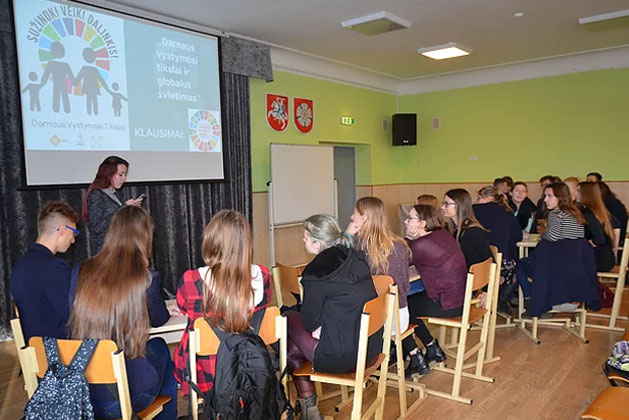
The first and by far the most successful initiative was the SDGs Ambassadors – this involved dozens of people who had had very little prior knowledge on what the SDGs were. The response to the call to organise workshops to present the SDGs was overwhelming – it was clear evidence people do want to get involved in global topics, these just need to be presented in an engaging way. Largely self-organised, this campaign reached the furthest corners of the country, including youth and community centres, secondary schools, and universities.

Another initiative was a Hackathon/Hack for Development, where 42 ICT students from Kaunas University of Technology’s gifted program were invited to come up with solutions via technology to global challenges such as human trafficking together with development and ICT experts. As the Hackathon also involved ICT businesses, many new partnerships were formed, and the winning solution got the chance to be developed as an app.

NGDO Platform also used forum theatre (part of the Theatre of the Oppressed, an applied theatre method) to invite people to be the trigger for change themselves. Forum theatre is a participatory practice where actors present a conflict situation relevant to the audience, in which the audience is then asked to intervene suggesting possible solutions. Based on equality and understanding, we had professional actors enact through stories what it feels like to be Muslim in Lithuania.

With rising islamophobia and hatred towards migrants and refugees, we used this method to provoke open, honest discussions among members of the public, many of whom later reported that the experience helped them challenge their own preconceived notions as well as think about openness from a different perspective. The goal was to create greater cultural awareness and tolerance and challenges preconceptions on inequality, migration and emigration, and equal opportunities.

Additionally, more conventional methods were used in the campaign, including a photography exhibition raising questions about resource exploitation across the globe, various panel discussions involving politicians, representatives from the NGO sector, and the media, as well as interactive workshops introducing SDGs in educational institutions. A colourful informational leaflet featuring the world’s best practices on the SDGs was created specifically for the campaign and 3,000 copies were distributed and available in libraries, youth centres, and popular cafes.

The National Non-Governmental Development Cooperation Organisations’ Platform (Lithuanian NGDO Platform – www.pagalba.org) brings together 21 Lithuanian non-governmental organisations working in the field of development cooperation and development/global education. NGDO Platform was established on 29 March 2007.