Brave New World: A conference experiment from the future

By Ramona Bruck, Forum Umwelt & Entwicklung (German Forum on Environment and Development)

“The year 2048 is close to becoming a remarkable breakthrough for German sustainability policy. After thorough negotiations, the government managed to published the two-year action plan ‘Save Sustainability’ which might give a new momentum for the implementation of the ’Governance Goals on Goodness and Global Justice’ ”. [1]

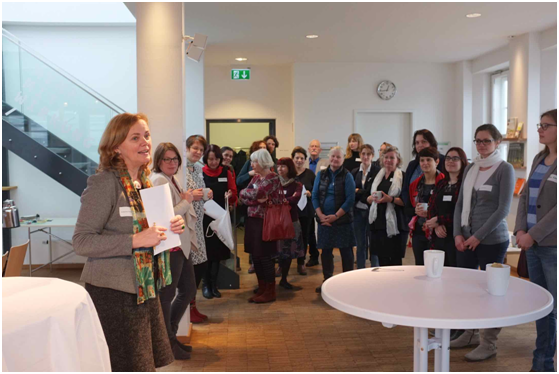
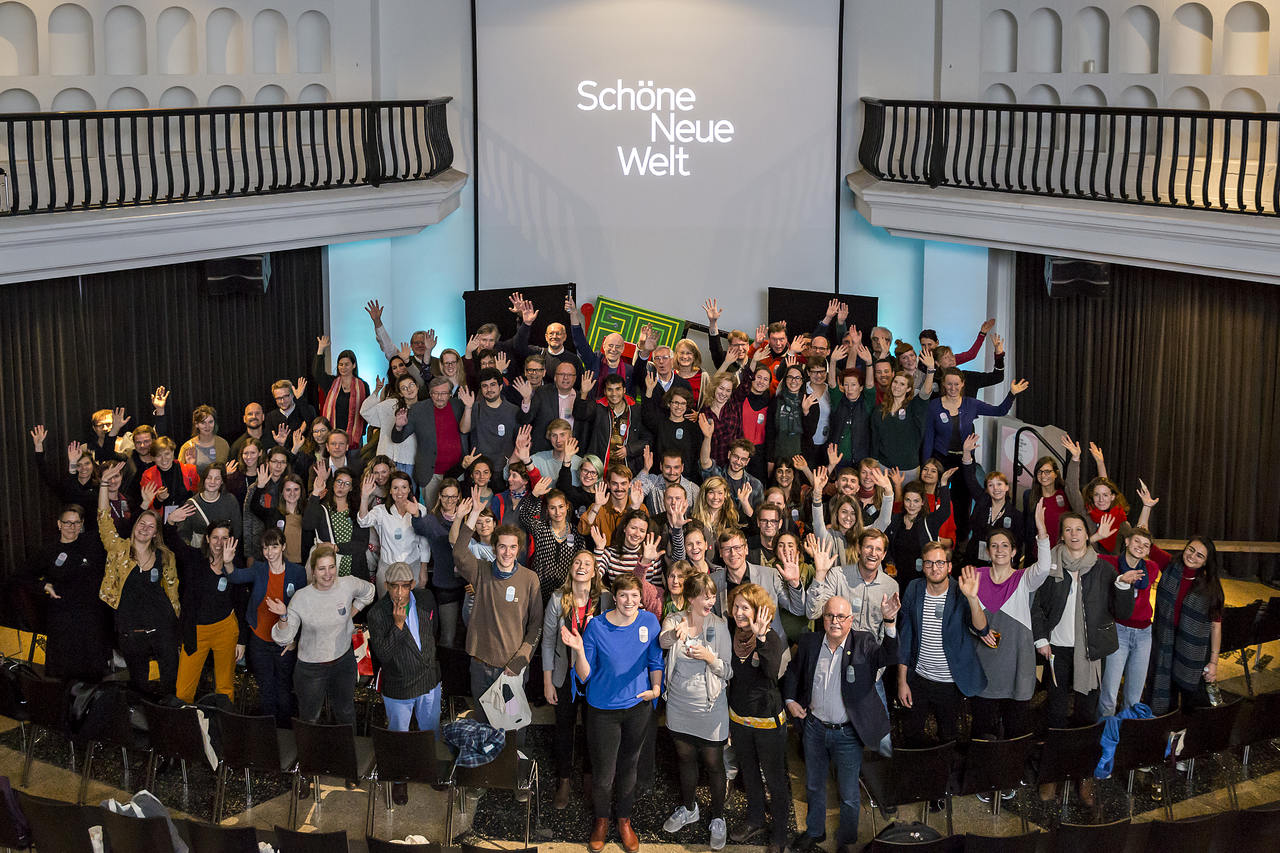
Inspired by Huxley’s ‘Brave New World’ as well as Orwell’s ’1984’, the German NGO Forum on Environment and Development was invited to a new, brave kind of conference in November 2018. Through time travel, the aim was to change the perspectives and to critically reflect on the current political and social situation as well as upcoming challenges and turnarounds. Therefore, it was not surprising that – after a stunning light installation that set the mood for the future – no one other than Aldous Huxley himself welcomed the 220 guests at the conference. He pointed out that time traveling is still an evolving technology – which bares several risks. One of this is the unpredictability about which path the present will choose to go. Fortunately, this conference gave the rare chance to look at two scenarios at the same time and these two confronting scenarios to exist parallel. On the one hand, there was an utopian, positive scenario (plan A), where current demands by civil society e.g. sustainability, equality and fair world trade were fully implemented. Herta Däubler-Gmelin, former minister of justice, played the role of herself as a 100-year old activist, looking back at the last 30 years. She explained how after many conflicts and catastrophes at the beginning of the century the political system has been undergoing major changes – even against predominant business interests. Still there was also a dystopian, negative scenario (plan B), where current trends moved forward, unrestrictedly manifesting unstoppable consequences such as climate change, extensive digitalisation and data collection and acute social inequality. Karl-Mephisto Cassandra, (played by Peter Wahl, co-founder of attac) pointed out that even the most ambitious actions against climate change or loss of species were already too late.

Yet the focus of the conference did not – or at least not primarily – lie on visionary ideas and remarkable acting, but convincing arguments on how the world would look like in 2048, given the paths we take today. Diving deeper into the scenarios, the participants could choose between eight different forums (digitalisation, democracy, bio-economy & agriculture, Europe, urbanisation & rural depopulation, social inequality, climate & energy). Based on the underlying idea of the two diverging scenarios. Each forum was composed by one representative of plan A and B, representing individuals from the year 2048: Business representative, old activist or even a living algorithm. The time travelers gave a brief outline what had happened during the last 30 years, which milestones had been important and how they managed to shape the world as it was now, in 2048. The second part covered a discussion between the representatives of both plans. Plan B was in general easier to trace, because current trends are simply continuing and can easily be imagined in the future. However, the challenge was to explain comprehensibly why these trends were carried on despite being recognised as problematic by critical civil-society.

In this respect, plan A was much more tricky, because they not only needed to figure out the momentums during the past 30 years in which civil society was able to change the established the path, but also needed to describe strategies and methods they and on which strategic alliances change they were built.

This two-day conference was also accompanied by different cultural elements as well as ‘future food’. Along with a stage play ‘avanti popolo’ and a poetry slam, the impressive performance by Katharina Schlothauer as Margarethe Thatcher provoked the audience just as the real person had done in the past: “You want to change the world? Let someone explain this to you, who already did.. Me. […] You need the dissatisfied. Tell them you do something good for them – even it is not true. We stood for a better future. At the end, the majority believed me – or at least they believed more in me than in the rest”.

Finally, we returned from the future and invited the concluding panel, NGO representatives from 2018, to draw their conclusions.

Check out our website for the full documentation: https://www.snw2048.de/dokumentation-1/

 Forum Umwelt & Entwicklung / the German Forum on Environment and Development was founded in 1992 after the UN conference on Environment and Development (“Rio“). We coordinate German NGOs in international political processes on sustainable development and environmental issues. Our mission is to raise awareness in the German public on the connection between environment and development and to insist on a change of the current wasteful economy and lifestyle of industrial countries.

[1] Staudt, Elisabeth https://www.snw2048.de/blog-1/2018/9/4/sonderauflage 
Thinking outside the box to spark interest in the SDGs

By Elisabeth Staudt, German NGO Forum on Environment and Development

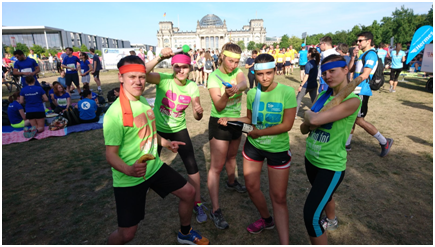
In June, Forum Umwelt und Entwicklung (FUE)/German NGO Forum on Environment and Development took advantage of the wonderful weather and the upcoming football world championship to try out new creative approaches to engage citizens on the Sustainable Development Goals. On June 8th the team of FUE was part of a charity run in Berlin. The run is a tradition for many Berlin based companies, but also for government officials. Over 5.000 teams participate in the event. FUE designed and printed different running jersey (themed as “SDG Ninja Turtles), raising awareness for different sustainability challenges in Germany and around the world. Another format that tried to get the public more interested in the topic of SDGs and sustainability was a pub quiz, which focused on the role of Germany as a perceived sustainability champion. With questions like “Which beverage consumes more water in its productions: Beer or wine?” the quiz aimed at highlighting our responsibility in unsustainable practices and political decision-making. Both activities were very well received and hopefully be repeated in the next months.

For more information please contact: Elisabeth Staudt, Forum Umwelt und Entwicklung Germany, staudt@forumue.de

The German Forum on Environment & Development was founded on December 12th 1992 after the UN conference on Environment and Development (“Rio“). Its purpose is to coordinate German NGOs in international political processes on sustainable development. The NGO Forum on Environment and Development maintains contacts with organizations from developing countries and organizes with international organizations for joint actions. It supervises the international work that continues to run at UN level after on environment and development. One of its main purposes is to make the German public aware of the connection between environment and development and to insist on a change of the current wasteful economy and lifestyle of industrial countries since they deprive millions of people, especially in southern countries, of the basis of their existence.

GERMANY: SDG Festival of Action in Bonn

By Roman Fleissner, AWO

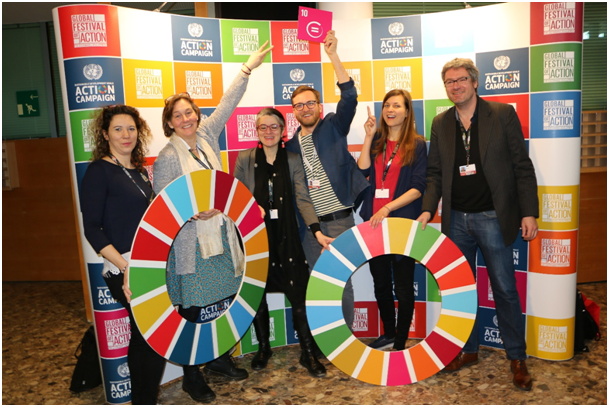
Partner organizations from Germany had the chance to join the SDG Festival in Bonn this year. The annual festival organized by the UN SDG Action Campaign aimed to showcase many actions taken by national, European and international actors to strengthen SDG implementation. According to the organizers, over 1.500 participants participated in over 50 interactive sessions hosted by over 250 speakers. In addition, over 300.000 people followed the festival online. AWO International, WECF Germany and Forum Umwelt & Entwicklung were invited to co-host a session together with several European umbrella organizations. Under the title “From policy to practice: Framing communication of the Sustainable Development Goals in the European Union” the session focused on means, strategies and tools for communicating the SDGs to different target audiences in Europe.

Regarding the project’s Inequalities campaign, some of the hands-on, how-to workshops provided us with useful approaches how to plan and implement the campaign by using storytelling, video and “visual voices” to inspire local action for sustainable development. Furthermore, a workshop on power analysis and stakeholder mapping proved to be especially useful for identifying key momentums and target groups to approach, advocating for SDG implementation. Impressive exhibitions of virtual reality settings to reach out to the public or an engaging decent-work game provided further inspiration.

Despite the successful opportunity to present the first efforts in our project “Make Europe Sustainable for All” and connect with many partners around the globe, many NGO participants left the 3-day festival with mixed feelings. So far the Festival does not succeed with pairing enthusiastic and creative approaches of many highly motivated stakeholders with real political engagement and commitments. We will encourage questions of (political) responsibility, funding and effective coalition building in next year’s proposal.

AWO International was founded in 1998 as a professional association for development cooperation and humanitarian action within the framework of the German welfare organization “Arbeiterwohlfahrt” (AWO, literally: Workers’ Welfare). In cooperation with local partner organizations, AWO International is committed to support marginalized and disadvantaged groups of society to sustainably improve their living conditions. In crisis situations, AWO International, also in cooperation with local non-governmental organizations, quickly provides humanitarian aid to the affected population and supports the rehabilitation and reconstruction process. The head office of AWO International is in Berlin, Germany.

WECF publication: Municipalities as active drivers of gender-just and sustainable development

By Katharina Habersbrunner, WECF Germany

Together, the European Charta for Gender Equality and Agenda 2030, with its transformative character, offer useful guidance for local and regional governments to create more equal and sustainable cities and communities. As a result of the increasingly accessible and green city developments, and more knowledge and openness to the concepts of sharing and inclusiveness, it may seem that the idea of simply fulfilling minimum requirements has been replaced with innovative municipal thinking and acting. The legal implementation of gender budgeting in Vienna and Munich and the active engagement of citizens in the sustainable city development of Hamburg demonstrate pioneering municipal spirit. Yet, in some European countries, local democracy is disturbed – some municipalities view the Agenda 2030 as an additional task that is unfeasible due to the lack of resources, and even though the concepts of gender equality and mainstreaming have already been formal guidelines for over twenty years, the concepts are still widely ignored.

A transformation towards a sustainable and just community requires municipal visions that reflect the worthwhile commitment of integrating gender budgeting and mainstreaming, gender-appropriate pensions, class-independent education and health access, clean air in inner cities… In times of lacking sustainable and gender-just law enforcement, municipal pioneers are needed to enable exchange and collaboration across municipal sectors, new partnerships and active citizen engagement. Every municipal decision must make a contribution to sustainability, because the global sustainability goals are not an additional task: they are fundamental for the sustainable and gender-just development of our cities and communities, and therefore require aligning with local plans. Municipalities need to utilise their local power to engage with citizens and to enable ambitious projects to bring abstract concepts, such as the issues of climate, demographic and increasingly unequal change, to life.

The WECF publication (only available in German at the moment), which will be published shortly on the WECF website, summarizes tools and instruments for gender-just implementation and shows from various perspectives the high potential of municipalities and civil society to implement and advance sustainable and gender-just projects, cities and neighbourhoods.

Women Engage for a Common Future (WECF) is an international network of over 150 women’s and civil society organisations implementing projects in 50 countries and advocating globally to shape a just and sustainable world; our Common Future.

We were at the Global Festival of Ideas for Sustainable Development!

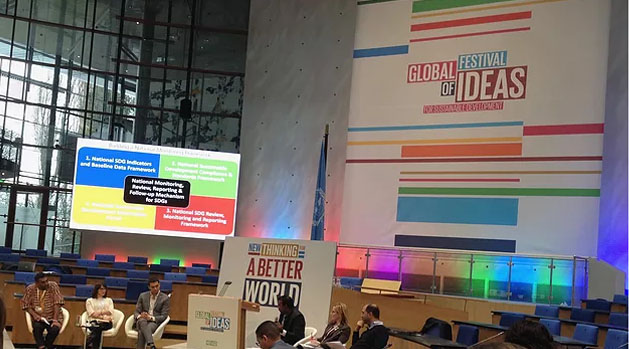
Members of SDG Watch Europe Steering Group Ingo Ritz and Leida Rijnhout participated in the Global Festival of Ideas for Sustainable Development on 1-3 March 2017 in Bonn. The Global Festival of Ideas is the first in a series of annual forums, hosted by the UN SDG Action Campaign and supported by the Federal Government of Germany. The Festival brings together leading thinkers, policy-makers and civil society, together with gaming experts and policy simulators, to deliver the world’s first playable policy conference.

Here the panel on policy coherence and  Uchita De Zoysa – Sri Lanka, explaining the need for a format for country progress reporting, which should strengthen the governmental accountability.