#EuropeanFootprints #WhatDoYouCareAbout stories for a sustainable future: Responsible life choices

By Anna, Finland 

The past years have been overshadowed by worsening environmental problems and climate change. As these problems have become more evident and severe, a lot of people are now overwhelmed with feelings of inadequacy and hopelessness. While it is true that solving the climate crisis requires determined and radical action from governments and policy makers around the world, it is equally true that over 70% of carbon emission originates from everyday household activities. Keeping in mind that we, Europeans, have one of the highest carbon footprints per capita, what and how much we consume in our everyday lives is not negligible. A lot of this consumption is unnecessary and useless. Even the most conservative calculations show that people could save around € 3,000 per household every year by cutting back on goods such as alcohol, cigarettes and junk food, and by making environmentally-friendly choices such as reducing private car mobility and air travel. 

Hence, my fellow researchers and I wanted to tackle the commonly held misconceptions that citizen-consumers’ choices do not have any impact and role in stopping climate change, and that climate action is expensive and requires very advanced technology. In fact, stopping climate change would only cost € 3 per person per day, if we were to start investing immediately. This amount is based on the Stern report of how much needs to be invested in climate change mitigation measures, such as renewable energy, to stop climate change at 2°C. The €3 is calculated according to GDP, accounting for Europeans’ share in the effort. Nevertheless, making environmentally conscious decisions at all times may sometimes feel exhausting and discouraging. 

Doing something for the environment should be just as easy, fast, fun and convenient, as shopping is today. Therefore we came up with the idea of Useless, which aims to encourage and empower citizens for anti-consumption through a mobile application. Save your money, and save the environment! Furthermore, when the saved money is invested in sustainable projects, such as renewable energy or regenerative food production, citizens can make a double impact on the climate: by avoiding CO2 emission from deterred consumption, and by decreasing CO2 emission through making sustainable investments. Thus, Useless combines micro-saving with impact-investing. While waiting for the application to come on the market, don’t be useless, just use less! 🙂 

Launch of 4D podcast for wardrobe change campaign: Remode-Toi!

By Antoine Sanouillet, Association 4D

The Remode Toi! podcast by Association 4D seeks to end the nightmare caused by the textile industry with alternatives and ethical solutions.

Association 4D has met actors committed to a sustainable way to make, recycle, reuse, renew and sell textiles. These people work everyday to change the view we have of our clothes in our modern societies. Multiplying their activities with mass action could allow them to have a real impact and achieve the Agenda 2030. They are participating and helping to implement sustainable lifestyles for citizens.

In “Remode Toi”, we showcase links between the projects of these committed actors and the SDGs. They are actors of change who work on a sustainable transition by focusing on interlinkages between the SDGs rather than cherry-picking single SDGs.

The members of Association 4D are convinced that we can not succeed in achieving the SDGs without citizens. The decade of action is now. This podcast allows you to meet and hear from citizens who act to change and transform our world.

The first episode was released on Friday, 13 March. We met the project-holder of the Textilerie in Paris: Elsa Monsegur. 

You can listen to the interview here and read our article (in French) here.

This podcast is part of the Wardrobe Change campaign as part of the Make Europe Sustainable for All project. Other episodes will follow every 2 or 3 weeks. Stay tuned by following Association 4D on our social media below and keeping up with our newsletter!

Facebook

Twitter

Instagram  

NEW RULES TO CLEAN UP CLOTHING ON THE HORIZON

By Emily Macintosh, EEB

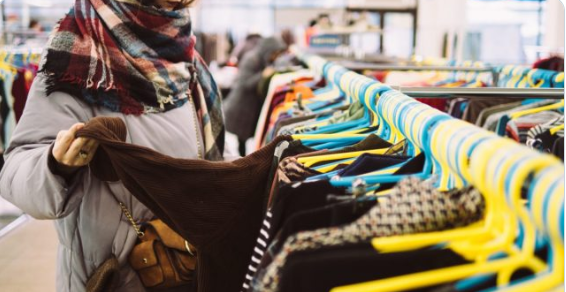
Fashion has been earmarked for new green rules as part of an EU masterplan to move Europe away from the ‘take-make-use-throw away’ economy.

The EU is consuming as if we had three planets, putting huge pressure on our natural resources. And overproduction and overconsumption of fashion – which has doubled since 2000 – makes a huge contribution to these dangerous levels of resource extraction.

In today’s ‘Circular Economy Action Plan’, the EU executive outlined the need for a new comprehensive strategy for textiles including so-called ‘Ecodesign’ laws for textiles sold in Europe.

Europe’s own environment agency reports that after food, housing and transport, textiles are the fourth largest cause of environmental pressure with 675 million tonnes of materials being used every year to produce the clothing, footwear and household textiles consumed in the EU. Yet data shows that globally 73% of all textiles end up in landfill or incineration.

New rules could, for example, put in place requirements to provide spare buttons, thread and zips to make it easier to repair clothes, restrict the content of certain chemicals in a garment, and set standards to ensure fabrics are more resistant to ‘pilling’ – that annoying stage when your favourite clothes become fuzzy.

Stephane Arditi, Policy Manager for the Circular Economy at the European Environmental Bureau, said: “We can’t recycle our way out of fashion’s overconsumption problem, we need to reduce resource use by using products for longer and preventing waste in the first place. We welcome that the Circular Economy Action Plan has announced future new rules on how textiles should be produced; these must ensure that sustainable clothes become the norm.”

Arditi added: “We need a strong labelling scheme so we know what is on our clothes and how they were produced, and we must make producers responsible for the textiles they sell and the associated waste. This will be vital to foster business models based around reuse and repair.”

Campaigners say it is essential that the Commission’s comprehensive strategy for textiles responds to both the environmental and social impact across the industry’s complex web of global supply chains, where poor working conditions and workers’ rights violations are rife.

In January, the EEB and 24 civil society groups from across the EU launched the Wardrobe Change campaign which is calling for EU leaders to take urgent action to rein in the fashion and textile sector.

WHY I MARCHED FOR THE ENVIRONMENT ON INTERNATIONAL WOMEN’S DAY

By KATY WIESE, EEB

Sunday 8 March marked the 25th anniversary of the adoption of the Beijing Declaration and Platform for Action (BPfA), a ground-breaking resolution that set out objectives in 12 key areas for the advancement of women’s rights.

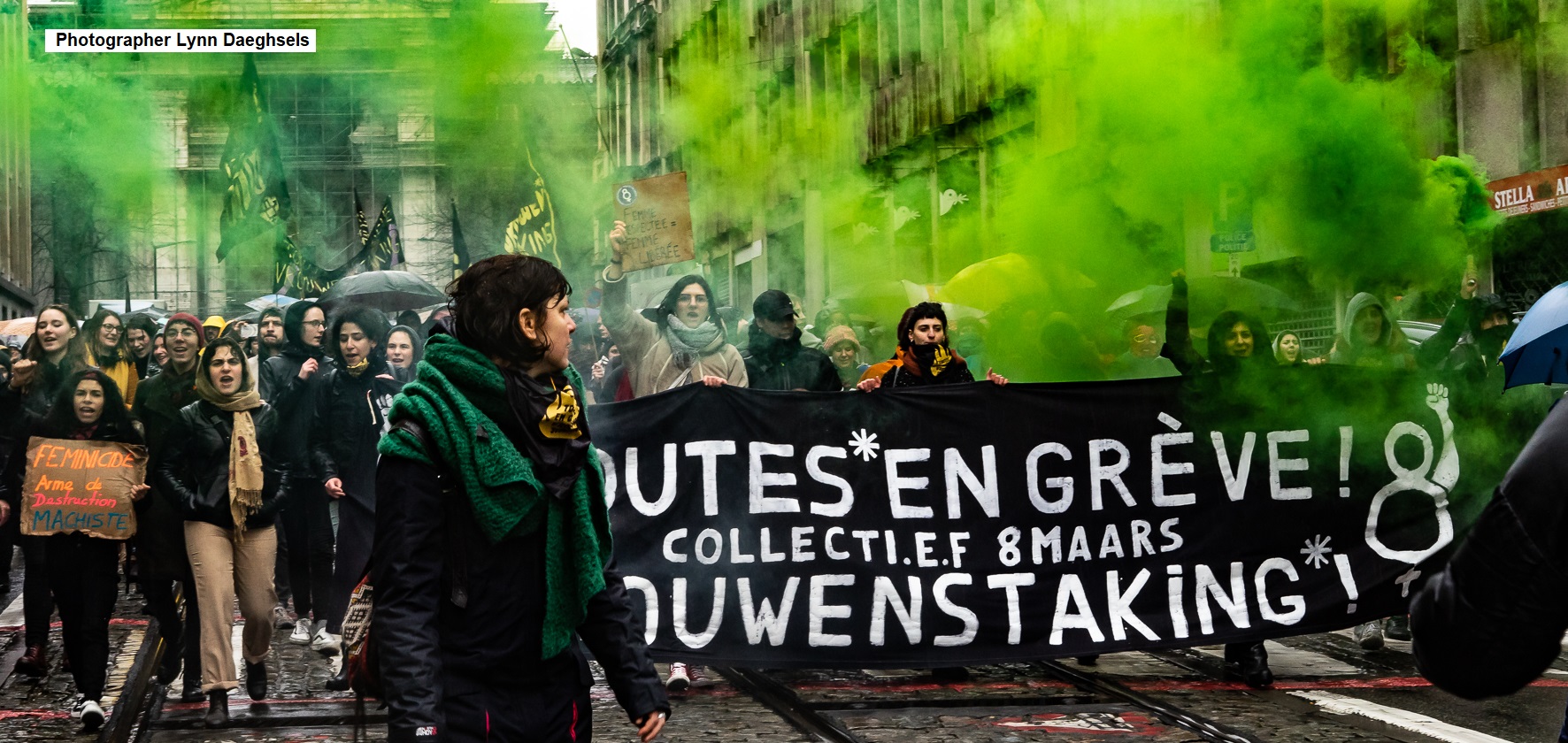
Last Sunday also marked International Women’s Day, when millions of people around the world took to the streets to harness the political power of diverse women to create transformative social change. I was one of them.

I joined this year’s march in Brussels, braving the rain with over 6000 other demonstrators because I cannot accept that despite efforts, we are far from being (gender) equal.  No country in the world has achieved gender equality or is on track to achieve it by 2030 – and we know that inequality is bad for everyone (including men).

I marched because environment and gender issues are inseparable. Climate change disproportionately affects women because they are often poorer, receive less education, and are not involved in political and household decision-making processes that affect their lives.

I marched because I am sick of the fact that 70% of climate negotiators are male although women are disproportionately impacted by climate change.

I marched because gender issues must be integrated into environmental policymaking, decision making, programmes and projects if we want to be serious about transforming our societies so they work for people and the planet.

Gendered environmental decisions – and decision-makers

Gender differences can be seen in resource use, consumption and nutrition. Studies of gender consumption patterns show that men eat more meat than women and drive longer distances, potentially leading to higher total energy use by men.

A study examining gender inequalities within the energy sector in the EU, identified gender gaps in energy access, energy poverty, the energy labour market and decision-making processes. This all limits women’s involvement in the energy transition.

A growing body of research suggests that women are more likely to express concern for the environment and support policies that are beneficial to the environment. For example, evidence showed that countries with more female parliamentarians are more likely to set aside protected areas for nature and ratify international environmental treaties.

However, women have little influence if limited purchasing power inhibits their ability to buy ethical products, if only a small number of women hold management positions in both the public and private sectors, and if 75% of green jobs will be related to sectors that are characterised as “non-traditional” for women.

A not-so gender-equal Europe

Earlier this month, the European Commission launched the EU Gender Equality Strategy, as a framework to deliver von der Leyen’s commitment to achieve a Union of Equality. The objective of this 5-year strategy is to improve gender equality across EU member states, to achieve significant progress “towards a gender-equal Europe”. The word environment is not even mentioned once. The Commission’s new climate law to address the climate emergency makes no link to gender equality at all.

An almost gender-equal Commission and a representation of women in the European Parliament that is above the world and EU average for national parliaments is a great start. But I wonder: how can we achieve a so-called Union of Equality with zero emissions by 2050, when politicians don’t seem to understand why gender equality matters for the environment?

If there is scientific evidence for gender differences in energy consumption, why is gender not being reflected in the National Climate and Energy Plans? Why is there no reflection of gender in the European Green Deal? The Climate Law? And why is there no mention of the environment in the EU Gender Equality Strategy?

While we should not expect that progress towards gender equality will magically solve all environmental problems, mounting evidence shows that advancements in gender equality could have positive impacts on environmental well-being. And this applies to the Global South as well as for the Global North. 25 years on from the Beijing Declaration – it seems we still have a long road to march.

How to integrate gender into our environmental policies:

  • Ensure gender equality in all decision-making bodies to ensure environmental, political, social and economic participation in decision-making
  • Follow-up on existing environmental and gender commitments by governments to ensure effective implementation
  • Integrate gender into existing and new frameworks and guidelines such as the European Green Deal, the Climate Law, the National Energy and Climate Plans etc.
  • Integrate gender into monitoring and reporting systems, prioritising the collection and analysis of gender-disaggregated data, and gender budgeting.

GENDER EQUALITY ACHIEVABLE IF CARE GAP AND CARE AS VALUABLE ‘WORK’ ARE RECOGNIZED

By Make Mothers Matter

In February, Make Mothers Matter responded to the Roadmap of the European Commission strategy on Gender Equality (2020-2024) which was published on 5th March 2020. In our response we advocated that gender equality is achievable if unpaid care work, greatly responsible for the pay and pension gaps, is recognised as a category of work.

In its response, MMM highlighted that EU legislation and policies have only had a limited impact on the gender pay gap and the pension gap persisting. Moreover, since 2005, the EU Gender Equality score has increased by only 5.4 points (+ 1.2 points since 2015). (EIGE, Gender Equality Index 2019).

The main issue is a lack of understanding of what the root causes of gender inequality are.  Among those:

  • Unequal share of unpaid care work (‘care gap’)
  • Gender stereotypes and discrimination
  • Inadequate EU and national legislation that encompasses the realities of the 21st century, an economy where women also perform paid work. Employment legislation is rigid and dates back to the industrial era when women performed care work and career breaks were not needed.

Make Mothers Matter strongly believes that gender equality will never be achieved until the “care gap” is recognized, and that care is redistributed and recognized as valuable work. The amount of time dedicated by women to care activities is much higher than men.

In the European Union, the lack of recognition of the value of such activities and the absence of measures to adjust the sharing of them is a major obstacle to gender equality. Women still perform the majority of unpaid care work, such as household work and caring for children, the disabled, the elderly or the frail. This inequality is difficult to prove because recent and reliable data of the share of unpaid care work in European households is not available. Only some estimates exist and what is not counted ‘does not count’.

This impacts women’s availability on the labour market, forcing women to reduce their paid working hours. As a consequence, this not only reduces their overall income, but also their career progression, time for training or retraining, and also affects their hourly-wage and pension income. In addition, there is the perception that women with children are less available, competent and are therefore discriminated against in terms of promotions, access to training, more senior positions, etc.

The result is a ‘motherhood penalty’ that raises concerns not only about the gender pay gap, but also for the capacity of societies to manage a sustainable balance between economic and social aspects.

There is an urgent need for the European Commission to set clear targets and indicators including impact assessments, instead of strategic engagement specifically addressing the topic of working time. It would also be important to include a subdomain that compares women without children to mothers in pay gap calculations. Comparing families with children and families without children hides the fact that in many cases, men compensate for the loss of income (extra hours, etc.) and the real gender gap is not shown. 

According to the ILO report (The motherhood pay gap: A review of the issues, theory and international evidence, Geneva, 2015), the motherhood gap increases with the number of children the mother has. In many countries in Europe, the gap is lower with one child but increases significantly with three.

Women need support when returning to the labour market after a career break due to care responsibilities, by validating their informal skills acquired working at home and giving them access to training in order to maintain their pay level and seniority.

If policies and societies tackle only the gender pay gap and there are no figures that show that mothers are penalized, society will not develop the capacity to support the costs of rearing children and a better distribution of child-rearing, knowing that the economy in general will also profit from such redistribution.

Make Mothers Matter calls upon the EU and the Member States to:

  • Acknowledge (and regularly measure) the care gap
  • Recognize and address this care gap as a main barrier to gender equality/ women’s economic empowerment and a root cause of inequality and discrimination
  • Recognize care as essential work that needs to be better supported and valued

We urge the authorities to take the necessary measures to meet the essential needs of European mothers to eliminate the discriminatory consequences of childbirth. These needs are drawn from the results of the survey we conducted with 12,000 mothers in Europe on their priorities (What Matters to Mothers in Europe, Survey of Mothers in Europe, 2011 results), observed best practices and other research results and can be reduced to five principles: time, choice, services, resources and recognition.

See here for more information.

First ever online UNECE Regional Forum on Sustainable Development

By Nadège Lharaig, EEB

On March 19, the UNECE Regional Forum on Sustainable Development was held online for the first time due to the Covid-19 crisis. Originally a 1,5 day event, it was scaled-down as a half-day online event and the outcome was rather disappointing.

An online event was indeed needed to prevent more the spread of Covid-19, but the format of the virtual forum didn’t leave much space for meaningful political dialogue. The presentations followed each other without real space for questions or reactions and the content was not solutions-oriented enough.

However, there were some highlights:  

Ms. Outi Honkatukia, Chief Negotiator for Climate Change in the Ministry of Environment in Finland, presented the country’s plan to be carbon neutral by 2035.

Civil society organizations that had gathered the day before delivered two powerful statements.  

Ms. Eva Peena, from EDUACTIVE in Italy, spoke on the behalf of civil society organizations on accelerating action and delivery for sustainable development in the UNECE Region and reminded us that “for the SDG process to have any hope of success all people must be reached by its proposed policies; wellbeing applies to everyone, not the few; long term policy-making based on a commitment to include everyone from all walks of life and age is needed now; implementation of the human rights framework must be at the core of the finance and policy making”. She also highlighted specific demands that civil-society has been advocating for a long time: the need for a cross-cutting human-rights based approach to the SDGs, multidimensional disaggregated data and a shift away from GDP measures, to name a few. She also shared newer requests such as the set up on an intergenerational commission to tackle the rollback of climate justice and oversee implementation of climate agreements.

Ms. Sehnaz Kiymaz from North Macedonia spoke on behalf of civil society organizations on ‘Accelerating SDGs’ progress through Voluntary National Reviews.’ She acknowledged that civil society organizations are more and more involved in the VNR process, as for example in North Macedonia, where 100 CSOs are consulted to draft the VNR, and in Finland where CSOs work jointly with the government to make sure that the state budget is compliant with the SDGs and commitments taken in the VNR. But she also mentioned structural barriers that prevent civil society to play its complete meaningful role in this process, such as lack of funding and shrinking of civic space. She asked for increased time, opportunities and resources for CSOs to engage with the review process of the VNRs, both at the regional and global levels and the need for “follow up” meetings with civil society, after their VNR sessions, to ensure implementation of the SDGs with full engagement of all sections of society.

As this Forum fell short of expectations due to the extraordinary circumstances, we want to continue the discussions between CSOs online and prepare for the High Level Political Forum, if it occurs as planned.  

Save the date and register for a webinar on meaningful CSO participation in VNRs on April 29, 2020 at 14.30 CET. More details coming soon !