The EU and the UN Treaty on Business and Human Rights: Time to Change Course

By Dimitris Christopoulos, Olivier de Schutter, Miguel Moratinos, and Eva Joly.

This article was published (in French) in Le Monde and in the Financial Times

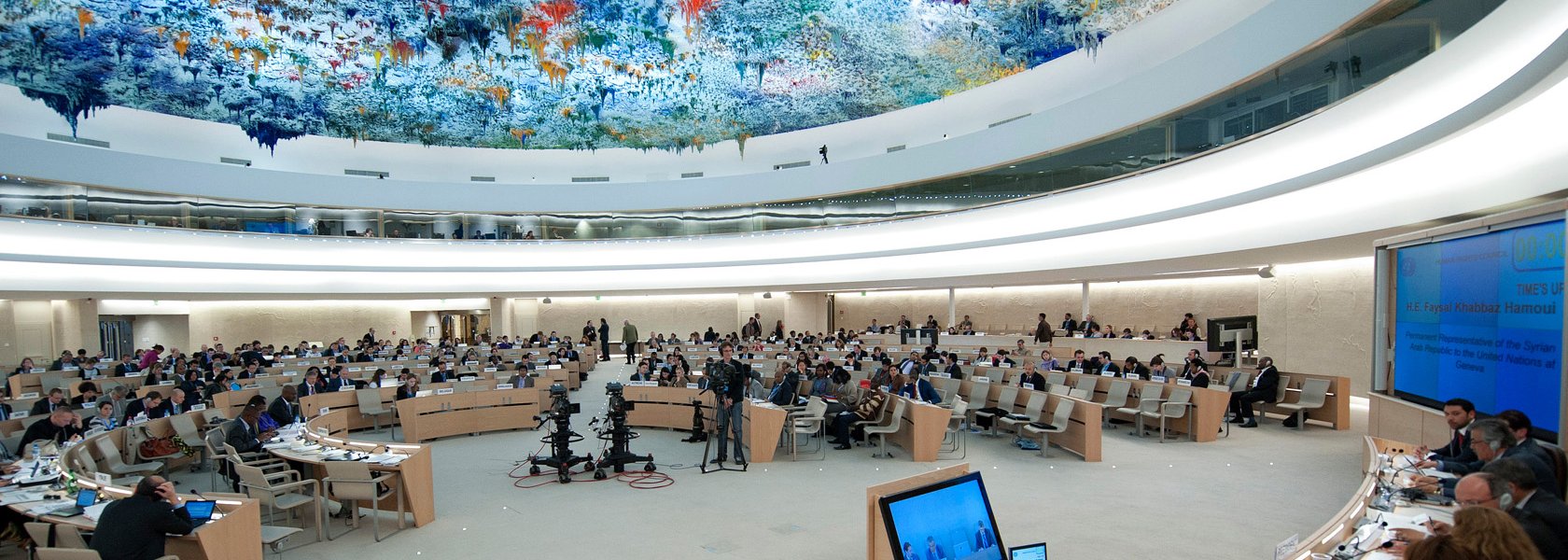
Since 2014, the 47 member-large intergovernmental United Nations body within which human rights issues are discussed, the Human Rights Council, has been working on a new Treaty on Business and Human Rights. An intergovernmental working group chaired by Ecuador, which has taken the lead in this process, has met in three successive sessions. At the most recent session in Geneva in October 2017, ’Elements’ were presented to guide the discussions. Still far short of a first draft, the ’Elements’ are a list of issues and options proposed for the delegation’s consideration.

The Member States of the European Union voted against the resolution that launched this process. The EU initially refused to even engage in the discussions. It finally accepted to do so only reluctantly, drawing ’red lines’ as conditions for entering into this dialogue. Its attitude, rather than constructive, has been defensive and suspicious of the intentions of the countries supporting the process. If and when the negotiations make progress over the coming months, it will not be thanks to the EU but rather in spite of its opposition.

As Europeans, we are deeply committed to the idea of a European Union whose external policies are guided by its values, including the universality and indivisibility of human rights and the promotion of multilateralism to address common problems, an idea expressed in Article 21 of the Treaty on the European Union. We regret that, until now, the EU has not proven capable of putting proposals on the table that would allow it to influence the negotiations in a constructive manner. We believe this is a mistake for four reasons.

First, while these obstructive tactics continue, precious political capital is being spent. In international diplomacy, the ability of any State or entity to influence discussions on an issue it cares about depends on its constructive engagement on other issues, which its partners attach greater importance to. By refusing to engage constructively, the EU will make it more difficult, in the future, to gather support for its own priorities. Its credibility, when it points at shortcomings of other governments, is already significantly reduced by its attitude in this particular dossier. This tactic is shortsighted and self-defeating.

Second, corporations registered in the EU are, by far, the most strictly regulated, ensuring that they neither violate human rights, nor be complicit in human rights violations. Under the Brussels 1 Regulation (now Regulation No. 1215/2012), victims of human rights violations attributable to EU-based companies have access to remedies before national courts in the EU. All EU Member States have established National Contact Points in accordance with the OECD Guidelines for Multinational Enterprises, allowing non-governmental organizations, trade unions and local communities to file complaints against corporations registered in the EU Member States that are allegedly acting in violation of the Guidelines, including their newly integrated human rights chapter. The Corporate Social Responsibility agenda of the European Commission has a strong human rights dimension, and large companies (with more than 500 employees) must report on the human rights violations that their activities may be responsible for, since the adoption in 2014 of a Directive to that effect. Further progress is taking place at the domestic level: France has taken the lead by adopting a law on 27 March 2017 imposing on companies of a certain size that they adopt “due diligence” plans to ensure, inter alia, the respect for human rights throughout their supply chains. The Netherlands has followed suit with a focus on child labour and nine national parliaments have sent a “green card” to the European Commission, requesting that an initiative be adopted at EU level.

The EU should be proud of the fact that these standards of corporate behaviour are imposed on its own companies. It is in the interest of these companies that the EU should enforce such standards even outside its area: competition will continue to be unfair, and the playing field will not be “level”, until this is done.

Third, in a number of EU Member States, often relying on classic civil liability rules, courts are ordering EU-based companies to comply with the duty to respect human rights throughout their activities, whether these take place in the EU or outside the EU. Case law is not always predictable, however. The scope of the “duty of care” a company owes to the employees or those affected by the activities of its subsidiaries or business partners, in particular, remains unclear. The current developments, based on case law, may be a source of legal uncertainty. The reputation of brands may be affected by lawsuits, filed under conditions that, in most EU Member States, no legislation clearly defines.

Fourth in the EU, perhaps more than in any other part of the world, citizens are turning away from economic globalization. Free trade agreements meet with strong resistance. The privileges of foreign investors, including their access to investor-State dispute-settlement mechanisms (in courts of arbitration, rather than ordinary courts), are being openly challenged. There has been a backlash against policies favoring regulatory reforms that comply with the exigencies of international competitiveness in almost all EU Member States, fueling economic nationalism and providing ammunition to demagogues from both the right and the left. It is high time for the EU to demonstrate that it supports a form of globalization that is tame, that serves sustainable development and does not result in further strengthening the power of the economic juggernauts.

No corporation deserves impunity. But corporations registered in the EU do deserve a level playing field, and they also have a right to legal certainty: progress towards multilateral standards of human rights conduct of companies could serve both goals at once. And the citizens of the EU have a right to expect that the EU foreign service engages in the international negotiations to promote the EU’s values, as required by the European treaties, rather than shying away from them, as if they were something to be ashamed of. The EU should put forward ambitious proposals for a legally binding instrument on business and human rights, and restore its credibility as a trusted participant in the shaping of a more humane economic globalization.
Inclusive sustainable development in Europe: a new report from the European Disability Forum

By Alexandre Bloxs, European Disability Forum – EDF

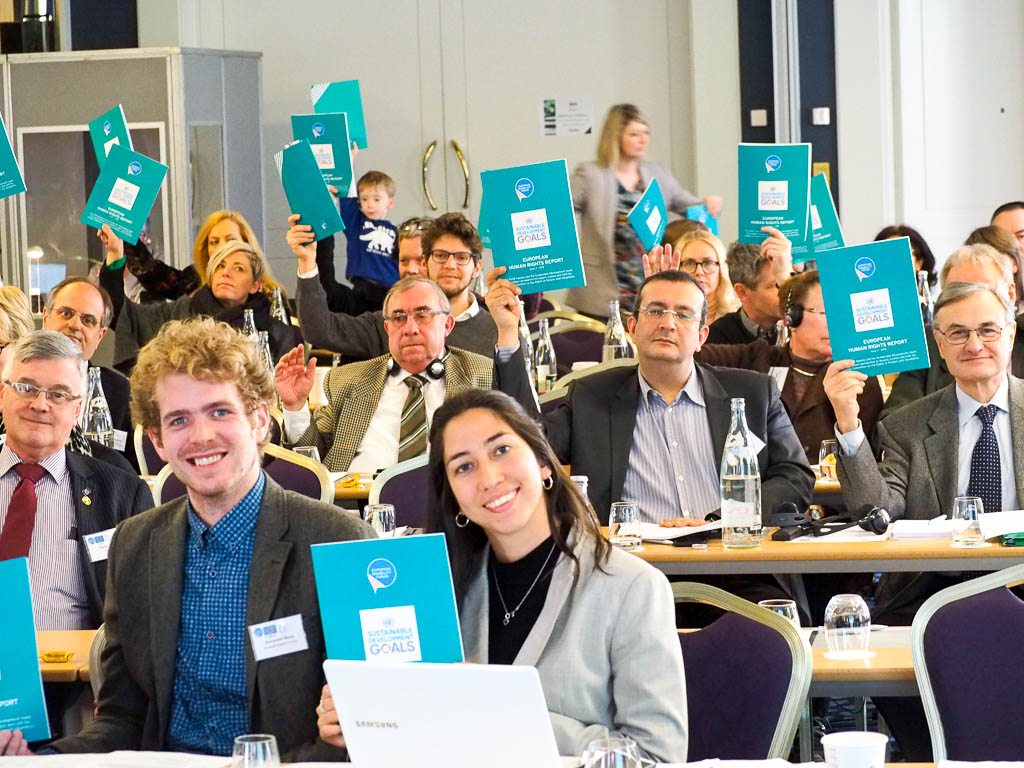
In March, the European Disability Forum (EDF) presented its 2nd human report entitled “2030 Agenda and Sustainable Development Goals (SDGs) report: A European perspective to respect, protect and fullfil the United Convention on the Rights of Persons with Disabilities”. The report provides an overview of the strong link between the Convention and the SDGs and presents recommendations on how to ensure Europe takes a human rights based approach to the Sustainable Development agenda, fully including persons with disabilities.

Presented during the SDGs conference, this report has been designed as a resource for organisations of persons with disabilities and decision-makers in Europe to learn more about the 2030 Agenda and what opportunities exist for advocacy around the SDGs in order to respect, protect and fulfil the CRPD, in Europe and in international cooperation.

The board members of EDF agreed to adopt a resolution where they call on the EU to fully include persons with disabilities in all policy dialogues regarding the SDGs, in Europe and in the context of international cooperation.

The European Disability Forum is an independent NGO that represents the interests of 80 million Europeans with disabilities. EDF is a unique platform which brings together representative organisation of persons with disabilities from across Europe. EDF is run by persons with disabilities and their families. We are a front runner for disability rights. We are a strong, united voice of persons with disabilities in Europe.

ECONOMIC GROWTH IS NOT COMPATIBLE WITH ENVIRONMENTAL SUSTAINABILITY

By Federico Demaria

“Growth for the sake of growth” remains the credo of all governments and international institutions, including the European Commission.

Economic growth is presented as the panacea that can solve any of the world problems: poverty, inequality, sustainability, etc. You name it. Left wing and right wing policies only differ on how to achieve it. However, there is an uncomfortable scientific truth that has to be faced: Economic growth is environmentally unsustainable. Moreover, beyond a certain threshold already surpassed by EU countries, socially it is not necessary. The central question then becomes: How can we manage an economy without growth?

Economist Kenneth Boulding famously said that: “Anyone who believes that exponential growth can go on forever in a finite world is either a madman or an economist”. Ecological economists argue that the economy is physical, while mainstream economists seem to believe it is metaphysical. Social metabolism is the study of material and energy flows within the economy. On the input side of the economy, key material resources are limited, and many are peaking including oil and phosphorus. On the output side, humanity is trespassing planetary boundaries. Climate change is the evidence of the limited assimilative capacity of ecosystems. It is the planet saying: “Enough is enough!”.

Mainstream economists, finally convinced by the existence of biophysical limits, started to argue that economic growth can be decoupled from the consumption of energy and materials (or from environmental impacts, that is the same thing). Historical data series (like Material Flow Accounting from EUROSTAT) demonstrates that this, up to now, has not happened. At most, there is relative decoupling (a decrease in resource use per unit of GDP). But, there is no absolute decoupling, that is what matters for sustainability: an absolute decrease of environmental resources consumption. The only periods of absolute dematerialisation coincide with economic recession. Trade should also be taken into account, to avoid externalization of pollution intensive activities outside the EU (the so called pollution heaven hypothesis).

The current economy cannot be circular. The main reason being that energy cannot be recycled, and materials only up to a certain extent. The global economy recycles less than 10% of materials; about 50% of processed materials are used to provide energy and are thus not available for recycling (it is basically fossil fuels). It is simple: Economic growth is not compatible with environmental sustainability. The list of nice oxymorons is long (from sustainable development to its reincarnations like green economy or green growth), but wishful thinking does not solve real problems. Increase in GDP leads to increase in material and energy use, and therefore to environmental unsustainability.

Technology and market based solutions are not magic bullets. Faith in technology has become religious: scientific evidence shows that, based on past trends in technological improvement, these are coming way too slowly to avoid irreversible climate change. For instance, efficiency improvements lead to rebound effects, in the context of economic growth (the more efficient you are, the more you consume; e.g. cars and consumption of gasoline). Renewable energy produces less net energy, because it has a lower EROI (Energy Return on Investement) than fossil fuels. For this, and other reasons, it cannot satisfy current levels of energy consumptions, which therefore needs to be reduced. Most of the world’s fossil fuel reserves must be left in the ground, unburned, to keep global temperature rise to no more than 2°C. In fact, fossil fuels should be called unburnable fuels.

Science sometimes bring bad news. An article recently published in Nature Sustainability argues that: “No country in the world meets the basic needs of its citizens at a globally sustainable level of resource use.” The question then is: How can the conditions for a good life for all within planetary boundaries be generated?

The uncomfortable truth to be faced by policy makers is the following:

  1. Economic growth is ecologically unsustainable. The total consumption of materials and energy needs to be reduced, starting from developed countries.
  2. Economic growth might also not be socially desirable. Inequalities are on the rise, poverty has not been eliminated and life satisfaction is stagnant.
  3. Economic growth is fueled by debt (e.g. quantitative easing), which corresponds to a colonization of the future. This debt cannot be paid, and the financial system is prone to instability (despite Basilea III).

For instance, scientifically is not clear how the European Union will achieve a low-carbon economy in a context of economic growth, since it implies a reduction of greenhouse gas emissions to 80% below 1990 levels by 2050. In fact, climatologists Kevin Anderson and Alice Bows have argued convincingly that: “for a reasonable probability of avoiding the 2°C characterization of dangerous climate change, the wealthier  nations need, temporarily, to adopt a de-growth strategy.”

Obviously, a transition from a growth society to a degrowth (or post-growth) one poses several challenges. However, the emerging field of ecological macroeconomics is starting to addresses them convincingly. Happiness and economics literature shows that GDP growth is not needed for well-being, because there are other important determinants (See Easterlin paradox). High life expectancy is compatible with low carbon emissions, but high incomes are not. Moreover, lack of growth may increase inequalities unless there is redistribution.

In any case, the issue is not whether we shall abandon economic growth. The question is how. Scientific debates around it are on the rise, but I am afraid policy making is behind. There are good signs: critiques of GDP as an indicator of well-being are common, there are policy proposals and degrowth is entering into the parliaments. This is not new. For example, in 1972 Sicco Mansholt, a Dutch social-democrat who was then EU Commissioner for agriculture, wrote a letter to the President of EU Comission Franco Maria Malfatti, urging him to seriously take into account limits to growth in the EU economic policy. Mansholt himself became President of the European Commission after only two months, but for a too short term to push a zero (or below) growth agenda. The time is ripe not only for a scientific degrowth research agenda, but also for a political one. As ecological economists Tim Jackson and Peter Victor argued in The New York Times: “Imagining a world without growth is among the most vital and urgent tasks for society to engage in.”

Federico Demaria is an ecological economist at Environmental Science and Technology Institute, Universitat Autònoma de Barcelona – which belongs to the world top ten research institutes on environmental studies. He is the co-editor of Degrowth: A Vocabulary for a New Era (Routledge, 2015), a book translated into ten languages, and of the forthcoming “Pluriverse: A Post-Development Dictionary“. He is a founding member of Research & Degrowth. Currently, he coordinates the research project EnvJustice, funded by the European Research Council.

This article was recently featured on META by the EEB.

Europe is experiencing an economic recovery but many new jobs do not lift people out of poverty

By Christian Nielsen, European Anti-Poverty Network (EAPN)

The latest forecasts tell a story of economic recovery. Europe is emerging out of a decade-long slump that nearly crippled a handful of countries and hampered employment and growth numbers in the rest. People are working again, industry is growing and business confidence is up, except perhaps in Brexit-paralysed Britain. This is surely good news for people living in poverty.

Or not. All this economic good cheer ignores a persistent and often under-reported problem in ‘wealthy’ Europe… having a job means little if it is poorly paid, unregulated, unstable or just plain unfair. This was the general sentiment at a recent EU-backed meeting in Brussels organised by the European Anti-Poverty Network (EAPN) which heard from a range of people experiencing poverty, especially the working poor.

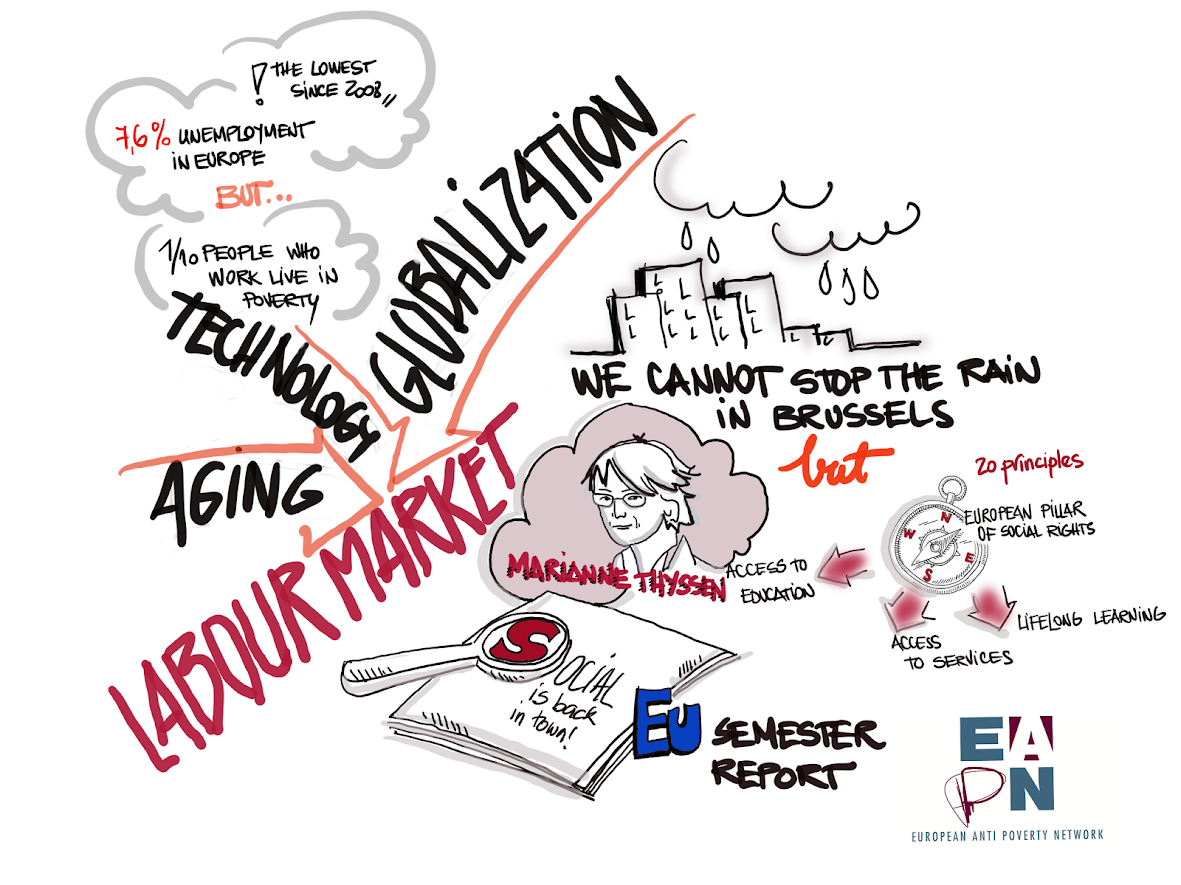
The European Union’s unemployment rate is currently around 7.5%, which is the lowest rate recorded in the bloc since December 2008. But according to a new EU report on ‘In-work poverty in the EU’, the number of European workers at risk of poverty has actually increased, from 8% in 2007 to 10% today.

Europe knows it has a problem and that there is a window of opportunity in the early stages of the recovery to tackle it. European Commissioner Marianne Thyssen, whose responsibilities include employment and social affairs, acknowledged this using Bob Dylan as inspiration. “The times, they are a-changin,” she said, and everyone — governments, industry, social partners, unions — needs to ensure no-one gets “left behind or pushed aside” in this changing world.

Yet the stark reality is that Europe’s recovery is opening up an economic no-man’s land between the rich and the ‘working poor’. This is a precarious place — especially for the 70 million Europeans who lack the skills or basic numeracy to take full advantage of the digital revolution — where even Europe’s much-vaunted social system seems unable to gain ground. It’s occupied by a growing class of Europeans who are not poor enough for many of the social services and not rich enough to afford decent accommodation and good health, or to start a family, move away from home…or simply to enjoy the benefits of a ‘living wage’.

“We live in a world of plenty but wealth is concentrated in fewer and fewer hands,” said EAPN’s Director Leo Williams. This is an “absurd paradox”, he added, in light of the recent Paradise Papers tax-avoidance scandal.

Flexibility leads to poverty

The causes of this wealth gap are entrenched in labour market principles which are geared towards flexibility and dynamism in order to stimulate growth, new jobs and mobility. But in practice, it engenders a power imbalance between workers and employers which translates into something called ‘low work intensity’. For others, it means low-paid or minimum-wage work, and for Europe’s legions of under-employed youth and graduates it means a succession of internships and other ‘non-standard’ or exotic working conditions crafted by employers to keep labour costs in check. This imbalance has direct consequences on the working poor, ranging from difficulties meeting childcare costs and poor or no housing, to high stress and failing health.

In this report, in-work poverty means household income is below the poverty line or threshold despite a full or part-time worker living there. The poverty threshold is defined as under 60% of the average household income (before housing costs).

Real-life struggles told by delegates invited from all over Europe to the ‘people experiencing poverty’ meeting were aimed at EU policy-makers and social actors. A single mother of four spoke of a life “treading water” and feeling socially excluded in the UK. “We really want justice, not judgement,” she said, and to be “cared for, not criticised” by society.

A delegate from Portugal said that even with two household incomes — one full-time and one part-time — her family struggled to make ends meet. Failing health and dwindling disposable income offered little hope for her children’s future. “I want work and stability… to be able to live not only survive,” she said.

Great stock has been put in the new European Pillar of Social Rights to guide the EU towards a more inclusive model of fair jobs and economic growth. Europe’s leaders recently gathered at a summit in Sweden to discuss a wide range of issues — education, training, lifelong learning, social protection, housing, fair wages, old-age pensions, in-work poverty, etc. — and to pledge support for the Pillar.

But for the quiet-spoken Croatian delegate back at the ‘people experiencing poverty’ meeting, who lamented the broken financial and political systems that can’t even prevent homelessness in ‘wealthy’ Europe, the imminent future looks less hopeful. He wondered how he would be able to afford to leave the shelter he calls home when his earnings are swallowed up by his poor health and the struggle for daily survival.

The European Anti-Poverty Network (EAPN) is the largest European network of national, regional and local networks, involving anti-poverty NGOs and grassroot groups as well as European Organisations, active in the fight against poverty and social exclusion.

Italy – Fifth advocacy meeting for Salesian organizations

By Ángel Gudiña Canicoba, Don Bosco Network (DBN)

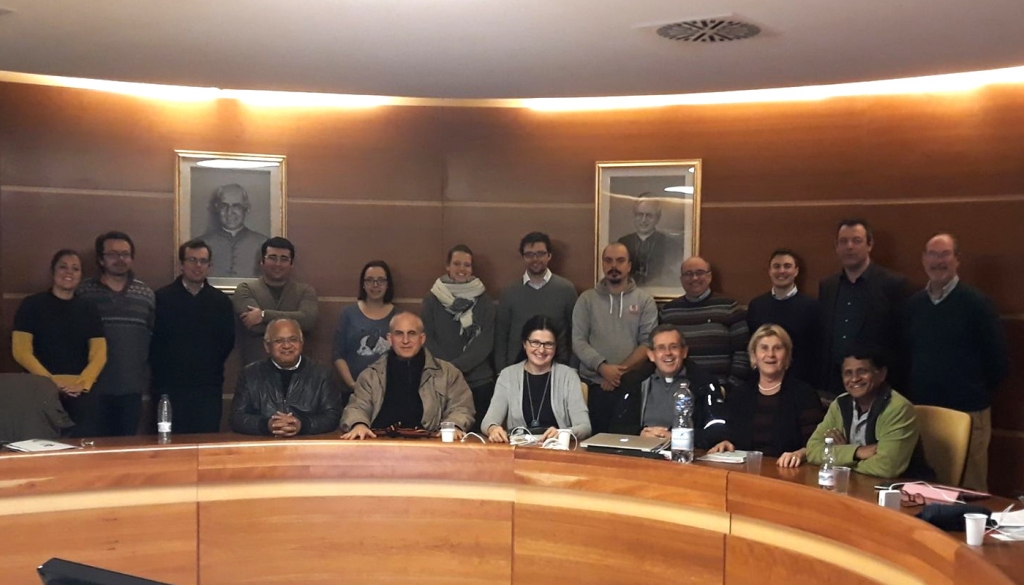
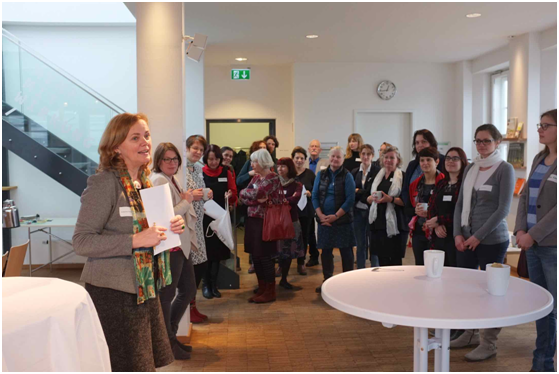
On 26 February, the federation of Salesian development NGOs – Don Bosco Network (DBN) – organized the 5th advocacy meeting for Salesian organizations in Rome, supported by Don Bosco International (DBI). The participants included over 20 representatives of Salesian organisations, including General Councillors for Missions and Youth Ministry, Fr. Guillermo Basañes and Fr. Fabio Attard, who shared their advocacy actions in several fields. Among the topics discussed were the Agenda 2030 for Sustainable Development, with a special focus on organizing the contribution for the Voluntary National Reviews and the HLPF of July 2018. Another key topic was migration with input from the Vatican Migrants’ and Refugees’ Section present in the Holy See document on UN Global Compacts.

DON BOSCO NETWORK (DBN) is a worldwide federation of Salesian development NGOs, formally registered in 2010 in Italy, whose vision, mission and actions are inspired by the values and principles expressed by the Gospel, the Teaching of the Catholic Church under the guidance of the Salesian congregation.

Report: European stakeholders provide their views on making the future EU budget more sustainable – but is the European Commission listening?

By Klára Hajdu, CEEweb for Biodiversity

Budget Commissioner Günther Oettinger has been touring the Member States in the last months to debate the future of the EU budget post 2020. He also says he has listened to the views of stakeholders during citizens’ dialogues. However, the debate has focussed on the new priorities from the very beginning, side-lining the equally crucial, though in some sense clearly more sensitive points about the quality of the spending. Since 2016, SDG Watch Europe within the People’s Budget campaign has been calling on the European Commission and the European Parliament for a sustainability reform of the EU budget – a reform that increases policy coherence, prevents wasteful spending and delivers tangible results in the wellbeing of the people and improves the quality of the environment.

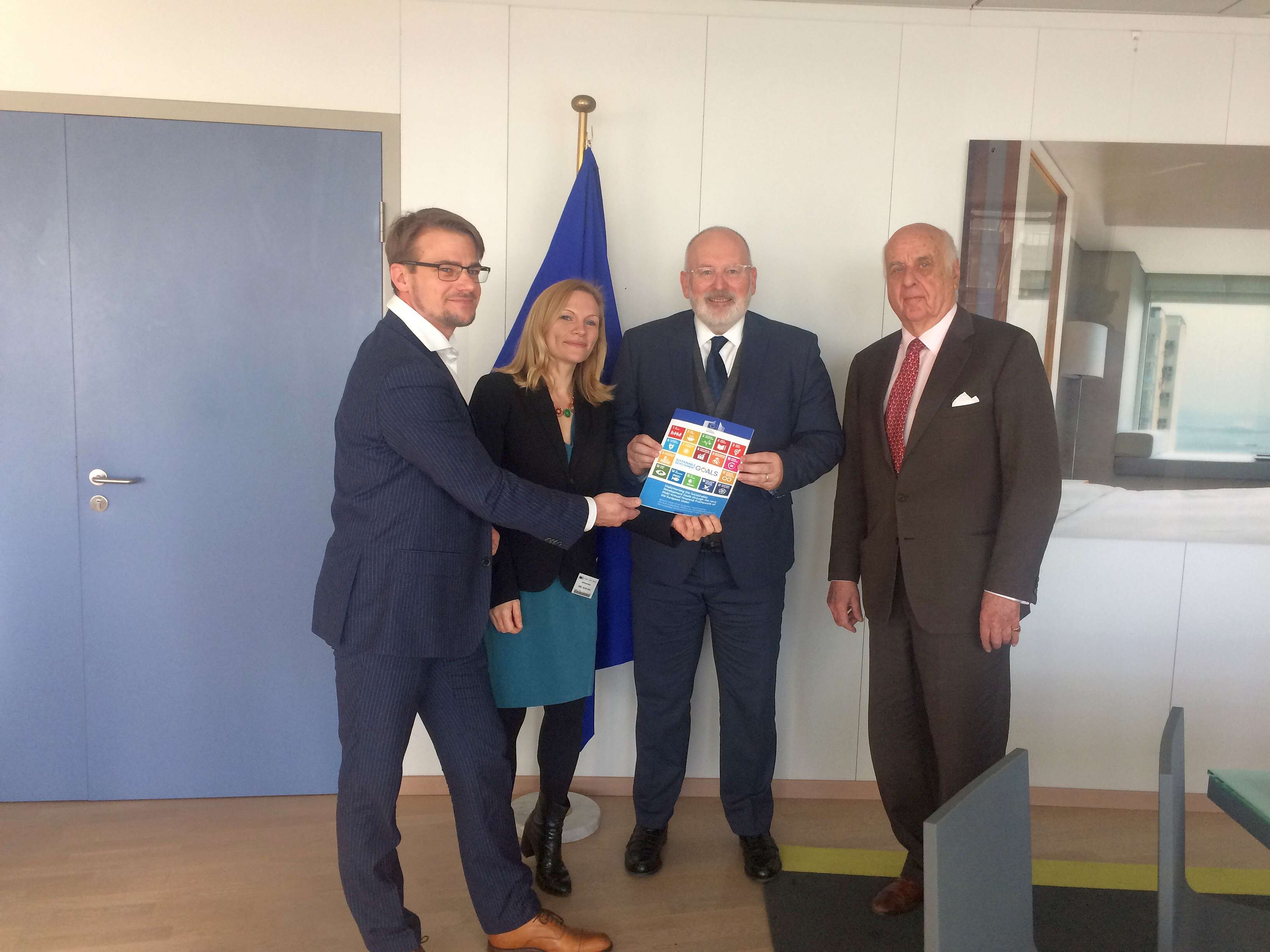
On 20 March, the MFF subgroup of the Multi-stakeholder Platform, which aims to advise the Commission on the future EU budget with a view to implement the Sustainable Development Goals, handed over their recommendations to First Vice-President Timmermans. This short and ambitious report, which reflects the opinion of CSOs from various fields, trade unions, businesses, academic institutions and individual experts, provides innovative, but still efficient measures so that the future EU budget better delivers. We hope that the European Commission will eventually listen to our advice.

Civil society vital to scrutinize governments’ progress on SDGs: NGOs develop new engagement mechanism for UNECE Regional Forum on Sustainable Development

By Patrizia Heidegger, EEB

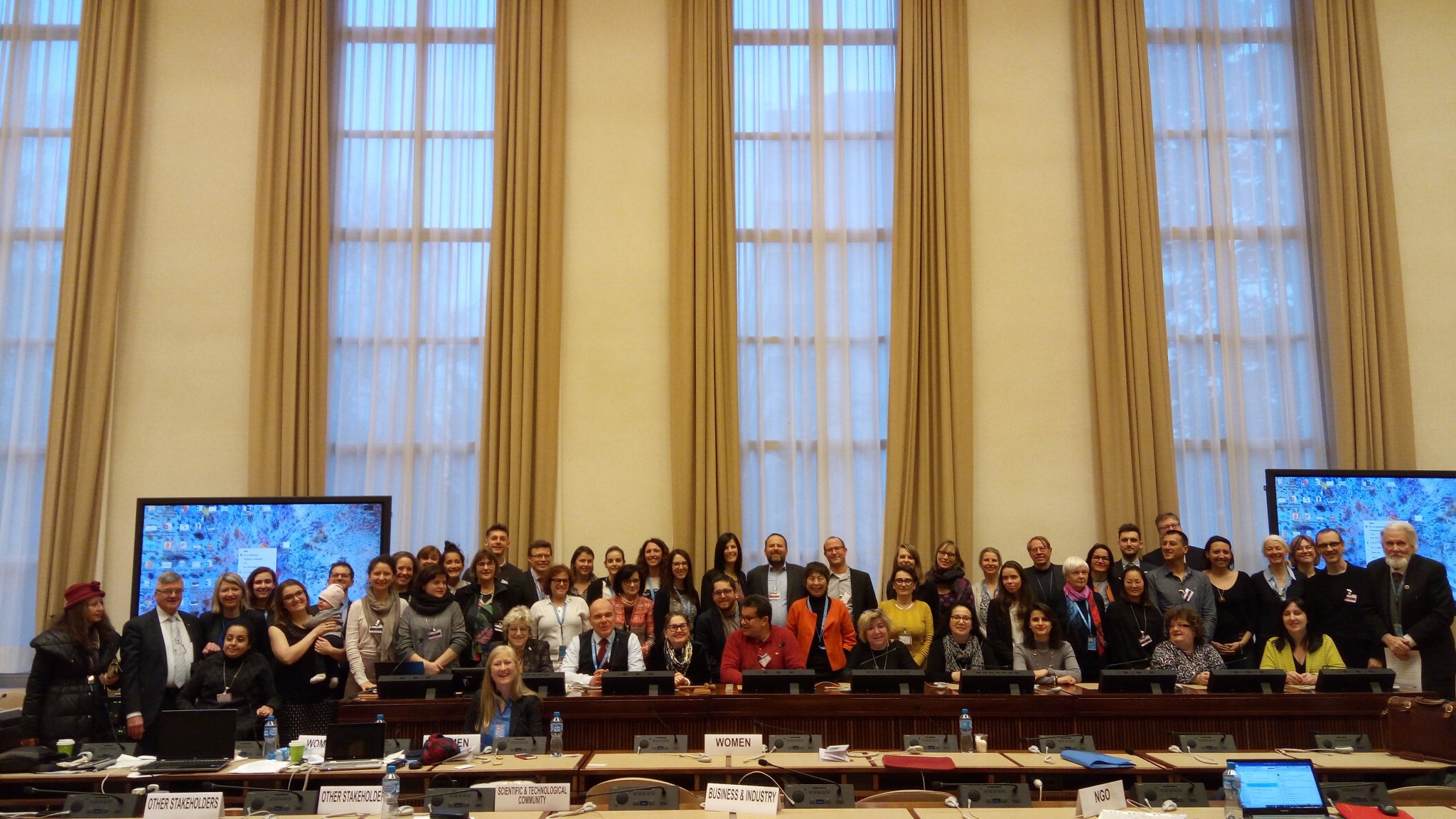
When governments from across Europe gathered in Geneva on 1 and 2 March to exchange about how they are progressing on the 2030 Agenda and its Sustainable Development Goals (SDGs), civil society was ready to scrutinize their performance. This year’s Regional Forum for Sustainable Development for the UNECE (RFSD) – shorthand for the United Nations Economic Commission for Europe which covers countries from both within the EU and beyond, including the Caucasus and Central Asia – focused on the goals on clean water and sanitation, affordable and clean energy, sustainable cities and communities, responsible consumption and production, and protecting the natural environment.

During the Forum, government representatives preferred talking about best practice examples rather than the measures they are taking to bring about the systemic change needed to achieve sustainable development. The role of public interest groups is crucial to ensure governments are properly taken to account, to provide an assessment of the gaps and shortcomings, and to present progressive solutions.

Since last year’s meeting, civil society organisations have developed a concept note on a Regional Civil Society Engagement Mechanism (RCEM) in order to institutionalise the participation of CSOs in all stages of the follow up and review of the SDGs at UNECE level. While the new mechanism is being set up, civil society representatives this year gathered during a full day preparatory meeting to bring together advocates for sustainable development from across the UNECE region as well as from different civil society sectors to agree on key messages and demands towards the assembled governments. Civil society seized the space offered by the Forum with a powerful opening speech, as panelists during various round table discussions and also in the closing session when Pat Clarke, SDG Watch Europe member from the EU Disability Forum, said in the joint CSO statement: “We strongly believe that the primacy of human rights & environmental protection must be reaffirmed over finance, trade & monetary rules!”.

The full participation of civil society organisations remains a challenge. First, governments in the region need to be supportive of meaningful civil society participation. On a more practical level, many CSOs lack the capacity and resources to get more involved in or even attend the Forum. But there are ways to engage: different networks such as the International Forum of National NGO Platforms and projects such as Make Europe Sustainable For All are working on training materials and webinars, while civil society is organised by a voluntary network through the Major Groups – including dedicated working groups. Subscribe to the mailing list by contacting our colleague Andreia Da Silva at WECF (andreia.dasilva@wecf.org). Join us and get active!

WECF publication: Municipalities as active drivers of gender-just and sustainable development

By Katharina Habersbrunner, WECF Germany

Together, the European Charta for Gender Equality and Agenda 2030, with its transformative character, offer useful guidance for local and regional governments to create more equal and sustainable cities and communities. As a result of the increasingly accessible and green city developments, and more knowledge and openness to the concepts of sharing and inclusiveness, it may seem that the idea of simply fulfilling minimum requirements has been replaced with innovative municipal thinking and acting. The legal implementation of gender budgeting in Vienna and Munich and the active engagement of citizens in the sustainable city development of Hamburg demonstrate pioneering municipal spirit. Yet, in some European countries, local democracy is disturbed – some municipalities view the Agenda 2030 as an additional task that is unfeasible due to the lack of resources, and even though the concepts of gender equality and mainstreaming have already been formal guidelines for over twenty years, the concepts are still widely ignored.

A transformation towards a sustainable and just community requires municipal visions that reflect the worthwhile commitment of integrating gender budgeting and mainstreaming, gender-appropriate pensions, class-independent education and health access, clean air in inner cities… In times of lacking sustainable and gender-just law enforcement, municipal pioneers are needed to enable exchange and collaboration across municipal sectors, new partnerships and active citizen engagement. Every municipal decision must make a contribution to sustainability, because the global sustainability goals are not an additional task: they are fundamental for the sustainable and gender-just development of our cities and communities, and therefore require aligning with local plans. Municipalities need to utilise their local power to engage with citizens and to enable ambitious projects to bring abstract concepts, such as the issues of climate, demographic and increasingly unequal change, to life.

The WECF publication (only available in German at the moment), which will be published shortly on the WECF website, summarizes tools and instruments for gender-just implementation and shows from various perspectives the high potential of municipalities and civil society to implement and advance sustainable and gender-just projects, cities and neighbourhoods.

Women Engage for a Common Future (WECF) is an international network of over 150 women’s and civil society organisations implementing projects in 50 countries and advocating globally to shape a just and sustainable world; our Common Future.

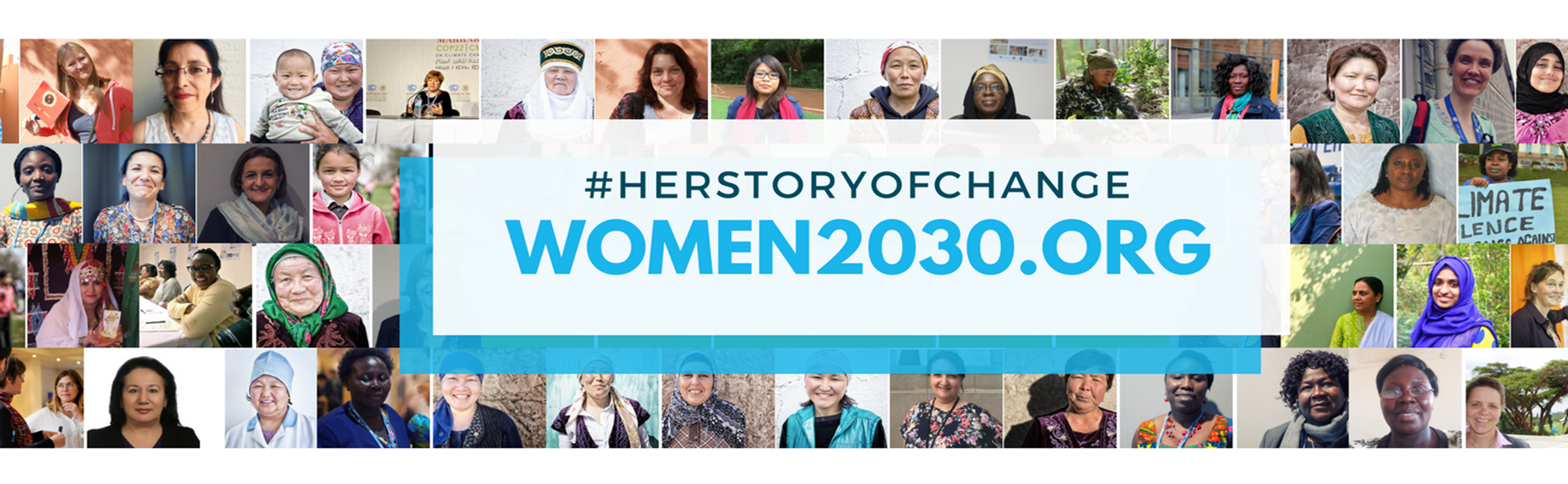
Launch website Women2030

By Chantal Van den Bossche, WECF

On 8 March, Women Engage for a Common Future (WECF) will launch the Women2030 website, on the day we celebrate women across the world and our mother planet.

The #women2030 project is being implemented in 52 countries across different regions of the world. It is led by a coalition of 5 women and gender network organisations collaborating to realize the Sustainable Development Goals (SDGs) in a gender-equitable and climate-just way. The coalition is part of a 5-year framework partnership agreement with the European Commission’s International Cooperation arm (DEVCO) called “Women CSOs implementing SDGs Agenda 2030.”

WECF and its members are more than ever engaged in bettering the situation of women across the world and that of the environment. Stories of incredible women from all over the world and of all professions, working to achieve gender equality and sustainable development goals, have been collected to illustrate the behaviour we all need to strive towards to achieve long-term social, economic, and environmental sustainability. Consequently, International Women’s Day on 8 March will be a celebration of those women who give hope to many other underrepresented women and communities, and who embody this hope for a fairer and more just future when it comes to women’s human rights and gender equality.

Women Engage for a Common Future (WECF) is an international network of over 150 women’s and civil society organisations implementing projects in 50 countries and advocating globally to shape a just and sustainable world; our Common Future

WOMEN OF THE WORLD ON STRIKE: the Spanish Platform of NGDOs (CONGDE) supports and joins the International Feminist Strike on 8 March

By Maria Gonzalez, Futuro en común

Last year Argentine feminists called for an international partial strike under the slogan “Not one less, we want ourselves alive”. Millions of women went out into the streets in 70 countries to make visible our demands for productive and reproductive work, areas in which our presence is essential and in which, at the same time, we are devalued, invisible and discriminated against.

In 2018, the feminist movement calls for an international strike to highlight our strength and our indignation at sexist violence, the violation of our sexual and reproductive rights, labour inequality, discrimination in access to economic, social and environmental resources, and the invisibilization of the paid and unpaid care work that, in its majority, women carry out all over the world. The Spanish Platform of NGDOs joins and participates in this mobilization. We make our call to all women to stop, to stop doing, to show how essential our work in all areas of life is, so that nobody can look the other way.

This international feminist strike goes beyond a work stoppage, it is a strike that puts at the center the nuclear participation of women in all spheres of life: consumption, education, paid and precarious work and essential care for people. It is a global strike, of all the women of the world, of our partners in Latin America, Africa, Asia and the Middle East, of migrants, of women in transit and refugees, of all those whose rights are constantly violated and who for that reason will not even be able to join this strike.

As development cooperation organizations, we work with all these women. In addition, we are a sector supported by 70% of the work and dedication of women, who, in a remunerated or voluntary way, are linked to international solidarity. Besides, it is a sector in which women, have little access to management positions and decision-making spaces. Like most sectors, NGDOs should also change to achieve a work model that puts the focus on care, solidarity and sorority, values highly defended in their ideals and principles.

You can find the full release here (Spanish and English).

Futuro en comun offers a space to meet for organisations, movements, social platforms and networks that are working to end poverty and inequalities while respecting the planet environmental limits.

For information on other international women’s strikes see here: http://parodemujeres.com/map-of-events/