EUROPE MUST TAME THE ILLICIT WILDLIFE TRADE

By Eva Izquierdo, EEB

The COVID-19 pandemic has drawn attention to the wildlife trade. Less well-known is that the European Union is one of the world’s leading markets both for licit and illicit wildlife. Eva Izquierdo highlights how, despite its commitment to curbing this harmful commerce, the EU is failing to take sufficient action and new trade agreements risk making the situation considerably worse.

The European Commission recently launched an online public consultation to build consensus around the medium-term direction for EU trade policy. The consultation – and probably the entire review of the European Union’s trade policy – will focus on the aspects of international trade that the European Commission wishes to boost: economic growth, jobs and consumer choice.

This short-sighted consultation leaves completely unspoken and forgotten the negative aspects of trade, such as trafficking. Consequently, the European Commission is failing to deliver a comprehensive consensus on the future of EU trade policy by not weighing up the tradeoffs between the positive and the negative sides of trade. Both sides should have been integrated in the consultation to get a holistic approach on trade.

The EU seems to perceive increasing trade as something that is intrinsically good and as something that should be pursued as a stand-alone objective, no matter how serious its consequences, from biodiversity loss to huge amounts of waste and deforestation. Regarding the latter, the illegal timber trade supplies 10-15% of global demand for wood, which rises to 50% in certain areas, hurting state revenues, the livelihoods of the rural poor and inflicting irreparable damage on nature.

Crime and no punishment. Although the EU has committed to a more sustainable and responsible trade policy, it is not investing enough resources to crack down on environmental crime. The European Union’s efforts to boost international trading and investment opportunities will be futile and counterproductive if the EU does not urgently fill in the gaps in enforcement that allow environmental crimes to be perpetrated without suitable punishment. New trade deals that eliminate customs duties and increase trade at any cost will blow the door wide open for environmental criminals to be committed with impunity.

The case of illegal wildlife trade in particular underscores how much a holistic approach can help defining good trade policies. The line between legal wildlife trade and wildlife trafficking is blurry. EU legal wildlife trade is estimated to be worth €100 billion. The volume of wildlife trade has increased exponentially over the last few decades, helped by international trade agreements. According to WWF’s Living Planet Report 2020, trade has exploded with the value of exports rising 200-fold from 1970 to 2017, with the largest increases in developed countries (1,200-fold).

How many billions of disguised illegal trade is included in the €100 billion of legally wildlife traded? We cannot know but we can be certain that a good percentage is included.  Due to a lack of resources and staff, it is difficult for EU member states to crack down on wildlife trafficking and properly implement the EU action plan against wildlife trafficking.

There is also a significant loophole which blur the lines between the legal and illegal and provide opportunities to effectively launders some forms of illicit trade. There are endangered and vulnerable species which are protected by domestic legislation and which are exported illegally out of their country of origin. However, once they reach the EU, these species can be legally traded.

Natural health insurance. Beyond the obvious, if shortsighted, economic benefits, trade policy can play an important in protecting ecosystems and, consequently, helping reduce the risk of future pandemics. If we want to strike the right balance between a Europe that is “open for business” and a Europe that protects its people, Europe needs to eradicate illegal wildlife trade and its fatal consequences for human health.

Scientists are convinced that pandemics whose origin is wildlife consumption or increasing proximity to wildlife due to habitat destruction will become more frequent in the near future. In addition to the current COVID-19, another coronavirus known as MERS-COV or camel flu is still killing people. In November 2002, an outbreak of severe acute respiratory syndrome (SARS) began in China and spread to 29 countries. Before SARS, the world was hit by HIV, Ebola and avian flu.

Wildlife trafficking is not only a clear threat to global biodiversity but also to the European Commission’s ambition of using trade policy to develop international governance measures that support stability and predictability. Wildlife trafficking threatens national security and fuels conflicts by providing funding to militia and terrorist groups in developing countries. More than 1,000 rangers have been killed during anti-poaching operations in the last 10 years, mostly in Africa and Asia.

Therefore, in addition to promoting environmental objectives such as wildlife protection, EU trade policy and international trade agreements should ensure effective enforcement inside and outside Europe, by incorporating concrete  measures to reduce environmental crime and in particular wildlife trafficking. Such actions could include prioritising the prosecution of wildlife trafficking in criminal justice systems, using community-based social marketing to reduce demand and implementing strong measures to combat corruption at all levels.

The EU could reduce wildlife trafficking by requiring minimum supply chain due diligence and related public reporting for all goods placed on its market and exported from its territories.

As the Union moves towards digital product passports, these passports and information should be shared with our trading partners and they should be required to use such passport before placing products on the EU market. This will help increase traceability and transparency about the risks in the global supply chains, and will help in joint international control mechanisms and enforcement efforts, as well as ensure that people and consumers have the same level of information on the products that they buy, regardless of their origin.
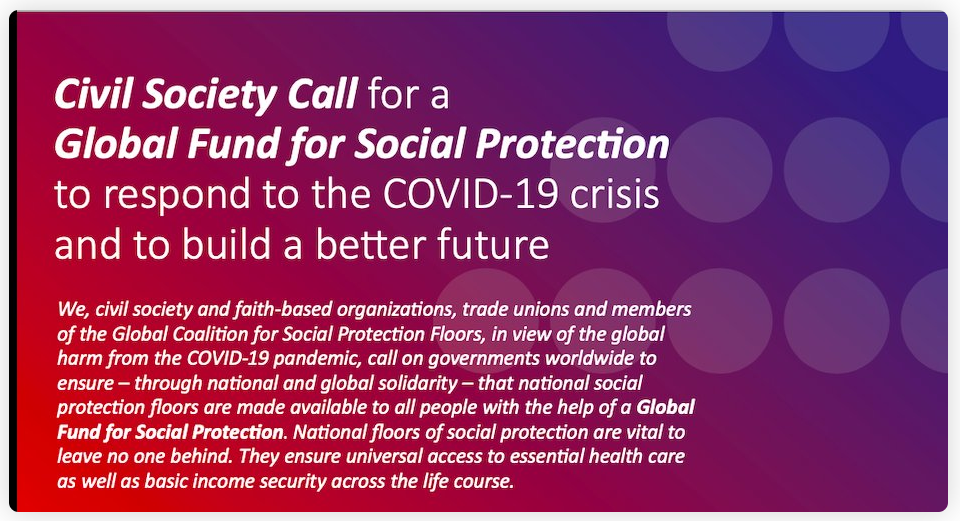
Civil Society Call for a Global Fund for Social Protection to respond to the COVID-19 crisis and to build a better future

By GCAP

GCAP has joined 200+ civil society organizations  and others to call for a Global Fund for Social Protection.

The call is available in Arabic, Russian, English, French and Spanish.
The list of signatories is here.

The press release “Over 200 civil society organizations and trade unions unite to call for a Global Fund for Social Protection to protect the most vulnerable during COVID-19 and beyond” is here, (pdf version).

We, civil society and faith-based organizations, trade unions and members of the Global Coalition for Social Protection Floors, in view of the global harm from the COVID-19 pandemic, call on governments worldwide to ensure – through national and global solidarity – that national social protection floors are made available to all people with the help of a Global Fund for Social Protection. National floors of social protection are vital to leave no one behind. They ensure universal access to essential health care as well as basic income security across the life course.

We recall that

  • The member states of the United Nations have long agreed on the fundamental human rights of all people to social protection and to health;*
  • Despite this, more than two thirds of the world’s population are still denied the right to comprehensive social protection;
  • As a result of the COVID-19 pandemic, the number of people without protection is increasing significantly, with the number of people that are food insecure alone projected to double to a quarter of a billion this year;
  • Social protection systems are a proven direct and fast-acting mechanism that reduce and prevent poverty, help counter inequality, and can unleash the creativity and productive capacity of people by providing a basic level of security that ensures dignity and access to all essential goods and public services;
  • Social protection is a vital investment in socio-economic development and in resilience in view of natural and climate disasters, economic and other humanitarian crises;
  • Social protection systems offer highly effective safeguards against the social and economic fallout of the present and future health and socio-economic crises; and
  • Many studies have shown that ensuring a basic level of social protection for all is affordable for most countries and entirely achievable through the solidarity of the international community.

We recognize, that

  • Many national governments develop, implement and monitor social protection floors, with the participation of civil society, trade unions and informal worker organizations;
  • Generally and principally  the financing of social protection systems must fall to national budgets;
  • There are, nevertheless, a few countries where technical support for the setting-up of national social protection floors and co-financing from the international community are required due to multiple factors, including high socio-economic vulnerability and persistent low levels of national revenue;
  • Based on conditions in the pre-COVID-19 era, some 10 to 15 countries have social protection financing gaps amounting to more than 10 per cent of their GDP, and require temporary international co-financing of minimum social protection floors, while they strengthen domestic resource mobilisation.

We call on all governments

  • To create a Global Fund for Social Protection, based on the principle of global solidarity, to support countries to design, implement and, in specific cases, provide temporary co-financing for national social protection floors. The mandate of the Fund would be to:
    • Support the introduction or finalization of national social protection floors with the full participation of people of all ages, including women, people with disabilities, minorities, and those living in poverty in their design, implementation and monitoring;
    • Ensure that national social protection floors are prepared for sustainability and for expansion in the event of shocks that affect entire communities;
    • Co-finance – on a transitional basis – the costs of setting up social protection floors in low-income countries where such transfers would otherwise require a prohibitively high share of the country’s total tax revenue;
    • Support the strengthening of domestic resource mobilisation, including international tax regulation, to underpin the future sustainability of national social protection systems;
    • Offer additional support for specific shock-responsive social protection interventions in countries where floors have not yet been established.

We envisage, that

  • The Global Fund for Social Protection would:
    • Be governed by a board, representative of both recipient and donor states, civil society organizations, trade unions and informal workers organisations in accordance with the Paris Declaration on Aid Effectiveness (2005) and ILO Recommendation R204 (2015);
    • Be governed by the principles of the Global Partnership for Effective Development Co-operation, notably the respect for country ownership, national financial co-responsibility and the necessary support for national systems;
    • Operate under the principles of accountability, transparency and participation;
    • Be financed through a combination of different sources such as:
      • Representing a greater focus of existing international development aid resources and development finance facilities;
      • Specifically earmarked sources, such as national, regional or global financial transaction taxes (FTT), an arms trade tax, carbon taxes, air ticket solidarity levies, and levies on profits;
      • Increased development aid, multilateral grants and funds for emergency response;
      • Voluntary contributions of individuals and other donors.
  • UN organizations and development and humanitarian aid organizations, including civil society active in the countries of focus will deliver technical country support.

We therefore call on all governments

  • To establish a Global Fund for Social Protection that will help bring an end to avoidable human suffering, poverty, extreme inequality, ill-health and avoidable deaths associated with the current and future crises, and for them to invest in the development of national social protection floors in all countries through the principle of national and global solidarity.

Note:

* As enshrined, for example, in articles 22 and 25 of the Universal Declaration of Human Rights (1948), articles 9 and 12 of the International Covenant for Economic, Social and Cultural Rights (1966), ILO Recommendation 202 (2012) as well as other instruments and confirmed by the Sustainable Development Goals (2015).

Time to reach for the moon -The EU needs to step up action and lead the transformation to sustainability

By Patrizia Heidegger, EEB

The EU and its Member States were a driving force behind the negotiation and adoption of the 2030 Agenda and the Sustainable Development Goals (SDGs). Now, the EU’s lea­dership is needed to make the Goals a reality, at home and globally. The EU has the power to pass transformative laws and commands the resources needed to drive the transition towards sustainability. Commission President Ursula von der Leyen has called the European Green Deal, which she has put forward to address many of our sustainability challenges, the EU’s “man on the moon moment”. The time is now for the EU to reach for the moon and lead by example.

The EU, which prides itself on its core values of human rights, freedom, democracy, equality and the rule of law, has many positive achievements to its credit: cleaner rivers and better waste management, reduced chemical pollution, stronger social protection and consumer rights, quality education and free movement within the Schengen area, to name a few.

But the EU’s ambition to be a frontrunner for the 2030 Agenda and the SDGs has yet to be realised. If everyone in the world lived like the average European, we would need 2.6 planets to satisfy our demands on nature. Our economic system, characterised by labour exploitation and resource depletion, overconsumption, and waste, is not sustainable. It has deepened inequalities and social exclusion, globally and within most Member States, and will deprive future genera­tions of the ability to meet their needs. 

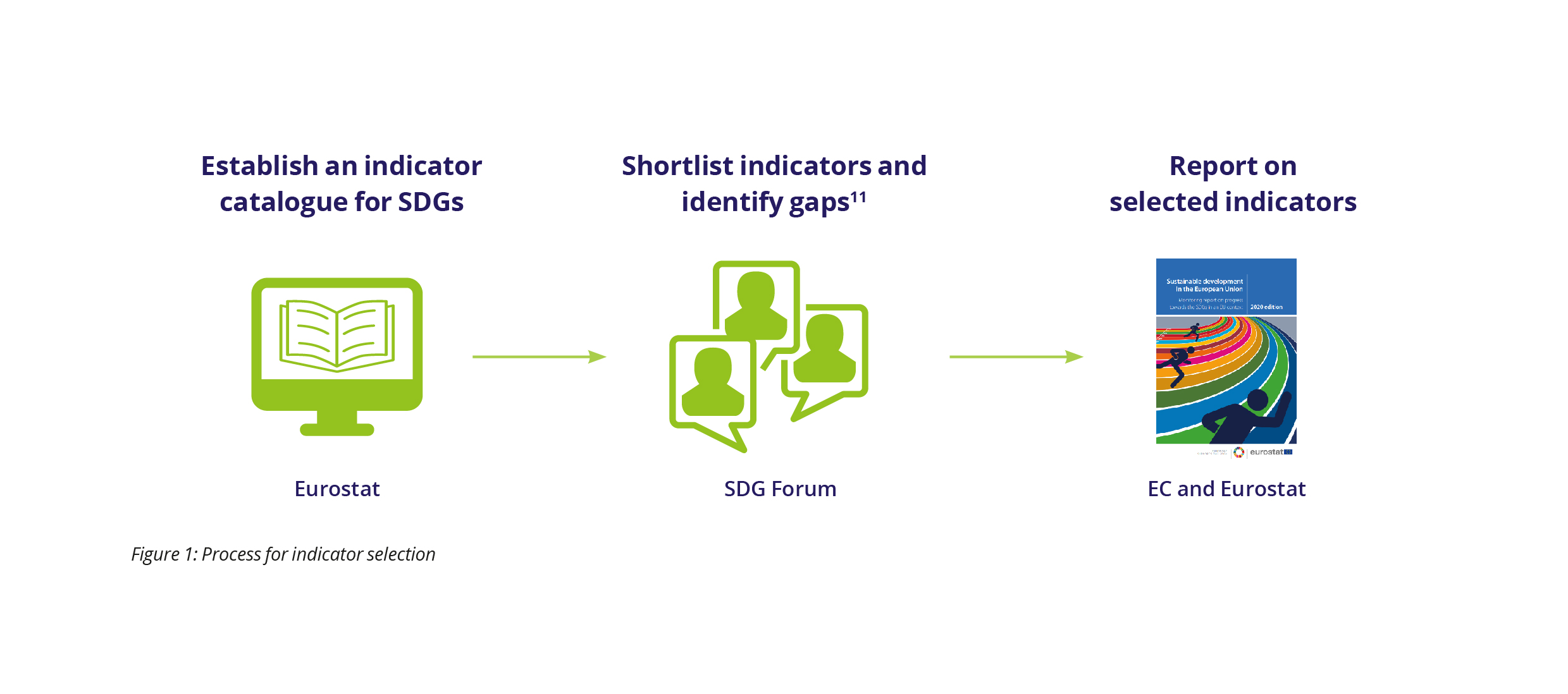
The indicators used by the EU to monitor and report on the SDGs provide an overly positive picture. The yearly Eurostat SDG report celebrates even the slowest progress but ignores pressing challenges, including our global ecological footprint, homelessness, and human rights violations in European supply chains. It does not ask which policies drive sustainability, and which undermine it, which funds support the transition, and which block it. The European Commission does not promote a public debate about its SDG report’s fin­dings and what needs to be done to accelerate action. There is no role for civil society in the EU’s SDG monitoring.

This is why SDG Watch Europe presents an SDG monitoring report for the EU now to take stock where we stand and to hold the EU to account on the implementation of the 2030 Agenda and the SDGs five years after their adoption.

This report explains why the EU’s SDG reporting creates an illusion of sustainability and makes concrete proposals for meaningful monitoring to become a stronger foundation for transformative policies. We tell a more critical story about sustainability in the EU. Our report flags up serious gaps, bringing them to life with 17 individual stories. We also share our vision of what a truly sustainable Europe could look like. We show what we can achieve by 2030 if we do the right things now, building on our Manifesto for a Sustainable Europe for its Citizens, published by civil society for the 2019 European Elections. We offer 17 solutions, real-life examples of progressive policies, innova­tive initiatives and truly sustainable business models. These glimpses of a sustainable Europe nurture hope and inspire action in people – and need a progressive political framework to support and scale them up.

We would like to thank all members and partners of SDG Watch Europe for pooling their knowledge and wisdom to create this report, and for sharing their vision of a sustainable Europe for its people. The time to act is now!

#EuropeanFootprints #WhatDoYouCareAbout stories for a sustainable future: Creative media

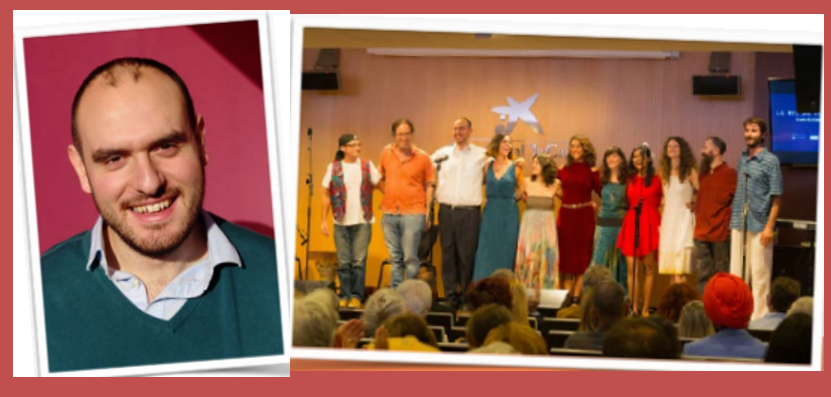
By Diego, Spain

“Us” vs. “them”. When put in contrast, these two words summarize world history in less than one second. Tellingly, this simple dichotomy is at the root of the deadliest conflicts mankind has ever seen. Nowadays, we are witnessing how this belligerent dichotomy pervades our societies, threatening hard-won rights and freedoms. But, here is where education and peace come into play. The concepts of education and peace are intertwined as one necessitates the other to exist. Education can only thrive if there is sustainable peace, and there can only be peace if it is sustained by education. Only if we teach people today how to embrace the “Other” as a fellow human being, will we have the chance to live in peace tomorrow. 

In a world fraught with conflict, the BCN World Music project teaches its audience to embrace the “Other” through music. This initiative brings together musicians from different nationalities with the aim of conveying a strong message of peaceful coexistence. As its acronym (BCN) suggests, the project was born in the city of Barcelona. Our concerts are a mix of storytelling and music, where we interpret folk songs in several languages such as Macedonian, Judeo-Spanish, Turkish, Romani or Bengali – among others. This particular format enables us to explain the meaning of each song to the audience as well as to deconstruct static and dichotomic notions of identity. 

Music – as an expression of cultural identity – is not confined to the discursive borders of the nation. Music is universal – it permeates and ultimately transcends those borders. When I launched the project, my idea was to bring this worldview to the stage. However, the ultimate outcome is much more than a mere idea – it is a reality. It is exactly the example I want to see in the world. I can proudly say that we have managed to break the “us vs. them” dichotomy and hold humanity under the universal embrace of music.

Participation in online NGO campaign for new deforestation & human rights regulation

By FERN

We are concerned: at the moment, there is nothing that stops products linked to deforestation and human rights from entering the EU market. We need a new EU law to stop this.

A European Commission public consultation on this issue is expected in June and will run for 12 weeks. A number of NGOs have come together to use this opportunity to get broad support for a new law, showing the European Commission that citizens care. This consultation is open to all citizens around the globe, not just Europeans. Taking part in this public consultation is a once in a lifetime opportunity to make a difference in deforestation  and land-grabbing, with a huge impact on the rest of the world. We have to be quick in joining forces.

WWF has prepared a petition tool that – once users sign it – sends our pre-formulated answers straight to the Commission’s official consultation on the user’s behalf. The petition tool is easy to implement and the tool has been proven to be successful in the past. In a nutshell, we would like to discuss the following support from you for this 11-12 week period of the public consultation:

  •         Implementation of an iframe for this petition tool on your website
  •         A number of (ideally at least three) direct mailings focusing solely on this topic, to all supporters 
  •         Regular social media posts on your channels (ideally at least 3/week or more)
  •         You can also support us in different ways, do get in touch

Regarding the timing, we expect the consultation to start in June, so we’re working towards a start on 30 June. This is subject to change in case the Commission is not ready to publish the consultation on that day. 

Our more detailed response towards the public consultation can only be prepared once the public consultation is online, but it will orientate itself along the lines of our common NGO briefing.

Communications

We are currently developing the messaging and visuals including angles on food, health, trees, consumer rights, solidarity, iconic species, biodiversity hotspots, forest fires, climate and so on, so we will be able to share nice assets for your audience! (These will be shared 14 days before the launch of each comms package).

We will provide you with free, attractive social media material and we can combine our campaigning expertise. There will be great opportunities for (social) media engagement as well and this action will lead traffic to your website; you will get exclusive access to the database of email addresses for your newsletter. 

More info?

We have prepared a Q&A about this phase of the campaign, its aims and how the petition tool works, which you can find here. You can register for your website’s iframe for the petition tool through this form or you can email us if you want to support in a different way.  

Feel free to forward this email to colleagues and other NGO contacts in case they would be interested.

Join us and be part of a great new movement against deforestation! 

Thank you in advance – #Together4Forests!

WORLD’S LARGEST LESSON

By Project Everyone team and delivered in partnership with UNICEF

World’s Largest Lesson brings the Global Goals to children all over the world and unites them in taking action. Since our launch in September 2015, we have reached over 130 countries and impacted over 8 million children each year. 

We believe all children everywhere should have the opportunity to learn about the Global Goals and feel inspired to take action for them. That’s why all our resources are free, open-source and translated into over 10 languages. We believe in the power of creativity and that all children can find their own individual way of taking action for the Global Goals. That’s why we are really proud of our animated films, written by Sir Ken Robinson, animated by Aardman and introduced by well-known figures like Emma Watson, Serena Williams and Malala Yousafzai. 

We encourage you to use our materials to teach lessons, run projects and engage young people in supporting the Global Goals! 

We are part of the wider Project Everyone team and delivered in partnership with UNICEF, along with many other NGOs, private-sector organisations and foundations. 

USE THE POWER OF STORIES

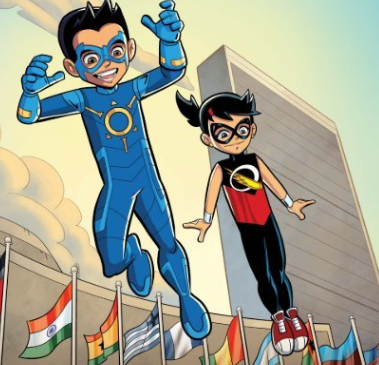
Stories are effective in teaching because they require readers to not only passively receive information, but also interact with the text and images to construct meaning, and that is the key to the magic. Words and pictures work together!

“I guess one person can make a difference.”

-Stan Lee , comic-book writer, former president and chairman of Marvel Comics

Check out the free materials available here: https://worldslargestlesson.globalgoals.org/using-the-power-of-comics/

Progress at a snail’s pace. Statement published by the SDG Watch Europe Steering Group as Eurostat publishes 2020 SDG monitoring report

By SDG Watch Europe

Over the past five years, since the adoption of the 2030 Agenda and the Sustainable Development Goals (SDGs), “the EU has made progress towards almost all goals” according to the latest SDG monitoring report released today by Eurostat. Although that sounds like good news, SDG Watch Europe, the leading civil society organisation monitoring the EU’s record on implementing the SDGs, says that not only has progress been too slow and patchy, but some of our most pressing challenges are simply not measured. 

Eurostat latest SDG monitoring report concludes that there is significant or moderate progress for 13 out of the 17 SDGs. However, the situation is not as clear-cut and straightforward as the report suggests. 

The politics behind the numbers 

Eurostat has chosen 100 indicators for its SDG monitoring report. “Although statistics project the impression of objectivity and impartiality, the choice of an indicator can be highly political: what you measure – or not – can entirely change the picture”, says the SDG Watch Europe’s Steering Group. 

Here is a simple example: the EU is the world region most dependent on imported raw materials and that this comes with heavy social and environmental impacts in other parts of the world. Eurostat looks at Domestic Material Consumption (DMC) as an indicator for SDG 12 on sustainable consumption and production. But this does not properly reflect global material footprints and does not consider all the materials extracted to produce the goods that the European public consumes. 

The Raw Material Equivalent (RME) of European imports is around 2.5 times higher. “So, looking at Domestic Material Consumption rather than RME allows us to paint a rosier picture of our footprint”, the Steering Group says. “Overall, there is a tendency towards using flattering indicators rather than facing the inconvenient truth”. 

Slow progress is not enough 

SDG Watch Europe points out that another pitfall is how Eurostat defines progress. The majority of the current SDG indicators are not linked to any quantifiable targets. In this case, Eurostat considers any improvement as progress. “Even when progress comes at a snail’s pace and we are falling short of becoming sustainable by 2030 the current methodology paints a positive picture”, explains Ingeborg Niestroy from the Steering Group. 

To stay with the example of our unsustainable level of resources use: since the adoption of the SDGs in 2015, the percentage of materials used and reused in a circular way has been hovering around 11%. The progress is so slow that we will be far away from a circular economy in 2030 – and yet the report shows us a green arrow pointing upward. The lack of clear targets cannot be attributed to Eurostat given targets are political decisions, but the definition of progress is flawed. 

Who is paying the bill? 

SDG Watch Europe also points out that the current indicator set falls short of monitoring the externalities of EU policies and practices: How do European supply chains affect working and living conditions of those producing our goods? How much land, water, energy, and raw materials are we using up outside our boundaries? Are we making sure the Common Agricultural Policy (CAP) does not negatively impact food security globally? What about tax avoidance of European companies and its negative impact on sustainable development in other countries? Already last year, we asked the EC “Who is paying the bill?”. 

With some of the indicators we are even twisting our negative effects on others pretending we are doing them good: “SDG Watch Europe members can only shake their heads when they look at how Eurostat is monitoring SDG 17 on global partnership: the indicator says the more we import from developing countries, the more sustainable we are. We all know that our clothes, IT gadgets, imported foods, the fuel in our tanks or the stones plastering our town squares are too often produced in violation of human rights while destroying the environment,” Patrizia Heidegger from the Steering Group adds, “why do we not measure instead how much we actually contribute to living wages and sustainable environmental management in poorer countries?”. 

Too many left behind 

Turning to internal problems, the SDG monitoring process also turns a blind eye on things such as homelessness or people struggling to find affordable rents, child poverty, the number of refugees living in squalid camps or those millions without access to safe drinking water in the EU – all of this happening with a European economy generating a GDP of 5 trillion EUR annually. 

Looking at today’s report (that does not yet reflect the impact of COVID-19), it is shocking to see that inwork poverty has continued to increase (SDG 1). More than 9% of all people in Europe with a job do not earn enough to make a decent living. This is one of several striking examples how the celebrated growth in GDP (SDG 8) does not translate into a growth in well-being for people and the planet. 

The COVID-19 crisis has exposed our current failures highlighting the underfunding of a profit-oriented health system (SDG 3), our dependence on global value chains (SDG 12 and 17), the hardship of people working in precarious jobs (SDG 8), of women taking on unpaid or invisible care work (SDG 5), unequal access to education (SDG 4) and missing financial safety nets (SDG 1). The pandemic has bought the deep inequalities that have been existing in the EU to the forefront: many vulnerable groups such as migrants, refugees, ethnic minorities, including Roma, people with disabilities, homeless people or older people have never had equal access to quality employment or adequate health care and are often more exposed to environmental health risks. 

With Falling Through the Cracks SDG Watch Europe has shown already last year that progress on SDG 10 has been too slow, and we need political solutions. SDG Watch Europe is now calling on the EU and Member States to let this crisis be a wake-up call. With 10 key demands, SDG Watch Europe published a statement pointing out the most important elements of a sustainable, inclusive and green economic recovery just last Friday. 

Failing on too many goals 

The report also admits that progress towards the environmental aspects of sustainability is slow or even absent, for instance with progress on SDG 13 on climate in part stalled, and pressure on ecosystems and biodiversity (SDG 15) increasing. The indicators for SDG 2 reflect the EU’s struggle in setting up a sustainable food system. The indicators show that ammonia emissions and groundwater pollution with nitrates are far too high. With only 8% of farming land under organic practices, the vast majority of agricultural land suffers from high levels of soil erosion with an average sale of 360 000 tons of pesticide in the EU each year. 

In relation to gender equality (SDG 5), we are actually moving away from the Goals. Women are still less employed and less paid even though they are better educated than men. Eurostat itself argues that the progress made is not sustainable. The EC has just drafted a new Gender Equality Strategy, but its main political programme, the European Green Deal, does not even mention gender equality. 

The report is unable to address how different EU policies run counter to achieving social or environmental objectives. It does not address the question how we are making sure all our policies are coherent and all contribute to sustainable development within and beyond the EU. 

Need for overall strategy and strong political leadership 

Today’s report shows the need for the new European Commission to take up a leadership role regarding the 2030 Agenda and the SDGs. The Commission President herself needs to embrace the responsibility for her team of Commissioners to deliver on the SDGs. Statements on the importance of the SDGs are not enough. We finally want to see tangible action. Beyond the European Green Deal and integrating the SDGs into the European Semester – which has not yet happened in any substantial way for the 2020 cycle – the EU needs to give itself an overarching Sustainable Europe 2030 Strategy and set clear targets to achieve all the SDGs by 2030.

Global Day of Solidarity on 22 May – #StrongerTogether – in response to COVID-19 crisis

By Global Call to Action Against Poverty (GCAP)

You can read the original article on GCAP’s website here.

The COVID-19 crisis has highlighted and worsened systemic inequalities. During the lockdown, 80% of urban workers in India have lost their livelihoods, and globally the level of extreme poverty has skyrocketed. People worldwide are facing health problems, loss of income, hunger and violence. Human rights abuses have also worsened, and structural racism in countries such as the US has been thrown into the limelight.

Many of us are working with people in need and demanding governments respond to support the most vulnerable. But this is not enough. We need global solidarity and joint action for those especially affected by the crisis.

This is why we came together on the Global Day of Solidarity on 22 May 2020. Thanks to all who joined! GCAP in collaboration with many other CSOs mobilized people around the world to raise their voices in solidarity with each other and to call on governments to work together at the global level. 

The results are impressive – especially on social media. Using #StrongerTogether in combination with “solidarity” there were at least 6,000 posts which reached 43 million people & 126 million impressions in 100+ countries.

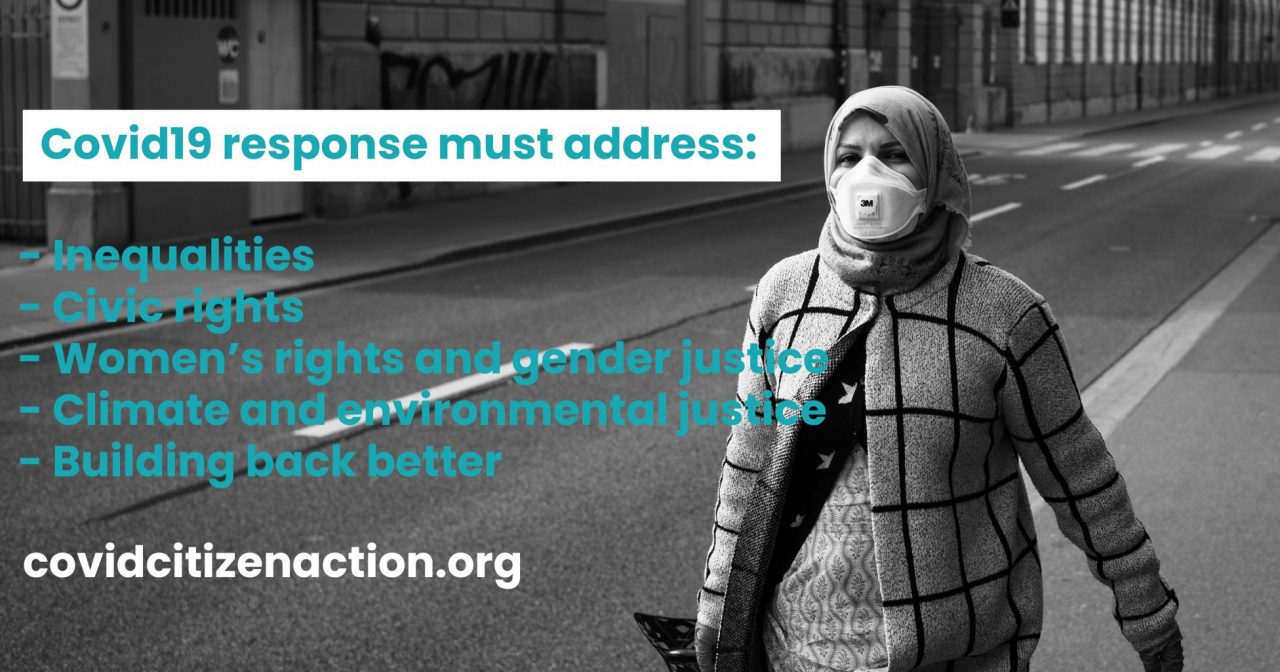
Over 700 organizations have now signed the Joint Civil Society Statement and 12-point plan for governments and the UN on the COVID-19 response at covidcitizenaction.org. Many GCAP National Coalitions have sent letters to their governments based on the joint statement, and the press release was also covered by several media.

GCAP members from Bangladesh to Ghana to Lithuania to Argentina shared their messages on how we can be #StrongerTogether to overcome COVID-19 and also stand together (#IStandWith) with the most vulnerable.

Three GCAP regions highlighted the challenges:

  • LAC: COVID-19 pandemic deepens inequalities in Latin America and the Caribbean

Beyond the effects of the COVID-19 pandemic, it is very clear that this health emergency has highlighted the profound inequalities in our societies, aggravating the global crises in which we find ourselves. In addition to those already difficult circumstances in the region LAC, we live in a context of many threats and setbacks for civil, political, economic, social, cultural and environmental rights.

Read more of GCAP LAC’s statement on the region’s challenges that are exacerbated by this health crisis

  • Africa: Women and Girls with Disabilities in the Fight Against COVID-19

“I live with my daughter who helps with selling water on the street. My daughter’s husband who used to support us was involved in an accident and is bedridden, so I am left with only my daughter. Ever since the lockdown started, my daughter cannot go out and sell the water to support us in the house.” Elizabeth Antwiwaa, a visually impaired woman in Kumasi, Ghana

Women and girls with disabilities represent more than half of all persons with disabilities worldwide and almost 20% of all women worldwide. But their needs and rights are largely unmet, clothed in invisibility. These existing gender, age, disability and structural inequalities in public and private environments are being exacerbated by the multifaceted impact of the COVID-19 crisis. 

Read more in Leave No Woman Behind statement addressing these concerns: Lift the Veil of Invisibility of Women and Girls with Disabilities to Hear Their Voices and Address Their Rights and Needs in the Fight Against COVID-19.

  • Asia: We Are All Vulnerable, But Some More Than Others

Eighty percent of urban workers in India have lost their livelihoods. Nearly half of all households across the country do not have enough money to buy a week’s worth of essentials.

Migrant workers constitute more than 90% of COVID-19 cases in Singapore, as overcrowded dormitories and initial inattention compromised foreign worker health.

The Dalits, groups that encounter recurring prejudice and inequitable treatment due to their work and descent, face discrimination in COVID-19 disaster responses.

GCAP Asia’s statement addresses these and other inequalities related to COVID-19. Released in advance of the 7th Asia-Pacific Forum on Sustainable Development, it calls on leaders to act.

Global Call to Action Against Poverty (GCAP) supports people in their struggles for justice and brings individuals and organisations together to challenge the institutions and processes that perpetuate poverty and inequalities. Together, we defend and promote human rights, gender justice, social justice, climate justice and the security needed for the dignity and peace of all. GCAP is a network of over 11,000 civil society organisations organized in 58 National Coalitions and in constituency groups of women, youth and socially-excluded people, among others.

COVID-19 response, emergency intervention in the rural communities

By World Vision Romania

The life of children and families in the villages where World Vision Romania is active has always been tough due to difficult access to proper food, medicines, and hygiene products, amongst other factors. Now, because of the current pandemic, their situation has become even more desperate. 

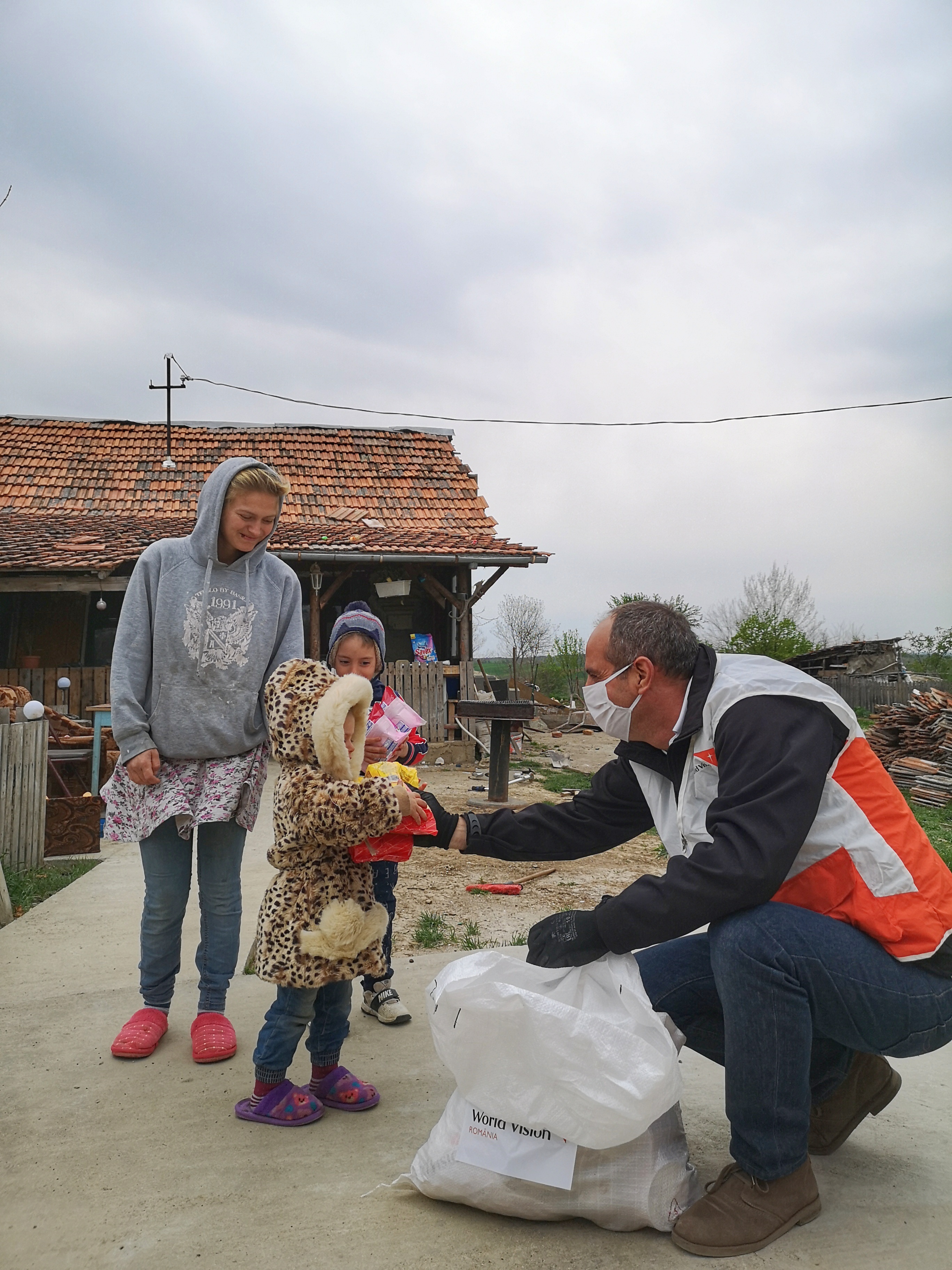
World Vision Romania is there and through our intervention we aim to help 7,500 families and 14,000 children in various ways so that they can still lead a normal life, as much as possible, in the following ways:

  • Supporting digital education in every possible way and with all the resources that we have. Children must continue to study. 
  • Providing packages with food, hygiene products, school materials and activity packs, and even electronic devices, internet SIM cards and other basic products. 
  • Connecting with children and their families and monitoring their health. We provide psychological counselling to those in need, via phone or online. 

People can donate to help sustain our intervention via text message: text SPERANTA to 8864 (SPERANTA means HOPE); each message equals 4 euro or donate online at https://worldvision.ro/coronavirus. All donations help us to support vulnerable families from rural areas survive the crisis. All individuals and companies who have necessary resources for rural families (food, hygiene products, digital infrastructure) are kindly asked to contact us at: donatori@wvi.org.

Please see more details about our response below:

We provide material support:

  • Disinfectants, protection masks, gloves, chlorine, water, toilet paper, wet napkins and other hygiene products;
  • Food packages for those placed in quarantine;
  • School materials, activity packs, games for the children isolated at home;
  • Electronic devices (tablets, computers) and internet SIM cards so that even children living in remote/isolated villages can have access to digital education during the coronavirus pandemic.

We provide digital home schooling:

  • We have identified solutions for distance communication with children via phone, apps, online platforms, e-learning and videoconferencing;
  • More than 5770 children can attend online courses via the “The School in a Box” e-learning platform;
  • 12th grade students from “I want in the 9th grade”  take part in remedial activities online. Hundreds of other high school students attend online personal development workshops. Students without access to internet or digital devices keep in touch with teachers via phone.

We provide counselling and monitor health conditions:

  • All our psychotherapists, psychologists, social and educational assistants provide phone or video psychological counselling;
  • Nurses keep in touch with the families on a daily basis to monitor their health condition; 
  • We provide information about essential preventive behaviour so they can stay safe and sane. 

Scavenger hunt in Portugal

By Telma Costa, CPADA

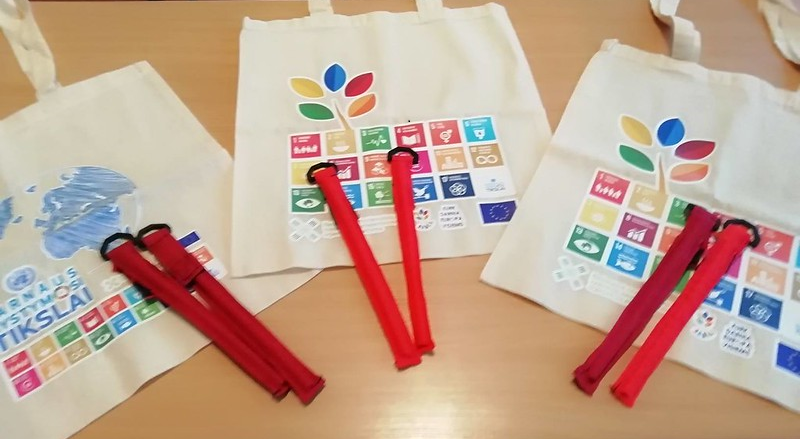
CPADA took the SDGs to schools as part of the Make Europe Sustainable for All Project. Through a scavenger hunt, students and teachers were able to get familiar with the 17 SDGs, and think about how they can have different meanings in the reality of different countries. For example, for those living in Portugal, SDGs 3 (Good Health and Well-Being) and 6 (Clean Water and Sanitation) seem as simple as having doctors and water, but for children and families in less developed countries these represent a challenge to survival, especially in the current reality of the Covid-19 Pandemic. 

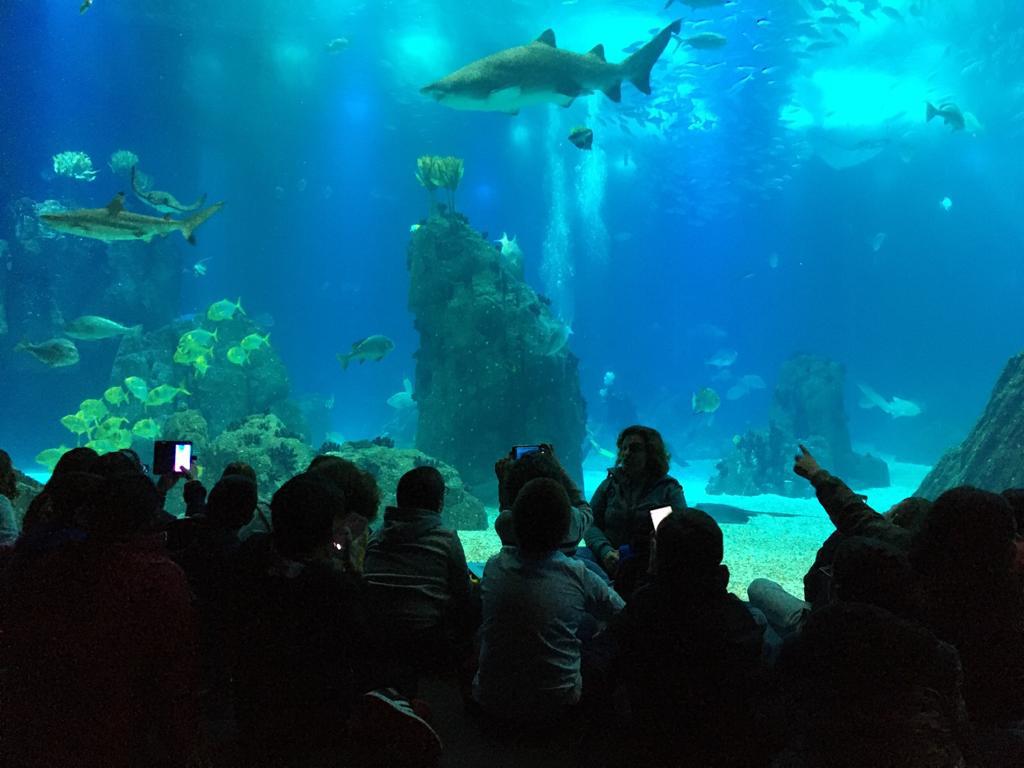
The last of the SDGs is 17 (Partnerships for Development), so one of the goals of this treasure hunt was to demonstrate the ultimate lesson: that to achieve the other 16 SDGs, simple teamwork and partnership are essential to reach the end! Of course, everyone won … even if the prize was simply more knowledge! The school we worked with is located in a municipality near Lisbon with a high rate of needy families, and the Project provided these children with another adventure – a visit to the Lisbon Oceanarium and a workshop on biodiversity that explained the human impact on its decrease and how this contributes to climate change. This was a great example of a small action that helped impact those who are the future of our planet!