News

UN Secretary-General Releases Advance Version of 2018 SDG Progress Report

By UN

On 10 May, UN Secretary-General Antonio Guterres issued, in advance, the unedited 2018 edition of the annual report on progress towards the SDGs. The report is based on selected SDG indicators for which data is available, using the latest data as of 10 May 2018.

The report titled, ‘Progress towards the Sustainable Development Goals,’ is produced to inform the UN High-level Political Forum on Sustainable Development (HLPF). The global indicator framework used in the report was developed by the UN Inter-Agency and Expert Group on Sustainable Development Goal Indicators (IAEG-SDGs), and later adopted by the UN General Assembly (UNGA) in July 2017 (resolution 71/313).

For each of the 17 SDGs, the Secretary-General’s report provides an overview paragraph on progress. This is followed by a list describing statistical trends for the targets under each Goal.

Some of the most notable discoveries in the report include:

  • Goal 2 (greater food security and the end of hunger): after a prolonged decline, “world hunger appears to be on the rise again”. This indicates that the prospect of ending hunger and malnutrition by 2030 has become increasingly difficult.
  • Goal 7 (affordable and clean energy): ensuring access for all “has come one step closer,” and notes improvements in industrial energy efficiency.
  • Goal 13 (climate action): 2017 was one of the three warmest years on record, and the world continues to experience rising sea levels, calling for countries implement their commitments under the Paris Agreement on climate change.
  • Goal 16 (peace, justice and strong institutions): there has been progress in regulations to promote public access to information, “albeit slowly,” as well as in strengthening national human rights institutions.

Some of the SDGs’ 169 targets are not reflected in the report, due to lack of data or methodological development on their respective indicators. The report stresses the need for quality, accessible, open, timely and disaggregated data, brought about through strengthened capacities of national statistical systems.

The 2018 session of the HLPF will convene from 9-18 July 2018, in New York, US.

The full report can be found here.

ANIMALS ON THE AGENDA – A new front in the struggle against inequality?

By Spanish Green MEP Florent Marcellesi’s and philosopher and author Corine Pelluchon

Animal exploitation on a mass scale remains a grotesque reality today. But a cultural shift is underway, and animal-rights awareness and activism is on the rise. The Green European Journal sat down with Spanish Green MEP Florent Marcellesi and philosopher and author Corine Pelluchon to discuss change on the horizon.

Green European Journal: What explains the resurgence of animal rights as an issue in politics and society in recent years?

Corine Pelluchon: It’s not a resurgence, it’s an emergence in society, and in politics in particular. It stems from the challenging of a tired, worn-out development model, whose social and environmental counterproductivities are plain to see. Animal rights and awareness of animal suffering and its intensity is made more tangible by images than environmental damage is. The depth of the animal rights issue lies, in my opinion, in its challenging of this development model, which leads beings to become numb and divided, accepting it because it’s intolerable, but it’s also a lever for putting forward another model. It’s the hope that we can promote a society where the interests of humans and animals are taken into account and where we can transform the economy and achieve ecological transition.

On the political side of things, there is, on the one hand, pressure from civil society, animal welfare charities who are mobilising certain politicians, even though animal rights has been slow in becoming a political end in itself. It has still not been accepted as a constitutional principle. On the other hand, while some (including members of the European Parliament) want to improve animal welfare, and even end certain cruel practices, they often lack the means to make themselves heard because representative democracy prioritises the immediate interests of mankind today, and not the long term and other living creatures; it also favours very economistic politics in which lobbies are powerful. I think that there has been a divorce between politicians and stakeholders in civil society. For example, most farmers have understood that they need to change model.

Florent Marcellesi: Just ten years ago, if you said, “I’m a vegetarian”, people would laugh at you. Today, the initial reaction is more likely to be: “I’m doing everything I can to eat less meat.” This very profound cultural shift certainly hasn’t yet led to any major concrete changes, even less so at a political level, be it in Europe or in member states, but change, slow and gradual, has begun in terms of production and consumption. And what is certain is that the power of images, through videos made in abattoirs, for example, partly explain the visibility of the issue. This power of images leads us back to ourselves, to our development model. Nobody would allow our pets to suffer what pigs, cows, or chickens suffer.

Change, slow and gradual, has begun in terms of production and consumption.

In politics, those fighting for animal rights remain somewhat in the minority. I think that the question of animal welfare has already moved forward in a way that cuts across issues more. For example, under Article 13 of Title II of the Lisbon Treaty, animal welfare is recognised but is also limited by a clause on cultures, as is the case for bullfighting, for example. But the most notable absentee is animal rights. How can we have conceived our representative democracy only in terms of humans? What about ‘non-human entities’? Nature? Sentient beings? The ‘voiceless’ raise a fundamental democratic question about animal rights.

In the current fight to protect animals, should we see a deeper continuity with the fights against injustices such as slavery, racism, and the like? A new front in the struggle against inequality?

Corine Pelluchon: There is a sort of convergence of logic between condemning racism, sexism, and speciesism. However, I think that the issue runs deeper because it’s a question of civilisation, as I showed in Manifeste animaliste. Politiser la cause animale Today, it’s our humanism itself and our idea of ourselves, our identity, which are at stake. In my book Éléments pour une Éthique de la Vulnérabilité – Les hommes, les Animaux et la Nature published in 2011, I took the opposite stance to traditional animal rights advocates, who contrast animalism with humanism, to show that the animal issue, which questions our own humanity, who we are and how we got there, can only be understood as part of a renewed humanism that takes into account subjectivity and vulnerability. The goal is to complete the unfulfilled legacy of human rights, which were founded on an atomist and abstract conception of the subject. All my work in Les Nourritures. Philosophie du corps politique (Seuil, 2015) and Éthique de la considération (Seuil, 2018) is dedicated to this.

Taking responsibility for animal suffering and stepping through the looking glass is something hard to endure.

I was born in the countryside: my father was a farmer. At the time, cows lived for 14 years. They had horns, they all had names. Today, they live for four years, are worn out, have cancers of the uterus because they are inseminated too early and metabolise enormous amounts to produce enormous amounts of milk. Sure, pigs were killed on the farm, but there were no gestation crates, no un-anesthetised castration of piglets. Today, the industrial farming that has been the norm since the Second World War, with an acceleration in the 1980s and 1990s, shocks and scares people, especially the younger generation. I think that everyone is aware and concerned, but there are many people who employ psychological defence strategies, because it’s difficult to take responsibility for this violence, to experience all the negative emotions associated with the shame of making animals suffer what they do. Taking responsibility for animal suffering and stepping through the looking glass is something hard to endure. Turning this suffering into political engagement takes time. That’s why it’s very important to accompany this awareness of animal suffering with words, and not just videos. Today, it’s time that certain countries, particularly France and Spain, which lag far behind, make progress on certain points.

Florent Marcellesi: As soon as you explain the figures to people, they’re horrified. At a global level, 60 billion land animals are sacrificed every year. Added to that are 100 billion sea animals. In Spain, for example: 50 million pigs are sacrificed each year, which is equivalent to the population of Spain. For chickens, it’s 700 million a year, which is more than the population of the European Union! I don’t think that the word ‘exploitation’ is strong enough; we should talk about ecocide. It’s an ‘animal genocide’, as Mathieu Ricard would say, a large-scale massacre authorised and implemented by the system and in which the public authorities and societies are stakeholders.

I don’t think that the word ‘exploitation’ is strong enough; we should talk about ecocide.

I think there are connections between movements for equality. Rosa Parks and Coretta Scott King were fighting for animal rights, by extension of the non-violence movement. Alice Walker, author of “The Color Purple”, said: “The animals of the world exist for their own reasons. They were not made for humans any more than black people were made for white, or women created for men.” I think that, just as environmentalism brought nature into democracy, even if it’s still incomplete, animalism will bring animals into it. That’s why there needs to be connections between these different movements. Progressivism forgot about environmentalism, and environmentalism forgot about animalism somewhat. It’s the next step. Of course, adding the interests of animals to the interests of humans and nature further complicates the overall approach. But, whether it’s in the European Parliament or everyday life, it’s very important to change the model of development, production, and consumption to have this complete and holistic vision.

How can we reconcile these different points? What are the different points of friction?

Florent Marcellesi: There are points of friction, it’s undeniable, for example, around invasive species and biodiversity. But there are also many points of convergence that interest me more than points of friction, which can make us lose our way and lose sight of the overall goal. But we must come together around the main thing, which is a sustainable, fair, and democratic development model with more than just the human being at its core.

Corine Pelluchon: That’s exactly my way of doing things. We have to negotiate in politics, find common ground when there is disagreement, accept differences. It’s also important to avoid pointless debates, like whether veganism means not keeping pets. First of all, I think that it’s a shame to cut us off from everything that animals teach us, like otherness. But we also need to stop pitting vegans and non-vegans against each other. Because the real problem is first of all industrial farming with its consequence for the climate, land grabbing, and the fact the demand for animal products has an impact on the 865 million people who suffer from hunger and the two billion who suffer from malnutrition and live in poor countries where cereals are exported for American and European livestock. Not to mention health problems, such as antibiotic resistance due to their massive use in industrial pig farming, like in Germany. The problems that I’m talking about here are enough to find major areas of convergence and to encourage Westerners to halve their consumption of animal products, including dairy products. That’s the recommendation for returning to a consumption level similar to that seen at the beginning of the 20th century, whereas today in France, 70 to 80 kilograms of meet are eaten per person, per year, which is enormous. The most important thing in our actions for moving towards ecological and food transition is that we insist on the convergence between the environment, health, social justice, and animal welfare. The goal is to have tolerant and non-violent partners to achieve profound and long-lasting change.

Florent Marcellesi: In political ecology, it’s the famous slow revolution, part of a long-term radical reformism. Given the figures that we’ve cited, to think that we can abolish animal exploitation overnight is a fantasy. I think that we should have an abolitionist goal. Ethically, it’s the most coherent, but in practice, we need to be able to make day-to-day progress and work with everyone.

Industrial farming is key because it is the crux of the problem and cuts across issues: climate (15 percent of greenhouse emissions), health (800 million people who are dying of hunger, and 800 million others who have problems with obesity, cancer, and diabetes caused by poor diet, including meat), working conditions in farming (in abattoirs, for example), deforestation in the third world, and, of course, animal suffering. In this context, reducing the consumption of meat is a sustainable and beneficial action: it helps change the system and allows the consumer to live in better health. We need to remind people of the pleasure that comes from eating much less meat. People can live much better and with fewer illnesses. Eating meat twice a week is more than enough and lets people rediscover other sources of protein, such as legumes. To change this means changing two things: on the one hand, changing the production system so that it gives greater importance to vegetable proteins than animal proteins, and on the other hand, of course, changing the Common Agricultural Policy (CAP) in Europe, which currently supports the food industry and mega farms, which are multiplying, but which should support agroecology and small organic and extensive farms.

Corine Pelluchon: I recently spoke to a group called Agrospective. The representatives of McDonald’s, for example, have heard what I’m saying because they notice that consumers are shifting. They respond with vegetarian menus. It was very interesting, and business has high expectations of MEPs in re-orienting the CAP. Personally, I’m also a big believer in encouraging individuals to organise, in terms of land use, for example. This could be done via an environmental and social payment for projects that pave the way for the transition.

2019 European elections: can we hope for a real European movement? Is the European level the most relevant when it comes to animal rights?

Florent Marcellesi: There needs to be a convergence between everyone. If we want a long-term transition with little steps, we need to move forward together. Convergence implies different movements taking animal rights into consideration. For example, it would be useful if a movement like DiEM25 included these animalist issues in its project for Europe. This implies animalist parties taking on questions such as the environment, the fight for gender equality, and so on. And it also implies environmentalists taking a step forwards by declaring loud and clear that the convergences are stronger than the points of friction. I would like us to converge at the elections or at least in the same political group in the European Parliament so we can take on the food industry lobbies that are very much present in Brussels. Work is already underway in this direction with an intergroup in the European Parliament that is fairly well organised, and in which I participate alongside all the MEPs involved in animal rights. We need to strengthen these trends.

Corine Pelluchon: I think exactly the same thing. I would simply add that the environment, if it is taken seriously as wisely inhabiting the Earth and living alongside other living creatures, necessarily includes animal rights. I think that the danger for animalist parties lies in being new in some countries and therefore being potentially isolated, which would be a shame for the European elections. A broad vision can’t be made up as you go along. It involves thinking about humans in their relationships with other beings. The lobbies are extremely well organised, so to fight them we need to be organised and united too.
Confronting inequality: basic income and the right to work

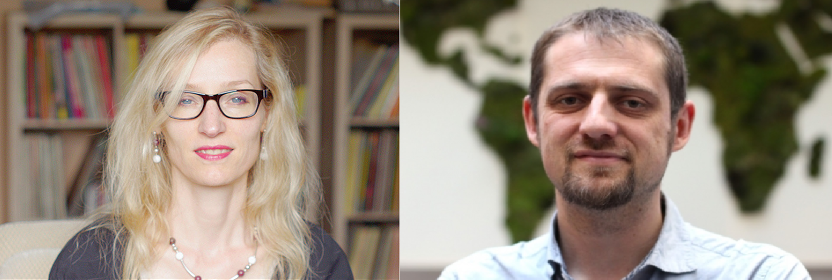
By Tim Jackson

Ten years after the financial crisis, inequality in advanced economies is still rising. Tim Jackson presents the findings of a new CUSP working paper to explore potential solutions.

The idea of a citizen’s income originated with Thomas More, who in his work, Utopia (1516), suggested that it could be a means to redistribute wealth when common lands were privatised. More recently, it has enjoyed a resurgence with former Greek finance minister, Yanis Varoufakis, proposing a form of basic income as the solution to the modern dilemma of rising unemployment due to technological advances, in particular robotization and machine learning. For the same reason, the suggestion has become popular amongst the Silicon Valley elite. Just last week, Finland’s basic income trial (the first of its kind in Europe) came under the spotlight with claims that the scheme was to be abandoned as a failure – a claim the Finnish government took pains to deny

Money for no work clearly has its attractions, as Dire Straits pointed out. However, the idea that a universal basic income can remove inequality within society needs a careful examination. Is it more effective in sharing wealth than a tried and tested income tax, where higher income earners are taxed at higher rates? Or than a tax on capital assets, as the French economist Thomas Piketty has proposed? Can any of these measures prevent the systemic inequality that has become more prevalent in advanced economies in recent decades?

These questions lay behind the most recent CUSP working paper on confronting inequality in a post-growth world, in which a macroeconomic SIGMA model was used to explore the dynamics of inequality as the growth rate declines.

Piketty famously pointed out that a declining growth rate can have a damaging effect on the distribution of income. He insisted not only that rising inequality in the US was a direct result of a slowing economy, but also that declining growth rates must inevitably have such an impact. His magnum opus Capitalism in the 21st Century was described as a wake-up call for capitalism. It was also a profound challenge to anyone interested in the prospects of prosperity without growth. A post-growth world with an ‘explosive’ rise in inequality is not a happy prospect.

As it turns out, Piketty made a couple of assumptions in his workings which are critical to the outcome of the analysis. The first of these concerns the behaviour of the savings rate as the growth rate declines with Piketty implicitly assuming it would stay constant. The second key assumption concerns the ease with which it is possible to substitute capital for labour. With constant savings rate and high substitutability of capital for labour, one can easily demonstrate that Piketty was correct. Inequality rises explosively as a result.

It is also possible to see that these conditions look a lot like the world we’re being told to welcome: a small minority of high-tech companies driving an increasingly automated world with a rising capital intensity in which there is less and less need for wage labour. Demand may well stagnate, but as long as the owners of capital have sufficient sway over government to protect their returns, the show can go on. The outcome would be as dystopian as it is possible to be.

Worse still, in these circumstances there is no real consolation in the basic income. In fact, our simulations showed that you could use all three measures (basic income, income tax and capital tax) in combination at rather high rates and you would still end up fighting a losing battle against rising inequality. Perhaps more worryingly for the advocates of the basic income, it turns out to be the least effective of the three measures that were tested in the report, unless it could be introduced at rates considerably higher than those being tested in Finland (and elsewhere).

Fortunately, however, the outlook is not unambiguously bleak. The authors of the report looked into other possible outcomes from Piketty’s assumptions. One possible outcome would be that the net savings rate declines alongside the growth rate. In fact, this outcome may be more likely than one in which the savings rate remains constant: with declining growth and constant savings it is increasingly difficult to protect the rate of return on capital. A decline in returns is unlikely to act as an incentive to invest and will therefore lower the savings rate. At any rate, allowing the savings rate to decline alongside growth immediately allows for inequality to be contained between more reasonable bounds.

There is more good news. With a modest protection on the right to work and fewer incentives to accumulate capital (modelled through a low substitutability between capital and labour) we found that inequality declines ‘naturally’ in the report’s model, even without the impact of measures like the basic income. Taken together with redistributive policies measures, it is possible to eliminate inequality almost entirely, even as the growth rate declines towards zero.

In other words, there are post-growth worlds in which social progress remains entirely possible. It is a comforting outcome in a week when the UK’s quarterly growth rate slumped to a five-year low. It is also a vital finding for those who are less convinced by the growth-obsessed, hyper-capitalism that haunts us today.

Fight Inequalities campaign gets underway

By Solidar, World Vision and the EEB

Last week on 6 June, the global Fight Inequalities campaign was launched at the European Development Days.

The campaign was organised by civil society organisations from 15 EU countries who are working to increase awareness and push for the policy and social change needed to tackle inequality and poverty in Europe and beyond.

Inequality cuts across all of the Sustainable Development Goals. Tackling inequality should therefore be a priority, as none of the Sustainable Development Goals can be achieved.  

The campaign calls for societies to be more inclusive for women, children, different ethnic groups, marginalised people, and for EU citizens to become agents of change in their own communities.

Representatives from EU institutions took part in the campaign launch that took place at the ‘Make Europe Sustainable For All’ stand at the EDD event.

The #FightInequalities stand at the EDDs created an interactive and enriching experience. The 17 steps towards equality game, depicted all of the 17 Sustainable Development Goals (SDGs). The player would walk through various stories of inequalities happening to people in their everyday lives, both from Europe and beyond. This way, the player would learn about the different forms that inequality can take. After, the visitor had the opportunity to contribute to the inequalities mosaic with a picture and a quote reflecting the outcomes of the interaction.

More information at: http://makeeuropesustainableforall.org/campaigns/

See Get Up project’s new videos on talent waste, gender pay gap and work life balance!

By ALDA

When you were a child, have you ever been told to act like a girl (or a boy)?

In the European Union, women earn on average 16% less than men. For the same job. Why?

Working women in the EU spend on average 26 hours/week on unpaid care and housework. Working men… 9 hours.

Gender stereotypes affect everyone since their birth, continuing to become prominent in schools and at work place though the entire life. ALDA and all partners of the project GET UP hope to delete this from all future conversations.

Watch and share our new videos on talent waste, gender pay gap and work life balance and promote a more gender equal society!

ALDA is part of the project GET UP –  Gender Equality Training to overcome Unfair discrimination Practices in education and labour market, co-funded by the Rights, Equality and Citizenship programme of the European Union. The project tackles the stereotyping of educational and career choices, and promotes gender equality in education, training, career guidance and at the workplace.

More information about the project GET UP

ALDA – The European Association for Local Democracy is a membership based organisation gathering more than 300 members (including local authorities, associations of local authorities, and civil society organisations) coming from more than 40 countries dedicated to the promotion of good governance and citizen participation at the local level.

12 Questions for the Future of Europe: Commission Launches Online Citizens’ Consultation

By the European Commission

On Europe Day, 9 May 2018, the European Commission launched an online public consultation addressed to all Europeans, asking them what direction they want the European Union to take in the future.

This unique consultation, part of the broader Future of Europe debate launched with the Commission’s White Paper on 1 March 2017, was prepared by a panel of 96 citizens from 27 Member States, who came together to decide what questions to put to their fellow Europeans.

European Commission President Jean-Claude Juncker said today: “With the European elections around the corner, it is time to decide what the European Union at 27 should be. Whatever happens, it must be a Europe built by Europeans. The survey we are launching today puts the question to all Europeans: What future do we want for ourselves, for our children and for our Union? Now is the time for Europeans to make their voices heard, loud and clear, on the issues that concern them and what they want their leaders to do about them.”

For the first time, the Commission convened a Citizens’ Panel on 5-6 May to draft a public consultation. Hosted by the European Economic and Social Committee, a group of 96 Europeans came to Brussels and worked together to draft a 12-question online survey. This unique exercise in participative democracy means that citizens are at the heart of the conversation on the Future of Europe.

This is part of the ongoing debate on the future of the EU at 27, launched with the Commission’s White Paper of 1 March 2017. People can already submit their views online – today’s consultation will further complement this. The online consultation will also run in parallel to the ongoing Citizens’ Dialogues being organised by the European Commission and by Member States. Almost 700 of these interactive public debates have been held in 160 cities since 2012, and the Commission will increase their frequency between now and the European elections in May 2019, with a target of organising 500 more events.

In addition to the Commission’s work, Citizens’ Dialogues are now being organised by national governments in all Member States, following an initiative from France which received the support of the Heads of State or Government of the future EU27. The Commission is sharing the benefits of its experience with Member States. The consultation will run until the Sibiu summit on 9 May 2019. The Commission will present an interim report to Member States on the White Paper process at the December 2018 European Council. A final report will then be presented at the first EU27 Summit in Sibiu, Romania, on 9 May 2019, just a few weeks ahead of the European elections.

Background

In  March  2017, the  Commission launched  a new debate on the  future of the EU at 27,  through the publication of a  ‘White  Paper on  the Future  of Europe’.  Members  of the Commission  have been travelling  across Europe and listening  to citizens’ views on the different scenarios put forward, giving everyone a chance to contribute to shaping the Union.

For more information

Online: Consultation on the Future of Europe

Factsheet: Dialogue with Citizens ahead of the European elections

Brochure: Citizens’ dialogues on the Future of Europe

White Paper on the Future of Europe

The 6th scenario

Commission press release – 9 May 2018

EMIN European Bus Tour Campaign for Guaranteed Minimum Income Schemes across Europe

By European Minimum Income Network (EMIN)

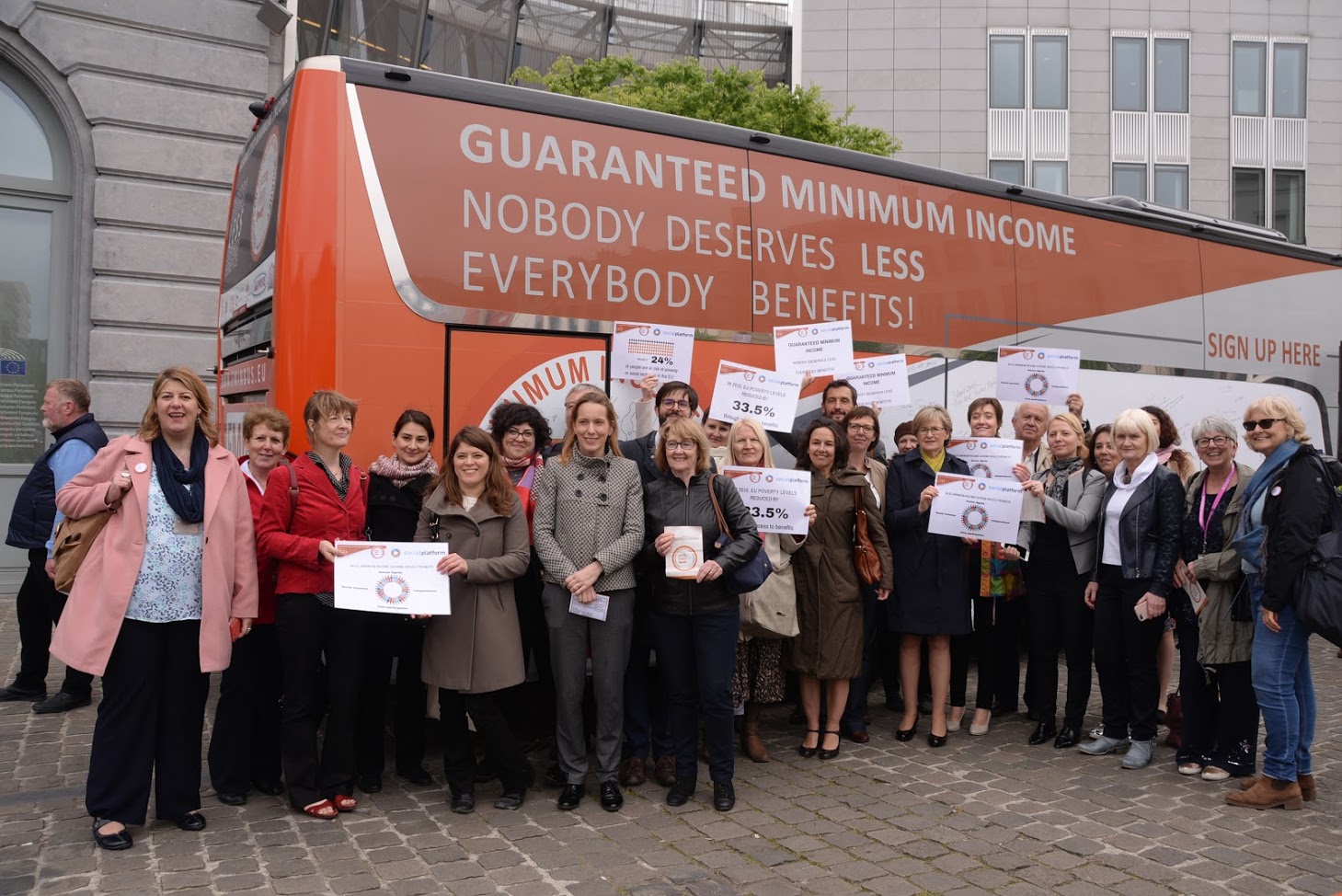
2 Buses, 32 Countries, 64 days, over 120 events and over a thousand volunteers for Guaranteed Minimum Income Schemes.  

On 24 April the EMIN partners, together with experts by experience, Commissioner Marianne Thyssen, Mairead McGuinness, (Vice President European Parliament), more than 20 civil society organisations, members of the European Parliament, Axelle Red, and many other supporterslaunched the EMIN bus tour.

With this tour, we want to raise awareness and campaign for the progressive realisation of well-designed Minimum Income Schemes: guaranteeing income support for everybody who needs it, for as long as they need it, enough to live a life in dignity and fully participate in society, adapted to the cost of living in every European country.

Although all European member states have some kind of minimum income scheme, none of them can be considered to be fully adequate, accessible and enabling.

Fintan Farrell, EMIN Project Manager: “The EMIN bus journey is a journey to promote real democracy. A democracy that can deliver the maximum good for the maximum number of people. Guaranteed access to decent income through accessible minimum income schemes is the base on which we can build such a democracy.”

Alias Onyadon, Expert by Experience, Belgium: increasing social minimums to an adequate level would have a real impact on the daily life of people experiencing poverty and on society. Especially in the current context of failure of policies to fight against poverty, we need an increase in social investment more than ever.

Cidalia Barriga, Expert by Experience, Portugal.: “The minimum income scheme was clearly not enough but it allowed me to feed my children and to ensure they could continue with their education”

The progressive realisation of these Guaranteed Minimum Income schemes would have a huge impact on the fight against poverty: not only the people who need these schemes, but society as a whole would benefit from it!

Follow our adventures on www.eminbus.eu and sign our petition https://you.wemove.eu/campaigns/Guaranteed-Minimum-Income-Scheme

The European Minimum Income Network (EMIN) is an informal Network of organisations and individuals committed to achieve the progressive realisation of the right to adequate, accessible and enabling Minimum Income Schemes.  EMIN unites various experts, professionals, academics and diverse entities active in the fight against poverty and social exclusion.

NYC Takes Historic Step in Local Tracking of Progress Toward Global Goals

By: Alexandra Hiniker, Strategic Relationships Manager, NYC Mayor’s Office for International Affairs

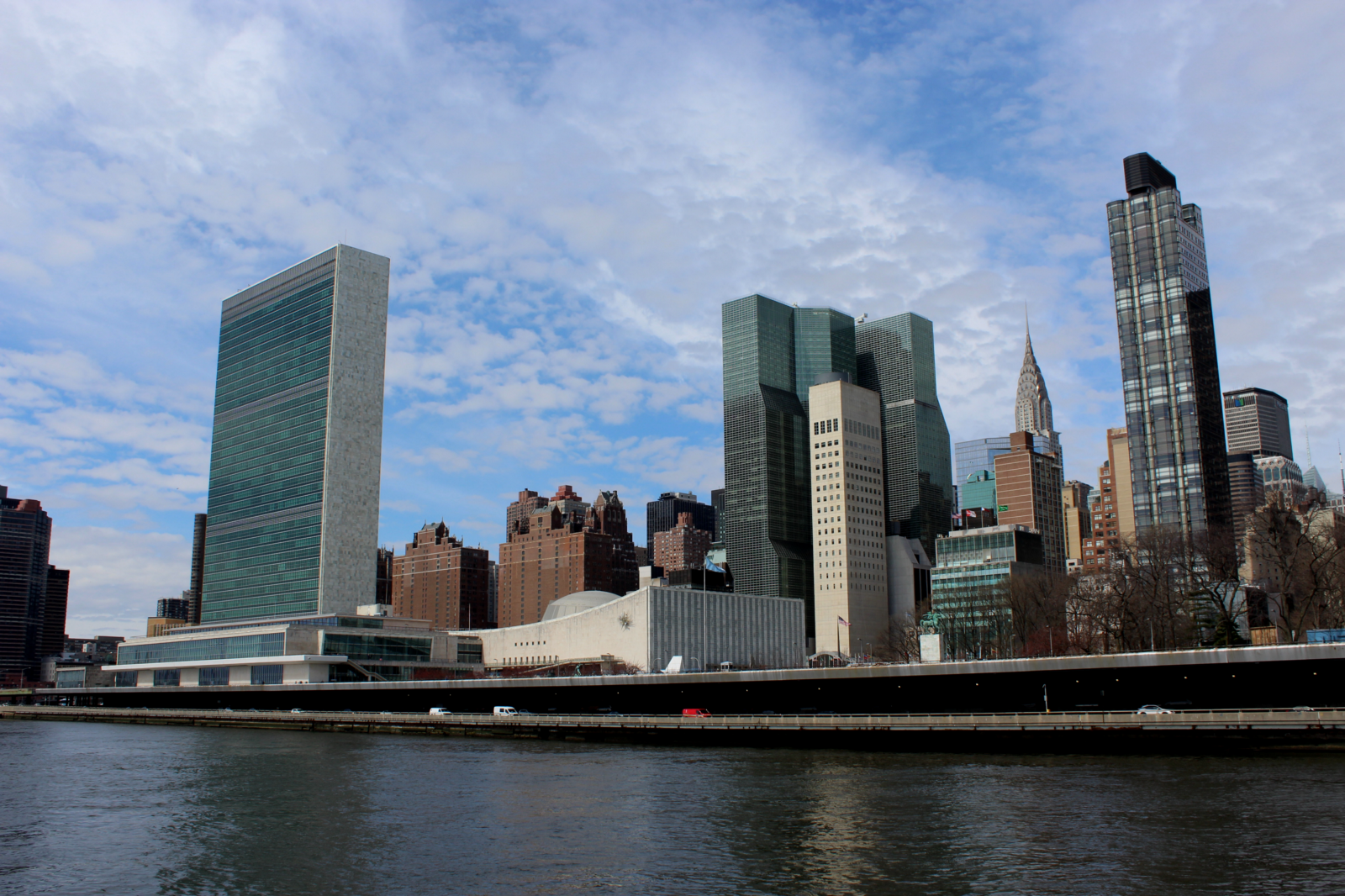
New York City will become the first city in the world to report directly to the United Nations on the status of its implementation of the Sustainable Development Goals (SDGs) during the High-Level Political Forum this July. The publication will be called a Voluntary Local Review (VLR), modeled after the Voluntary National Reviews (VNR), which all member states are invited to present.

The VLR is part of Global Vision | Urban Action, the NYC Mayor’s Office for International Affairs program exploring the synergies between the April 2015 OneNYC strategy and the SDGs. Since the launch of Global Vision | Urban Action in 2015, the program has been focusing on critical topics such as mental health, equity in tech, decent work for all, addressing climate change through infrastructure, and wastewater treatment.

Please see the press release and click here for our Medium post that explains the VLR in more detail.

How the Human Rights Movement Failed

By Samuel Moyn

Published April 23, 2018 in the New York Times

The human rights movement, like the world it monitors, is in crisis: After decades of gains, nearly every country seems to be backsliding. Viktor Orban in Hungary, Rodrigo Duterte in the Philippines and other populist leaders routinely express contempt for human rights and their defenders.

But from the biggest watchdogs to monitors at the United Nations, the human rights movement, like the rest of the global elite, seems to be drawing the wrong lessons from its difficulties.

Advocates have doubled down on old strategies without reckoning that their attempts to name and shame can do more to stoke anger than to change behavior. Above all, they have ignored how the grievances of newly mobilized majorities have to be addressed if there is to be an opening for better treatment of vulnerable minorities.

“The central lesson of the past year is that despite considerable headwinds, a vigorous defense of human rights can succeed,” Kenneth Roth, the longtime head of Human Rights Watch, contended recently, adding that many still “can be convinced to reject the scapegoating of unpopular minorities and leaders’ efforts to undermine basic democratic checks and balances.”

That seems unlikely. Of course, activism can awaken people to the problems with supporting abusive governments. But if lectures about moral obligations made an enormous difference, the world would already look much better. Instead, those who care about human rights need to take seriously the forces that lead so many people to vote in majoritarian strongmen in the first place.

The truth is that the growth of international human rights politics has accompanied the very economic phenomena that have led to the rise of radical populism and nationalism today. In short, human rights activism made itself at home in a plutocratic world.

It didn’t have to be this way. The Universal Declaration of Human Rights, which was promulgated in 1948 amid the consolidation of welfare states in Europe and North America and which formed the basis of the human rights agenda, was supposed to enshrine social protections. But in the 1970s, when activists in the United States and Western Europe began to take up the cause of “human rights” for the victims of brutal regimes, they forgot about that social citizenship. The signature group of that era, Amnesty International, focused narrowly on imprisonment and torture; similarly, Human Rights Watch rejected advocating economic and social rights.

This approach began to change after the Cold War, especially when it came to nongovernmental advocacy in post-colonial countries. But even then, human rights advocacy did not reassert the goal of economic fairness. Even as more activists have come to understand that political and civil freedom will struggle to survive in an unfair economic system, the focus has often been on subsistence.

In the 1990s, after the Cold War ended, both human rights and pro-market policies reached the apogee of their prestige. In Eastern Europe, human rights activists concentrated on ousting old elites and supporting basic liberal principles even as state assets were sold off to oligarchs and inequality exploded. In Latin America, the movement focused on putting former despots behind bars. But a neoliberal program that had arisen under the Chilean dictator Augusto Pinochet swept the continent along with democracy, while the human rights movement did not learn enough of a new interest in distributional fairness to keep inequality from spiking.

Now the world is reaping what the period of swelling inequality that began in the 1970s through the 1990s sowed.

There have been recent signs of reorientation. The Ford Foundation, which in the 1970s provided much of the funding that made global human rights activism possible, announced in 2015 that it would start focusing on economic fairness. George Soros, a generous funder of human rights causes, has recently observed that inequality matters, too.

Some have insisted that the movement can simply take on, without much alteration of its traditional idealism and tactics, the challenge of inequality that it ignored for so long. This is doubtful.

At the most, activists distance themselves from free-market fundamentalism only by making clear how much inequality undermines human rights themselves. Minimum entitlements, like decent housing and health care, require someone to pay. Without insisting on more than donations from the rich, the traditional companionship of human rights movements with neoliberal policies will give rise to the allegation that the two are in cahoots. No one wants the human rights movement to be remembered as a casualty of a justifiable revolt against the rich.

If the movement itself should not squander the chance to reconsider how it is going to survive, the same is even truer of its audience — policymakers, politicians and the rest of the elite. They must keep human rights in perspective: Human rights depend on majority support if they are to be taken seriously. A failure to back a broader politics of fairness is doubly risky. It leaves rights groups standing for principles they cannot see through. And it leaves majorities open to persuasion by troubling forces.

It has been tempting for four decades to believe that human rights are the primary bulwark against barbarism. But an even more ambitious agenda is to provide the necessary alternative to the rising evils of our time.

Samuel Moyn is a professor of law and history at Yale and the author, most recently, of “Not Enough: Human Rights in an Unequal World.”

Integrate sustainability pledges into the future EU budget

By People’s Budget campaign

European decision-makers, civil society organisations, academics and other stakeholders from all over Europe call on the European Parliament, the Council and the Commission to integrate sustainability into the next Multiannual Financial Framework (MFF) of the EU.

The EU budget is not an accounting tool, but a means to achieve common political goals. The EU aims for sustainable development as enshrined in the Treaty, and it is also committed to implement the 2030 Agenda for Sustainable Development, including the Sustainable Development Goals. This is the decisive moment when the EU can demonstrate its commitment to coherently mainstream sustainability principles, goals and objectives into funding decisions for the next decade.

We therefore call on the European Parliament, the Council and the European Commission to embed the “Think Sustainability First” principle when planning and implementing the next MFF and depending policies, which is also in line with the recommendations of the High Level Expert Group on Sustainable Finance. Sustainability does not only increase policy coherence, but also supports the efficient use of EU funds delivering results.

We also call on the European Parliament, the Council and the Commission to show their political commitment to sustainable development and the implementation of the 2030 Agenda for Sustainable Development in a joint declaration attached to the MFF regulation.

We are committed to work together with all European, national and regional decision-makers and stakeholders for a sustainable, strong and democratic future of Europe that benefits all people.