ASviS publishes its 2025 Report: a call to accelerate Italy’s path towards Sustainable Development

By ASviS

Ten years after its first Report, ASviS renews its commitment to the 2030 Agenda. “We are stubborn, but not blind,” the document states – reminding that, despite growing geopolitical tensions and social divides, sustainable development remains the only way forward to ensure peace, democracy, and justice for future generations.

The 2025 Report warns that the world is on track to achieve only 18% of the SDG targets by 2030, while wars, inequality, and the climate crisis deepen. It highlights how the European Union, once a global leader in sustainability, is now struggling with contradictions between its commitments and concrete policies.

In Italy, progress towards the SDGs remains slow: only 29% of national targets are within reach, with setbacks on poverty, inequalities, and environmental protection. ASviS calls for a “Transformative Acceleration Plan” to guide the country towards the 2030 Goals, and urges Parliament to approve a law on Generational Impact Assessment, a key tool to protect the rights of future generations enshrined in the Italian Constitution.

The Report proposes actions to strengthen governance, boost social cohesion, and accelerate the green and digital transitions from renewable energy and circular economy to education, innovation, and fair labour. Its message is clear: achieving sustainable development means uniting peace, democracy, and environmental protection because “reconciling with the environment,” as Italian President Mattarella said, is the path to a fairer future for all.

The full report can be read here: https://asvis.it/rapporto-asvis-2025/

Bringing SDGs to the forefront in Italy and beyond

By ASviS

ASviS and the Italian Ministry of Education renewed a Memorandum of Understanding in July to promote sustainable development in the education system.

The ASviS research area has published an article titled The territorialisation of the 2030 Agenda: a multilevel approach” in the academic journal “Asa 2022 Data-Driven decision making”, published by Firenze University Press in July.

Enrico Giovannini, ASviS Scientific Director, will attend the second SDG Summit in New York on 18-19 September, to represent Italian civil society at this crucial event, in particular with an online event on the Alliance channels on the 19th.

In conjunction with its stakeholders, ASVIS plans a number of activities to mark ‘Global Week’,, the UN’s worldwide mobilization to inspire and connect change-makers from September 15-25.On 19 October, ASviS will present its 2023 Sustainable Development Report in Rome and online. Analysis and recommendations on Italy’s progress toward the 17 Sustainable Development Goals are included in the document, which will also be available in English soon.

Sustained Pressure For A Sustainable Europe

By Khaled Diab, EEB

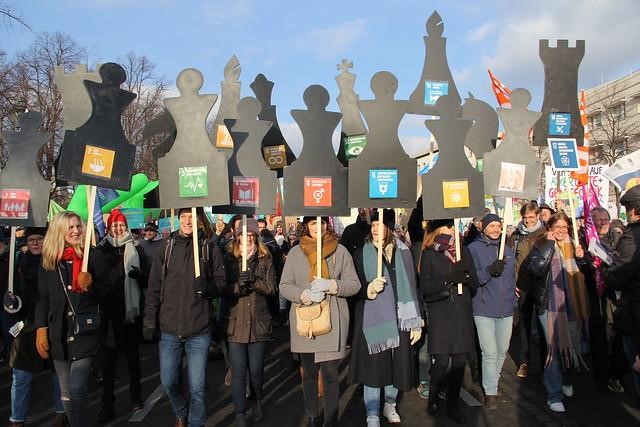
Civil society organisations from across Europe are urging European Union leaders to make sustainable development the golden thread running through all EU policies.

European Union leaders are due to hold a summit in Brussels on 20-21 June 2019 where they will hammer out the EU’s strategic agenda for the coming five years. A leaked draft of the five-year plan obtained by Euractiv reveals that the top priority EU leaders wish to pursue between 2019 and 2024, under the misleading heading “protecting citizens and freedoms”, revolves around migration, border controls and counter-terrorism.

While this may appear to be the populist thing to do, it is not the most popular, according to various opinion polls. Protecting the environment and sustainable living are popular amongst European citizens, regardless of their political ideologies. A near universal 94% of EU citizens say that protecting the environment is personally important to them, according to Eurobarometer, the EU’s polling agency.

Moreover, a recent YouGov poll found that the majority of Europeans polled were in favour of introducing greater protections for the environment, even it negatively affected economic growth, and that corruption, housing, health, pensions and unemployment rank above or equal to migration.

These trends were confirmed by what has been dubbed as the ‘green wave’ during the European Parliament elections.

Despite this clear preference for the environment among European citizens, the leaked draft plan relegates green policies to third place, behind migration and “developing our economic base”.

The golden thread of sustainability

Reflecting the clear preferences of millions of citizens to prioritise the environment, housing, health and employment, as well as responding to the urgent environmental and socio-economic crises facing Europe and the world, European civil society decided to join forces to demand the political establishment get its act together.

More than 150 organisations signed an open letter urging EU leaders to render sustainable development “the golden thread running through all EU policies” in the 2019-2024 strategy and beyond.

“Urgent action is needed to address escalating inequalities and tackle the climate crisis, stop the rapid loss of biodiversity, ensure sustainable consumption and production and quality employment for all, and manage a just transition towards an economic system founded on wellbeing and quality of life,” the signatories stated.

The letter was the brainchild of the European Environmental Bureau, the European Confederation of Relief and Development NGOs (CONCORD) and the Platform of European Social NGOs (Social Platform).

“The next five years will be decisive if we are to advance social justice, including by fighting poverty and social exclusion, creating quality employment, and ensuring the health, dignity and well being of all people,” says Kélig Puyet, director of the Social Platform. “To achieve this, our leaders need to do more than pay lip service to social and environmental sustainability.”

“The outgoing European Commission wanted to make us believe in infinite ‘green’ growth while leaving the economic system untouched,” notes Patrizia Heidegger, director of global policies and sustainability at the EEB. “We need the next Commission to focus on an economy for human well-being within ecological limits – and a political leadership that dares to ask: how much is enough to live well?”

Making Europe sustainable can only be achieved through sustained pressure. “The high priority that the large majority of European citizens assign to the environment and their active and constant demands for a better and more sustainable future are making a difference in the corridors of power in national capitals and in Brussels,” says Jeremy Wates, secretary general of the European Environmental Bureau (EEB). “But they need to keep up the pressure by making it abundantly clear to politicians that they will not settle for anything less than a sustainable Europe.”

Originally published 13.06.19 on EEB’s META: https://meta.eeb.org/2019/06/13/sustained-pressure-for-a-sustainable-europe/

REACTION OF SDG WATCH EUROPE on EUROPEAN COMMISSION REFLECTION PAPER “TOWARDS A SUSTAINABLE EUROPE BY 2030”

In 2015 the European Commission and member states committed themselves to achieve the 2030 Agenda, including the 17 SDGs in 2030. Since then a lot is said, less is done. SDG Watch Europe and many civil society groups with us, asked for a concrete Plan of Implementation to achieve those goals. This week, 3,5 years later, shortly before the mandate of this Commission ends, a long awaited reflection paper on the Sustainable Development Goals was published.

We deeply regret that the paper stays very vague and does not contain any concrete plan, targets or timeline. Five years after the adoption of the 2030 Agenda for Sustainable Development, the EU is still in the phase of “Reflection”, without have a plan of implementation on the SDGs, which are quite concrete in targets.

Claiming that sustainability is in the” DNA” of Europe and that we are global frontrunners in sustainable development, is not only self-congratulatory but factually wrong. On too many SDGs, the EU and its Members States can demonstrate only insufficient success or even regression.

In reality, the EU has one of the world’s worst ecological footprints and CO2 emissions per capita.

Read the full reaction from SDG Watch Europe here:

https://www.sdgwatcheurope.org/wp-content/uploads/2019/02/reaction-on-Reflection-paper-SDGs.pdf


Europe is experiencing an economic recovery but many new jobs do not lift people out of poverty

By Christian Nielsen, European Anti-Poverty Network (EAPN)

The latest forecasts tell a story of economic recovery. Europe is emerging out of a decade-long slump that nearly crippled a handful of countries and hampered employment and growth numbers in the rest. People are working again, industry is growing and business confidence is up, except perhaps in Brexit-paralysed Britain. This is surely good news for people living in poverty.

Or not. All this economic good cheer ignores a persistent and often under-reported problem in ‘wealthy’ Europe… having a job means little if it is poorly paid, unregulated, unstable or just plain unfair. This was the general sentiment at a recent EU-backed meeting in Brussels organised by the European Anti-Poverty Network (EAPN) which heard from a range of people experiencing poverty, especially the working poor.

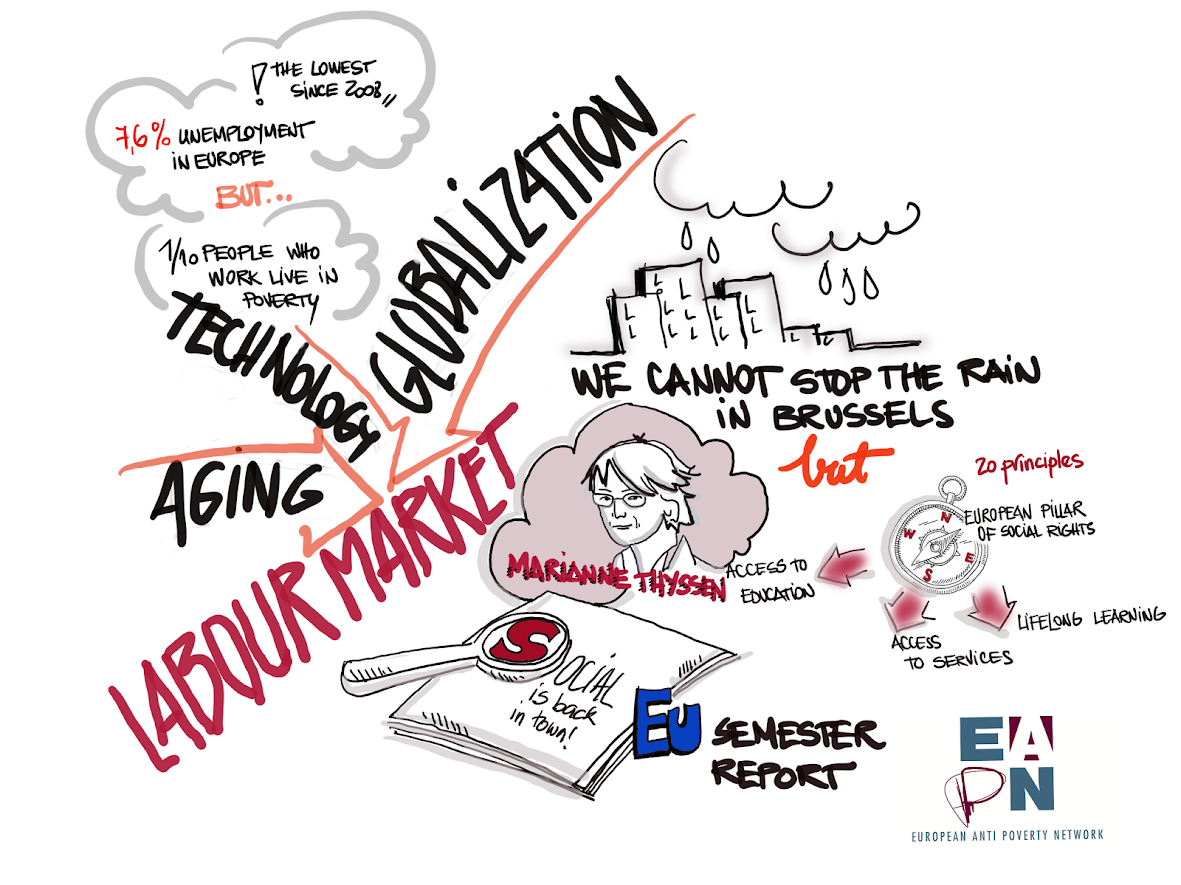
The European Union’s unemployment rate is currently around 7.5%, which is the lowest rate recorded in the bloc since December 2008. But according to a new EU report on ‘In-work poverty in the EU’, the number of European workers at risk of poverty has actually increased, from 8% in 2007 to 10% today.

Europe knows it has a problem and that there is a window of opportunity in the early stages of the recovery to tackle it. European Commissioner Marianne Thyssen, whose responsibilities include employment and social affairs, acknowledged this using Bob Dylan as inspiration. “The times, they are a-changin,” she said, and everyone — governments, industry, social partners, unions — needs to ensure no-one gets “left behind or pushed aside” in this changing world.

Yet the stark reality is that Europe’s recovery is opening up an economic no-man’s land between the rich and the ‘working poor’. This is a precarious place — especially for the 70 million Europeans who lack the skills or basic numeracy to take full advantage of the digital revolution — where even Europe’s much-vaunted social system seems unable to gain ground. It’s occupied by a growing class of Europeans who are not poor enough for many of the social services and not rich enough to afford decent accommodation and good health, or to start a family, move away from home…or simply to enjoy the benefits of a ‘living wage’.

“We live in a world of plenty but wealth is concentrated in fewer and fewer hands,” said EAPN’s Director Leo Williams. This is an “absurd paradox”, he added, in light of the recent Paradise Papers tax-avoidance scandal.

Flexibility leads to poverty

The causes of this wealth gap are entrenched in labour market principles which are geared towards flexibility and dynamism in order to stimulate growth, new jobs and mobility. But in practice, it engenders a power imbalance between workers and employers which translates into something called ‘low work intensity’. For others, it means low-paid or minimum-wage work, and for Europe’s legions of under-employed youth and graduates it means a succession of internships and other ‘non-standard’ or exotic working conditions crafted by employers to keep labour costs in check. This imbalance has direct consequences on the working poor, ranging from difficulties meeting childcare costs and poor or no housing, to high stress and failing health.

In this report, in-work poverty means household income is below the poverty line or threshold despite a full or part-time worker living there. The poverty threshold is defined as under 60% of the average household income (before housing costs).

Real-life struggles told by delegates invited from all over Europe to the ‘people experiencing poverty’ meeting were aimed at EU policy-makers and social actors. A single mother of four spoke of a life “treading water” and feeling socially excluded in the UK. “We really want justice, not judgement,” she said, and to be “cared for, not criticised” by society.

A delegate from Portugal said that even with two household incomes — one full-time and one part-time — her family struggled to make ends meet. Failing health and dwindling disposable income offered little hope for her children’s future. “I want work and stability… to be able to live not only survive,” she said.

Great stock has been put in the new European Pillar of Social Rights to guide the EU towards a more inclusive model of fair jobs and economic growth. Europe’s leaders recently gathered at a summit in Sweden to discuss a wide range of issues — education, training, lifelong learning, social protection, housing, fair wages, old-age pensions, in-work poverty, etc. — and to pledge support for the Pillar.

But for the quiet-spoken Croatian delegate back at the ‘people experiencing poverty’ meeting, who lamented the broken financial and political systems that can’t even prevent homelessness in ‘wealthy’ Europe, the imminent future looks less hopeful. He wondered how he would be able to afford to leave the shelter he calls home when his earnings are swallowed up by his poor health and the struggle for daily survival.

The European Anti-Poverty Network (EAPN) is the largest European network of national, regional and local networks, involving anti-poverty NGOs and grassroot groups as well as European Organisations, active in the fight against poverty and social exclusion.
Italy – Fifth advocacy meeting for Salesian organizations

By Ángel Gudiña Canicoba, Don Bosco Network (DBN)

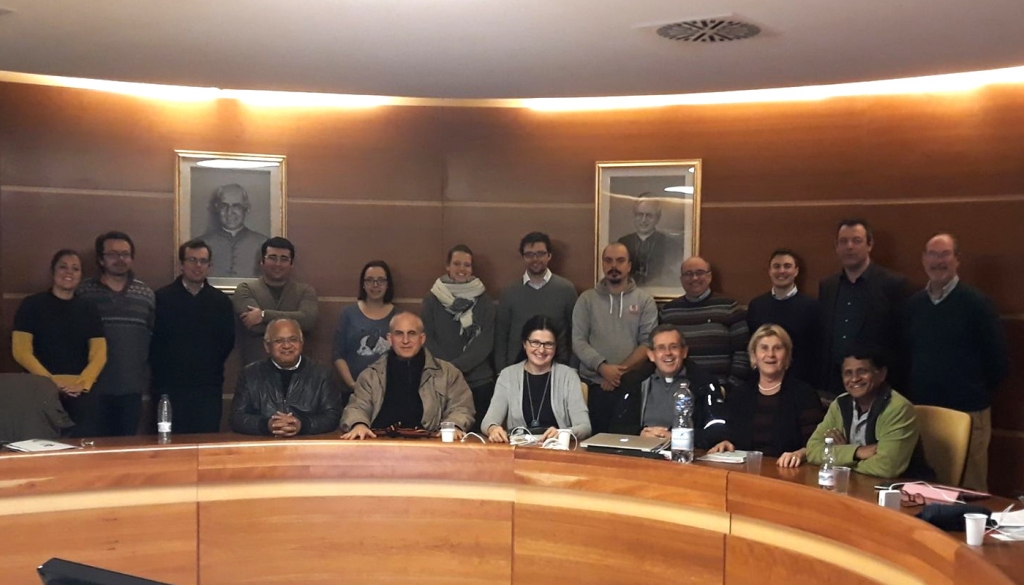
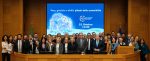
On 26 February, the federation of Salesian development NGOs – Don Bosco Network (DBN) – organized the 5th advocacy meeting for Salesian organizations in Rome, supported by Don Bosco International (DBI). The participants included over 20 representatives of Salesian organisations, including General Councillors for Missions and Youth Ministry, Fr. Guillermo Basañes and Fr. Fabio Attard, who shared their advocacy actions in several fields. Among the topics discussed were the Agenda 2030 for Sustainable Development, with a special focus on organizing the contribution for the Voluntary National Reviews and the HLPF of July 2018. Another key topic was migration with input from the Vatican Migrants’ and Refugees’ Section present in the Holy See document on UN Global Compacts.

DON BOSCO NETWORK (DBN) is a worldwide federation of Salesian development NGOs, formally registered in 2010 in Italy, whose vision, mission and actions are inspired by the values and principles expressed by the Gospel, the Teaching of the Catholic Church under the guidance of the Salesian congregation.

Report: European stakeholders provide their views on making the future EU budget more sustainable – but is the European Commission listening?

By Klára Hajdu, CEEweb for Biodiversity

Budget Commissioner Günther Oettinger has been touring the Member States in the last months to debate the future of the EU budget post 2020. He also says he has listened to the views of stakeholders during citizens’ dialogues. However, the debate has focussed on the new priorities from the very beginning, side-lining the equally crucial, though in some sense clearly more sensitive points about the quality of the spending. Since 2016, SDG Watch Europe within the People’s Budget campaign has been calling on the European Commission and the European Parliament for a sustainability reform of the EU budget – a reform that increases policy coherence, prevents wasteful spending and delivers tangible results in the wellbeing of the people and improves the quality of the environment.

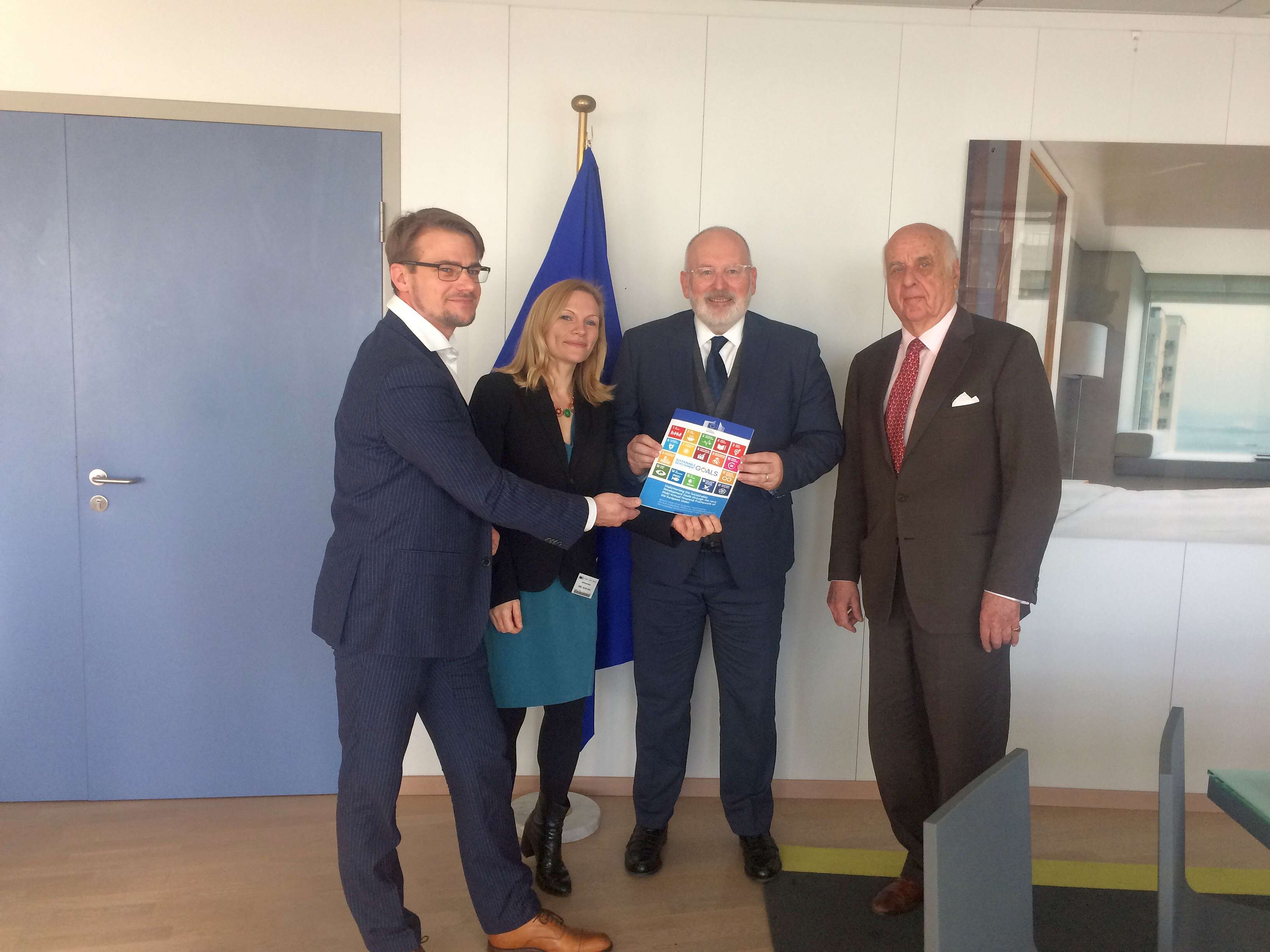
On 20 March, the MFF subgroup of the Multi-stakeholder Platform, which aims to advise the Commission on the future EU budget with a view to implement the Sustainable Development Goals, handed over their recommendations to First Vice-President Timmermans. This short and ambitious report, which reflects the opinion of CSOs from various fields, trade unions, businesses, academic institutions and individual experts, provides innovative, but still efficient measures so that the future EU budget better delivers. We hope that the European Commission will eventually listen to our advice.

World Vision: Communications Campaign on Women and Girls in Peace and Security

By Lorena Mohr, World Vision

For this year’s International Women’s Day, the World Vision EU Office wants to draw specific attention to the contributions of young women and girls to peace and security, as well as their specific needs in conflict contexts. Young women and girls have unique insights and experiences living through all phases of conflict and are crucial in identifying local solutions to achieve sustaining peace and social change. Both UN Security Council Resolution 1325 on Women, Peace and Security and UN Security Council Resolution 2250 on Youth, Peace and Security emphasise the need to engage women and girls in all stages of peace processes. Still, their contributions are often overlooked, and too often men alone make decisions that affect the lives of women and girls.

To that end, World Vision has produced a series of short video statements with several MEPs. Under the motto “It Takes the EU to empower Women & Girls as Peacebuilders”, they highlight the positive role women and girls play as agents of peace, and explore the complex relation between gender equality and peace. In the run-up to the 8th of March, we will feature one video message a day on our social networks, starting from 1 March. MEPs of different nationalities, political affiliations and age groups will show support for women and girls’ empowerment and participation in the peace and security realm.

World Vision is a child-focused relief, development and advocacy organisation dedicated to working with children, families and communities worldwide to reach their full potential by tackling the causes of poverty and injustice. It works in close to 100 countries in most regions of the world, focusing on the most vulnerable and hardest to reach children. Addressing gender equality is one of the key platforms of World Vision’s work. We tackle this issue at the grassroot/community level up to the international level through our programs in a wide range of sectors, in order to transform discriminatory practices together with women, girls, men, and boys.

Celebrating Women Farmers – the Gatekeepers to Food Security – on International Women’s Day

By Niamh Holland-Essoh, IFOAM

Women farmers play a fundamental role in ensuring food security particularly in rural societies but lack of access to training and resources often results in yields up to 30% lower than those of male farmers. Although women are responsible for about half of the world’s food production, female nutrition indicators, across all age groups, are worse than those of their male counterparts.

Empowering women to farm organically can increase yields, provide a greater nutritional diversity of fruit and vegetables for family meals, and increase household income when surplus produce is sold. In the hands of women, increased income leads to an improvement in children’s nutritional intake and general health.

Women who farm organically are also nourishing the soil and protecting biodiversity – essential ingredients for healthy crops, healthy people and a healthy planet!

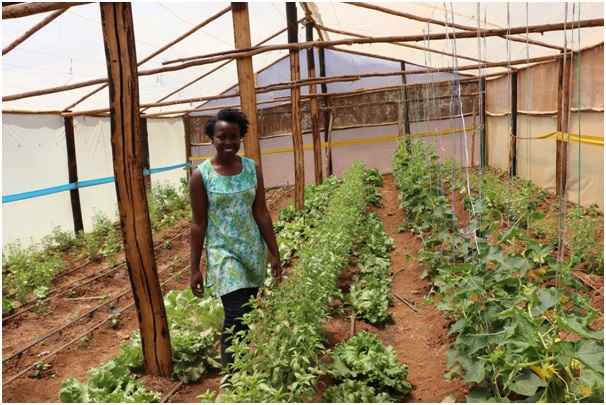
See this video of Sylvia Kuria, an organic farmer in Kenya, and the story of her farm. “I’ve got so many reports where they say, you know, your kale, your spinach, your carrots are so sweet. I tell them it’s because they are just growing in the natural way that they were supposed to have grown. We are not altering anything about the plant. It is just growing the way it is supposed to be and that is why it is that tasty.”

IFOAM – Organics International has almost a thousand members in over 120 countries. We are working toward the adoption of truly sustainable agriculture, value chains and consumption in line with the principles of organic agriculture – health, ecology, fairness and care.

Building momentum: the need of including all women for real gender equality

By Alba Gonzalez, CBM

Every year on 8 March, the international community celebrates International Women’s Day, which, according to the UN, recognises women’s achievements without regard to divisions, whether national, ethnic, linguistic, cultural, economic or political.

Currently, women rights are being more and more recognised. The 2030 Agenda for Sustainable Development includes the need for “achieving gender equality and empowering all women and girls” as a key element for sustainable development. Unlike the Millennium Development Goals (MDGs), the 2030 Agenda and its Sustainable Development Goals (SDGs) highlights the need to include the rights of persons with disabilities as part of its “Leaving No One Behind” motto. Only by applying the principle of universality, meaning the need to respect human rights for all.

The European Union (EU) has been one of the biggest supporters of the inclusion of rights of persons with disabilities during the adoption of the 2030 Agenda. In addition, it is the first regional body to ratify the human rights treaty the UN Convention on the Rights of Persons with Disabilities (CRPD). In its Article 6, the CRPD recognises that “women and girls with disabilities are subject to multiple discrimination” and that “States Parties shall take all appropriate measures to ensure the full development, advancement and empowerment of women, for the purpose of guaranteeing them to exercise and enjoyment of the human rights and fundamental freedoms”. However, and despite some efforts of the EU to promote and realize the rights of women and girls with disabilities, multiple discrimination on the basis of disability are not fully mainstreamed in EU development policies and programmes.

Barriers and discrimination towards women and girls with disabilities

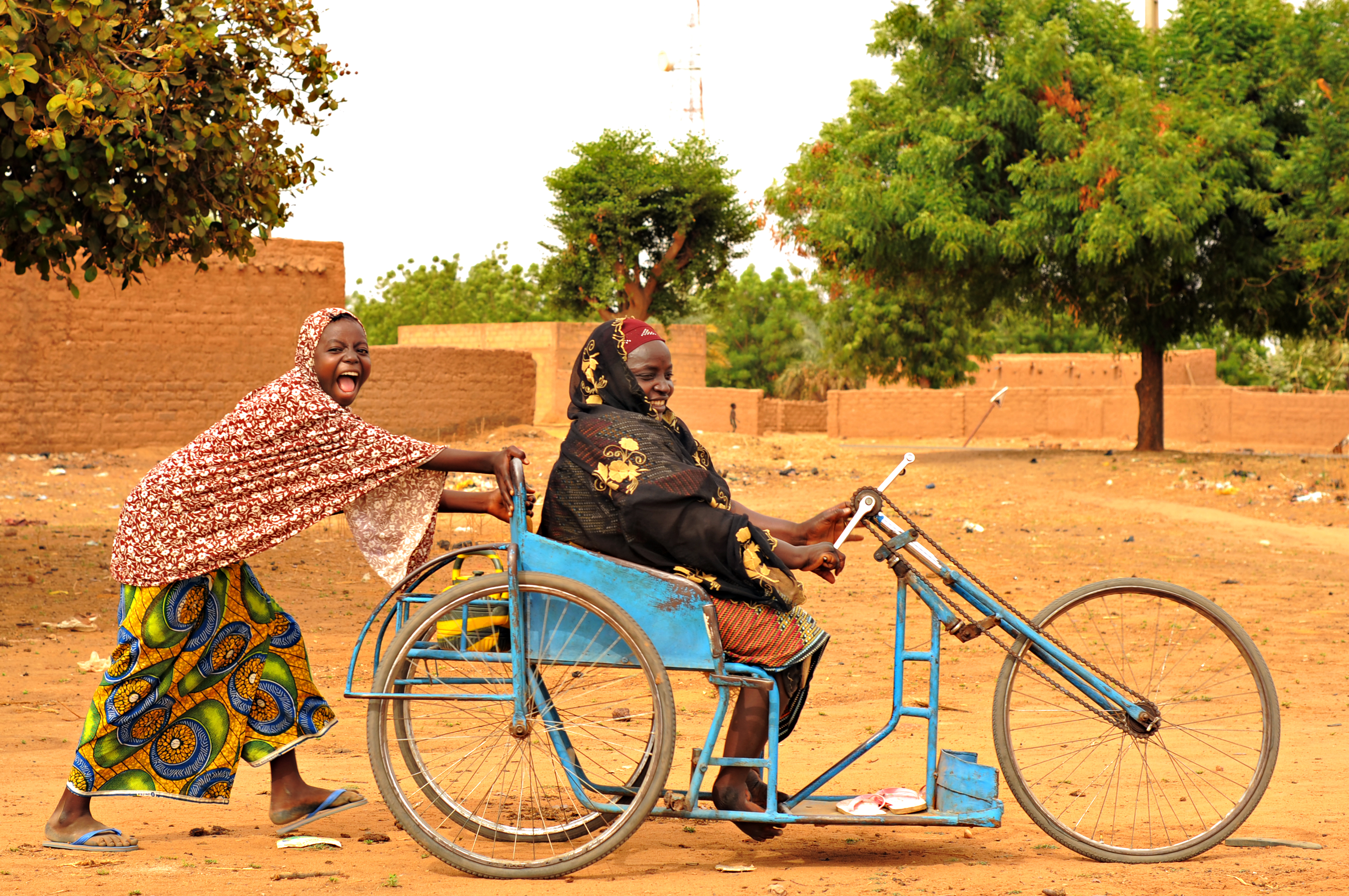
Women and girls with disabilities face more barriers to access education. Lack of accessibility, together with attitudinal barriers that consider women and girls with disabilities as objects of pity instead of equal human right’s holders are two of the biggest barriers that women and girls with disabilities face. Sexual abuse and harassment is more frequently experienced among women and girls with disabilities than those without. This is especially the case for women and girls with intellectual disabilities, and the perpetrators are most frequently care givers, family members or close people from the community.

As the CRPD Committee Members highlight in the General Comment on women and girls with disabilities, the lack of recognition before the law for women and girls with disabilities makes it almost impossible for them to report these abuses. Their word is not taken seriously, and most of the time they are perceived as persons without legal capacity. Forced sterilisation is a very common practise for women and girls with disabilities, both in developing and developed countries, which is is again especially relevant for women and girls with intellectual disabilities.

Steps forward

The EU has expressed its commitment to gender equality and women empowerment. The Gender Action Plan (GAP) is one of the first steps for the EU to promote women rights in developing countries. However, the GAP fails on the principle of leaving no one behind as the rights of women and girls with disabilities are not properly reflected. Despite mentioning the need to include multiple discrimination in its introduction, there are no mentions to women with disabilities in any objective or indicator of the GAP.

Disability has not been included in mainstream gender policies and programmes; gender has not been properly addressed in disability policies and programmes.  However, the 2030 Agenda offers now the opportunity to revise our way of working and, in that sense, CBM is working in cooperation with other civil society organisations (CSOs) or platforms such as SDG Watch Europe in order to build bridges. Only by working together, will all women achieve their rights and contribute to sustainable development.

CBM is an international Christian development organisation, committed to improving the quality of life of people with disabilities in the poorest communities of the world.