United Nations adopts ground-breaking Pact for the Future to transform global governance

By ASviS

The Summit of the Future was held on 22 and 23 September at the United Nations headquarters in New York. During this high-level event, the UN Member States, including Italy, adopted the “Pact for the Future”, the “Declaration on Future Generations” and the “Global Digital Compact”.

Covering a range of issues from nuclear disarmament to climate change, and human rights to digitalization, the Pact for the Future contains 56 actions. According to the United Nations, it is the most significant international agreement in recent years. ASviS Scientific Director, Enrico Giovannini, also noted that the approved documents are a step forward on the road to sustainable development.

The Pact was created with the aim of strengthening cooperation between countries and intensifying efforts to achieve the Sustainable Development Goals of the 2030 Agenda. These remain key reference points for guiding political, economic, and social decisions at both the international and national levels.

The road to achieving these Goals is certainly not without challenges, and ASviS will soon take stock of the delays and progress of the 2030 Agenda in Italy and Europe with the presentation of its ninth Report, on 17 October in Rome, which will also be live-streaming. Among other analyses, the Report will include, among other analyses, scenarios for the SDGs in 2030.

Life Long Learning Week 2024

By LLL

The 14th edition of the Lifelong Learning Week will take place from 18-22 November focusing on the overarching topic of “21st century challenges for the teaching profession; a call for system change“, which is the annual theme of the Lifelong Learning Platform for 2024.

More than 20 workshops, events and networking moments will accompany this iconic event as we explore the needs and challenges of educators today. Topics will range from digital competences, to the question of neutrality, issues of representativeness in decision-making to working conditions, and from teachers in formal settings to all other sorts of educators, this LLLWeek promises to deliver!

One highlight? Our EU Lifelong Learning Stakeholders’ Forum, on the afternoon of Monday 18 November, will assess the Erasmus+ programme and its ability to be inclusive and support all learners on their lifelong learning journey.

Do not miss out! Head over to the LLLWeek main page, browse all events and register for as many as you wish!

Building Resilience Through Key Competences: A Path to Future-Proof Learning

By LLL

In this position paper, the Lifelong Learning Platform (LLLP) explores the importance of developing key competences that learners need to adapt to any future societal challenge, in line with SDG 4. The paper examines what learners require to strengthen their resilience in an ever-changing world, while also considering the impact of recent crises such as COVID-19, Russia’s war of aggression in Ukraine, the climate crisis and the rampant digitalisation of societies.

The position paper offers recommendations for changes at the system level, provider level and learner level to introduce a new approach to competence development. The main focus is on the need for a whole-of-government approach that includes all education and training stakeholders in the decision-making and implementation of policies. Additionally, it emphasises the importance of recognising the diversity of learning providers and the competences learners need to actively participate in their own learning journey.

You can read it in full here.

Can the Summit of the Future Support Sustainability Science Diplomats?

By RCE middle Albania

The 2030 Agenda for Sustainable Development has fostered a global community of young science diplomats. While it is difficult to define the boundaries of science diplomacy, the strong engagement of young people in the Sustainable Development Goals (SDGs) over the past seven years may have empowered them to act as such.

With the principle that every contribution toward the SDGs is valuable, global efforts have been inclusive. Although complex and challenging for many organizations, the SDGs have been more easily embraced by younger generations, fostering a sense of responsibility and commitment. Through various initiatives and SDG funds, youth have been involved in numerous activities, such as raising awareness, collecting and utilizing data, grassroots and national initiatives, monitoring and accountability efforts, and shadow reporting on progress.

The Pact for the Future, adopted at the Summit of the Future in September 2024, marks a significant milestone in global cooperation. It emphasizes the urgent need for a unified approach to addressing the world’s most pressing challenges, including accelerating progress on the SDGs. This represents a unique opportunity to advance the 2030 Agenda at a time when multilateralism faces significant challenges.

There are high expectations that Chapter 4 of the Pact for the Future, which focuses on youth and future generations, along with the Declaration on Future Generations, will boost the involvement of young people in the 2030 Agenda and the 17 SDGs. It is anticipated that this will recognize the role of young sustainability science diplomats in tackling global challenges.

For more information, please refer to the publication on IISD.https://sdg.iisd.org/commentary/generation-2030/can-summit-of-the-future-support-sustainability-science-diplomats/

A European Agenda To Navigate Uncertain Times – How to steer the EU towards wellbeing for all now and in the future

By Social Platform

These are uncertain times. Geopolitical tensions and armed conflicts, rising costs of living, growing multidimensional inequalities, accelerating climate and biodiversity crises, security risks, pandemics, rapid development of AI systems, risk of disinformation, political polarisation, migration and an ageing society are causing uncertainty among the peoples, governments, and businesses of Europe. These problems make people insecure about their own future and that of the next generations. The European Commission (EC) urgently needs a policy agenda that tackles these challenges and uncertainties.

The Need to Change

• What the science says. The contribution of economic growth to wellbeing is decreasing and the benefits are not being shared equitably. Humanity is transgressing six out of nine planetary boundaries, thereby disrupting natural systems and causing significant damage to the economy and future wellbeing. In addition, other challenges, such as an ageing society, also threaten the future wellbeing. These interconnected problems should be tackled simultaneously.

• What people want. People across Europe feel uncertain about the future and a majority support reforms of the economic model. There is also specific support for actions on climate change, creation of quality jobs, public spending on social policies, poverty and social exclusion, public health, and investments in future generations.

• What businesses need. European companies know that change is coming. In fact, US and Chinese green programs (e.g. the Inflation Reduction Act) are leading to competitive pressures for European business. Companies need a long-term consistent EU vision to stimulate sustainable and competitive business models. This would help multinationals as well as small and medium-sized enterprises innovate and invest while navigating geopolitical uncertainty.

The Change we Need

• Define the goal. Article 3 of the Treaty of Europe states that “The Union’s aim is to promote peace, its values and the well-being of its peoples.” Globally, there is also scientific and institutional convergence towards wellbeing as an overarching policy goal. There are three elements: ensuring current wellbeing (e.g. health, education, peace and security, air quality, quality employment, economic prosperity, social relationships, etc.), ensuring future wellbeing (mitigating climate change, biodiversity loss, resolving conflicts, dealing with ageing society, boosting innovation and competitiveness, etc.), as well as limiting wellbeing inequalities for current and future generations (gender inequality, income/wealth inequality, risk of poverty, social exclusion, discrimination etc.). These elements are strongly interconnected and overlap in some cases. Together the goals it to achieve Sustainable and Inclusive Wellbeing: Wellbeing for all, now and in the future.

• Overcome barriers and enabling change. To create policies for sustainable and inclusive wellbeing, it is important to identify vested interests, fear of change and resistance that hinders reforms and systemic change. Simultaneously, these policies should recognise the uncertainties people and businesses face. The policy agenda should be holistic and cross-cutting, and policy-silos need to be overcome.

• European leadership. This policy shift requires institutional leadership and effort to ensure the horizontal coordination of policies. One of the ways this could be achieved is by appointing an Executive Vice-President (EVP) for Wellbeing and Future Generations to lay the groundworks for and oversee the implementation of this policy agenda.

• No need to start from scratch. This policy agenda should build on the many initiatives, policies, legislation and governance processes which the EC (and Member States) has already put in place. It should also take into account academic and policy debates from around the world. This provides an indispensable foundation to develop the required policy agenda.

This joint paper co-issued by the SPES, WISE Horizons, ToBe, WISER, and MERGE projects proposes a policy agenda for the new European Commission to ensure sustainable and inclusive wellbeing. It calls for integrated public and stakeholder support to develop policies that address immediate concerns and secure the future wellbeing of all, aiming for a secure, prosperous, and equitable Europe through forward-thinking policymaking. The paper puts forward concrete suggestions on how the European Commission can advance sustainable and inclusive wellbeing in times of polycrisis. These include strengthening the science-based policy toolkit, reforming the European semester process, as well as implementing policies for 5 societal transformations and 13 policy areas.

Find the full paper here: https://mergeproject.eu/publications-steer-wellbeing/
SDG Watch Europe Updates from the Summit of the Future and the Global Peoples Assembly

Civil Society Organisations attend Summit of the Future for revitalised multilateralism and public participation for the 2030 Agenda

By SDG Watch Europe

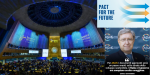
SDG Watch Europe was among the key civil society representatives at this year’s Summit of the Future Action Days in New York, held on 20-21 September.

During the Action Days, SDG Watch Europe participated in a high-level side event organised by the European Parliament and Ivory Coast focusing on the financing needed to achieve the SDGs. They highlighted the urgent need to reform the financial architecture to create a fairer global financial system. The event concluded with positive remarks from European Parliament President Roberta Metsola, who emphasised the ‘strong political will to push forward progress’ from the Parliament.

Alongside bilateral meetings with key officials, delegations, and civil society organisations from different countries, SDG Watch Europe and the EEB shared some preliminary findings from their research on deliberative democracy at the 2024 Global People’s Assembly, which took place on the sidelines of the UN Summit of Future. This research was presented to demonstrate to both EU and global decision-makers why public participation and deliberative democracy must be strengthened, and how they can accelerate SDG implementation. The event discussed the role of democracy and public participation in boosting civic space and advancing the SDGs implementation.

It’s not a secret that the SDGs are significantly behind schedule, with the UN’s own projections stating a meagre 17% of targets are on track for 2030, with over one-third either stalled or moving backwards. Despite this, the Pact for the Future, the main outcome document of the Summit, falls short on concrete commitments for greater civil society involvement, public participation and deliberative democracy, and concrete steps for implementing SDGs in the last five years before 2030.

The EU therefore must step up its efforts. This includes a new European Voluntary Review in the 2024-2029, as well as clear leadership and structured involvement for civil society in the SDGs throughout the new mandate.

SDG Watch Europe will discuss the key civil society demands and priorities for the incoming European Commission at the Civil Society Forum for Sustainability, taking place in Brussels on the 4 and 5 November. More information is available here.