See Get Up project’s new videos on talent waste, gender pay gap and work life balance!

By ALDA

When you were a child, have you ever been told to act like a girl (or a boy)?

In the European Union, women earn on average 16% less than men. For the same job. Why?

Working women in the EU spend on average 26 hours/week on unpaid care and housework. Working men… 9 hours.

Gender stereotypes affect everyone since their birth, continuing to become prominent in schools and at work place though the entire life. ALDA and all partners of the project GET UP hope to delete this from all future conversations.

Watch and share our new videos on talent waste, gender pay gap and work life balance and promote a more gender equal society!

ALDA is part of the project GET UP –  Gender Equality Training to overcome Unfair discrimination Practices in education and labour market, co-funded by the Rights, Equality and Citizenship programme of the European Union. The project tackles the stereotyping of educational and career choices, and promotes gender equality in education, training, career guidance and at the workplace.

More information about the project GET UP

ALDA – The European Association for Local Democracy is a membership based organisation gathering more than 300 members (including local authorities, associations of local authorities, and civil society organisations) coming from more than 40 countries dedicated to the promotion of good governance and citizen participation at the local level.

12 Questions for the Future of Europe: Commission Launches Online Citizens’ Consultation

By the European Commission

On Europe Day, 9 May 2018, the European Commission launched an online public consultation addressed to all Europeans, asking them what direction they want the European Union to take in the future.

This unique consultation, part of the broader Future of Europe debate launched with the Commission’s White Paper on 1 March 2017, was prepared by a panel of 96 citizens from 27 Member States, who came together to decide what questions to put to their fellow Europeans.

European Commission President Jean-Claude Juncker said today: “With the European elections around the corner, it is time to decide what the European Union at 27 should be. Whatever happens, it must be a Europe built by Europeans. The survey we are launching today puts the question to all Europeans: What future do we want for ourselves, for our children and for our Union? Now is the time for Europeans to make their voices heard, loud and clear, on the issues that concern them and what they want their leaders to do about them.”

For the first time, the Commission convened a Citizens’ Panel on 5-6 May to draft a public consultation. Hosted by the European Economic and Social Committee, a group of 96 Europeans came to Brussels and worked together to draft a 12-question online survey. This unique exercise in participative democracy means that citizens are at the heart of the conversation on the Future of Europe.

This is part of the ongoing debate on the future of the EU at 27, launched with the Commission’s White Paper of 1 March 2017. People can already submit their views online – today’s consultation will further complement this. The online consultation will also run in parallel to the ongoing Citizens’ Dialogues being organised by the European Commission and by Member States. Almost 700 of these interactive public debates have been held in 160 cities since 2012, and the Commission will increase their frequency between now and the European elections in May 2019, with a target of organising 500 more events.

In addition to the Commission’s work, Citizens’ Dialogues are now being organised by national governments in all Member States, following an initiative from France which received the support of the Heads of State or Government of the future EU27. The Commission is sharing the benefits of its experience with Member States. The consultation will run until the Sibiu summit on 9 May 2019. The Commission will present an interim report to Member States on the White Paper process at the December 2018 European Council. A final report will then be presented at the first EU27 Summit in Sibiu, Romania, on 9 May 2019, just a few weeks ahead of the European elections.

Background

In  March  2017, the  Commission launched  a new debate on the  future of the EU at 27,  through the publication of a  ‘White  Paper on  the Future  of Europe’.  Members  of the Commission  have been travelling  across Europe and listening  to citizens’ views on the different scenarios put forward, giving everyone a chance to contribute to shaping the Union.

For more information

Online: Consultation on the Future of Europe

Factsheet: Dialogue with Citizens ahead of the European elections

Brochure: Citizens’ dialogues on the Future of Europe

White Paper on the Future of Europe

The 6th scenario

Commission press release – 9 May 2018

EMIN European Bus Tour Campaign for Guaranteed Minimum Income Schemes across Europe

By European Minimum Income Network (EMIN)

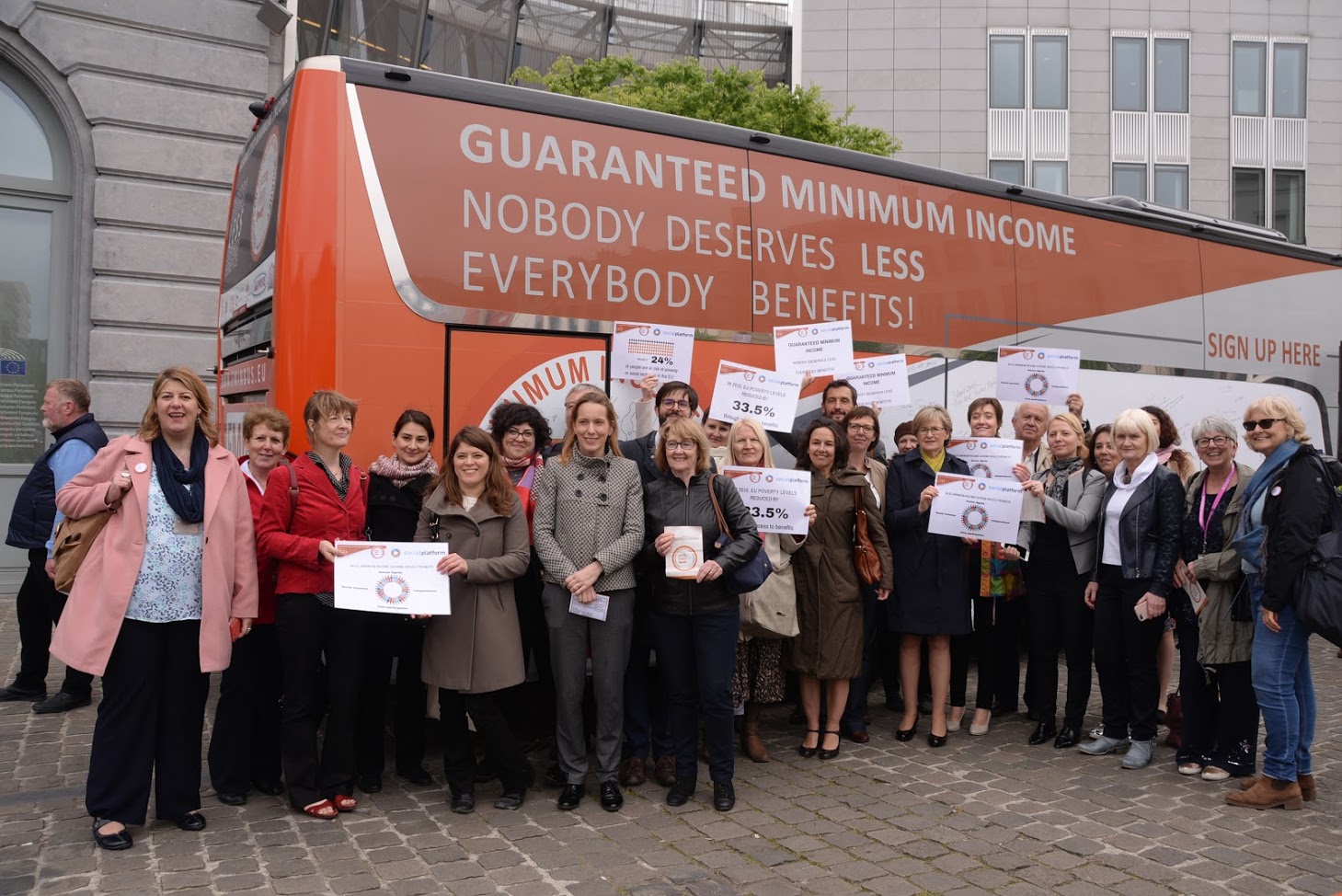
2 Buses, 32 Countries, 64 days, over 120 events and over a thousand volunteers for Guaranteed Minimum Income Schemes.  

On 24 April the EMIN partners, together with experts by experience, Commissioner Marianne Thyssen, Mairead McGuinness, (Vice President European Parliament), more than 20 civil society organisations, members of the European Parliament, Axelle Red, and many other supporterslaunched the EMIN bus tour.

With this tour, we want to raise awareness and campaign for the progressive realisation of well-designed Minimum Income Schemes: guaranteeing income support for everybody who needs it, for as long as they need it, enough to live a life in dignity and fully participate in society, adapted to the cost of living in every European country.

Although all European member states have some kind of minimum income scheme, none of them can be considered to be fully adequate, accessible and enabling.

Fintan Farrell, EMIN Project Manager: “The EMIN bus journey is a journey to promote real democracy. A democracy that can deliver the maximum good for the maximum number of people. Guaranteed access to decent income through accessible minimum income schemes is the base on which we can build such a democracy.”

Alias Onyadon, Expert by Experience, Belgium: increasing social minimums to an adequate level would have a real impact on the daily life of people experiencing poverty and on society. Especially in the current context of failure of policies to fight against poverty, we need an increase in social investment more than ever.

Cidalia Barriga, Expert by Experience, Portugal.: “The minimum income scheme was clearly not enough but it allowed me to feed my children and to ensure they could continue with their education”

The progressive realisation of these Guaranteed Minimum Income schemes would have a huge impact on the fight against poverty: not only the people who need these schemes, but society as a whole would benefit from it!

Follow our adventures on www.eminbus.eu and sign our petition https://you.wemove.eu/campaigns/Guaranteed-Minimum-Income-Scheme

The European Minimum Income Network (EMIN) is an informal Network of organisations and individuals committed to achieve the progressive realisation of the right to adequate, accessible and enabling Minimum Income Schemes.  EMIN unites various experts, professionals, academics and diverse entities active in the fight against poverty and social exclusion.

NYC Takes Historic Step in Local Tracking of Progress Toward Global Goals

By: Alexandra Hiniker, Strategic Relationships Manager, NYC Mayor’s Office for International Affairs

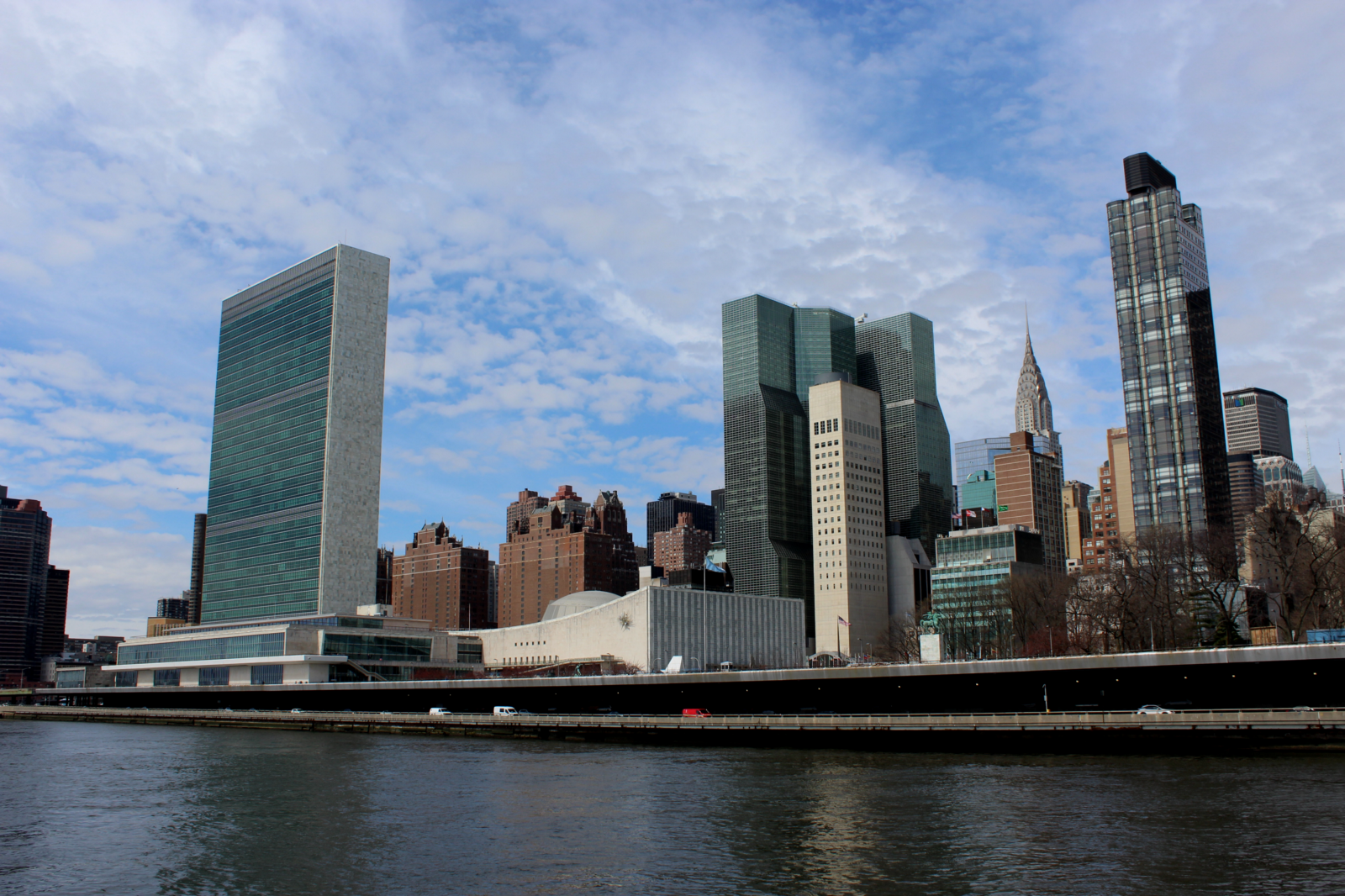
New York City will become the first city in the world to report directly to the United Nations on the status of its implementation of the Sustainable Development Goals (SDGs) during the High-Level Political Forum this July. The publication will be called a Voluntary Local Review (VLR), modeled after the Voluntary National Reviews (VNR), which all member states are invited to present.

The VLR is part of Global Vision | Urban Action, the NYC Mayor’s Office for International Affairs program exploring the synergies between the April 2015 OneNYC strategy and the SDGs. Since the launch of Global Vision | Urban Action in 2015, the program has been focusing on critical topics such as mental health, equity in tech, decent work for all, addressing climate change through infrastructure, and wastewater treatment.

Please see the press release and click here for our Medium post that explains the VLR in more detail.

How the Human Rights Movement Failed

By Samuel Moyn

Published April 23, 2018 in the New York Times

The human rights movement, like the world it monitors, is in crisis: After decades of gains, nearly every country seems to be backsliding. Viktor Orban in Hungary, Rodrigo Duterte in the Philippines and other populist leaders routinely express contempt for human rights and their defenders.

But from the biggest watchdogs to monitors at the United Nations, the human rights movement, like the rest of the global elite, seems to be drawing the wrong lessons from its difficulties.

Advocates have doubled down on old strategies without reckoning that their attempts to name and shame can do more to stoke anger than to change behavior. Above all, they have ignored how the grievances of newly mobilized majorities have to be addressed if there is to be an opening for better treatment of vulnerable minorities.

“The central lesson of the past year is that despite considerable headwinds, a vigorous defense of human rights can succeed,” Kenneth Roth, the longtime head of Human Rights Watch, contended recently, adding that many still “can be convinced to reject the scapegoating of unpopular minorities and leaders’ efforts to undermine basic democratic checks and balances.”

That seems unlikely. Of course, activism can awaken people to the problems with supporting abusive governments. But if lectures about moral obligations made an enormous difference, the world would already look much better. Instead, those who care about human rights need to take seriously the forces that lead so many people to vote in majoritarian strongmen in the first place.

The truth is that the growth of international human rights politics has accompanied the very economic phenomena that have led to the rise of radical populism and nationalism today. In short, human rights activism made itself at home in a plutocratic world.

It didn’t have to be this way. The Universal Declaration of Human Rights, which was promulgated in 1948 amid the consolidation of welfare states in Europe and North America and which formed the basis of the human rights agenda, was supposed to enshrine social protections. But in the 1970s, when activists in the United States and Western Europe began to take up the cause of “human rights” for the victims of brutal regimes, they forgot about that social citizenship. The signature group of that era, Amnesty International, focused narrowly on imprisonment and torture; similarly, Human Rights Watch rejected advocating economic and social rights.

This approach began to change after the Cold War, especially when it came to nongovernmental advocacy in post-colonial countries. But even then, human rights advocacy did not reassert the goal of economic fairness. Even as more activists have come to understand that political and civil freedom will struggle to survive in an unfair economic system, the focus has often been on subsistence.

In the 1990s, after the Cold War ended, both human rights and pro-market policies reached the apogee of their prestige. In Eastern Europe, human rights activists concentrated on ousting old elites and supporting basic liberal principles even as state assets were sold off to oligarchs and inequality exploded. In Latin America, the movement focused on putting former despots behind bars. But a neoliberal program that had arisen under the Chilean dictator Augusto Pinochet swept the continent along with democracy, while the human rights movement did not learn enough of a new interest in distributional fairness to keep inequality from spiking.

Now the world is reaping what the period of swelling inequality that began in the 1970s through the 1990s sowed.

There have been recent signs of reorientation. The Ford Foundation, which in the 1970s provided much of the funding that made global human rights activism possible, announced in 2015 that it would start focusing on economic fairness. George Soros, a generous funder of human rights causes, has recently observed that inequality matters, too.

Some have insisted that the movement can simply take on, without much alteration of its traditional idealism and tactics, the challenge of inequality that it ignored for so long. This is doubtful.

At the most, activists distance themselves from free-market fundamentalism only by making clear how much inequality undermines human rights themselves. Minimum entitlements, like decent housing and health care, require someone to pay. Without insisting on more than donations from the rich, the traditional companionship of human rights movements with neoliberal policies will give rise to the allegation that the two are in cahoots. No one wants the human rights movement to be remembered as a casualty of a justifiable revolt against the rich.

If the movement itself should not squander the chance to reconsider how it is going to survive, the same is even truer of its audience — policymakers, politicians and the rest of the elite. They must keep human rights in perspective: Human rights depend on majority support if they are to be taken seriously. A failure to back a broader politics of fairness is doubly risky. It leaves rights groups standing for principles they cannot see through. And it leaves majorities open to persuasion by troubling forces.

It has been tempting for four decades to believe that human rights are the primary bulwark against barbarism. But an even more ambitious agenda is to provide the necessary alternative to the rising evils of our time.

Samuel Moyn is a professor of law and history at Yale and the author, most recently, of “Not Enough: Human Rights in an Unequal World.”

Integrate sustainability pledges into the future EU budget

By People’s Budget campaign

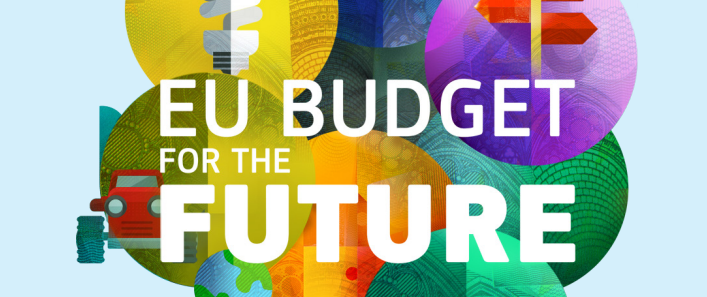
European decision-makers, civil society organisations, academics and other stakeholders from all over Europe call on the European Parliament, the Council and the Commission to integrate sustainability into the next Multiannual Financial Framework (MFF) of the EU.

The EU budget is not an accounting tool, but a means to achieve common political goals. The EU aims for sustainable development as enshrined in the Treaty, and it is also committed to implement the 2030 Agenda for Sustainable Development, including the Sustainable Development Goals. This is the decisive moment when the EU can demonstrate its commitment to coherently mainstream sustainability principles, goals and objectives into funding decisions for the next decade.

We therefore call on the European Parliament, the Council and the European Commission to embed the “Think Sustainability First” principle when planning and implementing the next MFF and depending policies, which is also in line with the recommendations of the High Level Expert Group on Sustainable Finance. Sustainability does not only increase policy coherence, but also supports the efficient use of EU funds delivering results.

We also call on the European Parliament, the Council and the Commission to show their political commitment to sustainable development and the implementation of the 2030 Agenda for Sustainable Development in a joint declaration attached to the MFF regulation.

We are committed to work together with all European, national and regional decision-makers and stakeholders for a sustainable, strong and democratic future of Europe that benefits all people.