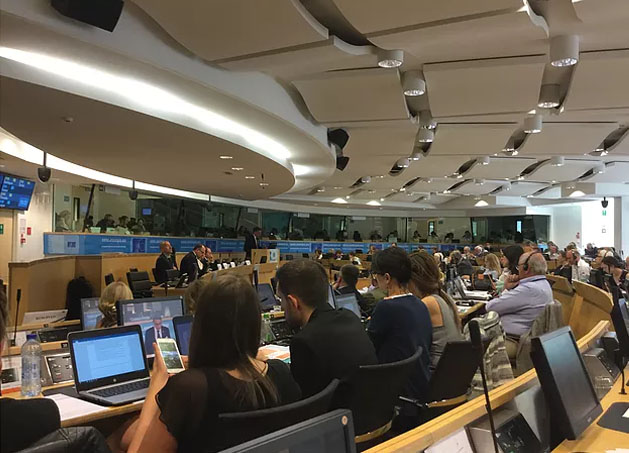
SDG Watch Europe was present at the recent conference hosted in Brussels by the European Economic and Social Council (EESC) called ” the UN Agenda for Sustainable Development-a new frontier of rights and progress for the EU”. Speakers included Christian Friis Bach, Executive Secretary of the UN Economic Commission for Europe ( UNECE), Celina Charveriat Director of the Institute for European Environmental Policy Karl Flakenberg Hors Classe Senior Advisor for Sustainable Development, European Policy Strategy Centre ( EPSC) of the European Commission and several civil society speakers including members of SDG Watch Europe.
Category: May 2017
STAKEHOLDER VIEWS on the next EU budget cycle
Results of the stakeholder survey designed by SDG Watch Europe.
Highlights from the 314 stakeholder responses
The great majority of the respondents (95.8%) agrees or strongly agrees with the question statement, that the EU budget should be a key driver for a more sustainable future for Europe.
When elaborating how the new EU Budget cycle could better contribute to improving people’s lives and their well-being, respondents most frequently mention paying more attention to the well-being and the real needs of the society (like investing in youth, families, research, health and education), contributing to a green economy, and implementing and mainstreaming Sustainable Development Goals and sustainability as a way of increasing people’s wellbeing.
EU funding should be also able to reflect on local needs and be more transparent, also as a way of showing to the people how the EU budget makes their lives better.
For strengthening the social dimension of the European Union through the EU budget many respondents stress the need for allocating more funds to social inclusion and social cohesionat different levels, where the application of subsidiarity is also essential.
For improving the quality of environment respondents mostly mentioned the transition to a low carbon economy with the help of the EU budget and the phasing out of environmentally harmful subsidies. To make this happen, respondents also urge mainstreaming environmental and climate aspects in the EU budget and other policies and also mention sustainability proofing as a methodological framework.
Replies also emphasize the importance of local circumstances and thus call for an increase the number of small scale EU funded projects implemented by local communities.
Replies also urge that the EU budget cycle should devote more funds to the transition of the economy from the current domination of the economic growth paradigm to another model, and to building a circular economy.
Ways to promote good governance in the next EU budget cycle first of all include more participation – of citizens, NGOs, experts, local communities, etc. – in the opinion of the respondents, which should be complemented by a strengthened monitoring system (leading to consequences if needed).Most of the respondents (87%) agree or strongly agree with the question statement that the next EU budget cycle should clearly direct public money to serve the public good and avoid serving private interests. However, interpretations vary on defining “public good” and “private interests”.
Most of the respondents (93%) agree or strongly agree that the next EU budget cycle should increase policy coherence for sustainable development. Taking a holistic view to avoid shifting negative impacts to other areas, horizontal integration of legislations, cross-sectoral cooperation and aligning EU policies and thus the EU budget with global agreements, such as the 2030 Agenda or the Paris Agreement are the most often mentioned ways to achieve this.
Most of the respondents (84%) agree or strongly agree with using incentives and/or conditionalities to increase the efficiency of the use of EU funds by MSs. Applying ex ante and ex post conditionalities (e.g. anti-discrimination; gender equality, implementing environmental objectives) to all EU funding instruments is mentioned as one possible way of implementation.
Download the full report here.
The stakeholder responses were collected through an online survey in early 2017 and presented at the COSI 3 Meeting organised by Global Citizen and SDG Watch Europe and financially supported by the European Commission. The above opinions do not necessarily reflect the views of SDG Watch Europe, Global Citizen or the European Commission.
Sustainability principles for the future EU budget
SDG Watch Europe is putting forward eight sustainability principles to ensure coherence in the future internal and external EU spending and to put sustainability at the heart of the European project. We call on the European Commission, the European Parliament and the European Council to integrate these principles from the very beginning of the financial policy planning, and thus prioritise the interest of the citizens and the implementation of the Sustainable Development Goals. SDG Watch Europe will also propose sustainability proofing methods for the future EU budget to help make it happen.
Sustainability principles for the future EU budget to be applied as an inseparable set:
-
The EU budget shall work for the people and with the people, with greater transparency, respectful of diversity and meaningful participation of the citizens
-
The EU budget shall strengthen the common European values, in Europe and globally
-
The EU budget shall increase wellbeing and contribute to decreasing inequality and social exclusion at all scales
-
The EU budget shall take a holistic approach, support systems change and promote innovation, which is required for the transition to sustainability and building a circular economy.
-
The EU budget shall serve a diversified and resilient economy and society, where the full potential of all communities, organisations and businesses of any size is fully achieved.
-
The EU budget shall serve the public good.
-
The EU budget shall contribute to decreasing the total environmental pressures (use of natural resources, use of land and emissions of waste, toxic substances, greenhouse gases and alien genotypes) to return to within planetary boundaries, and should not contribute to shifting of environmental pressures in time and space.
-
The EU budget should contribute to improving the state of environment and maintaining and restoring ecosystem services, which is the very foundation of our society and economy.
Contact:
Klára Hajdu (hajdu@ceeweb.org) and Deirdre de Burca (deirdredeburca12@gmail.com),
Co-facilitators of the work initiative on the EU budget under SDG Watch Europe sdgwatcheurope@gmail.com