Brave New World: A conference experiment from the future

By Ramona Bruck, Forum Umwelt & Entwicklung (German Forum on Environment and Development)

“The year 2048 is close to becoming a remarkable breakthrough for German sustainability policy. After thorough negotiations, the government managed to published the two-year action plan ‘Save Sustainability’ which might give a new momentum for the implementation of the ’Governance Goals on Goodness and Global Justice’ ”. [1]

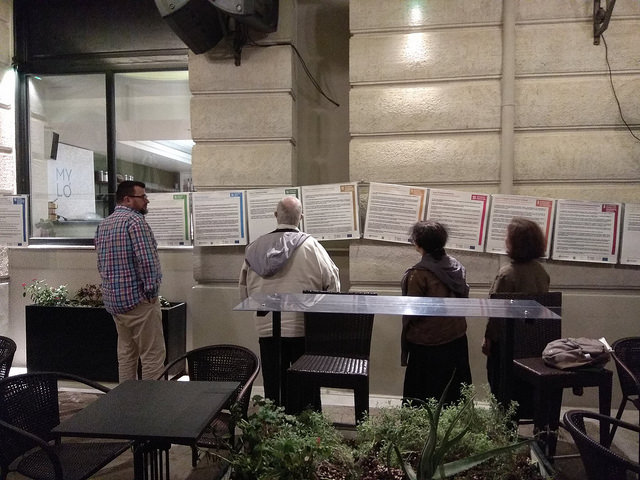
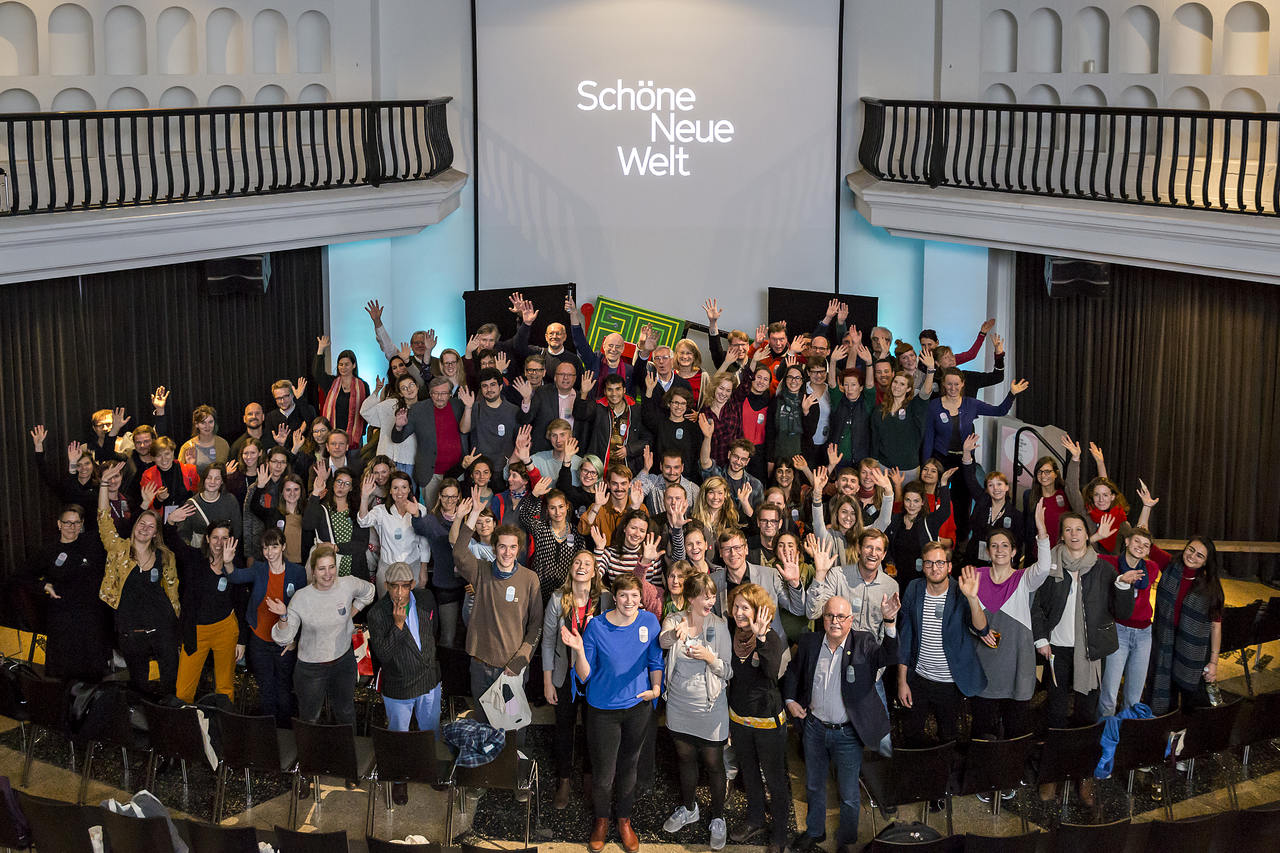
Inspired by Huxley’s ‘Brave New World’ as well as Orwell’s ’1984’, the German NGO Forum on Environment and Development was invited to a new, brave kind of conference in November 2018. Through time travel, the aim was to change the perspectives and to critically reflect on the current political and social situation as well as upcoming challenges and turnarounds. Therefore, it was not surprising that – after a stunning light installation that set the mood for the future – no one other than Aldous Huxley himself welcomed the 220 guests at the conference. He pointed out that time traveling is still an evolving technology – which bares several risks. One of this is the unpredictability about which path the present will choose to go. Fortunately, this conference gave the rare chance to look at two scenarios at the same time and these two confronting scenarios to exist parallel. On the one hand, there was an utopian, positive scenario (plan A), where current demands by civil society e.g. sustainability, equality and fair world trade were fully implemented. Herta Däubler-Gmelin, former minister of justice, played the role of herself as a 100-year old activist, looking back at the last 30 years. She explained how after many conflicts and catastrophes at the beginning of the century the political system has been undergoing major changes – even against predominant business interests. Still there was also a dystopian, negative scenario (plan B), where current trends moved forward, unrestrictedly manifesting unstoppable consequences such as climate change, extensive digitalisation and data collection and acute social inequality. Karl-Mephisto Cassandra, (played by Peter Wahl, co-founder of attac) pointed out that even the most ambitious actions against climate change or loss of species were already too late.

Yet the focus of the conference did not – or at least not primarily – lie on visionary ideas and remarkable acting, but convincing arguments on how the world would look like in 2048, given the paths we take today. Diving deeper into the scenarios, the participants could choose between eight different forums (digitalisation, democracy, bio-economy & agriculture, Europe, urbanisation & rural depopulation, social inequality, climate & energy). Based on the underlying idea of the two diverging scenarios. Each forum was composed by one representative of plan A and B, representing individuals from the year 2048: Business representative, old activist or even a living algorithm. The time travelers gave a brief outline what had happened during the last 30 years, which milestones had been important and how they managed to shape the world as it was now, in 2048. The second part covered a discussion between the representatives of both plans. Plan B was in general easier to trace, because current trends are simply continuing and can easily be imagined in the future. However, the challenge was to explain comprehensibly why these trends were carried on despite being recognised as problematic by critical civil-society.

In this respect, plan A was much more tricky, because they not only needed to figure out the momentums during the past 30 years in which civil society was able to change the established the path, but also needed to describe strategies and methods they and on which strategic alliances change they were built.

This two-day conference was also accompanied by different cultural elements as well as ‘future food’. Along with a stage play ‘avanti popolo’ and a poetry slam, the impressive performance by Katharina Schlothauer as Margarethe Thatcher provoked the audience just as the real person had done in the past: “You want to change the world? Let someone explain this to you, who already did.. Me. […] You need the dissatisfied. Tell them you do something good for them – even it is not true. We stood for a better future. At the end, the majority believed me – or at least they believed more in me than in the rest”.

Finally, we returned from the future and invited the concluding panel, NGO representatives from 2018, to draw their conclusions.

Check out our website for the full documentation: https://www.snw2048.de/dokumentation-1/

 Forum Umwelt & Entwicklung / the German Forum on Environment and Development was founded in 1992 after the UN conference on Environment and Development (“Rio“). We coordinate German NGOs in international political processes on sustainable development and environmental issues. Our mission is to raise awareness in the German public on the connection between environment and development and to insist on a change of the current wasteful economy and lifestyle of industrial countries.

[1] Staudt, Elisabeth https://www.snw2048.de/blog-1/2018/9/4/sonderauflage 
#Vote4Values Tracker: Affect the EU Elections and Protect Fundamental Values

by Israel Butler, LibertiesEU

Is the party you’re thinking of voting for in bed with parties from other countries that are violating basic values? If you’re voting centre left, centre right or liberal, then the answer is yes.

If mainstream political groups kicked out their bad apples, could they make a majority coalition committed to protecting our fundamental values? What would happen if all the parties currently in trouble with the EU were to join forces with political groups that are openly against fundamental values? Our #Vote4Values elections tracker will bring you the answers based on the latest polling data.

European countries embraced the basic values of the rule of law, pluralist democracy and fundamental rights after the Second World War. Any country that wants to join the EU has to first prove that it has created rules, like civil liberties, and institutions, like independent courts, that guarantee these values. All EU institutions are legally bound to respect these values, and the European Parliament has underlined its own commitment to uphold them in its internal rules.

But political parties that openly violate basic shared European values have been doing better in recent national elections. In some countries they are now in power, either alone (like in Hungary and Poland) or in coalition (like in Italy, Austria and Romania). Even when these parties have been unable to take power, they have caused mainstream political parties in the political centre to adopt more authoritarian rhetoric and policies, such as in the Netherlands and Sweden.

Between 23 and 26 of May this year, citizens around the EU will be voting in the European Parliament elections. Some experts are predicting a big political shake-up, and not just because of Brexit. The two biggest political groups in the European Parliament (on the centre right and centre left) are likely to see their share of seats fall. And the number of seats held by MEPs that reject basic values is likely to increase.

Don’t know what a ‘political group’ is, or how the European Parliament works? Check out our primer.

Want to find out what political group a party in your country belongs to? Check out this link.

The two openly anti-values political groups in the European Parliament are expected to increase their share of the seats. These are the Europe of Freedom and Direct Democracy (or EFDD, with the likes of Alternative fur Deutschland and Italy’s Five Star Movement) and the Europe of Nations and Freedom group (or ENF, which includes the parties of Geert Wilders, Marine Le Pen and Matteo Salvini). These groups aren’t expected to get anything close to a majority. In fact, over 70% of MEPs expected to be elected to the European Parliament are from parties that respect basic values.

But this doesn’t mean you can breathe a sigh of relief. Despite this encouraging pro-values majority, there at least two remaining problems.

First, there are anti-values MEPs in each of the main political groups in the European Parliament. The centre-right European People’s Party (EPP), the centre-left Socialists and Democrats (S&D) and the centrist Liberals (ALDE) each have MEPs from national parties that have run into trouble with the EU for flouting its basic values. Political groups tend to defend their member parties from attack, and nobody is clean. We’ve seen this most clearly with the EPP, which has shielded its Hungarian member Fidesz for many years. But other political groups often do the same. MEPs find it difficult to put partisan politics aside and come together to put pressure on governments that are breaking the rules if they are from their own political group.

Want to find out what political group a party in your country belongs to? Check out this link.

Second, before national elections, mainstream political parties will often rule out working with anti-values parties. But the centre-right EPP has not done this. It’s possible, then, that anti-values MEPs could club together and build a majority coalition with the centre-right EPP, as they have in some countries like Austria. If that happened in the European Parliament, we could see any attempts to take action against governments violating basic values blocked.

We’ve partnered with John Morijn, a researcher affiliated to the University of Groningen and New York University, to bring you our #Vote4Values tracker for the 2019 European Parliament elections. The predictions about how many seats are going to be won by the different political groups is based on publicly available data from the poll of polls – an aggregation of national polls that will be updated regularly.

What can you use the elections tracker for?

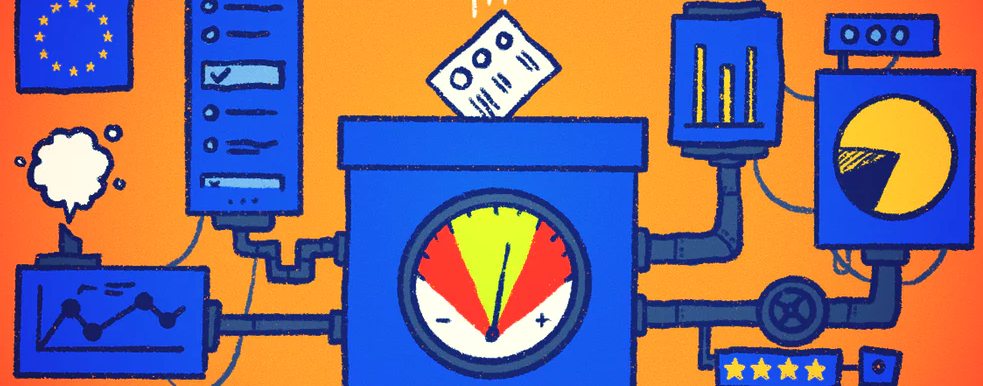
We’ve created a series of infographics showing you how pro- and anti-values parties are expected to perform in the European Parliament elections. This should let you see:

  • What proportion of MEPs are anti-values, which political groups they belong to, and how they’re expected to do in the elections.
  • Possible coalitions that could be formed to protect basic values if political groups are willing to kick out their bad apples.
  • Possible anti-values coalitions that could be formed if mainstream political groups decide to collaborate with anti-values political groups and parties.

What do we mean by ‘anti-values’?

Tell Me More

Who have we classed as anti-values?

Tell Me More

With over 70 percent of MEPs expected to be pro-values, you’d have thought it would be easy to guarantee that the European Parliament will champion our rights and freedoms. But because all the main political groups contain bad apples, anti-values MEPs could still end up at the heart of political power. The only way to stop this is if voters start asking their political representatives why they want to collaborate with anti-values parties instead of making new alliances with MEPs who will champion fundamental values.

If you still have questions about how the European Parliament works or what political groups are, head over to our primer and see our latest info video.

If you’re all clued up, you’re ready to dive in to the tracker. #Vote4Values.

MY World 360°

By Digital Promise Global

Recognising the experiential storytelling potential of immersive technologies like virtual reality, Digital Promise Global, the United Nations SDG Action Campaign, and Oculus have launched MY World 360°, supporting youth worldwide to create 360° media as a way to share their perspectives and advance positive action toward the Sustainable Development Goals (SDGs).

The program aims to drive youth engagement and agency, improve youth understanding about global issues impacting communities around the world, build young people’s technical production skills with new media, and spur public awareness and action.

MY World 360° includes a Program Guide and FAQ to help participants learn about the SDGs, and to develop the skills needed to capture, edit, and share 360° media to represent their perspectives and their communities in an immersive and compelling way.

Watch the films from the first MY World 360° playlist on Facebook (also available on YouTube) screened at the United Nations General Assembly.

Get Involved!

Sign up below to receive updates, resources, and information on how to participate in the MY World 360° Global Challenge.

Spread the word by sharing the MY World 360° flyer and logo with your networks.

Submit your 360° media via the MY World 360° Submission Form by April 1, 2019 to be considered for the next United Nations showcase opportunities.

Follow us on social media:

Tag us in posts related to MY World 360° and use hashtags #myworld360, #SDGs, #Act4SDGs, and #Youth4SDGs.

Invitation to contribute to ECOSOC thematic report on the long-term impact of current trends in the economic, social and environmental areas on the realization of the SDGs

By DESA/OISC

Held on an annual basis, the High-level Segment of ECOSOC represents the culmination of ECOSOC’s annual cycle of work and convenes a diverse group of high-level representatives from Government, the private sector, civil society and academia for policy dialogue, review, and recommendations on the 2030 Agenda for Sustainable Development and other internationally agreed development goals. In particular, the HLS of ECOSOC is mandated to focus on future trends and scenarios and the long-term impacts of current trends on the realisation of the SDGs. It also aims at enhancing knowledge-sharing and regional and international cooperation.

The 2019 High-level Segment of ECOSOC will be held 16-19 July 2019 at UN Headquarters in New York and will be informed in part by the ECOSOC Thematic Focus Report “Long-term impact of current trends in the economic, social and environmental areas on the realization of the Sustainable Development Goals.”

Major Groups and other Stakeholders are invited to submit inputs to this ECOSOC Thematic Report. If you would like to contribute, we ask that you kindly submit an executive summary of your inputs (500 words max.) in order to facilitate integration into the final report.

Please send all contributions to Anastasia Kefalidou at kefalidoua@un.org

The deadline to receive submissions is 15 March 2019.

2019 ECOSOC Thematic Focus Report

“Long-term impact of current trends in the economic, social and environmental areas on the realization of the Sustainable Development Goals: Report of the Secretary-General”


DRAFT OUTLINE

  1. Introduction (1.5 pages)

It will briefly mention the theme of the 2019 High-level Segment, explain the new focus of the high-level segment of ECOSOC and the need to discuss future oriented trends and scenarios, and present the focus and content of the report.

  1. Future global trends and scenarios (5 pages)

This section will elaborate on a few prominent future scenarios and trends with the highest probability to have a significant impact on the global efforts to realise the 2030 Agenda and the 17 SDGs. It will bring out the fact that it is often difficult for long term scenarios, projections and analysis to look at the multiple and integrated dimensions of sustainable development and such works often pertain to a particular sector or discipline. The section will highlight any holistic projections and scenarios but also projections and scenarios related to specific aspects such as economic growth, climate change, food security, population, water etc.

Sources for this chapter: work conducted within the UN system on future trends, scenarios and foresight (including work conducted by DESA for the first GSDR, EAPD, DSDG, Population Division etc.); future trends and scenarios developed by specialised agencies such as FAO, WB, IMF etc.; IPCC; work of OECD, IIASA, SDSN, and various think tanks and researchers. UN system organisations and DESA divisions are invited to help identify such major scenarios and projections and their key findings, as well as to provide short analytical inputs.

III. Key implications for the implementation of the 2030 Agenda (5 pages)

This section will discuss the negative and positive implications of the previously identified trends

and scenarios, and how it is anticipated that they could shape policies and actions geared towards the implementation of the 2030 Agenda. The section will also discuss the potential effects of inaction. It will

highlight the fact that many countries focus on short term planning rather than develop a long-term

vision, but also give examples of countries having developed a long-term vision.

Sources for this chapter: analysis associated with the above projections and scenarios, research of the

literature, related reports of international organisations and think tanks. A search of the VNR reports and

literature such as OECD publication on this topic could be used to analyse the extent to which countries

use long term planning. DESA Divisions and UN system organizations are invited to provide analytical

inputs or references to important analysis.

  1. Recommendations for the way forward (2 pages)

This section will present broad directions for policies and strategies to tackle, halt or harness the effect

of the main trends and scenarios and highlight the potential role of ECOSOC.

Sources for this chapter: This chapter will build on the above analysis. UN system organizations and

DESA divisions are invited to provide bullet point recommendations and ideas.

  1. Conclusion (1.5 pages)

It will summarise the main messages of the report.

Our homes are where Europe’s future starts. Housing Europe Manifesto for the European Elections 2019

By Housing Europe

Why investing in public, cooperative and social housing is the best return on investment for Europe. The scope of Europe’s housing challenge, the housing providers’ offer, the needs in the post-2020 EU and Housing Europe’s proposals. Stay tuned with our campaign all the way up until May when the European Elections will take place.

I. Europe’s Housing Challenge

Although growth has returned to big parts of our continent, it is leaving many behind and our societies are increasingly unequal. Similarly, the recent ‘recovery’ in housing markets is far from benefiting everyone.

The current state of housing markets can be summarised as followed:  

  1. Housing has become the highest expenditure for Europeans and overburden rates remain stable at high level, hitting disproportionally harder the poor. 4 out of 10 Europeans below the poverty line are overburdened by housing costs.
  2. House prices are growing faster than income levels in most Member States, while inequality and housing exclusion are mutually reinforcing. Broad target groups lack the possibility to enter the housing market like youth and migrants. Meanwhile mobility is limited due to high housing prices, which affect the opportunity to move for workers and families.   
  3. Territorial divide is alarming, as finding adequate and affordable housing in places with job opportunities is increasingly hard. Shrinking cities and regions are quickly becoming a priority on the agenda of local and regional authorities.
  4. As the level of housing construction is still low, especially major cities face a structural housing shortage reinforced by recent waves of migration.
  5. Political response to Europe’s housing challenge remains poor, a fact reflected in increasing levels of homelessness and overall housing exclusion.
  6. Climate change is alarming. The housing sector is a major user of energy and materials. Penetration of energy efficiency measures and renewable energy in the housing sector should be facilitated while maintaining affordability for all. Building and construction materials make out a large proportion of Europe’s waste: waste handling for recycling and circular business models is needed.

II. What we offer | Why social, cooperative and cooperative housing matters?

1/ Growth for all

Social, cooperative and public housing providers do promote a variety of housing options for various target groups and housing needs (Housing First, social, affordable housing, targeted offer for elderly, young, migrants, etc., social mix). Affordable housing favours labour mobility too, which has an impact on local unemployment rate.

2/ Communities for all

Social, cooperative and public housing providers are partners for cities, urban and rural communities that can help deal with the most pressing challenges like urban sprawl and socio-spatial segregation.

3/ Not only a roof

Social, cooperative and public housing organisations provide social innovation, employment services, health services, digital inclusion to the residents, in order to improve their quality of life

4/ Leaders for a fair energy transition

Social, cooperative and public housing providers build nearly zero energy homes, renovate existing dwellings and promote the production of renewable energy, thus contributing to reduce CO2 emissions, energy bills and increase comfort and living conditions. Good handling of construction and renovation waste for recycling and circular business models is also on the agenda of housing providers. Thus, they contribute to achieve a fair energy transition and promote circular and decarbonised energy in the European Union.

III. What is needed?

1/ Stability for Evolution

Social, cooperative and public housing organisations need public investment and supportive legislations to build affordable and decent homes for those whose housing needs cannot be met by market providers.

2/ Cohesion for Fairness

EU funding programmes have to support social and territorial cohesion through better housing and adapted housing solutions, in particular by ensuring equal access to affordable housing between territories.

3/ Flexibility for Progress

EU tax, competition and internal market rules have to be supportive of the investment efforts made by social, cooperative and public housing organisations.

4/ Action for Fair Energy Transition

Climate objectives can only be achieved through a mix between energy savings and production of renewable energy (in particular in a decentralised approach); social, cooperative and public housing organisations should be further supported in leading the way forward.

5/ Support for Circular Economy

Using recycled material as inputs for new construction and renovation, improve information regarding the health impact of building materials are essential to move towards a sustainable and decarbonised economy.

Although housing policies are primarily a matter of national and local governments, the European Union has a role to play.

To be able to further support affordable housing and liveable communities in the EU, Housing Europe members call for…

  • …download our detailed proposals below & support us #housingeu
  • Stay tuned, our campaign will be unfolding with a lot of material for each of the above points over the course of the next months. Watch our video.

See more here : http://www.housingeurope.eu/resource-530/our-homes-are-where-europe-s-future-starts

Housing Europe is the European Federation of Public, Cooperative & Social Housing. Since 1988 it is a network of 45 national & regional federations gathering 43.000 housing providers in 24 countries. Together they manage over 26 million homes, about 11% of existing dwellings in Europe.

WILL THE GLOBAL PACT FOR THE ENVIRONMENT SAVE THE PLANET?

By Patrizia Heidegger, EEB

“Every person has the right to live in an ecologically sound environment adequate for their health, well-being, dignity, culture and fulfilment”. That is the first article of a draft ‘Global Pact for the Environment presented by French President Macron in 2017. You would be forgiven for thinking that this right already exists. But unbelievably, in 2019 we have no globally recognised human right to a healthy environment. Governments from around the globe are now discussing the content of a future Global Pact for the Environment and the principles it should turn into rights for people and obligations for states.

The lack of a human right to a healthy environment and numerous other gaps and inconsistencies in international environmental law are what the Global Pact for the Environment seeks to address – with the ultimate aim of helping us save the planet and tackle the various urgent ecological and social crises humankind faces.

From the Rio Declaration on Environment and Development brokered back in 1992 to the current 2030 Agenda for Sustainable Development signed by world leaders in 2015, numerous principles of environmental protection and environmental democracy have been established. It is a tempting prospect to imagine bringing them together into one harmonised and legally binding international treaty that courts could use to enforce environmental law around the globe.

All countries bar five (the Philippines, Russia, Syria, Turkey, and the United States) gave the green light to start work on the Pact in 2018. Now, in 2019, diplomats are meeting to make progress on the text. However, environmental organisations warn that the process of agreeing on the Pact could actually risk weakening hard fought for principles of environmental law.

It remains to be seen whether enough governments have the political will to take big steps forward in creating new environmental rights and obligations and whether they can agree on the principles they want to strengthen. While some of the emerging economic powers seek to emphasise their national sovereignty by deciding how to use up their natural resources, other governments want to advance environmental democracy – much to the displeasure of authoritarian regimes. Some Latin American countries demand enshrining the rights of nature itself, an idea not yet reflected in the Western legal tradition. Has the process already stalled before it has really started?

Another challenge is the question of whether the time is ripe. Governments around the globe already struggle to put the hundreds of existing environmental agreements they have signed up to into reality. Some critics ask whether it would not be more fruitful to focus on stepping up implementation, identifying the funds necessary to put in place what has already been decided, working with governments to build up their capacity and expertise on environmental issues, and developing new environmental rules for the most pressing issues such as plastic pollution. They are afraid that another international process will not change things on the ground while tying up governments in another round of negotiations.

And where is civil society in all of this? For most of us, the Pact is both a risk and an opportunity. In the current political climate, I am afraid that long fought for principles are watered down rather than strengthened. Progressive governments may not be strong enough to argue against Trump, Putin, Erdogan, Maduro, Assad and – most recently – Bolsonaro. And yet, there is hope that a Global Pact for the Environment may ultimately help those who suffer from environmental harm and strengthen environmental defenders whose lives are under threat. We hope that it may help us to hold polluters accountable and to create new obligations for governments and businesses.  We hope it may strengthen environmental democracy around the globe. As Marcos Orellana from Human Rights Watch argues, the pact “will give those exposed to mercury in artisanal gold mines in the Philippines, those poisoned by soot in Piquiá de Baixo in northeastern Brazil, those contaminated by lead in Kosovo, and activists attacked for protecting their environment and lands, the tools and political leverage they need to defend their rights”.

So, of course, we will advocate for a Global Pact for the Environment that can bring the legal framework for environmental protection and environmental democracy to a whole new level. I welcome the words of those political leaders who have called for the inclusion of civil society into the process. The process will only be a legitimate one with strong and meaningful civil society participation. But NGOs also need supporters who are willing to fund such work.

If the process is successful, the Global Pact for the Environment could underscore the importance of legally binding instruments in environmental protection. It could close gaps and inconsistencies in international environmental law. It could turn important principles into rights, including climate justice and intergenerational equity, the rights of nature, the duty of care for the environment, the precautionary and the polluter pays principle, environmental democracy – and, last but not least, the right to a healthy environment.