Inequalities are everywhere and they are growing. Activists organised a guerrilla action at the European Development Days to ask for political actions! META followed them around and here’s what happened.
On 18 June 2019, activists fighting for equality in the EU and around the world gathered at the European Development Days to distribute a newly published report.
Inequalities in the EU are growing to the point that we might not deliver on the commitments it took with the Sustainable Development Goals (SDGs).
Marie-Amelie followed around the team to learn more about the challenges we are facing and about the recommendations from the NGOs.
Despite the European Union’s commitment to ‘leave no one behind’, millions of people in Europe are falling victim to widening inequalities, a newly released EU-wide report concludes.Meanwhile, European governments are not doing enough to bridge the chasm.
The SDGs are the world’s crisis plan to end poverty and protect the planet, and tackling inequalities is one of the 17 goals that all EU countries have signed up to deliver in the coming years. Inequalities also cut across and affect many of the other SDGs.
The release was timed to coincide with the European Development Days (EDD), whose theme also related to addressing inequalities and “building a world which leaves no one behind”.
A Fight Inequality campaigner talks about the report with a passerby. Image: Sonia Goicoechea
While visitors and delegates to the event received a wealth of information about inequalities in developing nations and how the EU social model could help tackle these inequalities, missing from the official programme was how the much-vaunted European model was under assault and how many forms of inequalities were widening in a part of the world which prides itself on its egalitarianism.
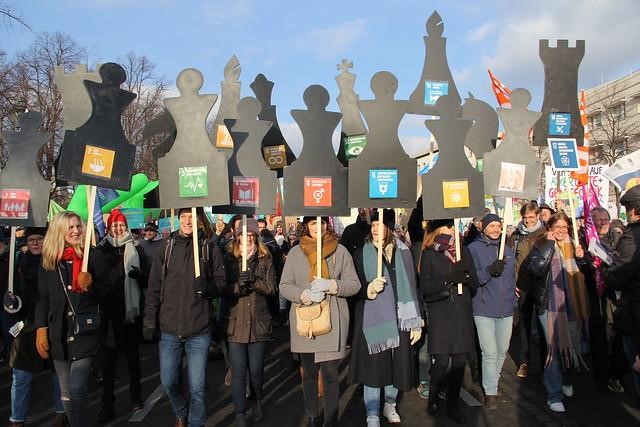
To raise awareness of this oversight, a team of ‘Fight Inequality’ activists, dressed fetchingly in sandwich boards with eye-catching designs, talked to hundreds of visitors outside the EDD venue in Brussels about inequalities in Europe and about the report.
“Inequality is not only a fact in the Global South, it is also a problem in Europe,” Patrizia Heidegger, director of global policies and sustainability at the European Environmental Bureau (EEB), said during a packed side event at the EDD.
“The EU is one of the wealthiest regions on the planet and prides itself on being a leader in social progress and sustainability,” she explained. “The reality is quite different.”
Fractured lives
‘Falling through the cracks: Exposing inequalities in the European Union and beyond’ finds that the European Union and its member states are failing millions of the most vulnerable and marginalised people in Europe and the wider world, as significant socio-economic and environmental inequalities worsen or persist.
The report maps the reality of various forms of inequality, both nationally and at the European level. It includes national reports from 15 countries that, together, represent nearly three-quarters of the EU’s combined population and 11 thematic reports exploring key dimensions of inequality, including gender, age, disability, ethnicity and homelessness.
“The gap between the richest and poorest in Europe is widening – 20% of the EU population earns less than the poverty threshold in their country,“ explained Ingo Ritz, director of programmes at Global Call to Action against Poverty, one of the organisations involved in the report.
But the story does not end at the chasm between the haves and the have-nots. “Across the EU, 10% of those employed and living in poverty. The gender pay gap in the EU is 16% and much higher in some countries. The gender pension gap stands at 40% in the EU, exceeding 45% in Germany, Luxembourg and the Netherlands,” Ritz elaborated. “The richest men in France have a life expectancy of 84 years, while the poorest men have a life expectancy of 71 years.”
Inequalities are also sharpening in other European countries too. In Germany, “40% of full-time workers live below the poverty line, which also affects the lives of families and children,” noted Anja Ruhlemann of Women Engage for a Common Future (WECF), which also contributed to the report.
When it comes to age, “young people have become the population group at greatest risk of poverty and social exclusion, with more than one in four young people affected by this risk,” the report observes in its chapter on youth.
In countries where age-related inequalities are at their starkest and where young people lack opportunities, there is enormous pressure to migrate in search of a better life. However, young people are fighting to create opportunities at home. “I don’t want to leave my country because I want to be a part of my country’s future,” Teodora Grau (16), a youth activist from Romania and a member of the World Vision Children Consultative Council, told the audience at the report launch.
Sustained demands for sustainability
‘Falling through the cracks: Exposing inequalities in the European Union and beyond’ makes numerous recommendations designed to tackle, reduce or eliminate the inequalities it highlights.
A group of recommendations revolve around repairing Europe’s frayed social safety net and strengthening it. Examples in this regard include introducing a basic minimum income for all, ensuring equal pay for equal work, and the expansion of social transfer and social protection policies.
On the other side of the balance sheet, the report demands that taxation policies be reformed to help reduce inequalities, protect the environment, to encourage more sustainable lifestyles and to avoid harming countries outside the EU. Several recommendations relate to human rights and policies to overcome discrimination against women, the young and people with disabilities, among others.
Rather than the current fixation on economic growth, the European Union should seek to enhance quality of life and welfare, the document insists. Towards this end, the report proposes that the EU be guided by a Sustainability and Wellbeing Pact.
Campaigners have been calling for the EU to put sustainable development at the heart of its agenda for many years. Civil society even launched a Manifesto for a Sustainable Europe in September last year.
Since the European election last month, demands have become more vocal for the EU to deliver on the SDGs, by making them and sustainable development in general the “golden thread” that runs through all of the EU’s work.
By the Organisation for Economic Co-operation and Development (OECD)
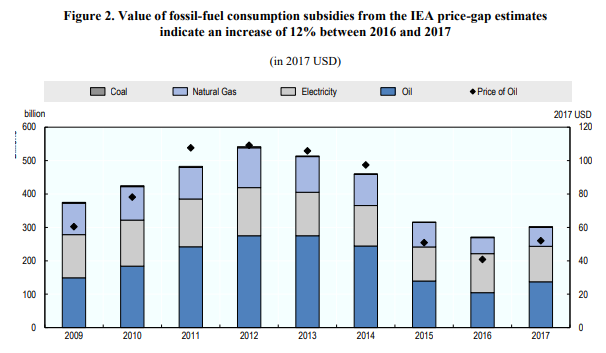
Fossil-fuel subsidies are environmentally harmful, costly, and distortive. After a 3 years downward trend between 2013 and 2016, government support for fossil fuel production and use has risen again, in a threat to efforts to curb greenhouse gas emissions and air pollution, and the transition to cleaner and cheaper energy. Support across 76 countries increased by 5% to USD 340 billion in 2017, according to a new OECD-IEA report prepared for the G20.
The reversal comes as some countries reinstated stronger price controls on fossil fuels, in response to volatility in international oil prices, which made it harder to continue energy pricing and taxation reforms.
Some progress has nonetheless been made: the report finds that many countries, including Argentina, India, Indonesia and several Middle Eastern and Northern African economies, have continued to take steps to reduce support for energy consumption. Western Europe has completed its phasing out of hard-coal subsidies and efforts continue to end state aid to coal-fired power generation in the European Union.
Oil and gas industries in several countries, however, continue to benefit from government incentives, mostly through tax provisions that provide preferential treatment for cost recovery. Such policies go against domestic efforts to reduce emissions.
The report was presented to G20 energy officials ahead of the G20 Ministerial Meeting on Energy Transitions and Global Environment in Karuizawa, Japan, where countries reiterated their commitment to phasing out inefficient fossil fuel subsidies and encouraged countries that have not done so to volunteer for a Peer Review.
“This new OECD-IEA report signals a worrying slowdown in our efforts to phase out fossil fuel subsidies,” said OECD Secretary-General Angel Gurría. “The critical nature of the climate change crisis has never been clearer than it is today. Countries should be accelerating their reforms, not taking their feet off the pedal. We cannot promote inclusive and sustainable growth if we continue subsidising fossil fuels!”
The report combines the IEA’s price-gap approach to capture the transfer to consumers of policies that keep fossil fuels below reference prices and the OECD’s 2019 Inventory of Support Measures for Fossil Fuels, which takes stock of spending programmes and tax breaks used in the 36 OECD countries and eight emerging countries (Argentina, Brazil, China, Colombia, India, Indonesia, Russia and South Africa) to encourage fossil fuel production or use. These include measures that reduce prices for consumers or that lower exploration and exploitation costs for oil and gas companies.
Increasing transparency on the use of scarce public resources can help to keep up momentum for fossil fuel subsidy reform. Building on the evidence brought to the table by the OECD, G20 countries committed in Pittsburgh in 2009 to “rationalise and phase out over the medium term inefficient fossil fuel subsidies that encourage wasteful consumption.” Since then G20 countries – China, Germany, Indonesia, Italy, Mexico and the United States – have completed voluntary G20 Peer Reviews of inefficient fossil fuel subsidies, and Argentina and Canada are just starting theirs. The OECD has been asked to play Secretariat role for all the country reviews, to chair and facilitate these processes, which have to date evaluated more than 100 government interventions relating to the production and use of fossil fuels.
“OECD evidence leaves no doubt” says Gabriela Ramos, OECD Chief of Staff and G20 Sherpa – “inefficient fossil fuel subsidies undermine global efforts to tackle climate change, aggravate local pollution, and are a strain on public budgets, draining scarce fiscal resources that could be invested in education, skills, and physical infrastructure. We urge all G20 countries to keep up the effort, and join the voluntary G20 Peer Reviews of inefficient fossil fuel subsidies.”
For further information journalists are invited to contact the OECD Media Office (+33 1 45 24 97 00.)
Working with over 100 countries, the OECD is a global policy forum that promotes policies to improve the economic and social well-being of people around the world.
Civil society organisations from across Europe are urging European Union leaders to make sustainable development the golden thread running through all EU policies.
European Union leaders are due to hold a summit in Brussels on 20-21 June 2019 where they will hammer out the EU’s strategic agenda for the coming five years. A leaked draft of the five-year plan obtained by Euractiv reveals that the top priority EU leaders wish to pursue between 2019 and 2024, under the misleading heading “protecting citizens and freedoms”, revolves around migration, border controls and counter-terrorism.
While this may appear to be the populist thing to do, it is not the most popular, according to various opinion polls. Protecting the environment and sustainable living are popular amongst European citizens, regardless of their political ideologies. A near universal 94% of EU citizens say that protecting the environment is personally important to them, according to Eurobarometer, the EU’s polling agency.
Moreover, a recent YouGov poll found that the majority of Europeans polled were in favour of introducing greater protections for the environment, even it negatively affected economic growth, and that corruption, housing, health, pensions and unemployment rank above or equal to migration.
These trends were confirmed by what has been dubbed as the ‘green wave’ during the European Parliament elections.
Despite this clear preference for the environment among European citizens, the leaked draft plan relegates green policies to third place, behind migration and “developing our economic base”.
The golden thread of sustainability
Reflecting the clear preferences of millions of citizens to prioritise the environment, housing, health and employment, as well as responding to the urgent environmental and socio-economic crises facing Europe and the world, European civil society decided to join forces to demand the political establishment get its act together.
More than 150 organisations signed an open letter urging EU leaders to render sustainable development “the golden thread running through all EU policies” in the 2019-2024 strategy and beyond.
“Urgent action is needed to address escalating inequalities and tackle the climate crisis, stop the rapid loss of biodiversity, ensure sustainable consumption and production and quality employment for all, and manage a just transition towards an economic system founded on wellbeing and quality of life,” the signatories stated.
“The next five years will be decisive if we are to advance social justice, including by fighting poverty and social exclusion, creating quality employment, and ensuring the health, dignity and well being of all people,” says Kélig Puyet, director of the Social Platform. “To achieve this, our leaders need to do more than pay lip service to social and environmental sustainability.”
“The outgoing European Commission wanted to make us believe in infinite ‘green’ growth while leaving the economic system untouched,” notes Patrizia Heidegger, director of global policies and sustainability at the EEB. “We need the next Commission to focus on an economy for human well-being within ecological limits – and a political leadership that dares to ask: how much is enough to live well?”
Making Europe sustainable can only be achieved through sustained pressure. “The high priority that the large majority of European citizens assign to the environment and their active and constant demands for a better and more sustainable future are making a difference in the corridors of power in national capitals and in Brussels,” says Jeremy Wates, secretary general of the European Environmental Bureau (EEB). “But they need to keep up the pressure by making it abundantly clear to politicians that they will not settle for anything less than a sustainable Europe.”