Newsletter from the SDG Watch Europe network –  JAN 2019

View this newsletter in your browser

Latvian case study on SDGs and VNR

By Inese Vaivare, LAPAS

The Latvian Platform for Development Cooperation (LAPAS) has been working on the Sustainable Development Goals (SDGs) since 2014, when the stakeholder involvement in the post-2015 process took place. In 2014, LAPAS established the working group on the SDGs within the platform uniting active NGOs, UNESCO NC, and academia. This group aims to coordinate current projects and to mainstream the SDGs in the relevant activities.

Since then, many awareness raising activities have been implemented to mainstream the SDGs – such as tax justice, fast fashion, food security and many more. These include the annual Global Education Week where thematic movies are screened, and the newspaper “The World Becomes Better Place” distributed and relevant workshops organised in cooperation with more than 60 regional partners – schools, youth centres, libraries and others. Special attention has been paid to the training of youth and private companies.

To glocalize the global issues locally, LAPAS has gathered 34 people stories (on each goal) on how the SDGs are being implemented in the work of CSOs, local governments, research institutions and small enterprises. This approach was multiplied at the Baltic level and with the support of the NCM all three Baltic countries gathered best practice cases – 17 for each country.

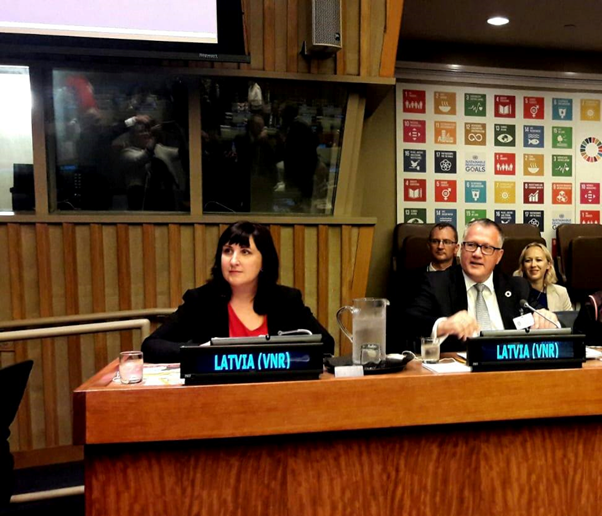
In 2018, Latvia presented its Voluntary National Review (VNR) at the HLPF and with the support of Forus LAPAS, which prepared a CSO Spotlight Report on the Implementation of the SDGs in the national level in Latvia, participated in the HLPF, including a side event by giving a presentation together with the Minister of Economics.

The experience was written up in in a publication “Voluntary National Review: Connector. Case of Latvian CSOs” – pre-VNR process, VNR and post-VNR.

Since the VNR process, LAPAS continues to work actively with all stakeholders to establish a  multi-stakeholder coalition and the integration of the SDGs in a new National Development Plan.

All materials are available at www.lapas.lv (Global Goals).

The Latvian Platform for Development Cooperation (LAPAS) was established in 2004. The same year, when Latvia joined the European Union. LAPAS unites Latvian NGOs, which believe that Latvia’s transition experience to a democratic market economy can be useful to others. LAPAS also promotes NGO participation in development cooperation and coordinates Latvia’s efforts in development education.

Considerations on linking Urban Agendas and the SDGs

By René Hartinger, Ökosoziales Forum Wien

The 2030 Agenda for Sustainable Development with it’s 17 Sustainable Development Goals is the most important and most widely known agenda for a sustainable transformation of our societies and our global system. Explained in the shortest possible way (that I can think of), it leads a way into a better future of well-being and decent living conditions for everyone, while societal and economic well-being no longer depends on the exploitation of others – be it the people working in the production or supply chain or the marine systems that are overfished. The forests that are cut down and the species extinct for short-term interest, or the tax payers and workers that uphold the common goods while others shift billions to tax morasses. And, of course: the future generations, that will simply not have the same chances, as their forefathers and foremothers who pumped the atmosphere so full of greenhouse gases that the climate finally collapsed. To give this a name, it is, as the Austrian-German Scientist Uli Brand calls the “imperial way of living” – a lifestyle of some, that is based on unsustainable and unethical exploitation, and simply can not be generalised. The main challenge is to overcome the lock-ins of unsustainability.

To overcome these, the SDGs prompt asking the right questions and consider the right criteria to move towards a liveable world for all. The 17 Goals highlight the cornerstones identified on the way towards the 2030 Vision – which is a world in balance. These goals are highly usable on different political levels: first, they remind us of the 17 main aspects that the world community found important to be considered in political decisions, policies, strategies and measures. Second, they are “down to earth” enough to start conversations about the world we want to live in 2030 with the majority of the people, even with those not visiting our panel discussions or sharing our enthusiasm for terms such as “sustainable development”, “eco-social market economy” or “social-ecological transformation”. Nevertheless, and despite the low barriers, the systemic approach behind the SDGs is leading deep and deeper, once you bear them in mind and consider them in your thoughts and actions.

With a focus on urban areas and cities, a few things can be assumed, thinking about the role and responsibility, the potential and starting points of cities in contributing to reach these 17 Goals (and the liveable and sustainable societies and cities they’re aiming for). Over 50% of the world’s population already lives in cities, and in a few decades,  it will be 70% or more- which underlines the weight of what is happening in the centres. (Centres because cities – small ones as well as metropolitan regions – are always of high importance for the rural areas around them). Cities are also often incubators for the cultural, intellectual and spiritual life of a nation, which is important for two reasons: first, culture is what lies underneath our lifestyles, therefore transformation needs to begin there, rooted in our culture and values. Second, many ideas, which could lead the way towards a liveable 2030, are born, incubated, negotiated or tried out in the centres. And last, not least, many sustainable solutions (such as a well-developed public transport system, universal health services and social security programmes, long distance energy, etc) are based on innovation and infrastructure investments that only make sense in cities, because of the financial meaningfulness – which is why you generally find subways, operas and hospitals in centres.

Therefore, one can think about the Agenda 2030 and it’s 17 Goals in an urban context in two different ways. The first way is that the SDGs are a political compass and communications tool, which enables cities (and their mayors, politicians, administrations, etc) to connect with their citizens and different stakeholders in order to discuss the living conditions and surroundings we want in 2030, and to develop proper strategies and measures within these processes. The more we use the Goals in these dialogues, the more well understood and familiar it will be to work with them, which is a huge benefit. It makes political processes more inclusive and integrative, and it is efficient, as you do not always need to then explain terms such as “social-ecological transformation”, “smart city” or the like. The SDGs are bringing these bulky terms down to earth in a low barrier manner – which is very important, because urban agendas and many people simply ARE down to earth. To summarise: this first way therefore suggest to us to focus on the benefits and chances of the SDGs in the political and societal process and dialogue.

The second way to think about the SDGs in an urban context is the “other way round” – not to start with the SDGs as such, but with issues of concrete urban relevance. Housing, traffic, water and energy supply, air quality, social cohesion, education and health system, poverty prevention and reduction – all of these and many more topics are core urban agendas. Therefore, it could be a promising approach to promote the SDGs with urban actors without starting with “Have you heard there is a new set of goals by the United Nations that…”. But, for example, as housing is a big topic and highly relevant for mayors, start with a differently approach – “We know that housing is a big topic in your city that you are working on. You know, there is this new set of goals for a good future for all by the United Nations, which can be very useful in dealing with such complex issues. You can use these set of goals – the “SDGs” – for your city to find the best possible ways to develop your housing policies in the next years by getting in touch with your own citizens as well as other actors worldwide (other cities, scientists, civil society organisations or businesses) to learn more about what it is important and possible, or to promote what you do here within the worldwide SDG-community.” Such conversations could not only lower the barrier, but also enable new potentials, as working with the SDGs always opens the view and allows an organised, well-reflected approach on the complexity of sustainable development issues.

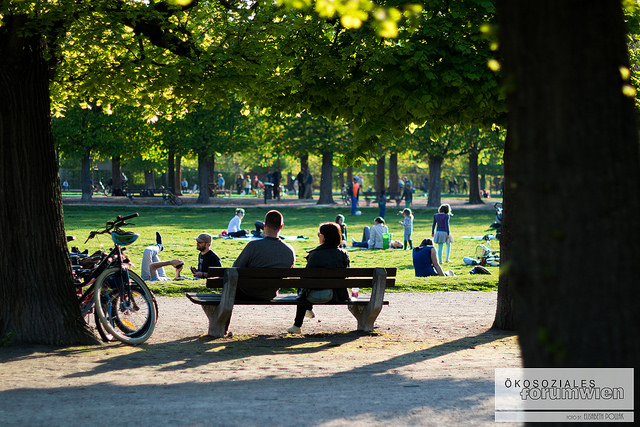
Combining and using these two views and approaches is promising and productive from our point of view, setting free the urban areas’ potential in sustainability transformation (or the inverse, for breaking out of unsustainable lock-ins). With a focus on housing, for example here in Vienna, the SDGs have helped us to understand that with the 100 year old successful “Vienna Model” of social housing, we do not only have a leverage in providing affordable housing, but also in emission reduction and protection of ecological niches in our city, providing spots of local recreation for the people right outside their door, and much more. But the 17 Goals also help us to understand and to communicate that affordable housing is not a solution unless there is no high quality of public services, social stability and healthy and sound natural environment provided too. And, of course, this also implicates our duty to take care of the future– e.g. through broad education and widespread nature and climate protection measures. We, therefore, consider the SDGs and the Agenda 2030 highly relevant with great potential, and we use them willingly and gladly. But they also remind us, that these set of goals and icons are only a new name for what we and our forefathers and foremothers have been working on long before 2015 – a good city to live in for generations to come. This understanding can be leveraging – as it connects our own efforts and history with a promising new approach and common language leading into a liveable and good future for all.

Rene Hartinger, born 1984, was involved in establishing SDG Watch Austria in 2017 and 2018 and is today Secretary General of the Vienna Ecosocial Forum. The core topics of his organisation are food consumption and production, urban agriculture, nature in cities, and a broader approach on sustainable cities and liveability through the lens of the Agenda 2030’s 17 SDGs. www.oekosozial.at/wien
Towards a just transition: reconciling climate action with the fight against inequalities

By Association 4D

Today, the nationally determined contributions under the Paris Agreement are leading us towards a global warming of around 3.2°C. According to a recent UN report, a tripling of efforts may be needed to keep warming to below 2°C, a goal formulated in the Paris Agreement and in the 2030 Global Agenda for Sustainable Development (Agenda 2030). But how can we accelerate the transition to a low-carbon society when a non-negligible section of the population perceives it as a social injustice, which has negative impacts on employment and the purchasing power of households?

The dependence of our development model on energy, especially fossil fuels for travel, undeniably creates losers, who tend to be the poorest and most vulnerable. Inequalities manifest themselves in access to natural resources, particularly energy: for example, the share of the household budget allocated to energy (fuel, heating) is proportionately much greater for low-income households than for wealthy households.

The reduction of inequalities is now at the core of the international and national political agenda. At the international level, issues of justice and equity are central to international standards and agreements on sustainable development. Thus, the Paris Agreement recognises the principle of common but differentiated responsibilities and respective capacities, which enables the fine-tuning of the conventional obligations of states, according to the level and needs of their development. At the centre of the 2030 Agenda is a cross-cutting principle that applies to all of its Sustainable Development Goals (SDGs): leave no one behind. It also includes a goal that is specifically dedicated to reducing inequalities (SDG 10), along with related thematic targets and means. The President of France, Emmanuel Macron, has made the reduction of inequalities a key issue for the G7 that will meet in August 2019 in Biarritz. It is also a major cross-cutting priority for NGOs and associations as part of their contribution to the national roadmap for SDG implementation.

The Sustainable Development Goals: the glue binding the social-ecological pact together?

As social unrest intensifies, how can the SDGs contribute to climate action and the reduction of inequalities? SDG implementation can indeed enable the transition to a low-carbon society to be reconciled with social justice, under certain conditions:

  1.      Firstly, the establishment of wealth indicators other than GDP is essential to measure the impact of the transition regarding its effect on human well-being, rather than in terms of the GDP growth that it could create. Today, GDP growth is an indicator that is used as an ultimate goal for societies. However, it is not appropriate to address the many crises of the 21st century, such as climate change, biodiversity erosion, poverty and growing inequality, the decline of social cohesion, and the democracy crisis. In fact, GDP growth exacerbates – if not, causes – these crises, since exponential material growth is impossible to maintain sustainably in a finite world. In France, the 2015 adoption of the Eva Sas Law, which aims to take into account ten new wealth indicators[1] in the definition of public policies, is an important, but insufficient, step. Since 2015, the French government’s publication of the annual report on these new indicators has been disconnected from national legislative processes, particularly from the budget preparation process. Thus, the purpose of these indicators is today more political (even symbolic) than it is instrumental (budget preparation, evaluation of public policies, etc.). Although the 2030 Agenda, a compromise derived from two years of intense negotiations between developing countries, developed countries and civil society, does not undermine GDP growth as a social project,[2] this new global framework of public action offers all actors, state and non-state, the opportunity to use social-ecological indicators to monitor the implementation of this agenda at national and local levels. For example, civil society actors can already assess their projects using these indicators to identify their positive or negative externalities, or conduct counter-evaluations of local or national public policies.
  2.      Secondly, it is important to accelerate ownership and acculturation of the SDGs by all actors, state and non-state, by developing impact assessments. States, communities, NGOs, and companies can no longer develop public policies, action strategies or projects without considering and taking into account their impacts on sectors that are outside of their usual sphere. This entails developing tools to characterise and assess these impacts: for example, regarding the energy transition, an ex-ante assessment of the draft laws proposed by government or parliament, or strategies and projects developed by non-state actors, should be systematically carried out to improve their coherence with social objectives relating to the fight against social and territorial inequalities. In France, Senator Franck Montaugé’s bill is a step in the right direction. Its purpose is to establish a Parliamentary Council for the evaluation of public policies and well-being, whose mission would be to “inform Parliament on the consequences of public policies on the well-being of populations and sustainability”, on the basis of an assessment carried out from the ten new wealth indicators of the Eva Sas Law. This bill, which was referred back to committee in March 2018, could be enriched with the integration of the SDG’s 98 monitoring indicators, proposed by France’s National Council for Statistical Information (CNIS) in June 2018. A second option would be to seize the opportunity presented by the “large-scale consultation on the ecological transition” organised in January 2019 by the French government to carry out this assessment to stimulate debate.
  3.      There is also a need to strengthen the role of citizens and the individual dimension in SDG implementation. Fostering individual change requires an improvement of its social acceptability, and therefore to consider the diversity of socio-economic situations and inequalities that can be created or reinforced by measures to accelerate the transition to a low-carbon society. It is therefore necessary initially to clarify this diversity of situations and, based on typical profiles determined according to different socio-demographic criteria,[3] to anticipate the inequalities that could be faced by citizens who would engage in the transition. Based on these typical profiles, individual transition prospective scenarios should be developed to enable everyone to plan for a successful life in 2030, and to evaluate their own potential for action. Association 4D, through its Our Life 21 tool, which describes individual prospective stories developed on the basis of internationally agreed targets and scientific scenarios,[4] is a pioneer in this area. The comparison of the prospective stories of the energy transition undertaken by 16 typical families shows that there is a transitory risk of aggravating inequalities among individuals in terms of energy consumption and GHG emissions by 2030,[5] which in turn could widen socio-economic inequalities in the event of an increase in energy prices due to the introduction of a carbon tax. By developing this tool in the framework of SDG implementation, Association 4D aims to highlight the diversity of individual transition trajectories, identifying the capacity for action of each one, and also the obstacles to individual change (socio-economic and territorial inequalities), and the public policies needed to catalyse citizen transition towards sustainable development.
  4.      Finally, it is necessary to support the transition of the most vulnerable by establishing compensation instruments within climate change public policies. The social acceptability of the energy transition, and in particular the ecological taxation around which the social unrest in France has crystallised today, faces two main pitfalls. Firstly, most of the revenue from this tax is allocated to the general state budget, although research has shown that acceptability increases if ecological tax revenues are dedicated to the transition (Hourcade and Combet 2017, Sénit 2012). In 2018, for example, only 560 million euros out of the 4 billion euros of revenue generated by the carbon tax were allocated to the energy check, a compensation mechanism designed to help the poorest households. While the budget allocated to the energy check should reach 740 million euros in 2019, this increase remains too low to both compensate energy inflation (+20% in 2018 for gas, +1.7% for electricity[6]) and help the most vulnerable to sustainably escape from energy poverty. Secondly, the increase in ecological taxation was carried out in a generally unfair fiscal context, marked by a decline in the purchasing power of the poorest following an increase in indirect taxes and decrease of family benefits, a major tax giveaway to the wealthiest (elimination of the wealth tax, decrease in corporate tax), who are sometimes also the most polluting, and the exemption of some very carbon-intensive sectors (aviation and sea transport, for example).[7] While the government focuses its efforts on the reduction of public spending, it seems unlikely that the resources allocated to the energy transition will be sufficient to improve its social acceptability. For example, the annual renovation of 500,000 homes, an objective that was reaffirmed as part of the new Multiannual Energy Plan (PPE) presented by the government on 27 November, is underfunded. Indeed, the energy transition tax credit, the main tool dedicated to the renovation of private housing, saw its budget halved in the 2019 draft budget law, from 1.6 billion Euros in 2018 to 800 million Euros in 2019. According to I4CE’s 2017 Landscape of Climate Finance, the government should invest an additional 2 billion euros a year to meet the PPE’s energy renovation targets. Another example is the mobility bill, presented on 26 November, which does not challenge the place of the private car in mobility, and leaves aside public transport and the necessary public investments for its development, despite its importance for the reduction of social and territorial inequalities. Here again, the SDGs can be useful: the assessment of the state budget in light of the SDGs would improve the coherence between the means allocated to the various sectoral public policies and the social and environmental values ​​and objectives listed in the 2030 Agenda (solidarity, equality, inclusion through access to basic human rights for all, fight against urban sprawl, etc.).[8]

The current protests of the Yellow Vests do not reflect a rejection of engaging in the energy transition and the fight against climate change, but rather a rejection of injustice. We have provided four avenues that could potentially enable the SDGs to become the glue that holds a future social-ecological pact together.

[1] These include: employment rate, research effort, indebtedness, healthy life expectancy, life satisfaction, income inequality, poor living conditions, early exit from school system, carbon footprint, and land take.

[2] Target 8.1 thus aims to “sustain per capita economic growth in accordance with national circumstances and, in particular, at least 7% per annum GDP growth in the least developed countries”.

[3] For example: family situation (couple with or without children/single with or without children), geographical location (rural/peri-urban/urban; mountain/plains/coast), main transport mode (private car/public transport/soft mobility), type of housing (collective/individual; old/new), income level, socio-economic category.

[4] In particular, scenarios from the IPCC and from the Deep Decarbonisation Pathways Project developed by IDDRI.

[5] See also Chancel & Piketty (2015). Carbon and inequality: from Kyoto to Paris. Paris School of Economics, Working Paper.

[6] INSEE

[7] See for example the OpEd by Lucas Chancel in Libération.

[8] See the IDDRI study on integrating the SDGs into national budget processes.

Towards a Clean Environment Together – WECF

By WECF Netherlands

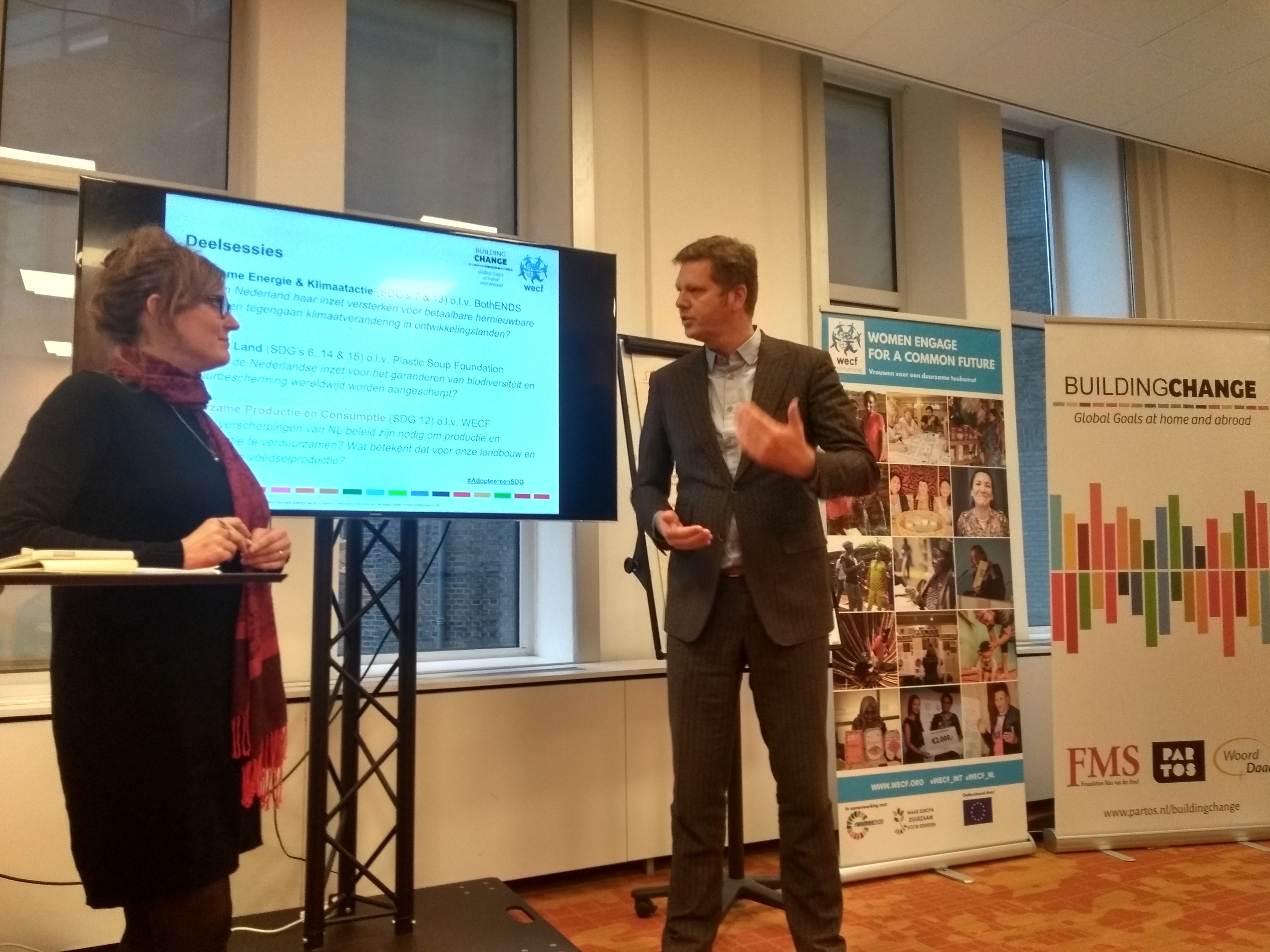
On 19 November 2018, WECF the Netherlands co-organised an expert meeting in The Hague with the national ‘Building Change coalition’. We discussed the next steps that need to be taken in the Netherlands to reduce our ecological footprint, limit global warming and contribute to reaching the SDGs internationally. The opening remarks by speakers Herman Sips (GCA) and Kiane de Kleijne (Radboud University, chapter scientist of the IPCC Report) set the tone for interesting discussions between 30 representatives of Dutch civil society, youth organisations and Member of Parliament Matthijs Sienot (D66). Sienot even became a new ambassador in the Dutch ‘Adopt an SDG’ Campaign! Read more about the results of the event here.

“Politicians are at the ‘thermometer of the earth’”, were the words of opening speaker Herman Sips of the Global Center on Adaptation. This illustrates the main conclusion of WECF and Building Change’s event on 19 November 2018: more coordination is needed from our Dutch government in order to reach the SDGs. Kiane de Kleijne, chapter scientist of the IPCC report, fully supported this view. If the Netherlands, and the rest of the international community, do not take action for mitigation and adaptation NOW, the SDGs will not be reached. This will have disastrous consequences for our environment, biodiversity along with our way of living and the economy. The Dutch government, in other words, needs to use its influence to create change. In the discussion about climate action, the focus needs to be on the benefits instead of the costs and risks.

During this afternoon event in The Hague, small groups of representatives of NGOs and youth organisations discussed recommendations to the Dutch government regarding renewable energy and climate action (SDG 7 & 13), water and land (SDG 6, 14 & 15), and sustainable consumption and production (SDG 12). At the end of the afternoon, MP Sienot promised to be the new adoptive parent of SDG 7 & 13 for our ‘Adopt an SDG’ campaign. That brings the total number of adoptive parents of SDGs in the House of Representatives to 25! A great outcome of a nice meeting, so let’s continue to work together for a clean climate!

RECOMMENDATIONS ‘Towards a Clean Environment Together’  WECF

Financing Climate Action

  •         The goals of the Paris Agreement can only be reached if we combine financing for sustainable development with the fast and complete phasing out of public financial support fossil-related projects by 2020.
  •         Climate financing needs to be accessible for the most poor and most marginalised groups. Public money is essential for adaptation, because these groups do not present a ‘business case’.
  •         Connecting to local needs is crucial. We need to aim for decentralised renewable energy solutions. These solutions are often faster, cheaper and more sustainable than big-scale infrastructure projects.
  •         To reach the goal of 1,5 C global warming, it is necessary to find new resources for climate financing. These need to be more focused on adaptation, not only mitigation.

Stimulating Innovation

  •         The current Dutch and European trade deals put the rights of sustainable farmers in developing countries at risks. The Ministry of Foreign Affairs needs to promote open food innovation, for example by removing patents for fruits and vegetables.
  •         The government needs to ensure that negative effects of mitigation initiatives on biodiversity and the environment are reduced as much as possible, for example in the Dutch water sector.

Sustainable Consumption

  •         There are many opportunities in changing people’s behaviour towards sustainable consumption, for example with the environmental damage caused by sanitary waste. Here, the consumer also needs to be made aware of effects on health.
  •         The government has a responsibility when it comes to changing the behaviour of the Dutch consumer. For example by (financially) promoting a shift from animal to plant-based proteins.
  •         We advocate for a CO2 tax. This will enlarge the consumer’s awareness of the ecological costs of what we consume, produce and import. The revenues from these taxes can be used for innovation and sustainability.

Regulation for plastics

  •         Regulation is essential for protecting the environment against the negative impacts of plastics.
  •         In the context of UNEA, the Netherlands needs to express their full support for the Norwegian initiative to come to global agreements on micro-plastics.
  •         The maximums for hazardous substances and micro-plastics in consumer products need to be lowered in both Dutch and EU contexts. The consumer needs to be informed about these amounts more clearly, on labels and tags.
  •         Regulation for monitoring soil and water quality needs to be screened and improved where needed in order to minimise the amount of micro-plastics in soil and waters.

Women in Europe for a Common Future (WECF) was officially registered as a foundation in 1994 in the Netherlands following an initiative of European women at the 1992 Earth Summit, to work together for sustainable development and to give a voice and organisation to the “Women Major Group” of Rio Agenda 21. WECF’s philosophy of enabling local project partners and network members to implement projects together, to share experiences within the network and to learn from each other, soon proved to be successful. Today, WECF’s expertise is well-known internationally.

OUR MANIFESTO FOR A FEMINIST EUROPE

By Manon Deshayes, European Women’s Lobby (EWL)

In May 2019, European citizens will vote to decide on the new composition of the European Parliament. The outcome of the elections will also have an impact on the face of the new European Commission and will have an influence on European politics, taking on the present and shaping the future of women and girls in Europe. Though we would like to believe otherwise, data shows that women are still very much second-class citizens in the European Union (EU). While most countries move in the right direction, some EU Member States have actually gone backwards and none has reached full gender equality. At this rate of progress, equality will not be seen in our or the next generations’ lifetimes. This is simply not acceptable. (EIGE data).

With the campaign 50/50: Women for Europe – Europe for Women, the European Women’s Lobby wants to achieve parity in the European Parliament, but also amongst the Commissioners as well as the top EU jobs. We also want the EU to realise that ensuring equality between women and men and integrating a gender perspective in all policy and financial frameworks is an obligation of the European Union as per the EU Treaties.

We launched our Manifesto for the elections, which is a comprehensive summary of our feminist vision for the future of Europe. We want women to have the same opportunities as men in every situation, to have the place they deserve in decision-making and leadership positions. We want women to be totally independent economically, which is vital for every woman. We want to put an end to the violence women face every day in every part of Europe, and we want women to be safe and live in dignity. We want women to be able to keep on fighting for their own rights by getting the funding they need and deserve for their organisations.

Through our recommendations, both for the national and European levels, we hope and strive for a feminist Europe, as we believe, as our president Gwendoline Lefebvre said, that today and in May, “Women and girls will seize this unique democratic moment to drive forward an equal, inclusive, diverse and democratic Europe where no one is left behind”.

The European Women’s Lobby (EWL) brings together the women’s movement in Europe to influence the general public and European Institutions in support of women’s human rights and equality between women and men.