Meet the Winners of the Gender Just Climate Solutions Award at COP24

By WECF

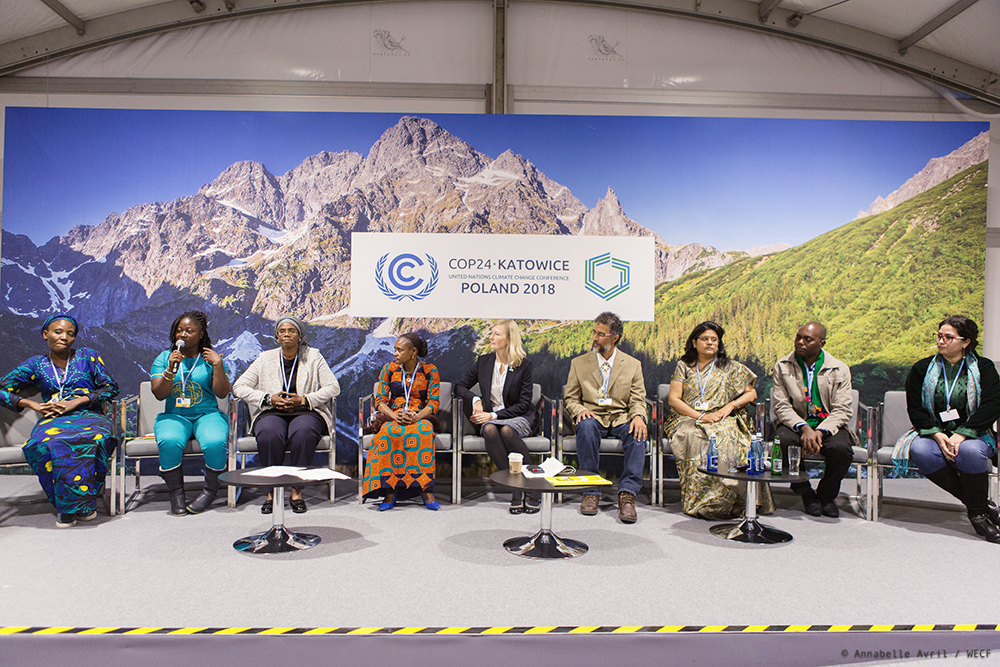
On the 70th anniversary of the Universal Declaration of Human Rights, we held our inagural Gender Just Climate Solutions Award and publication launch at the climate negotiations in Katowice, Poland.

The IPCC report have made us all aware of that time is of the essence if we are to avoid future global warming rising to more than 1.5 degrees. It is in times like these we need to look at the sustainable solutions that are already out there, to support and scale up innovative initiatives that put equity and sustainability at heart. Our award winners are not only challenging the status quo, they are turning the system upside down.

TRANSFORMATIONAL SOLUTIONS WINNER

Dorothee Lisenga (CFLEDD)

Congo DRC: According to a 2016 study, 70% of women in the DRC did until recently not have access to land and forest titles. The award winner is an amazing woman who has organised dialogues on women’s inheritance rights between customary chiefs, local and indigenous women. This has resulted in have led to huge successes in women’s access to land and forest rights of women in the provinces of Ecuador and Maindombe of the DRC.

NON-TECHNICAL SOLUTIONS WINNER

Clive Chibule (Green living Movement)

Zambia: this award winner has trained 537 women on leadership in project management and climate resilience. In a region stricken by climate-shocks, it has become necessary to support women farmers in diversifying their income, and making them less dependent on rain-fed harvests. Women farmers, with the support of the award winner, reproduce their own seeds, have planted over 35,000 trees, and created 250 vegetable gardens.

TECHNICAL SOLUTIONS WINNER

Trupti Jain (Naireeta Services)

India: Gujarat state is prone to short periods of heavy rains and flooding, followed by long droughts. Many farmlands have become waste lands. This award winner has combined women’s leadership with low cost and sustainable technology to tackle the severe impacts of excessive rain water from storms. This technology protects groundwater via a filtration system and increases soil fertility by reducing salinity. The units conserve 1-4 million litres of runoff water and can irrigate 22 acres during the dry season. While women still do not own the land, by owning the technology they help their community double their harvest which in turns has a tremendous impact on their role in the community as decision-makers. Since 2011, more than 3500 units have been installed in India and also increasingly abroad; in Ghana, Vietnam and Bangladesh. Each installed Bhungroo provides food security for 30 to 100 people, generating an additional income of about USD 5700 per year.

CONTINUED COLLABORATION

The Climate Technology Centre & Network (CTCN) is inviting the winners from 2018, 2017, 2016 and 2015 to a workshop on up-scaling gender just climate solutions, sharing of climate technology and finance. This is a continuation of our capacity-building cooperation initiated at COP23 and builds on south-south and technology knowledge sharing. It is a closed event but journalists are invited to come and interview the winners.

DOWNLOAD PUBLICATION

The publication is available in French and English.

ABOUT AWARD

Each winner have received a grant of 2,000 Euros, travel support for one representative to attend COP24, one year of mentorship activities from the members of the Women and Gender Constituency (WGC), and opportunity to participate in a skills training workshop held by CTCN. Being the 5th year running, this year we had 145 applicants, from 70 countries, 3 winners and 2 million readers of our publication.
Active for the SDGs – new tool and campaign for municipalities and citizens

By Sara Schmitt Pacífico, Climate Alliance

A good life is simple – campaign

Cities and towns are where life really happens. How can this life be made into a good life? Both for individuals and entire communities?

In our campaign “A good life is simple”, we showcase positive examples and offer new ways for you to integrate climate protection into your daily life. Incentives have been created in the fields of energy, mobility, consumption and nutrition to empower you to become active. We offer free materials in more than 13 languages. Use the posters and share them via social media, put them up in cafes, buses or your own office. The campaign is an easy way to communicate the SDGs through a progressive and positive way!

Join the campaign, reach out to your citizens and start a new movement. Whether posters, postcards or adverts in buses – we can gladly supply digital materials free of charge. A good life for all can only be achieved if we work together.

Overview campaign:

  • 1 campaign
  • 4 topics
  • 10 motifs
  • 13 languages

Link: http://overdeveloped.eu/en/downloads.html

contact: climatejustice@climatealliance.org

Change the future – online tool

Why wait when I can shape my future?

We need to work together to achieve social transformation. Get involved and join us today!

The “Change the Future” online tool offers municipalities, groups and individuals the opportunity to make a direct commitment to achieving a good life for all. The activities from the fields of energy, mobility, consumption and nutrition we have compiled suggest a variety of ways to get involved – either alone or as a team. The tool gives some preliminary impetus and ideas – especially for those who are not already active.

Overview campaign:

  • 1 online tool
  • 4 topics
  • 24 suggestions to become active
  • 808 potential changer points

Both offers are part of the EuropeAid project “Change the Power – (Em)Power to Change. Local Authorities towards the SDGs and Climate Justice”, as part of the DEAR program. “Change the Power  (Em)Power to Change” aims to empower local authorities / cities and towns in localising the SDGs and fostering a growing awareness and understanding of global interdependencies – not only as LA as such but with the support and engagement of their citizens. With the continuation and update of the successful campaign “A Good Life is Simple” we call attention on different topics, like energy, mobility, consumption etc. with a simple and thrilling message: Everyone can contribute and become part of the movement.

The Climate Alliance. For more than 25 years, Climate Alliance member municipalities have been acting in partnership with indigenous rainforest peoples for the benefit of the global climate. With some 1,700 members spread across 26 European countries, Climate Alliance is the world’s largest city network dedicated to climate action and the only one to set tangible targets: each member city, town and district has committed itself to reducing greenhouse gas emissions by 10 percent every 5 years. Recognising the impact our lifestyles can have on the world’s most vulnerable people and places, Climate Alliance pairs local action with global responsibility.

AGS 2019: Increase in social rights and participation but more needed to rebalance economic and social goals! – EAPN STATEMENT ON THE ANNUAL GROWTH SURVEY

By European Anti-Poverty Network (EAPN)

Today the European Commission adopted the Annual Growth Survey 2019 (AGS) as part of the Autumn Package. EAPN is actively engaging in the ‘European Semester,’ at EU and national level, as the main EU process for economic and social coordination in order to achieve a reduction in poverty, social exclusion and to implement the Pillar of Social Rights. In October, EAPN sent a letter to President Juncker[1] outlining our 6 key steps for change to get concrete results on poverty from the European Semester. In the coming weeks we will carry out a consultation with our members on the full Autumn package.

Does the AGS 2019 deliver? Our initial response is that the AGS 2019 takes some welcome steps towards increasing the focus on social rights and improving participation of civil society but falls short of rebalancing economic and social goals or delivering a concrete road map to deliver concretely on all social rights from the European Pillar of Social Rights, in the context of the SDGs. In order to achieve a Poverty Free Europe, we know that high level political commitments like the Pillar of Social Rights, the SDGs and the Europe 2020 poverty target must be translated into actions on the ground which create meaningful changes to the lives of those affected by poverty – and we are concerned that the AGS will not offer real answers to 113 million people still in poverty waiting for the EU to deliver on its promises of these political commitments.

“The problem is not that we run out of money occasionally. The real problem is that we live our entire lives this way and our children grow up in this too.”  Person with direct experience of poverty – EAPN 2018 Poverty Watch Summary.

Although the new AGS is a welcome step in the right direction, we are concerned the continuing dominant macroeconomic priorities still focused on growth, reducing costs on welfare states and ongoing austerity which prevent real progress on poverty and social rights. Our General Assembly in Vienna in September called for a change in approach, based on a recognition of the negative impacts of austerity and the pursuit of economic growth at the expense of people and the environment. The EU must truly commit to a Poverty Free Europe,[2] based on a new development model with a renewed focus on inequality, poverty and guaranteeing well-being. The EU will need to send out stronger evidence of this if it’s to convince people on the ground that the ‘Social Triple A’ means more than words.”  Leo Williams, EAPN Director.

EAPN welcomes:

  • the emphasis on reinforcing the social dimension and upward convergence of living and working conditions and the commitment to “turning the European Pillar of Social Rights into Action” and EU and national level;
  • the recognition that growth has not benefited everybody equally and that persistent high levels of inequality are a major challenge;
  • the recognition that tackling poverty and inequality requires inclusive and efficient tax-benefit systems, adequacy and coverage of benefits, wage growth, as well better tax collection and sharing of the tax-burden.
  • The focus on access to quality education/training through the life cycle, to care services, and investment in affordable housing – those more details are needed
  • The first mention of civil society in an AGS as a dialogue partner in order to gain legitimacy and ownership and “better socio-economic solutions”.

However, EAPN is concerned that the overarching narrative and priority continues to be private investment, growth and fiscal constraint. A real rebalancing of economic and social priorities must mean:

  • Actively promoting public social investment to reverse the negative impact of austerity
  • A concrete road map/action to spell out how all social rights in the EPSR will be progressively implemented and monitored, with requisite financial and economic support through the MFF
  • An integrated strategy to rapidly reduce poverty for all groups that guarantees access to quality jobs, adequate minimum income/ social protection, quality public services including social housing, allowing fiscal flexibility to ensure investment to deliver it
  • Reducing inequality by fairer distribution and redistribution policies: decent wages, progressive tax/benefit policies and investment in quality public services.
  • Ensuring that EU Funds are not only linked to CSRs on ‘economic reforms’ but ‘reforms’ in social investment to guarantee key social rights, which will concretely reduce poverty and inequality starting with Principle 14 of the Social Pillar – adequate minimum income.
  • Going further to make civil society organizations a real partner. Recital 11 of the new Employment Guidelines provides a new legal basis for civil society engagement in the Semester and needs concrete guidelines and new agreed process for structured engagement with civil society organizations as equivalent partners, at national and EU level, as well as investing in capacity building and effective participation.

Finally, a real commitment to rebalancing requires not just the insertion of positive social references, but a change of name, goals and approach – Transforming the Semester into a Social and Sustainable Semester, with an annual Social and Sustainable Survey, and redesigning the Stability and Growth Pact as a Stability and Wellbeing Pact, would send a vital signal that the EU means to deliver a Social and Sustainable Europe that defends people and planet, before markets and business.

[1] EAPN Letter to President Juncker on AGS (October 2018), Key demands: Ensure macroeconomic policies promote social rights and poverty reduction; 2) Progress on Poverty and social rights, with an integrated antipoverty strategy, and road map/action plan on EPSR; 3) Invest in Quality Employment – to ensure no one left behind; 4) Equal access to universal education and lifelong learning; 5) Increased EU Funds for poverty, supporting active inclusion ;6) Making participation a driver and civil society an equal partner

[2] Final Declaration of EAPN General Assembly (September 2018)

For further information, contact Sian Jones (Policy Coordinator) sian.jones@eapn.eu, or Elke Vandermeerschen (Communications Officer) elke.vandermeerschen@eapn.eu | Tel. +32 2 226 58 50.

The European Anti-Poverty Network (EAPN) is the largest European network of national, regional and local networks, involving anti-poverty NGOs and grassroot groups as well as European Organisations, active in the fight against poverty and social exclusion. It was established in 1990.

The SCAN-tool: A new way to explore links between climate action and SDGs

By Frauke Röser (NewClimate Institute), Sofia Gonzales-Zuñiga (NewClimate Institute) and James Rawlins (ECN)

In 2015, leaders from the member states of the United Nations agreed on objectives to shift all economies and societies toward sustainable and decarbonised development through the adoption of the Agenda 2030 on the Sustainable Development Goals (SDGs) and the Paris Agreement on limiting global warming to well below 2°C. Both frameworks interlink in such way that, if approached in the right way, climate and sustainable development actions can mutually reinforce each other. Likewise, failure in one process could undermine the success of the other.

Looking at it in this way, policy makers should pursue implementation of these agendas in a way that can allow to also maximise mutual benefits, understanding potential synergies and trade-offs between them to enable coherent policy planning and increasing implementation efficiency, in particular when considering limited institutional capacities.

The SDG Climate Action Nexus tool

The SDG Climate Action Nexus tool (hereafter referred to as the ‘SCAN-tool’) was developed under the umbrella of the NDC Support Cluster, as a collaboration between the “Ambition to Action” project, and the “Support for the Implementation of the Paris Agreement” project.

The SCAN-tool was developed to support policy makers across different departments and state levels, to identify and understand which climate mitigation actions may impact -positively or negatively- specific SDG targets. The SCAN-tool can support countries in presenting more ambitious NDC targets – required by the Paris Agreement – as a better understanding of how climate action can reinforce national sustainable development targets will improve political buy-in. Moreover, the tool may be helpful for a broader set of stakeholders, including the international support community and civil society, to better formulate their engagement strategies.

How it works

The SCAN-tool covers actions across seven mitigation sectors: electricity and heat, transport, buildings, industry, waste, agriculture, and forestry. The tool collects data from several studies on the nexus between climate mitigation action and specific development areas. The links between the two agendas are classified as either a ‘synergy’, where the mitigation action is likely to reinforce the achievement of the SDG target; or a ‘trade-off’, where there may be a potential conflict between the action and achieving the SDG target.

An interactive online version of the tool is available at www.ambitiontoaction.net/scan_tool/. To get a summary of the findings of the SCAN-tool, learn about the methodology for its development and access the database behind it, go to the ‘Resources’ section of the website. A similar analysis to scan links between adaptation actions and the SDGs was carried out and is available for download under the same section. Given differences in sector classifications and intervention types, mitigation and adaptation perspectives were not combined into one tool.

The findings

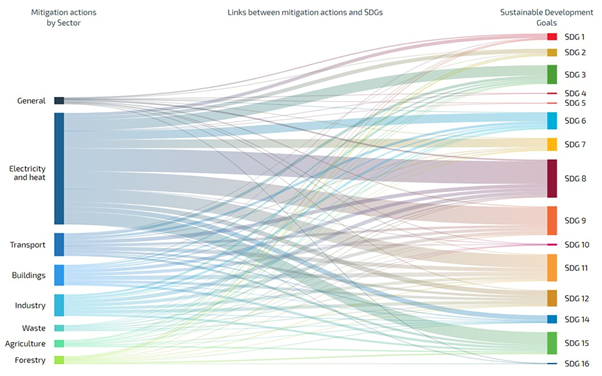
In total, 916 linkages were identified between sector-specific mitigation actions and the SDG targets. This highlights the opportunity and need to approach implementation in an integrated manner. As shown by the width of the lines in the figure below, some SDGs show significantly more links to the different mitigation actions of each sector. Where few linkages have been identified, this can generally be attributed to the transversal nature of the SDG. For example, SDGs related to education or gender equality are difficult to attribute to individual sectors but are relevant to consider across all sectors when designing or implementing mitigation actions.

Comprising a total of 167 targets under 17 goals, the SDG agenda in itself is extensive and complex. In many cases the targets overlap, complicating the attribution of linkages to individual subsectors and mitigation actions. To address this complexity and inter-relatedness, the SCAN-tool focusses on identifying primary impacts rather than secondary impacts that may also occur as a result.

As can be seen in the summary table below, the number of synergies outweighs the trade-offs found for all of the SDGs. In fact, 76% of linkages identified in the tool are positive. The table also shows that there are interactions between sector specific mitigation actions and most of the SDGs, suggesting a high potential for tackling both agendas simultaneously at the action level.

In addition to the impacts a mitigation action may have on the SDGs, the types of interventions used by government to stimulate those mitigation actions can also impact the achievement of the SDGs. The choice of policy instrument (e.g. taxes on liquid fossil fuels; innovation / demonstration programmes) can determine whether these actions can support or undermine the achievement of the SDG and its associated targets. This should be carefully considered when selecting and designing policies and intervention strategies.

Finally, many or perhaps all of the linkages are very context specific. The precise conditions in a country or region may mean that a linkage that is very important in one location could be far less important in another. The SCAN-tool provides users with an initial, high-level ‘scan’ of the links between mitigation actions and the SDGs. It is a first step in a journey that policy makers at the national and sectoral levels will need to take to maximize sustainable development benefits while minimizing trade-offs as they design and implement mitigation activities. A country-specific analysis will be necessary to fully understand the linkages and to provide robust information on their magnitude, before countries can exploit synergies and manage potential trade-offs in a comprehensive way.

NewClimate Institute for Climate Policy and Global Sustainability generates ideas on climate change and drives their implementation. We raise ambition for action against climate change and support sustainable development through research, policy design and knowledge sharing.

A positive post-growth future is possible and needed

By Nick Meynen, EEB

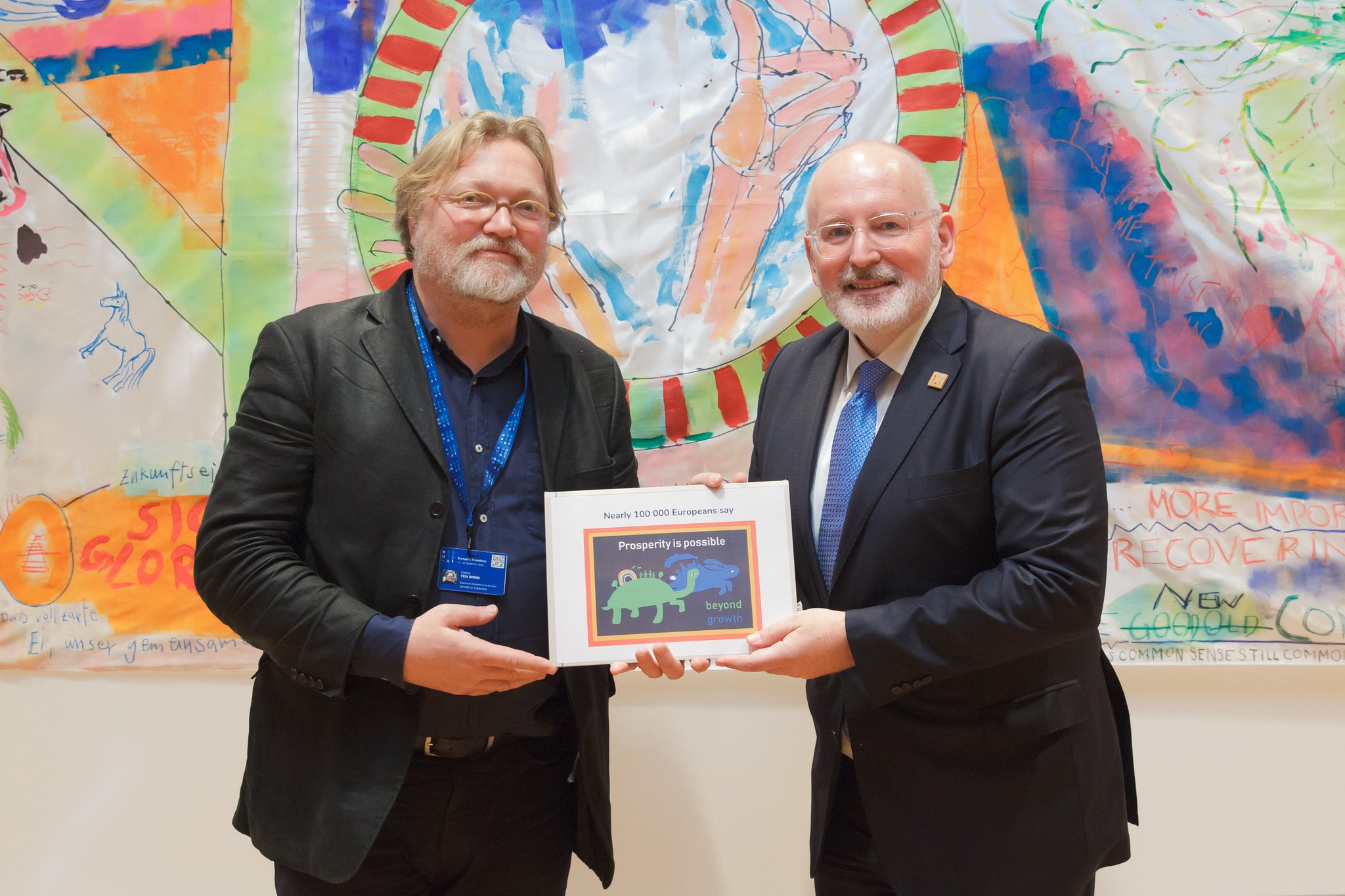
When 238 economists wrote an open letter calling on policymakers in Europe to end policies that aim for GDP growth, it was published by media in 16 countries across Europe. In the same week, the European Parliament hosted a major conference on post-growth, with the support from 8 MEPs from 5 political groups. EEB’s petition on wemove.eu/postgrowth  (based on the open letter) has secured support from almost 100.000 Europeans. In addition, major labor unions have shown their support to the letter and petition. People, experts, elected representatives and a wide range of civil society organisations all say we urgently need to move beyond the green growth narrative and get to grips with a post-growth world.

The EEB is taking a leading role in making policy makers aware of this need. At the bi-annual growth in transition conference in Vienna in November, EEB’s EU Director Patrick ten Brink gave First Vice-President of the European Commission Frans Timmermans the petition, which includes demands such as transforming the Stability and Growth Pact into a Stability and Wellbeing Pact and putting social and environmental indicators of progress before GDP. The EEB and Austrian EEB member EU-Umweltbüro also co-organised a debate with economists, civil society and representatives from big business and big cities on the positive pathways to a post-growth society. They identified key leverage points on HOW to make progress in the transition to a sustainable society for all, and are in the process of fine-tuning their demands. This work in progress will see the light of day ahead of the next elections.

EU must seize opportunity to adopt new political vision and give global leadership on sustainable development

Says leading EU CSO coalition SDG Watch Europe in Open Letter to EU Leaders

Urgent need for a new political vision for EU

In advance of the planned European Council summit in December (14th & 15th), a leading European civil society network SDG Watch Europe  has issued an open letter to EU Leaders highlighting the urgent need for them to focus on the Union’s future by adopting a strong political vision and showing global leadership on sustainable development. The coalition claims that there are very real political risks linked to the current, almost exclusive, focus of EU leaders on the management of Brexit and associated political issues.

“There is a sense that just like Nero fiddling while Rome was burning, the EU is distracted with Brexit while political conditions are deteriorating across the Union,” says Deirdre de Burca, member of the SDG Watch Europe steering committee. “Our coalition’s broad membership calls on European political leaders to urgently adopt sustainable development as a core political mission of the Union. We believe this important mission could help unite Member States at this critical time, while allowing Europe to assume an important global leadership role.”

Slow pace of EU implementation of the SDGs

“The Agenda 2030 for Sustainable Development is an ambitious global agenda which includes 17 sustainable development goals (SDGs) that were adopted by all UN member states in September 2015, says Leida Rijnhout of Stakeholder Forum for a Sustainable Future and member of the SDG Watch Europe steering committee. “”The EU was an important player in the negotiation of this global agenda” she says. “There were high expectations that sustainable development would move to the top of the EU’s own political agenda and those of its member states. Unfortunately these expectations have not yet been met. NGOs are very concerned about the missed opportunity that this represents for Europe and its citizens.”

SDG Watch Europe and its members claim that the pace of implementation of this global sustainable development agenda by the EU has been “very disappointing”.  They point to the fact that a full three years after the adoption of the SDGs, the EU has not yet developed an overarching European Sustainable Development Strategy 2030 to implement the goals.

Poverty & hunger

“Ending poverty and hunger and reducing inequalities are core objectives of the SDGs – in Europe and globally” says Ingo Ritz, Director of the Global Campaign Against Poverty (GCAP) and member of the SDG Watch Europe steering committee. “EU policies often negatively affect the lives of people around the world: European agricultural policies directly impact on small farmers in Africa. EU trade agreements and tax policies can negatively affect entire economies and undermine the achievement of the SDGs in many countries. The SDGs are global – all countries including the EU have a responsibility to implement them.”

Climate change

“The key findings of the recently published IPCC report on climate change again remind us that humanity has moved beyond planetary boundaries,” says Klara Hajdu of CEEweb for Biodiversity, a Central and Eastern European environmental NGO network, and member of the SDG Watch Europe steering committee. “Climate change and the destruction of ecosystems pose serious risks to the survival of humanity. We now have a window of opportunity over the next decade to radically change how our economy and society works, or we will need to face the ever more devastating consequences of not acting in time.”

External impacts of unsustainable EU policies

“The EU has much work to do to provide a healthy, environmentally friendly and prosperous life for its citizens,” says Marie-Luise Abshagen of the German NGO Forum on Environment and Development and member of the SDG Watch Europe steering committee. “Similarly, the external impacts of unsustainable European policies can be felt all over the world. We believe that many of its current policy processes, the various bilateral trade agreements in plan, new plans for deregulation within environmental programs, or security policies in violation of human rights are actually carrying us further away from realizing the SDGs. The failure to address these common European challenges would risk further disillusionment of the people in the EU.”

Sustainability not yet a genuine European brand

“Civil society is keen to work with the Commission to accelerate the transition to a sustainable future,” says Patrizia Heidegger from the European Environmental Bureau and member of the SDG Watch Europe steering committee. “However, President Juncker’s complete lack of focus on sustainable development has prevented this Commission from delivering on the SDGs,” she says. “‘Sustainability is a European brand’ is a slogan frequently used by Commission Vice-President Timmermans. This slogan is empty rhetoric if the EU and its member states do not face up to their unsustainable use of energy and natural resources. These practices damage the environment, not just in Europe, but around the globe. We want the EU to agree on clear targets to substantially reduce its global environmental footprint.”

“SDG Watch Europe has issued this open letter to EU leaders at this critical point in time because we are concerned about the EU’s lack of responsible and timely action on sustainable  development,” says Barbara Caracciolo, member of the SDG Watch Europe steering committee. “We hope that the EU political leadership will hear our call and  work with our members and other stakeholders to ensure that the SDGs are fully implemented by the EU in its internal and external actions,”  she says.

Link to Open Letter: https://www.sdgwatcheurope.org/documents/2018/12/sdg-weu-letter-to-european-leaders-7-december-2018.pdf/

For further information please contact: sdgwatcheurope@gmail.com